
TL;DR:
- Reputation marketing is a proactive approach that builds and amplifies positive brand perception to drive business growth. It focuses on creating trust signals through reviews, content, and search presence before crises occur, unlike reactive reputation management. Consistent effort in reputation marketing leads to higher conversions, better visibility, and sustained competitive advantage.
Most business owners hear “reputation marketing” and assume it means responding to bad reviews or putting out fires when something goes wrong online. That framing keeps you permanently on defense. What is reputation marketing, actually? It’s the proactive practice of building, amplifying, and leveraging your brand’s positive perception to drive real business growth. It turns trust into a growth engine rather than something you scramble to protect. This guide breaks down the full picture: the definition, the benefits, the tactics, and how to apply them without wasting time or budget.
Table of Contents
- Key Takeaways
- What is reputation marketing and how it differs from management
- Why reputation marketing matters for your business
- Core reputation marketing strategies and tactics
- Common misconceptions and pitfalls to avoid
- How to apply reputation marketing and measure results
- My honest take on reputation marketing after working with hundreds of SMBs
- Build your reputation the right way with Ibrand
- FAQ
Key Takeaways
| Point | Details |
|---|---|
| Proactive, not reactive | Reputation marketing builds positive brand perception before problems arise, rather than reacting to crises. |
| Trust drives purchases | 88% of consumers say user-generated content like reviews and testimonials influences their buying decisions. |
| SEO and reputation are linked | Search result management across Google, social media, and AI search is the strongest reputation signal you have. |
| Reviews need volume and recency | A high number of recent positive reviews outperforms a small set of older ones in building buyer confidence. |
| Measurement matters | Track review volume, share of voice, click-through rates, and engagement to know whether your reputation marketing is working. |
What is reputation marketing and how it differs from management
Reputation marketing is a proactive strategy amplifying positive brand perception, while reputation management is reactive damage control. The distinction sounds subtle. In practice, the two approaches produce completely different business outcomes.
Reputation management kicks in when something goes wrong: a wave of negative reviews, a PR crisis, or a competitor attack on your brand. The goal is to minimize damage and restore a baseline level of trust. Reputation marketing, by contrast, operates before anything goes wrong. It takes the goodwill you have already earned and turns it into a visible, persuasive asset that brings in new customers.
Here’s a quick comparison so the difference is crystal clear:
| Reputation management | Reputation marketing |
|---|---|
| Reactive: responds to negative signals | Proactive: builds and amplifies positive signals |
| Goal: damage control and recovery | Goal: growth, trust-building, and lead generation |
| Triggered by crises or complaints | Always-on, continuous effort |
| Channels: review responses, PR crisis tools | Channels: SEO, content, social proof, advertising |
| Outcome: restored baseline trust | Outcome: compounding brand authority and conversions |
The core components of reputation marketing include user-generated content (reviews, testimonials, photos), social proof across platforms, branded content that tells your story, and SEO that ensures positive signals dominate search results. Think of it as PR, content strategy, and performance marketing combined into one growth function.
“Reputation marketing converts brand trust into measurable commercial outcomes, sitting at the intersection of PR, content strategy, and performance marketing.” — Birdeye
Why reputation marketing matters for your business
The numbers here are hard to ignore. 88% of purchasing decisions are influenced by user-generated content like testimonials and online recommendations. That means before a prospect ever speaks to your sales team, your reputation has already done a significant portion of the selling. Or the un-selling, depending on what they find.
Here is what a strong reputation marketing program delivers:
- Higher conversion rates. Buyers who encounter consistent positive reviews and testimonials throughout their research phase are far more likely to convert. Social proof removes the hesitation that stalls decisions.
- Stronger brand visibility. When your reviews, testimonials, and branded content dominate search results, you take up more real estate in the places prospects look first.
- Lower customer acquisition costs. Word of mouth and earned credibility do the heavy lifting. You spend less on paid acquisition when your reputation pulls people in organically.
- Long-term brand equity. A track record of positive customer experiences compounds over time. Each new review, case study, or mention adds to a growing library of trust signals that are difficult for competitors to replicate.
- Customer loyalty and retention. Customers who see their own feedback featured and honored are more likely to return and refer others.
The importance of reputation marketing goes beyond vanity metrics. Businesses that proactively build reputation consistently outperform those that only defend it. This is not a branding exercise. It is a commercial advantage with a measurable return.
Pro Tip: Set a Google Alert for your business name and top competitor brand names. It takes two minutes and immediately surfaces new mentions you can respond to, amplify, or learn from.

Core reputation marketing strategies and tactics
Knowing what reputation marketing is becomes useful only when you know how to do it. Here is a practical framework you can start applying this week.
-
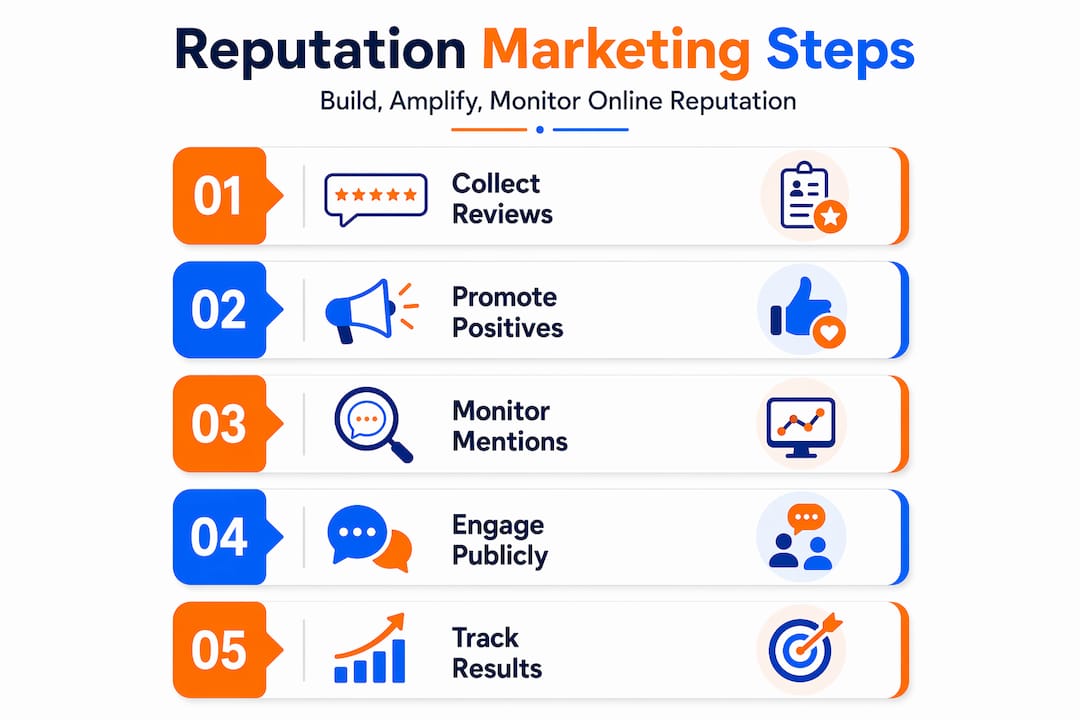
Collect and amplify customer reviews. Ask for reviews at the right moment: right after a successful delivery, a completed service, or a five-star support call. Positive reviews need to be recent and voluminous to build real trust. A business with 200 reviews from the past 12 months will consistently outperform one with 30 reviews from three years ago, even if the older reviews are more positive on average.
-
Build a testimonial library. Take the best reviews and turn them into formatted testimonials on your website, landing pages, email campaigns, and social media. You can read more about leveraging business testimonials as conversion assets if you want a detailed walkthrough of this process.
-
Manage your search result presence. Search result management, including your Google Business Profile, social accounts, and AI-generated search features, is the single most important reputation signal you control. Fill every field in your Google Business Profile. Post updates regularly. Make sure your website appears on page one for your own brand name.
-
Use entity optimization for AI search. Modern reputation management now includes entity optimization to influence AI-generated results and Knowledge Graph entries. Adding structured data to your website helps Google correctly associate your business with the right topics, services, and locations. This directly shapes what AI search assistants say about you when someone asks.
-
Integrate SEO with reputation content. Blog posts, case studies, and media coverage that rank for your brand-related keywords create a positive first impression before a prospect even visits your site. Tie your online brand building efforts directly to keyword strategy so your best content rises to the top.
-
Leverage social media as an amplification channel. Share customer stories, respond publicly to positive feedback, and repost user-generated content. This signals to both prospects and algorithms that real people trust and recommend your business.
Pro Tip: When responding to a positive Google review, mention a relevant service or location naturally in your reply. It adds keyword context to your Google Business Profile and helps with local search visibility at the same time.
Common misconceptions and pitfalls to avoid
Reputation marketing gets misapplied constantly. Here are the mistakes that derail most programs and how to sidestep them.
- Thinking it is just review collection. Review collection is one tactic inside a larger system. If you are not amplifying those reviews across channels, optimizing for search, and tracking what prospects actually see, you are leaving most of the value on the table.
- Treating it as a one-time project. Reputation marketing is not a campaign you run once and archive. Buyer trust erodes when review activity goes quiet or when content stops being updated. Ongoing effort is what separates brands that dominate search from brands that just appear on page two.
- Using one-size-fits-all solutions. Full-service reputation management requires deep integration of SEO, crisis response, content development, and digital privacy. Generic tools and generalist agencies rarely deliver this. Be skeptical of any provider that offers a flat-fee “reputation package” without first auditing your specific brand presence.
- Ignoring AI-driven search results. Controlling your brand narrative now requires technical SEO mastery alongside content strategy. If AI search assistants are pulling inaccurate or outdated information about your business, that is a reputation problem regardless of how good your Google reviews are.
- Not auditing what you already have. Many businesses discover that their reputation is being shaped by content they did not create: old directory listings, third-party review sites, or news articles from years ago. Knowing what exists before you build is not optional.
You can find a detailed checklist for protecting your business reputation proactively if you want to work through this audit systematically.
How to apply reputation marketing and measure results
Getting started does not require a full agency or a complex tech stack. It requires a clear process and consistent follow-through.
-
Audit your current online presence. Search your business name and review the first two pages of results. Check Google Business Profile, Yelp, Facebook, and any industry-specific directories. Note what is accurate, what is outdated, and what is missing.
-
Set specific goals aligned to business outcomes. “Get more reviews” is not a goal. “Reach 150 Google reviews with an average rating above 4.7 by Q4” is a goal you can track and act on.
-
Build positive content assets. Create case studies, write detailed service pages, publish blog posts that target questions your ideal customers ask. Each piece of quality content is a permanent positive signal in search.
-
Promote across multiple channels. Syndicate your best reviews and customer stories across your website, email list, social media, and paid ads. Do not let strong social proof sit in one place when it can work across ten.
-
Track the right metrics. Monitor review volume and average rating weekly. Watch your share of voice for key brand-related searches monthly. Track click-through rates from Google Business Profile and engagement on social proof content. Use this data to understand what is working and where to push harder.
-
Iterate based on what the data tells you. If review volume spikes after a certain type of email follow-up, do more of that. If a specific testimonial format drives more page engagement, replicate it. Reputation marketing rewards attention to patterns.
Following this process consistently is how you improve your online reputation in a way that actually compounds over time.
My honest take on reputation marketing after working with hundreds of SMBs
I have watched business owners treat reputation marketing as something they would “get to eventually,” right up until a competitor with a fraction of their experience started outranking them because that competitor had 300 recent reviews and a fully optimized Google Business Profile. That is when the urgency kicks in. By then, the gap is painful to close.
Here is my honest observation: most small business owners still think their product quality alone will generate word of mouth. Sometimes it does. But in an environment where a shift from reactive management to proactive marketing is now non-negotiable, quality without amplification is invisible.
The part that surprises even experienced marketers is the AI dimension. What an AI search assistant says about your business in 2026 is increasingly shaped by structured data, entity optimization, and Knowledge Graph associations. None of that happens automatically. I have seen businesses with genuinely great reputations get misrepresented in AI results simply because they never invested in the technical setup that tells search engines who they are.
My view: reputation marketing is not a PR luxury. It is as fundamental as having a professional website. The brands that understand this early will have a compounding advantage that becomes very difficult to compete with.
— TONY
Build your reputation the right way with Ibrand
Understanding reputation marketing is the first step. Executing it consistently across SEO, content, and search presence is where most businesses need support.
At Ibrand, we work with small and medium-sized businesses to build the kind of online reputation that generates real leads and builds lasting trust. Our approach starts with a full audit of your current digital presence, then moves into local SEO that ensures your business appears prominently when it counts. We handle the technical groundwork, from structured data and entity optimization to Google Business Profile management and review strategy, so your reputation becomes a growth asset rather than an afterthought.
If you want a plan tailored to your business, reach out and we will build one around your specific goals, market, and timeline.
FAQ
What is reputation marketing in simple terms?
Reputation marketing is the practice of actively building and promoting your brand’s positive image to attract new customers and drive growth, as opposed to simply responding when things go wrong.
How is reputation marketing different from reputation management?
Reputation management is reactive, focused on addressing negative content or crises. Reputation marketing is proactive, using reviews, testimonials, and branded content to amplify positive perception before problems arise.
Why do online reviews matter so much in reputation marketing?
Positive reviews need to be recent and numerous to build buyer confidence. A high volume of recent reviews consistently outperforms older, fewer reviews in influencing purchasing decisions.
What role does SEO play in reputation marketing?
SEO determines what prospects see when they search your brand name. Managing your search result presence, including your Google Business Profile and AI search features, is the most important reputation signal you control.
How do I know if my reputation marketing is working?
Track review volume and average rating, share of voice for brand-related searches, click-through rates from your Google Business Profile, and engagement on social proof content across your website and social channels.
Recommended
- Why Is Online Reputation Important for Small Businesses in 2025? | Ibrandmedia
- Why Is Online Reputation Important for Small Businesses in 2025? | Ibrandmedia
- Complete Guide to Managing Online Business Reputation | Ibrandmedia
- How to Manage Online Reputation: A 2025 Guide for Local Businesses | Ibrandmedia
Recent Comments