
TL;DR:
- Real-time analytics enables contractors to monitor campaign data constantly and make quick adjustments. It reduces wasted ad spend by detecting issues within minutes instead of days. Implementing call tracking, CRM integration, and structured review processes is essential for success.
Real-time analytics is defined as the continuous processing of campaign data as it arrives, giving contractors instant visibility into what is and is not producing booked jobs. The role of real-time analytics in contractor campaigns goes far beyond tracking clicks or impressions. It shifts decision-making from monthly reports to daily or hourly adjustments, directly reducing wasted ad spend and improving revenue per dollar. 40–60% of ad spend is wasted on campaigns that never result in a booked job. That number alone makes the case for live data. The industry term for this practice is real-time campaign intelligence, and it sits at the center of every high-performing contractor marketing operation in 2026.
How does real-time analytics improve campaign performance for contractors?
Real-time analytics cuts the gap between a problem appearing and a contractor fixing it. Without live data, a broken ad set or a misfiring keyword can drain budget for days before anyone notices. Real-time detection shifts issue discovery from days to minutes, preventing thousands of dollars in wasted spend. That speed is the single biggest financial advantage live data provides.
The metrics that matter most in contractor campaigns are not clicks or impressions. They are revenue-focused signals:
- Revenue per dollar spent (ROAS): The ROAS benchmark for contractor campaigns sits between 7x and 9x. Anything below 7x signals a campaign that needs immediate review.
- Cost per booked job: This tells you what each confirmed appointment actually costs, not just what each lead costs.
- Speed-to-lead: 32% of consumers now expect a contractor response within 24 hours, up from 18% the year prior. Slow response directly reduces close rates.
- Booked rate: The percentage of leads that convert to confirmed jobs. A sudden drop here signals a sales process problem, not always an ad problem.
Vanity metrics like page views and click-through rates feel good but do not pay invoices. Real-time dashboards that surface booked job data give contractors a direct line between ad spend and revenue.
Pro Tip: Set up automated alerts for any campaign where cost per lead rises more than 25% in a single day. That threshold is a reliable early warning signal before a campaign fully breaks down.

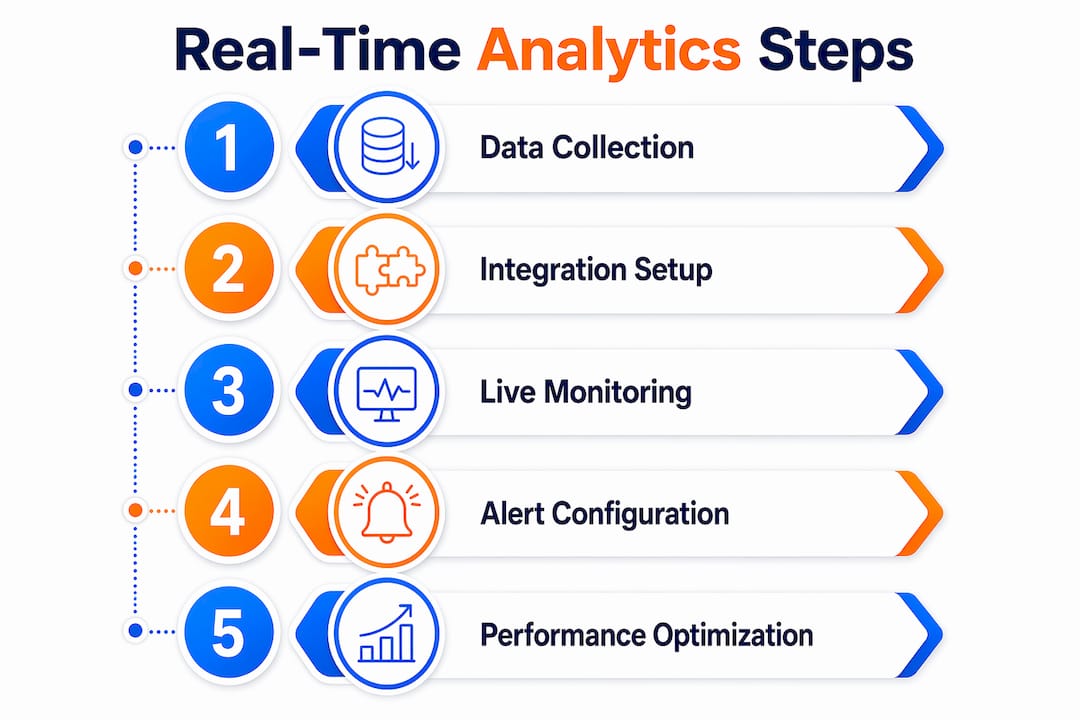
What integrations does a real-time analytics setup require?
A real-time analytics setup for contractors is only as good as the data flowing into it. Three core integrations make the system work: a CRM, a call tracking platform, and the ad platforms themselves.
60–70% of home service leads arrive via phone call, not web form. Without dynamic call tracking, contractors cannot attribute those calls to specific ads, keywords, or campaigns. The result is a reporting gap that makes ROAS calculations unreliable. Call tracking tools assign unique phone numbers to each traffic source, so every call gets matched to the campaign that generated it.
The most powerful integration is closed-loop attribution. This means feeding confirmed booked job data from your CRM back into your ad platforms. CRM-to-ad-platform conversion tracking improves smart bidding performance after 60–90 days of consistent data. Ad platforms use that revenue signal to find more customers who are likely to book, not just click.
Here is a breakdown of the core data streams and their roles:
| Data stream | What it captures | Why it matters |
|---|---|---|
| Ad platform data | Clicks, impressions, cost | Shows spend and traffic volume |
| Call tracking | Phone lead source and outcome | Attributes calls to specific campaigns |
| CRM data | Lead status, booked jobs, revenue | Connects spend to actual revenue |
| Website analytics | Form fills, page behavior | Captures non-phone conversion paths |
| Closed-loop attribution | Revenue fed back to ad platforms | Improves automated bidding over time |
The biggest challenge contractors face in building this stack is data quality. If your CRM is not updated consistently, the revenue data fed back to ad platforms is inaccurate. Garbage in, garbage out applies directly here.
Pro Tip: Tag every inbound call with a job outcome in your CRM within 24 hours. That discipline is what separates contractors who improve their bidding over 90 days from those who see no gains.
What best practices should contractors follow with real-time data?
Real-time data is a tool for better decisions, not a trigger for constant changes. The most common mistake contractors make is reacting to every daily fluctuation. Campaigns need time to gather data before patterns become meaningful.
-
Make one meaningful change per week. One adjustment per week outperforms frequent multiple weekly changes. Ad platforms use machine learning that requires stable conditions to optimize. Constant changes reset the learning phase and produce inconsistent results.
-
Use anomaly thresholds, not gut reactions. A 25% increase in lead cost or a 20% drop in booked rate are the right triggers for investigation. Smaller daily swings are normal statistical noise.
-
Track speed-to-lead as a campaign metric. Response time directly affects whether a lead becomes a job. Build a process where every new lead gets a call or text within one hour during business hours. Your campaign performance tracking should include lead response time alongside cost metrics.
-
Prioritize revenue metrics over activity metrics. Clicks and impressions measure activity. Booked jobs and ROAS measure outcomes. Successful contractors focus on the full search-to-job revenue pipeline, not just the top of the funnel.
-
Review dashboards on a set schedule. Daily check-ins for anomalies and weekly reviews for trend analysis create a disciplined system. Ad hoc reviews driven by anxiety lead to over-correction.
The shift from reactive monthly reporting to proactive daily monitoring is the defining operational change that separates growing contractor businesses from stagnant ones. Real-time data makes that shift possible, but only if the review process is structured.
Pro Tip: Integrate your call tracking tags with your ad platform conversion events directly. This single step gives you attribution data that most contractors running ads without it will never have.
What limitations should contractors know before adopting real-time analytics?
Real-time analytics is not the right solution for every contractor at every stage. Real-time infrastructure should be prioritized only when immediate insights can trigger immediate operational changes. If your team cannot act on a live alert within hours, the added complexity of a real-time setup produces no advantage over daily batch reporting.
Key limitations to understand before committing:
- Cost and complexity: Building a real-time data stack requires connecting multiple platforms, often with the help of a developer or a specialized agency. The setup cost is higher than basic monthly reporting.
- Data quality dependency: Real-time insights are only accurate if every data source is clean and consistently updated. A CRM with incomplete job outcome data will produce misleading ROAS figures.
- Expertise requirement: Reading live dashboards correctly requires knowing which fluctuations are noise and which are signals. Without that skill, real-time analytics implementation can lead to over-correction and worse campaign results.
- Platform learning disruption: Making changes based on short-term real-time data can interrupt ad platform learning cycles, reducing long-term performance.
- Operational readiness: If your sales team does not have a process for rapid lead follow-up, real-time speed-to-lead data will highlight a problem you cannot yet fix.
The right approach for most contractors is a hybrid model. Use real-time alerts for critical anomalies and daily snapshots for routine monitoring. Reserve deep analysis for weekly reviews when enough data has accumulated to identify real trends. Understanding digital marketing for contractors at a foundational level makes it easier to know when real-time tools add genuine value.
Key takeaways
Real-time analytics improves contractor campaign ROI by shifting budget decisions from monthly guesswork to daily data, with ROAS benchmarks of 7x–9x and closed-loop attribution as the core performance drivers.
| Point | Details |
|---|---|
| ROAS is the core metric | Target 7x–9x revenue per dollar spent; anything below signals a campaign needing review. |
| Call tracking is non-negotiable | 60–70% of leads arrive by phone; without call tracking, attribution and ROAS are unreliable. |
| Closed-loop attribution builds over time | CRM revenue data fed back to ad platforms improves smart bidding after 60–90 days. |
| One change per week is the rule | Frequent adjustments disrupt platform learning; one meaningful weekly change outperforms constant tweaking. |
| Real-time requires operational readiness | Live data only adds value if your team can act on alerts within hours of receiving them. |
Why real-time data changed how I think about contractor campaigns
The biggest shift I have seen in contractor marketing over the past few years is not the tools. It is the mindset. Contractors who used to wait for a monthly agency report are now reviewing dashboards every morning. That change alone has produced better results than any single tactic I have recommended.
What surprises most contractors when they first see live campaign data is how much money was quietly disappearing. A campaign running on the wrong keyword match type, a call tracking number that stopped working, a landing page that loaded slowly on mobile. None of these show up in a monthly summary until the damage is done. Real-time alerts catch them in hours.
The mistake I see most often is treating real-time data as permission to make constant changes. It is not. The discipline is in knowing when a number is a signal and when it is noise. A 15% cost-per-lead increase on a Tuesday is usually noise. A 30% increase sustained over three days is a signal. Learning that difference takes time, but it is the skill that separates contractors who get consistent results from those who chase their tails.
My honest recommendation: start with call tracking and CRM integration before you build anything else. Those two data streams give you 80% of the insight you need. Everything else is refinement. Contractors who try to build a full real-time stack before their sales process is solid end up with expensive dashboards that show them problems they cannot fix yet.
The contractors I have seen grow fastest are the ones who built disciplined review systems first, then added data complexity as their operations matured. Real-time analytics rewards process, not just technology.
— TONY
How Ibrand helps contractors get more from their campaign data
Contractors who want better campaign results without building a data stack from scratch have a direct path forward with Ibrand.

Ibrand works with small and medium-sized contractors to set up performance tracking, integrate call tracking with ad platforms, and build the closed-loop attribution systems that improve ROAS over time. The focus is always on metrics that connect to booked jobs and revenue, not vanity numbers. For contractors ready to improve their local visibility alongside their campaign data, Ibrand’s local marketing guide walks through the full process step by step. Pair that with a solid SEO foundation for small businesses and you have a complete growth system built on data, not guesswork.
FAQ
What is real-time analytics in contractor marketing?
Real-time analytics is the continuous processing of campaign data as it arrives, giving contractors instant visibility into cost, leads, and booked jobs. It replaces delayed monthly reports with live dashboards and automated alerts.
How does real-time data reduce wasted ad spend?
Real-time detection shifts issue discovery from days to minutes, stopping underperforming campaigns before they drain significant budget. Without live data, a broken ad set can waste thousands of dollars before anyone notices.
What is a good ROAS benchmark for contractor campaigns?
The ROAS benchmark for contractor campaigns is 7x–9x, meaning every dollar spent should return $7–$9 in revenue. Campaigns consistently below 7x require immediate review and adjustment.
Why is call tracking critical for contractor analytics?
60–70% of home service leads arrive via phone call. Without dynamic call tracking, contractors cannot attribute those calls to specific campaigns, making accurate ROAS calculation impossible.
How often should contractors adjust their campaigns based on live data?
One meaningful change per week is the recommended maximum. More frequent adjustments disrupt ad platform learning cycles and typically reduce long-term performance rather than improving it.
Recent Comments