
TL;DR:
- Website conversion occurs when visitors complete desired actions on a site, influencing revenue. Improving positioning clarity, load speed, trust signals, and personalization can significantly boost conversions. Tracking micro and macro conversions helps identify drop-off points to refine strategies continually.
Website conversion is defined as the moment a visitor completes a desired action on your site, such as making a purchase, submitting a contact form, or signing up for an email list. For small business owners, this single metric determines whether your website earns money or just takes up space. Average conversion rates range between 2% and 5%, varying by industry and traffic source. Understanding web conversion is the first step toward turning your site into a genuine sales tool, and this guide covers everything you need to know without the technical jargon.
What is website conversion explained as a business metric?
Website conversion, measured formally through conversion rate optimization (CRO), is the percentage of visitors who complete a goal you set. The formula is simple: divide the number of conversions by the total number of visitors, then multiply by 100. If 50 people buy from your store and 2,000 visited that month, your conversion rate is 2.5%.
Not all conversions carry equal weight. CRO professionals split them into two categories.
- Macro conversions are the main revenue actions: a completed purchase, a booked appointment, or a signed contract.
- Micro conversions are smaller steps that signal progress: clicking a product image, adding an item to a cart, or watching a demo video.
Macro conversions drive revenue, while micro conversions map the path a visitor takes before reaching that final step. Tracking both gives you a complete picture of where visitors stall.
Sample conversion rate calculations
| Visitors | Completed Actions | Conversion Rate |
|---|---|---|
| 1,000 | 15 | 1.5% |
| 1,000 | 30 | 3.0% |
| 1,000 | 50 | 5.0% |
| 5,000 | 160 | 3.2% |
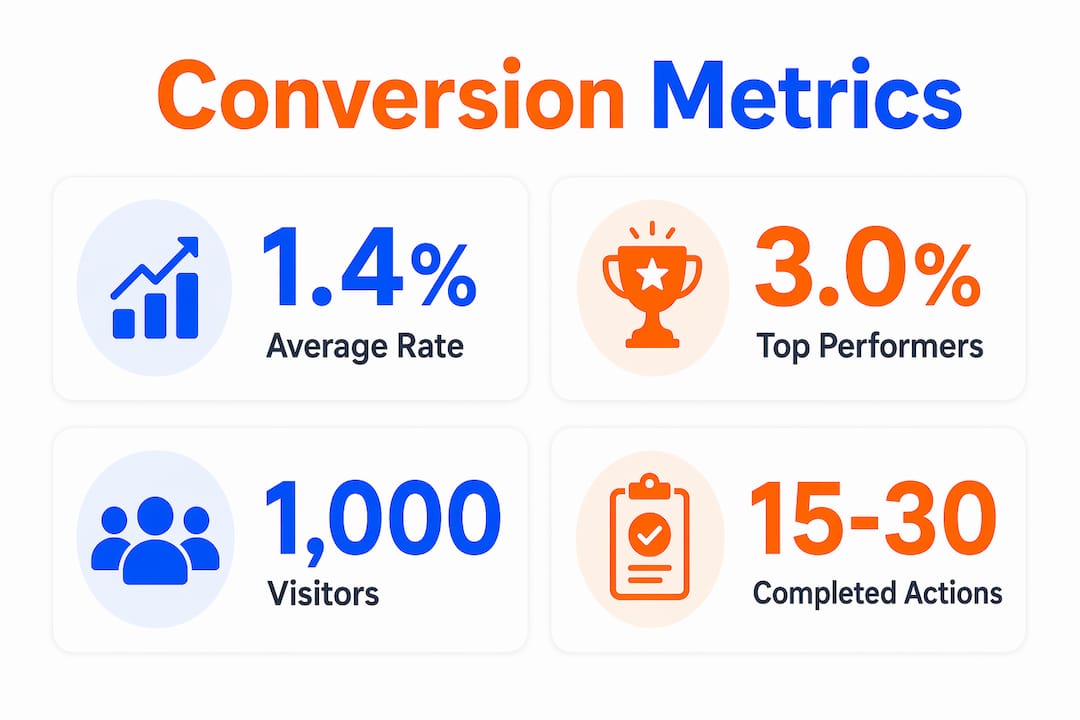
An average Shopify store converts at around 1.4%, while stores above 3.2% are considered top performers. These benchmarks give you a realistic target rather than chasing an arbitrary number.
What factors affect website conversion?
Positioning clarity is the single most important factor in conversion success. Visitors must understand what your business does, who it serves, and why they should care within 5 seconds of landing on your page. If your homepage headline is vague or generic, most visitors leave before reading another word.
Beyond positioning, several other factors directly influence whether a visitor converts.
- Load speed: Conversion rate improves by 17% for every second a website loads faster, because slow pages frustrate visitors and push them to competitors.
- UX design: Cluttered layouts, confusing navigation, and hard-to-find contact buttons all reduce conversions.
- Trust signals: Customer reviews, security badges, and clear return policies reduce purchase hesitation.
- Traffic quality: Visitors arriving from a relevant Google search convert at higher rates than cold social media traffic.
- Mobile experience: A site that breaks on a phone loses the majority of modern visitors before they even read your offer.
The customer journey also shapes conversion behavior. A visitor in the awareness stage needs education. A visitor in the decision stage needs proof and a clear next step. Serving the same message to both groups wastes your traffic. Personalization based on referral source, behavior, or location boosts relevance and conversion, and research shows 81% of customers prioritize tailored online experiences. Matching your message to where a visitor is in their decision process is one of the highest-return adjustments you can make.
Pro Tip: Test your site on a 4G mobile connection, not just your office Wi-Fi. Most small business websites load acceptably on fast connections but fail on the mobile networks your customers actually use.

What are the best strategies to boost website conversion?
The most effective conversion strategies share one trait: they reduce friction. Every extra click, confusing label, or slow-loading image is a reason for a visitor to leave. The tactics below address the most common friction points small business owners face.
- Write a clear headline above the fold. Your homepage headline should state your offer and your audience in plain language. “Affordable plumbing repairs for Denver homeowners” converts better than “Your trusted local service partner.”
- Use one primary call to action per page. Pages with multiple competing CTAs confuse visitors. Pick one goal per page and build everything around it.
- Add trust signals near your CTA. Place a customer review, a money-back guarantee, or a security badge directly beside your buy or contact button. Simplified forms, clear calls to action, and trust signals are proven conversion tactics.
- Shorten your forms. Every extra field you add reduces form completions. Ask only for what you need to follow up. Name and email beat name, email, phone, company, and message for most small business lead forms.
- Run A/B tests on your key pages. Change one element at a time, such as a headline, button color, or image, and measure the result over a statistically meaningful sample. Guessing what works is expensive. Testing what works is free.
- Use micro conversions to find drop-off points. If visitors add products to their cart but never check out, the problem is in your checkout flow, not your product pages. Tracking micro conversions helps you pinpoint exactly where visitors exit before completing a purchase.
- Personalize by traffic source. A visitor arriving from a Facebook ad about a specific product should land on a page about that product, not your homepage. Matching the ad message to the landing page is called message match, and it consistently lifts conversion rates.
Pro Tip: Run your A/B tests for at least two full weeks before declaring a winner. Shorter tests often catch statistical noise rather than real differences in visitor behavior.
SEO drives traffic to your site, while CRO converts that traffic into customers. The two disciplines reinforce each other. More relevant traffic means more opportunities to convert, and a higher conversion rate means more revenue from the same traffic you already have. You can read more about conversion rate tactics specifically built for small businesses to see how these strategies apply at your scale.
How do you measure and track website conversion performance?
Measurement turns guesswork into decisions. Without tracking, you cannot know which pages convert well, which traffic sources bring buyers, or where visitors abandon your site.
Google Analytics is the standard starting point for small business owners. Set up goals inside the platform to track macro conversions like form submissions and purchases. Then create events to track micro conversions like video plays, scroll depth, and button clicks. Both layers together give you a complete picture of your conversion funnel.
Key tracking practices that produce useful data:
- Segment by traffic source. Organic search visitors, paid ad visitors, and social media visitors behave differently. Mixing them into one number hides which channels actually produce buyers.
- Track exit pages. The page where most visitors leave tells you where your funnel breaks. Fix that page before spending more on traffic.
- Set up funnel visualization. Map the steps from landing page to conversion and watch where visitors drop off at each stage. This is where customer journey mapping becomes a practical tool, not just a theory.
- Benchmark against your own history. Industry averages are useful context, but your own month-over-month data is more actionable. A 10% improvement in your conversion rate is meaningful regardless of what the industry average says.
- Review data weekly, not monthly. Monthly reviews miss short-term problems like a broken form or a slow page caused by a recent update.
Tracking both macro and micro conversions is essential to identify where visitors drop off and fix the right problems. Without this distinction, you might spend weeks redesigning your homepage when the real issue is a confusing checkout page.
Key Takeaways
Website conversion is the core measure of whether your site turns visitors into customers, and improving it requires clarity, speed, trust, and consistent measurement.
| Point | Details |
|---|---|
| Define your conversion goal | Set one clear macro conversion per page before building any other element. |
| Benchmark your rate | Average rates run 2%–5%; Shopify top performers exceed 3.2%. |
| Fix positioning first | Visitors must understand your offer within 5 seconds or they leave. |
| Use micro conversions | Track small actions to find exactly where visitors exit your funnel. |
| Test and measure consistently | Run A/B tests for at least two weeks and review analytics weekly. |
What I’ve learned from watching small businesses ignore their conversion rate
Most small business owners I work with spend heavily on ads or SEO and then wonder why sales stay flat. The traffic is there. The conversions are not. The problem is almost never the product. It is almost always the page.
The most common mistake I see is prioritizing design over clarity. A beautiful website with an unclear headline will always lose to a plain website with a direct offer. Positioning clarity, the ability to tell a visitor exactly what you do and why it matters in under five seconds, outperforms every design trend I have seen come and go.
The second mistake is treating conversion optimization as a one-time project. You set up a new homepage, see a small lift, and move on. Real improvement comes from continuous testing. The businesses that consistently grow their conversion rates are the ones running at least one A/B test at all times, reviewing their analytics weekly, and adjusting based on what the data shows.
Personalization is where I see the biggest untapped opportunity for small businesses. Most owners send every visitor to the same homepage regardless of where they came from. Matching your landing page message to the specific ad, email, or search term that brought the visitor there can double your conversion rate without changing a single product or price. It requires more pages, but the return is worth the effort.
— TONY
How Ibrand helps small businesses convert more visitors into customers
Getting traffic to your website is only half the equation. Converting that traffic into paying customers requires the right combination of SEO, design, and ongoing performance tracking.
Ibrand works with small businesses to build websites and marketing campaigns that are built around conversion from the start, not as an afterthought. From optimizing your site for search to setting up real-time performance tracking, Ibrand’s team handles the technical side so you can focus on running your business. Every plan starts with a clear goal and a measurable baseline, so you always know what is working and what needs to change. If your website is getting visitors but not generating sales, that is the exact problem Ibrand is built to solve.
FAQ
What is a good website conversion rate for a small business?
Average conversion rates fall between 2% and 5% across most industries. Reaching 3% or above puts a small business in a strong competitive position.
What is the difference between macro and micro conversions?
Macro conversions are primary revenue actions like purchases, while micro conversions are smaller steps like clicking a CTA or watching a product video that signal a visitor is moving toward buying.
How does page speed affect conversion rate?
Faster load times directly increase conversion rates, with each second of improvement producing measurable gains. Slow pages raise bounce rates and reduce the number of visitors who ever see your offer.
What tools should I use to track website conversions?
Google Analytics is the standard tool for tracking both macro and micro conversions. Set up goals for primary actions and events for smaller engagement signals to get a full view of your conversion funnel performance.
Why is personalization important for website conversion?
81% of customers prioritize tailored online experiences, making personalization one of the highest-impact conversion strategies available. Matching your page content to the visitor’s source, behavior, or location significantly increases the chance they complete your desired action.
Recent Comments