
TL;DR:
- Online review management involves monitoring, responding to, and generating reviews to build trust and increase revenue. Small businesses improve their reputation and local SEO by automating review requests and responding promptly within 48 hours. Handling negative reviews thoughtfully enhances credibility and helps identify operational improvement areas.
Online review management is the process of monitoring, responding to, and generating customer reviews across platforms like Google Business Profile, Yelp, and Facebook to build trust and grow revenue. The industry term for the broader discipline is online reputation management, and review management is its most direct, day-to-day expression. 54% of consumers trust online reviews more than personal recommendations. That single fact makes managing online reviews one of the highest-return activities a small business owner can do. This guide covers what the process involves, how to do it efficiently, and how to turn customer feedback into real business improvements.
What is online review management explained in practice?
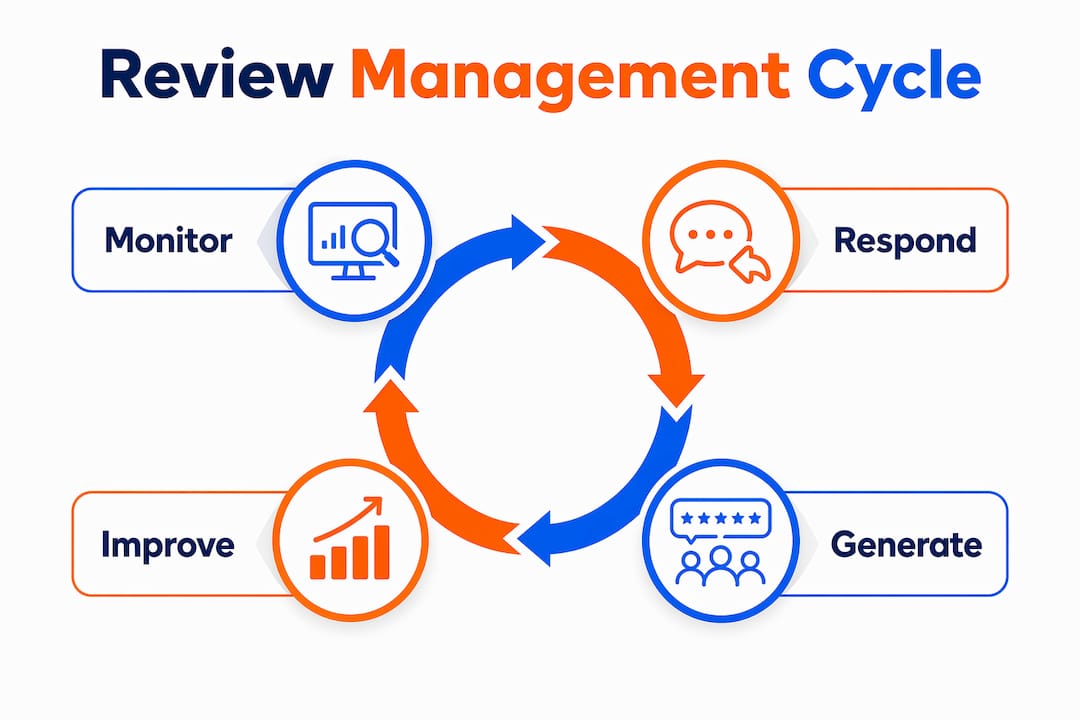
Online review management is a three-part cycle: monitor, respond, and generate. Each part depends on the others. A business that only monitors but never responds loses the trust signal that responses create. A business that responds but never asks for new reviews gets buried by competitors who do.
Monitoring means tracking every mention of your business across Google Business Profile, Yelp, TripAdvisor, Facebook, and any industry-specific platform relevant to your category. Consolidating multiple platforms into a single dashboard with real-time alerts prevents missed reviews and enables competitive benchmarking. Missing a review for two weeks is not a neutral outcome. It signals to customers that no one is paying attention.
Responding is where most small businesses underperform. Reviews that receive responses generate 12% more revenue, and customers are 45% more likely to visit a business that responds thoughtfully to negative feedback. That is not a soft metric. It connects directly to foot traffic and sales.
Generating new reviews is the part most owners skip entirely. Automated post-transaction review requests via email or SMS drive the majority of new reviews. Organic reviews skew negative because unhappy customers are more motivated to write. Automation offsets that bias by reaching satisfied customers at the right moment.
- Set up Google Business Profile alerts and claim your Yelp listing.
- Choose a review management tool or dedicate a weekly time block for manual monitoring.
- Build an automated email or SMS sequence triggered after each completed transaction.
- Create response templates for common review types, then personalize each one before sending.
- Analyze review themes monthly and flag recurring complaints for internal review.
Pro Tip: Include your business name and a relevant service keyword naturally in your responses to positive reviews. The U.S. Chamber of Commerce confirms that keyword-rich responses improve both customer relationships and search engine discoverability.
How can small businesses monitor and respond to reviews efficiently?
Time is the real barrier for small business owners. Manual review management takes 2–3 hours per week. That is manageable for a business with low review volume, but it becomes unsustainable fast as volume grows. The solution is a single dashboard that pulls all platforms into one view.

Tools like Birdeye, Podium, and Grade.us aggregate reviews from Google, Yelp, Facebook, and dozens of other sources. Each sends real-time alerts when a new review appears. That speed matters because customers expect a response within a few days. Ignoring negative reviews causes a 37% decline in customer advocacy. Delayed or generic responses produce a similar effect.
Efficient response habits follow a clear pattern:
- Respond to every review, positive and negative, within 48 hours.
- Acknowledge the specific experience the customer described. Never copy and paste the same reply.
- For negative reviews, apologize for the experience, offer a resolution path, and move the conversation offline when appropriate.
- For positive reviews, thank the customer by name, reference what they praised, and invite them back.
- Avoid defensive language. A defensive response to a bad review is visible to every future customer who reads it.
Pro Tip: Create three or four response frameworks for the most common review scenarios: great experience, minor complaint, serious complaint, and no comment left. Personalize the first and last sentence of each. This cuts response time in half without sacrificing authenticity.
Closing the feedback loop matters beyond the individual customer. When you respond publicly and resolve an issue, every future reader sees that you take accountability seriously. That visibility is a trust signal that no paid ad can replicate. For a deeper look at managing your business reputation, Ibrand has a full guide covering response frameworks and tracking methods.
What are common challenges and misconceptions in review management?
The biggest misconception is that a perfect 5-star rating is the goal. Negative reviews, when handled well, add credibility and social proof. Customers actively distrust businesses with only perfect ratings. A mix of reviews with thoughtful responses reads as authentic. A wall of identical 5-star reviews reads as manufactured.
A second misconception is that review management is purely a customer service function. It is not. Review management is an operational discipline that requires internal process fixes when complaint patterns repeat. If five reviews in one month mention slow service at checkout, that is not a PR problem. It is a staffing or process problem that needs a real fix.
| Common mistake | What it actually costs |
|---|---|
| Ignoring negative reviews | 37% drop in customer advocacy |
| Responding defensively | Visible damage to brand trust for all future readers |
| Buying fake reviews | Platform penalties and permanent credibility loss |
| Waiting for reviews to come in organically | Negative-skewed review profile due to unhappy customer bias |
| Treating all reviews as customer service | Missing operational signals that require internal changes |
The fake review trap deserves direct attention. Platforms like Google and Yelp use detection algorithms that flag suspicious review patterns. Getting caught results in penalties that are far harder to recover from than a few honest negative reviews. The only sustainable path is earning real reviews from real customers.
- 44% of consumers avoid businesses with no reviews at all. Zero reviews is not neutral. It is a red flag.
- Responding defensively to a negative review is worse than not responding. It confirms the customer’s complaint to every future reader.
- Prompting happy customers proactively is not manipulation. It is correcting the natural negative bias in organic review behavior.
How to leverage review feedback for business improvement and growth
Review data is one of the most direct forms of market research a small business can access, and it costs nothing to collect. Analyzing recurring complaint patterns leads directly to corrective action rather than cosmetic fixes. A restaurant that sees repeated mentions of slow delivery does not need a marketing campaign. It needs a logistics fix.
The process for turning reviews into improvements follows a clear path:
- Track themes monthly. Group reviews by topic: pricing, staff behavior, product quality, wait times, communication. Patterns that appear three or more times in a month are worth investigating internally.
- Benchmark against competitors. Review platforms show competitor ratings and review counts. If a competitor consistently earns praise for something you get complaints about, that gap is a product or service priority.
- Use review language in marketing. The exact words customers use to praise your business are the words your future customers search for. Pull those phrases and use them in your website copy, Google Business Profile description, and social media posts.
- Connect reviews to employee performance. Positive mentions of specific staff members are recognition data. Repeated complaints about a specific behavior are training data. Both are useful.
| Review insight | Business action |
|---|---|
| Repeated praise for speed | Highlight turnaround time in ads and listings |
| Repeated complaints about pricing clarity | Revise pricing page and in-store communication |
| Praise for a specific staff member | Recognize publicly, use as training model |
| Complaints about follow-up communication | Implement post-sale check-in process |
Thoughtful responses also support local search rankings. Google’s algorithm factors in review quantity, recency, and response rate when ranking local businesses. A business with 200 reviews and active responses outranks a competitor with 200 reviews and silence. The SEO benefit is real and measurable. For small businesses focused on building local trust through reviews, the connection between review activity and search visibility is direct.
Viewing reviews as actionable feedback rather than a chore is the mindset shift that separates businesses that grow from those that stagnate. The data is already there. The question is whether you use it.
Key takeaways
Effective online review management combines monitoring, responding, and generating reviews in a continuous cycle that builds trust, improves search rankings, and drives measurable revenue growth.
| Point | Details |
|---|---|
| Reviews drive purchase decisions | 54% of consumers trust reviews more than personal recommendations, making review presence non-negotiable. |
| Responses generate revenue | Businesses that respond to reviews earn 12% more revenue than those that stay silent. |
| Automation fills the review gap | Automated post-transaction requests offset the natural negative bias in organic reviews. |
| Negative reviews build credibility | A mix of reviews with thoughtful responses reads as authentic and trustworthy to new customers. |
| Reviews reveal operational gaps | Recurring complaint themes point to internal process problems, not just customer service issues. |
What I’ve learned after years of watching small businesses handle reviews
Most small business owners treat review management as damage control. A bad review appears, they panic, they respond poorly or not at all, and then they forget about it until the next one. That reactive pattern is the single biggest mistake I see.
Switching from reactive damage control to proactive listening changes everything. When you set up real-time alerts, build response templates, and automate review requests, you stop being surprised. You start seeing patterns. And patterns are where the real value lives.
The businesses I’ve watched grow fastest treat their review feed the way a good manager treats a weekly team meeting. They show up, they listen, they take notes, and they act on what they hear. They do not outsource their voice entirely to software, but they do use automation to handle the volume. The balance between a personal touch and a repeatable system is where effective reputation management actually lives.
Patience matters here too. A business with 20 reviews does not become a business with 200 reviews overnight. Consistent effort over six to twelve months is what builds a review profile that genuinely influences new customers. The businesses that quit after two months of automated requests never see the compounding effect. The ones that stay the course do.
— TONY
How Ibrand helps small businesses grow through review management
Small business owners who want to move faster on review management and local visibility do not have to figure it out alone.
Ibrand works with local businesses to build review management systems that fit their size, budget, and industry. From setting up Google Business Profile correctly to integrating automated review request tools, the team handles the technical setup so owners can focus on running their business. Ibrand also connects review management directly to local SEO for small businesses, so every review response and new review contributes to better search rankings and more foot traffic. If you want a plan that ties your review strategy to real growth, Ibrand is the right starting point.
FAQ
What is online review management?
Online review management is the process of monitoring, responding to, and generating customer reviews across platforms like Google, Yelp, and Facebook. Its goal is to build trust, improve reputation, and increase revenue.
How often should I respond to reviews?
Respond to every review within 48 hours. Businesses that respond thoughtfully to negative feedback see customers 45% more likely to visit, according to review management research.
Do negative reviews hurt my business?
Negative reviews handled well actually build credibility. Customers distrust businesses with only perfect ratings, and a thoughtful public response to a complaint demonstrates accountability to future readers.
How do I get more customer reviews?
Automated post-transaction requests via email or SMS are the most effective method. Organic reviews skew negative because unhappy customers are more motivated to write, so automation reaches satisfied customers at the right moment.
Does responding to reviews help with SEO?
Yes. Google factors in review quantity, recency, and response rate when ranking local businesses. Including relevant keywords naturally in responses also improves search discoverability.
Recent Comments