
Ranking on Google comes down to three things: content that genuinely answers what people are searching for, a site Google can actually crawl and index, and credible signals that tell Google your pages deserve to be seen. Get those three right and you have the foundation. Everything else is refinement.
Here are the highest-impact moves to start with:
- Fix indexability first. If Google can’t find your pages, nothing else matters. Run a
site:yourdomain.comcheck and submit an XML sitemap through Google Search Console. - Rewrite your title tags and meta descriptions. These take under two hours and directly affect click-through rates.
- Match your content to search intent. A page targeting “best running shoes” needs a comparison, not a brand story.
- Pass Core Web Vitals. Pages that load in under three seconds hold visitors; slow pages bleed them.
- Earn one or two quality mentions. A single link from a respected local publication or industry site moves the needle more than fifty directory submissions.
Realistic timing: title and indexability fixes can show up in Search Console within weeks. Content improvements and authority gains take three to six months of consistent work. Plan for both.
Key Takeaways
Ranking on Google requires helpful content matched to search intent, a technically sound and indexable site, and credible authority signals built over time through quality links and topical depth.
| Point | Details |
|---|---|
| Fix indexability first | Run a site: check and submit your XML sitemap in Search Console before any other work. |
| Title and meta fixes are fast wins | Rewriting title tags and meta descriptions takes hours and directly improves click-through rate. |
| Match content to search intent | Identify whether a query is informational, commercial, or transactional, then build the right page type. |
| Speed affects bounce rate | Pages loading in over three seconds see a 53% bounce rate; compress images and upgrade hosting first. |
| Ibrand’s structured approach | Ibrand starts with a technical audit, delivers a 90-day plan, and tracks rankings monthly with no guesswork. |
Table of Contents
- How does Google actually decide which pages rank?
- What should you fix first to improve your Google ranking?
- How do you create content that actually ranks?
- What technical SEO issues are holding your site back?
- Does structured data help you rank higher on Google?
- Why do backlinks still matter, and how do you earn them?
- How do you measure progress and know if SEO is working?
- What SEO myths and mistakes are quietly hurting your rankings?
- How a small agency approaches ranking for a typical client
- Ibrand’s SEO services for small businesses
- What a contrarian view on SEO actually gets right
- Sources
- FAQ
How does Google actually decide which pages rank?
Google’s ranking systems evaluate five core dimensions every time someone searches: the meaning of the query, the relevance of your content to that meaning, the quality of the content itself, the usability of the page, and contextual signals like the searcher’s location or search history. No single factor dominates in isolation.
Understanding this changes how you prioritize. Most small-business owners spend time on keyword density when they should be asking whether their page actually satisfies what the searcher came to do.
E-E-A-T (Experience, Expertise, Authority, Trust) is Google’s quality framework, and it matters most on topics where bad advice causes real harm: health, finance, legal, and major purchase decisions. For a local plumber or a boutique clothing store, E-E-A-T shows up in practical ways: a real author byline, a physical address, genuine customer reviews, and content that reflects hands-on knowledge rather than generic filler.
According to Search Engine Land, helpful content, topical authority, and content satisfaction signals are increasingly the primary drivers separating pages that rank from pages that don’t. The implication: writing more pages matters less than writing the right pages well.
- Query meaning: Google interprets intent, not just keywords. “Cheap flights” and “affordable airfare” trigger similar results because the intent is identical.
- Relevance: Does your page cover the topic the searcher actually needs? Keyword presence is a weak signal; topical depth is stronger.
- Quality: Is the content accurate, original, and written by someone with real knowledge of the subject?
- Usability: Does the page load fast, work on mobile, and avoid intrusive pop-ups?
- Context: Personalization, location, and search history fine-tune results for each user.
What should you fix first to improve your Google ranking?
Not all SEO work is equal. A small business with limited time should front-load the fixes that produce the fastest, most measurable results.
Quick wins (hours to one week)
- Check indexability. Type
site:yourdomain.cominto Google. If your pages don’t appear, you have an indexing problem to solve before anything else. - Submit your XML sitemap in Search Console. Sitemaps are one of the primary ways Google discovers pages, especially on newer or smaller sites.
- Fix title tags. Each page needs a unique, descriptive title under 60 characters that reflects the page’s actual content.
- Write meta descriptions. They don’t directly affect rankings, but a well-written meta description improves click-through rate, which sends a positive engagement signal.
- Add internal links. Link from your highest-traffic pages to your most important but underperforming ones. This passes authority and helps Google understand your site structure.
- Update thin or outdated content. A page with three paragraphs of generic text is a candidate for either expansion or consolidation.
Pro Tip: Use the Coverage report in Search Console to find pages marked “Excluded” or “Crawled — currently not indexed.” Those are your fastest wins: fix the underlying issue and request indexing.
Medium-term (weeks to two months)
- Improve page speed using PageSpeed Insights and address the specific recommendations it flags (image compression, render-blocking resources, server response time).
- Test mobile usability in Search Console’s Mobile Usability report and fix any touch-target or viewport issues.
- Add schema markup to pages where rich results are realistic (local business, FAQ, product pages).
- Expand content on pages that rank on page two. A page sitting at position 11–20 often needs more depth, not a new page.
Long-term (three months and beyond)
- Build a content hub: one pillar page covering a broad topic, supported by cluster pages on specific subtopics, all interlinked.
- Pursue quality backlinks through genuine outreach, local partnerships, and original content worth citing.
- Refresh your best-performing pages every six to twelve months to keep them accurate and competitive.
How do you create content that actually ranks?
The biggest mistake small-business owners make with content is writing what they want to say instead of what the searcher needs to hear. Start with intent.
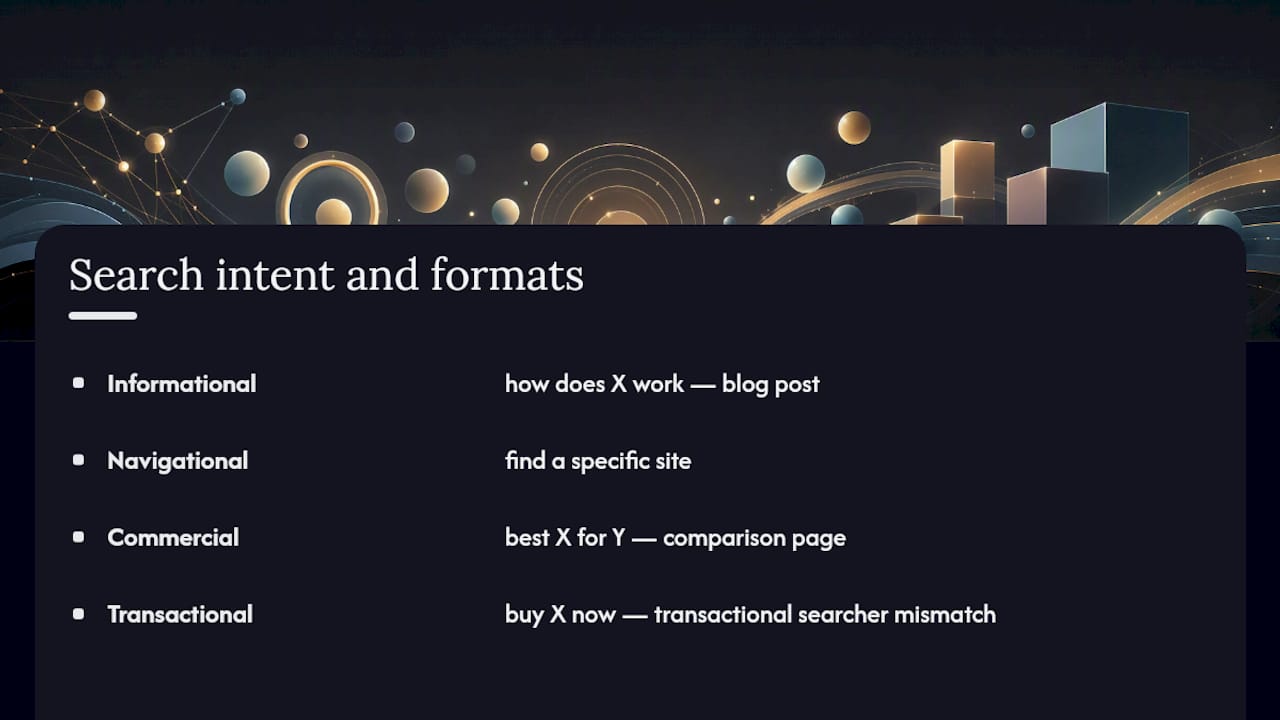
Search intent breaks into four types: informational (how does X work), navigational (find a specific site), commercial (best X for Y), and transactional (buy X now). Each type needs a different page format. A blog post works for informational queries. A comparison page works for commercial ones. Sending a transactional searcher to a blog post is a mismatch that Google notices.
Answer first, then expand. Backlinko’s analysis of passage-level ranking shows that Google now breaks pages into individual passages and evaluates each one against the query. A page where the answer is buried in paragraph seven loses to a page where it’s in paragraph one. Lead with the direct answer, then support it with evidence, examples, and context.
Pro Tip: Structure each section of your page so it answers one specific question completely. A section titled “How long does SEO take?” should answer that question in the first sentence, then explain the factors that affect timing. This increases your chances of appearing in featured snippets and AI Overviews.
Building topical authority means covering a subject more thoroughly than anyone else in your niche, not just writing more posts. A local HVAC company that publishes a pillar page on “home heating systems,” cluster pages on furnace types, heat pumps, and maintenance schedules, and FAQ pages for common repair questions will outrank a competitor with twenty disconnected blog posts on random topics.

Internal linking is the connective tissue. Link from your pillar page to each cluster page, and link cluster pages back to the pillar. Use descriptive anchor text that reflects the target page’s topic. This structure also makes it easier for Google to understand your site’s subject matter, which supports topical authority signals.
For content that builds trust, add author bylines with credentials, cite sources, include original data or observations, and write from genuine experience. These are the practical expressions of E-E-A-T that Google’s quality raters look for.
When to refresh versus when to create: if a page already ranks in positions 5–15 and gets impressions but low clicks, refresh it. If a topic has no page on your site at all, create one. Refreshing is almost always faster and cheaper than starting from scratch.
What technical SEO issues are holding your site back?
Technical SEO is the foundation. Content and links can’t compensate for a site Google struggles to crawl.

Indexability
Before anything else, confirm Google can access your pages. Check that your robots.txt file isn’t accidentally blocking important sections of your site. Verify that key pages don’t carry a noindex tag. Submit an XML sitemap through Search Console. PCMag’s SEO guidance notes that sitemaps are especially valuable for new sites, large sites, and sites with video or image content that might otherwise go undiscovered.
Canonical tags matter when you have similar or duplicate pages (product variants, filtered category pages, paginated content). A canonical tag tells Google which version of a page is the “official” one, preventing it from splitting ranking signals across duplicates.
Core Web Vitals
Google’s page experience signals center on three metrics:
Measure these in PageSpeed Insights or the Core Web Vitals report in Search Console. The most common fixes: compress images (use WebP format), enable browser caching, reduce server response time by upgrading hosting, and defer render-blocking JavaScript.
Shopify’s data puts the bounce rate for pages taking more than three seconds to load at 53%. That’s more than half your visitors leaving before they read a word.
Mobile-first indexing
Google indexes the mobile version of your site first. If your mobile experience is stripped-down or broken, your rankings reflect that. Test with Search Console’s Mobile Usability report. Common issues: text too small to read, clickable elements too close together, content wider than the screen.
Pro Tip: Run your most important pages through both PageSpeed Insights and Search Console’s URL Inspection tool. PageSpeed shows you what to fix; URL Inspection shows you what Google actually sees when it crawls the page.
Does structured data help you rank higher on Google?
Structured data (schema markup) doesn’t directly boost rankings, but it makes your pages eligible for rich results, which can significantly improve click-through rates. A recipe page with star ratings and cook time displayed in search results gets more clicks than a plain blue link, even at the same position.
For small businesses, the highest-value schema types are:
- LocalBusiness: Adds your address, phone number, hours, and service area to your search appearance. Critical for any business with a physical location.
- FAQ: Expands your search result with accordion-style questions and answers. Useful on service pages and resource pages.
- Product: Enables price, availability, and review stars in results. Relevant for e-commerce.
- HowTo: Displays step-by-step instructions directly in search results. Works well for tutorial and guide content.
Avoid adding schema to content it doesn’t describe. Marking up a blog post as a Product page, or adding FAQ schema to questions that aren’t actually on the page, violates Google’s guidelines and can result in manual actions.
To implement and test:
- Add JSON-LD structured data to the
<head>of the relevant page (most CMS platforms have plugins that handle this). - Test the markup with Google’s Rich Results Test before publishing.
- Monitor the Rich Results report in Search Console after deployment to confirm Google is reading the schema correctly.
For a deeper look at how schema affects AI-driven search features, this overview of schema markup in AI search covers the evolving role of structured data beyond traditional rich snippets.
Why do backlinks still matter, and how do you earn them?
A link from a credible, relevant site is a vote of confidence. Google uses these votes to assess whether your content is worth surfacing to searchers who haven’t heard of you yet. Search Engine Land confirms that one link from a respected publication often outweighs dozens of low-quality links. Volume without relevance is noise.
Realistic link-earning tactics for small sites:
- Original data or case studies. Publish something no one else has: a local market survey, a before-and-after case study from your own business, or a cost breakdown for your service. Journalists and bloggers link to primary sources.
- Local partnerships. Sponsor a community event, contribute to a local business association, or partner with a complementary business for a joint resource. These relationships produce natural, relevant links.
- Press outreach. Local newspapers and trade publications cover small businesses regularly. A newsworthy angle (a milestone, a community initiative, an unusual service) is often enough.
- Guest contributions. Write for industry blogs or local publications where your expertise is genuinely useful. The link in your byline carries real weight.
- Resource pages. Many industry organizations and local chambers maintain “recommended resources” pages. Getting listed there is straightforward and the links are typically relevant.
What to avoid:
- Link farms and private blog networks (PBNs). Google identifies and discounts these, and repeated use can trigger a manual penalty.
- Paid link placements without a
rel="sponsored"tag. Undisclosed paid links violate Google’s guidelines. - Automated link exchanges. Reciprocal linking at scale is a red flag.
- Exact-match anchor text at scale. If every link pointing to your page uses the same keyword phrase as anchor text, it looks manipulated.
If you’ve inherited a site with a toxic link profile, use Google’s Disavow Tool in Search Console to flag links you want Google to ignore. Use it carefully: disavowing good links by mistake can hurt rankings.
How do you measure progress and know if SEO is working?
Set up Google Search Console and connect it to Google Analytics before you make any changes. Without a baseline, you can’t tell whether your work is moving the needle.
Metrics to track:
- Impressions: How often your pages appear in search results. Rising impressions with flat clicks means your titles or meta descriptions need work.
- Average position: Where your pages rank on average. A page moving from position 18 to position 9 is progress worth noting, even before traffic increases.
- Click-through rate (CTR): The percentage of impressions that result in a click. Low CTR at a decent position is almost always a title or meta description problem.
- Page-level engagement: Time on page, scroll depth, and bounce rate in Analytics. These tell you whether visitors find what they came for.
| Metric | Where to find it | Check cadence |
|---|---|---|
| Impressions and CTR | Search Console > Performance | Weekly |
| Average position | Search Console > Performance | Weekly |
| Core Web Vitals | Search Console > Core Web Vitals | Monthly |
| Indexing errors | Search Console > Coverage | Weekly |
| Page engagement | Google Analytics | Monthly |
A realistic 90-day plan: spend the first month on indexability, title/meta fixes, and speed. Spend month two on content expansion and internal linking. Spend month three on outreach and schema. Review Search Console data at the end of each month and adjust based on what’s moving.
Pages that take more than three seconds to load see a 53% bounce rate — meaning more than half of visitors leave before engaging with any content.
Quick fixes (title tags, canonical errors, sitemap submission) can appear in Search Console within two to four weeks. Content improvements take three to six months to show meaningful position changes. Authority gains from backlinks take six to twelve months to fully reflect in rankings. Set expectations accordingly, and don’t abandon a strategy because it hasn’t produced results in thirty days.
When a page sits at position 5–10 with decent impressions but low CTR, A/B test the title tag. When a page ranks well but engagement metrics are poor, the content isn’t satisfying intent. When impressions are flat across the board, the problem is usually indexability or a lack of content targeting the right queries.
What SEO myths and mistakes are quietly hurting your rankings?
A lot of SEO advice circulating online is either outdated, oversimplified, or flat-out wrong. Acting on it wastes time and can cause real damage.
Common myths:
- “Exact-match domains rank automatically.” An exact-match domain (buyrunningshoesonline.com) carries no inherent ranking advantage. Content quality and authority determine rankings.
- “There’s a minimum word count for ranking.” Google has stated repeatedly that word count is not a ranking factor. A 300-word page that fully answers a query outranks a 2,000-word page that doesn’t.
- “You can buy your way to organic rankings.” Google Ads spend has no effect on organic search position. The SEO Starter Guide is explicit: organic visibility is earned through optimization, not purchased.
- “Keyword stuffing helps.” Repeating a keyword phrase twenty times on a page signals spam, not relevance. Write for the reader; use the keyword where it fits naturally.
- “More pages always mean more traffic.” Thin, low-quality pages dilute your site’s overall quality signals. Fewer, better pages consistently outperform a large volume of weak ones.
Red flags that signal a problem:
- A sudden drop in organic traffic (check Search Console for manual actions or algorithm update dates).
- Pages disappearing from the index (check the Coverage report for “Excluded” or “Noindexed” pages).
- A spike in crawl errors (check the Coverage and URL Inspection reports).
Immediate remediation steps:
- Remove or consolidate duplicate content using canonical tags or 301 redirects.
- Fix any
noindextags applied to pages you want Google to rank. - Submit your sitemap and request indexing for affected pages in Search Console.
How a small agency approaches ranking for a typical client
At Ibrand, a new client engagement starts with a diagnostic, not a proposal. The first step is understanding what’s actually broken before recommending what to fix.
The typical flow looks like this:
A technical audit comes first: indexability, Core Web Vitals, mobile usability, duplicate content, and canonical issues. Most small-business sites have at least two or three indexing problems that are suppressing rankings without the owner knowing. These get fixed in the first two to four weeks.
Then comes a content audit. Which pages are ranking but underperforming? Which queries does the site have no content for? The goal is to build a prioritized content plan, not a content calendar full of random topics. For local businesses, this often means a local SEO push alongside the content work: Google Business Profile optimization, local citations, and location-specific pages.
The third phase is a content sprint: producing or refreshing three to five high-priority pages based on the audit findings. These are the pages most likely to move from page two to page one, or from position eight to position three, within 90 days.
Monthly optimization follows: reviewing Search Console data, adjusting titles and meta descriptions based on CTR signals, identifying new content opportunities from rising impressions, and tracking backlink acquisition.

When to DIY vs. when to hire: If you have time and a basic grasp of your CMS, title tags, meta descriptions, and content updates are genuinely doable without an agency. Technical fixes (server configuration, JavaScript rendering issues, complex canonicalization) and sustained link outreach are where professional help pays for itself. The cost of getting technical SEO wrong is usually higher than the cost of hiring someone who knows what they’re doing.
Ibrand’s SEO services for small businesses
Ranking on Google without a clear plan means spending months on work that doesn’t compound. Ibrand offers small businesses a structured path: a technical audit in week one, a prioritized 90-day plan by week two, and monthly reporting that shows exactly where rankings are moving and why.
Services include technical SEO, content creation, local SEO, and performance tracking tied to real business outcomes, not vanity metrics. Every engagement starts with an honest assessment of where your site stands and what it will realistically take to improve. No long-term contracts required for initial engagements.
If you’re ready to stop guessing and start with a clear picture of what’s holding your site back, get your SEO plan for small businesses or explore the full optimization guide for small businesses to see what a structured approach looks like in practice.
What a contrarian view on SEO actually gets right
Most SEO guides treat ranking as a technical puzzle. Fix the title tags, hit the word count, get the links, and the rankings follow. That framing isn’t wrong, but it misses the more uncomfortable truth: Google is getting better at detecting whether a page was written to rank or written to help.
The sites that hold their rankings through algorithm updates tend to have one thing in common: they were built for a real audience, not for a search engine. The technical work matters, but it’s table stakes. The actual differentiator is whether your content says something the reader couldn’t find in thirty seconds on any other site.
Small businesses have a genuine advantage here that most SEO guides undervalue. A local contractor who writes from twenty years of hands-on experience, a boutique owner who publishes honest product comparisons based on what she actually stocks, a consultant who shares real client outcomes: these are the kinds of pages that earn links naturally, hold rankings, and convert visitors into customers. The SEO work amplifies what’s already there. It can’t manufacture it.
The mistake most small-business owners make isn’t ignoring SEO. It’s treating SEO as the strategy instead of the amplifier. Build something worth finding, then make sure Google can find it. That order matters.
Sources
These are the primary references worth bookmarking as you work through your SEO improvements.
- How Does Google Determine Ranking Results – Google Search
- How to Rank Higher (& Get More Visibility) on Google in 2026
- How to Rank Higher on Google: Proven SEO Strategies
FAQ
How do you get ranked on Google search?
Submit your site to Google via Search Console, ensure your pages are indexable, and publish content that clearly matches what your target audience is searching for. Technical health (speed, mobile usability, clean crawlability) and credible backlinks accelerate the process.
How much does it cost to reach the top of Google search?
Organic rankings can’t be purchased. As Google’s SEO Starter Guide makes clear, top organic positions are earned through optimization work, not ad spend. Costs vary based on whether you DIY or hire an agency, but the ranking itself is never for sale.
Is it realistic to rank number one on Google?
Yes, but it depends on the competitiveness of the query. Ranking first for a specific long-tail question in a niche market is achievable for a small site within months. Ranking first for a broad, high-volume term takes sustained content, authority, and technical investment over a year or more.
How long does SEO take to show results?
Technical fixes and indexability corrections can appear in Search Console within two to four weeks. Content improvements typically produce measurable position changes in three to six months. Authority gains from backlinks take six to twelve months to fully reflect in rankings.
What is the single most important ranking factor?
No single factor dominates, but content that genuinely satisfies the searcher’s intent is the closest thing to a universal prerequisite. Without it, technical perfection and strong backlinks still won’t hold a top position.
Recent Comments