
TL;DR:
- Audience targeting divides markets into groups based on shared traits to deliver more relevant campaigns. It significantly boosts marketing ROI and engagement by using demographic, psychographic, behavioral, and geographic data. Regularly updating segments and owning first-party data are essential for effective and precise audience targeting in small businesses.
Audience targeting is the practice of dividing your total market into distinct groups based on shared characteristics to deliver more relevant and effective marketing campaigns. Segmented campaigns generate up to 77% of total marketing ROI and drive over 100% higher engagement rates than broad-reach approaches. That single fact explains why understanding audience targeting is no longer optional for small businesses competing online. The industry term for this practice is audience segmentation, and it applies across every channel from paid search to email to social media.
What are the main types of audience segmentation and how do they work?
Audience segmentation divides your market into four core types, and each one answers a different question about your customer.
Demographic segmentation answers who. Age, income, gender, education, and job title are the most common variables. A local gym targeting women aged 25–44 with household incomes above $60,000 is using demographic segmentation. It is the easiest type to collect and the most widely used, but it rarely tells the full story on its own.
Psychographic segmentation answers why. It focuses on attitudes, values, lifestyle, and motivations. Two people with identical demographics can have completely different buying behaviors. A 35-year-old parent who values convenience will respond to different messaging than one who prioritizes price. Psychographic data typically comes from surveys, social listening, and customer interviews.

Behavioral segmentation answers what. Purchase history, website activity, email open rates, and product usage patterns all fall here. Behavioral data is the most predictive of future action because it reflects what customers actually do, not what they say they will do. Email marketing segmentation built on behavioral triggers consistently outperforms batch-and-blast campaigns.
Geographic segmentation answers where. For small businesses, this is often the most immediately useful type. A restaurant, a law firm, or a home services company has a natural geographic boundary. Knowing that your best customers live within 10 miles of your location shapes every channel decision you make.
| Segmentation type | Primary variable | Best data source | Typical use case |
|---|---|---|---|
| Demographic | Age, income, gender | CRM, census data | Broad audience filtering |
| Psychographic | Values, lifestyle | Surveys, social listening | Messaging and creative tone |
| Behavioral | Purchase, clicks, usage | Analytics, CRM | Retargeting, upsell campaigns |
| Geographic | Location, region | IP data, store records | Local campaigns, radius targeting |
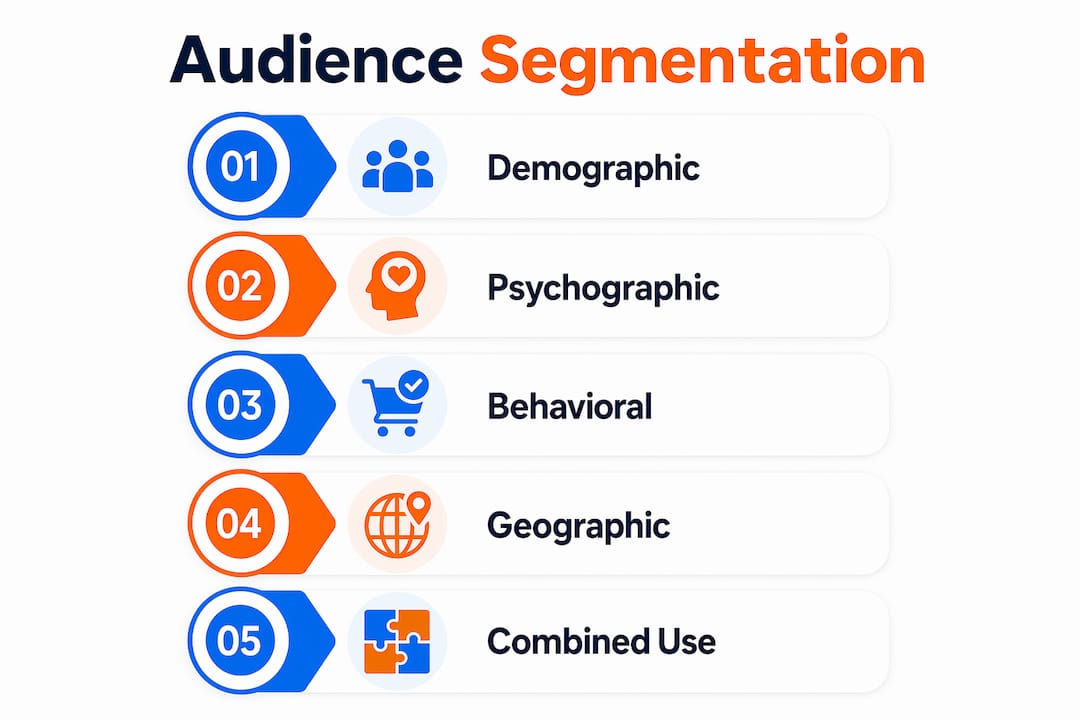
The real power comes from combining types. A small business targeting “women aged 30–50 within 15 miles who have visited the website twice but not purchased” uses all four layers at once. That level of specificity is what separates effective audience targeting from generic advertising.
Pro Tip: Start with behavioral and geographic data before adding psychographic layers. Behavioral data is already in your analytics platform and costs nothing extra to collect.
How does modern data use and first-party data shape effective audience targeting?
Building and owning first-party data is the only reliable path to targeting accuracy in 2026. Third-party cookies, which once allowed advertisers to track users across the web, have lost their dominance due to browser restrictions and privacy regulations. The shift is permanent.
First-party data comes directly from your own channels:
- CRM records: purchase history, contact details, lifetime value
- Website analytics: pages visited, time on site, conversion paths
- Email engagement: open rates, click patterns, unsubscribe signals
- Loyalty programs: repeat purchase frequency, product preferences
- Customer surveys: direct feedback on needs and motivations
81% of customers expect personalized brand experiences aligned with their actual behaviors and needs. That expectation cannot be met with stale demographic lists. It requires fresh, behavior-based data that you own and control.
Machine learning tools built into platforms like Google Ads and Meta Ads can identify patterns in your first-party data and find similar audiences at scale. Precise audience targeting reduces customer acquisition costs by 30–60% when first-party signals drive the model. Retargeting campaigns built on first-party data regularly achieve a return on ad spend of 4.2x or higher.
Pro Tip: Connect your CRM to your ad platforms using customer match or custom audience uploads. This turns your existing customer list into a targeting asset that no competitor can replicate.
Personalized marketing built on first-party data also reduces the risk of ad fatigue. When your message matches the customer’s actual stage in the buying process, frequency becomes less of a problem.
What are common mistakes and misconceptions in audience targeting to avoid?
The biggest misconception in audience targeting is that demographics alone are sufficient. Age and gender describe who someone is, not what they want or when they are ready to buy. Effective targeting uses intent signals and emotional drivers that go well beyond demographic filters.
A second critical error is confusing audience segmentation with customer segmentation. Audience segmentation serves acquisition: it identifies prospects who have not yet purchased. Customer segmentation serves retention: it groups existing buyers to improve loyalty and lifetime value. Treating these as the same thing leads to misaligned messaging and wasted budget.
Targeting is not about reaching more people. It is about reaching the right people and deliberately excluding everyone else.
Three more mistakes that drain small business budgets:
- Static segments: Building an audience once and never updating it. Customer behavior shifts constantly. Continuous refresh of segments is necessary to maintain relevance and avoid spending on audiences that no longer match your offer.
- Ignoring negative targeting: Failing to exclude audiences who are unlikely to convert. Deliberate exclusion improves lead quality and reduces wasted spend dramatically. Excluding past purchasers from acquisition campaigns, for example, is a basic step that many small businesses skip.
- Measuring only platform metrics: Click-through rate and impressions are not business results. Proper measurement frameworks must connect campaign activity to revenue, not just engagement. Tracking marketing ROI at the segment level is the only way to know which audiences actually drive profit.
How to practically implement an audience targeting strategy for small businesses?
A targeting strategy that works in practice follows a clear sequence. Skipping steps is the most common reason small business campaigns underperform.
-
Define your segments with measurable criteria. Identify 2–3 high-priority segments based on revenue potential and fit. Use your CRM and website analytics to find patterns among your best existing customers. A target audience identification process that starts with real customer data produces far more useful segments than one built on assumptions.
-
Collect and organize first-party data. Set up Google Analytics 4 with conversion tracking. Export your CRM contacts and tag them by purchase behavior, frequency, and value. Create separate audience lists for prospects, one-time buyers, and repeat customers.
-
Craft distinct messages for each segment. A first-time visitor needs trust signals and a clear value proposition. A repeat customer needs a loyalty offer or an upsell. Using the same ad copy for both groups wastes money on the wrong message. Psychographic insights from customer interviews sharpen the creative for each segment.
-
Select channels based on where each segment actually spends time. Behavioral data tells you this. If your highest-value segment opens emails on mobile between 7 and 9 a.m., that is where your budget goes. Targeting local audiences effectively often means combining Google local search ads with neighborhood-level social targeting rather than broad national placements.
-
Set measurement benchmarks before launch. Define success metrics for each segment: cost per lead, cost per acquisition, or revenue per customer. Segmentation enables businesses to refine pricing, service design, and product development, not just ad copy. Treat your segment data as a business asset, not just a campaign input.
-
Test, review, and refresh on a fixed schedule. Run A/B tests on creative and messaging within each segment. Review segment performance monthly. Drop or restructure segments that consistently underperform. Add new segments as your first-party data grows.
Pro Tip: Use your retargeting audience as a diagnostic tool. If your retargeting campaigns have low conversion rates, the problem is usually either the offer or the segment definition, not the channel.
| Implementation step | Key action | Success metric |
|---|---|---|
| Segment definition | Analyze CRM for top customer patterns | 2–3 defined segments with clear criteria |
| Data collection | Set up GA4 and CRM audience lists | Audience list size above 1,000 contacts |
| Messaging | Write distinct copy per segment | Click-through rate by segment |
| Channel selection | Match channel to behavioral data | Cost per acquisition by channel |
| Measurement | Track revenue per segment | ROI by segment, not just overall |
Key Takeaways
Effective audience targeting requires combining behavioral, demographic, psychographic, and geographic data with fresh first-party signals, clear measurement frameworks, and regular segment updates.
| Point | Details |
|---|---|
| Segmentation drives ROI | Segmented campaigns generate up to 77% of total marketing ROI versus broad-reach approaches. |
| First-party data is non-negotiable | Own your CRM and analytics data to maintain targeting accuracy as third-party cookies decline. |
| Negative targeting saves budget | Excluding irrelevant audiences reduces wasted spend and improves lead quality significantly. |
| Audience vs. customer segmentation | Use audience segmentation for acquisition and customer segmentation separately for retention. |
| Refresh segments regularly | Static segments decay quickly; review and update audience definitions at least monthly. |
What I have learned about targeting that most guides skip
Most articles on audience targeting treat it as a purely technical exercise. Set up your audiences, run your ads, check your dashboard. That framing misses the most important part.
The businesses I have seen get the most from segmentation are the ones that treat it as a cross-functional input, not just a media-buying decision. Their segment insights inform pricing conversations, product development priorities, and even how they hire. Segmentation manages complexity across the entire business, not just the marketing department. When the sales team, the product team, and the marketing team all share the same customer segment definitions, the whole organization gets sharper.
The other thing most guides understate is how fast segments go stale. A segment that performed well six months ago may be burning budget today because the behavior patterns shifted. Automation helps, but emotional and behavioral insights still require human interpretation. Algorithms optimize for the signal you give them. If your first-party data is thin or outdated, the algorithm will optimize toward the wrong outcome at scale.
My honest recommendation: spend as much time on segment maintenance as you do on segment creation. The initial build is the easy part. The discipline of updating, testing, and questioning your assumptions is what separates businesses that grow from ones that plateau.
— TONY
Ibrand’s approach to audience targeting for small businesses
Small businesses that want real results from audience targeting need more than ad platform tutorials. They need a foundation: a website that converts, search visibility that attracts the right visitors, and tracking that connects activity to revenue.
Ibrand works with small and medium-sized businesses to build that foundation. From SEO for small businesses that brings in qualified local traffic to real-time analytics that show which segments are converting, Ibrand’s services are built around the same principles covered in this guide. The team also provides website optimization for search to make sure your site earns the right visitors, not just more visitors. If you are ready to move from broad-reach advertising to a targeting strategy that actually pays off, Ibrand offers a personalized plan built around your business goals.
FAQ
What is audience targeting in digital marketing?
Audience targeting is the practice of segmenting your total market into groups based on shared traits or behaviors and delivering tailored messages to each group. It improves campaign relevance and reduces wasted ad spend.
Why does audience segmentation matter for small businesses?
Segmented campaigns generate up to 77% of total marketing ROI, making segmentation one of the highest-return activities a small business can invest in. It also reduces customer acquisition costs by focusing budget on the most likely buyers.
What is the difference between audience segmentation and customer segmentation?
Audience segmentation targets prospects who have not yet purchased, while customer segmentation groups existing buyers for retention and upsell campaigns. Using the same approach for both leads to misaligned messaging and wasted budget.
How do I start building a first-party data strategy?
Connect your CRM to your ad platforms, set up conversion tracking in Google Analytics 4, and create separate audience lists for prospects, one-time buyers, and repeat customers. Start with the data you already have before investing in new tools.
How often should I update my audience segments?
Review and refresh your segments at least once a month. Customer behavior shifts continuously, and static segments decay quickly, leading to budget waste on audiences that no longer match your offer.
Recent Comments