
A press release can help your local SEO, but not the way old playbooks claimed. Posting a keyword-stuffed announcement on a free distribution site will not move you up the map pack. A release about something genuinely newsworthy in your town can earn real coverage, local mentions of your business name, and consistent location signals. Those are the things that support local visibility. This guide shows what to announce, how to write it, how to handle links so you stay inside Google’s rules, and how to get the release in front of local reporters.
TL;DR
- Press releases help local SEO indirectly: through coverage, brand mentions, consistent business details and referral traffic, not through the release page itself.
- Announce real news: a new location, an award, a community event, a new service, a hire. Skip filler.
- Links you place inside a release to influence rankings should be marked
rel="nofollow"orrel="sponsored", per Google’s guidance. - Local reporters and community outlets beat mass syndication for most small businesses.
- Measure results with calls, direction requests and branded searches, not just the number of sites that carried your release.
Table of Contents
- Do press releases actually help local SEO?
- What Google says about links in press releases
- What is worth announcing
- How to write a release a local reporter will read
- Where to publish and send it
- Mistakes that waste money or cause penalties
- Our perspective on press releases and local SEO
- How to tell whether it worked
- Need help turning local news into local visibility?
- FAQ
- Sources
Do press releases actually help local SEO?
The honest answer: sometimes, and mostly as a side effect. The release is a vehicle. The benefit comes from what happens after it goes out.
Here is what a good release can contribute:
- Local coverage. A local newspaper, TV station site or community blog that writes about you creates an editorial mention tied to your city.
- Brand and location signals. Your business name, address, service area and category appear together on third-party pages. HigherVisibility’s 2025 study frames this as a signal feeding a wider local ecosystem, which helps search and AI tools associate a business with its community and services. It describes press releases as part of that ecosystem, not a standalone SEO hack.
- Referral traffic and trust. A reader who sees you in the local business section may search your name afterward. Branded searches are a healthy sign.
- Fresh assets to share. The same news can go on your site, your Google Business Profile posts and your social channels.
What a release will not do: act as a shortcut around the basics. If your Google Business Profile is incomplete, your website is slow on phones or your listings disagree on your phone number, no announcement fixes that. Start with the foundations in our guide to improving local search rankings for small businesses, then use press as an amplifier.
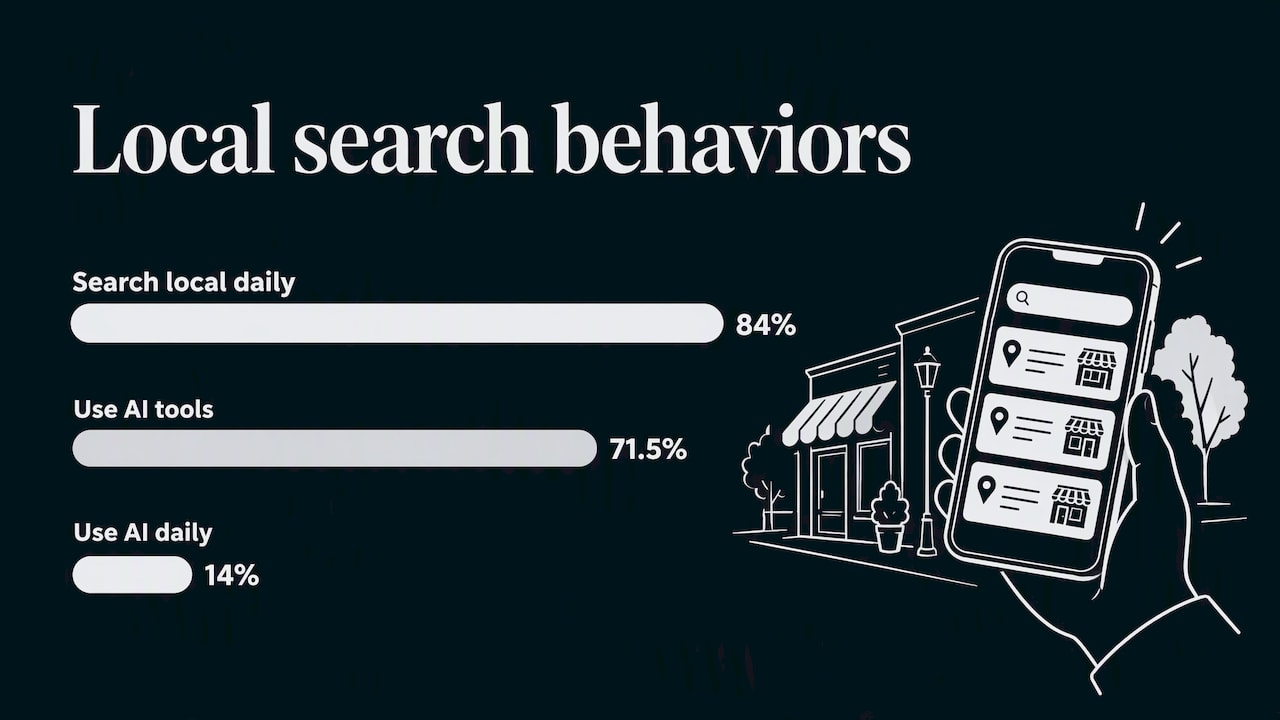
The search landscape is also shifting. A 2025 consumer survey reported that 84% of U.S. consumers search online for local businesses daily, that 71.5% of respondents use AI search tools, and that only 14% rely on them daily. People still search the traditional way, and AI summaries draw on what the web says about you. Accurate, consistent mentions help in both places.
What Google says about links in press releases
This is where small businesses get burned. Google’s spam policies treat links meant to manipulate rankings as a violation, and they specifically call out press releases distributed on other sites that carry optimized anchor text. The consequence can be a manual action or lower rankings.
The fix is simple. Google’s documentation on qualifying outbound links explains the rel values: nofollow for links you do not want to vouch for, and sponsored for paid or compensated placements. When a release you pay to distribute includes a link to your site, that link should carry one of these attributes, or you should leave it as a plain brand mention.
In practice:
- Link to your homepage or a relevant page with your business name as the anchor, not “best plumber in Dayton.”
- Never write a release whose main purpose is to carry a keyword-rich link.
- If a journalist writes a story and links to you on their own, that is an editorial link. You did not place it, and it is exactly the kind you want.
- Ask your distribution service how it handles link attributes before you pay.
A release is legitimate PR when it informs people. It becomes a problem when its job is to pass ranking credit.
What is worth announcing
Newsworthy is the filter. Ask: would a local editor care, and would a resident find it interesting? If the only reason to write it is to publish something, skip it.
| Announcement | Why local editors care | Local SEO angle |
|---|---|---|
| New location or service area | Business openings are standard local news | Reinforces your address and service-area signals |
| Award or certification | Recognition is credible third-party news | Builds trust and name mentions |
| Community event, sponsorship or fundraiser | Residents want to know what is happening | Ties your name to the neighborhood |
| New service or major change | Useful to a specific audience | Supports category and service relevance |
| Milestone (10 years, 1,000 jobs) | Human-interest hook | Brand authority |
| Hiring, or a staff member honored | Local employment news | Name mentions and local ties |
| Local data or seasonal tips from your trade | Gives reporters an expert source | Positions you as the local authority |
The last row is underused. An HVAC owner who offers a short, factual tip sheet before the first cold snap, or a dentist who offers a local back-to-school oral health reminder, becomes a source reporters return to. That kind of relationship outlasts any single release.
How to write a release a local reporter will read
Keep it short, factual and easy to lift into a story. One page is enough.
1. Write a plain headline with the city in it
Say what happened and where. “Riverside Family Dental Opens Second Office in Mesa” beats any clever line. A headline that names the place and the news serves readers, reporters and search engines alike. Avoid hype and all caps.
2. Put the facts in the first paragraph
Who, what, where, when, why it matters to the community. A reporter should be able to stop after paragraph one and still have the story.
3. Add a real quote
One quote from you or a team member, with name and title. Use something you actually said. A quote about the neighborhood or the customers you serve is more useful than corporate talk.
4. Include your business details exactly as they appear everywhere else
Business name, address, phone number, website and service area. Match the details on your Google Business Profile character for character. Consistency matters because mismatched details create confusion. Our guides on local listings optimization and how to use local listings to boost visibility walk through getting this right.
5. Write for people first
Google’s guidance on people-first content applies to anything you publish on your own site: content created to help people, not to manipulate rankings. Mention your city and service naturally. If a sentence reads oddly because a keyword is jammed in, cut it.
6. Offer a photo and a contact
Local outlets run photos. Supply a high-resolution image with a caption and say who to call for an interview.
Where to publish and send it
Most small businesses get more from a short list of local contacts than from a wide syndication package.
Your own website first. Publish the release as a news page on your site, with clear headings and your business details. This gives every mention something to point to. If your site is thin or outdated, fix that before announcing anything. Our notes on writing for SEO to reach local customers cover how to structure it.
Local reporters and editors. Build a simple list: the city paper, community weeklies, local TV and radio news sites, chamber of commerce newsletters, neighborhood blogs and trade publications. Square’s guide to distributing a press release suggests the same starting point: a media list of local publications and journalists who cover topics like yours, kept as a simple note or spreadsheet. Personalize each email with a line about why the story fits that reporter’s beat.
Community partners. Chambers of commerce, business improvement districts, local nonprofits and event organizers often share member news. Those mentions carry strong local context.
Paid distribution services. These can make sense for a larger announcement, but treat them as an add-on. A paid wire release often lands on pages with little local readership. Check the link attributes (see above) and judge success by pickup from relevant local outlets, not by a long list of sites that republished the text.
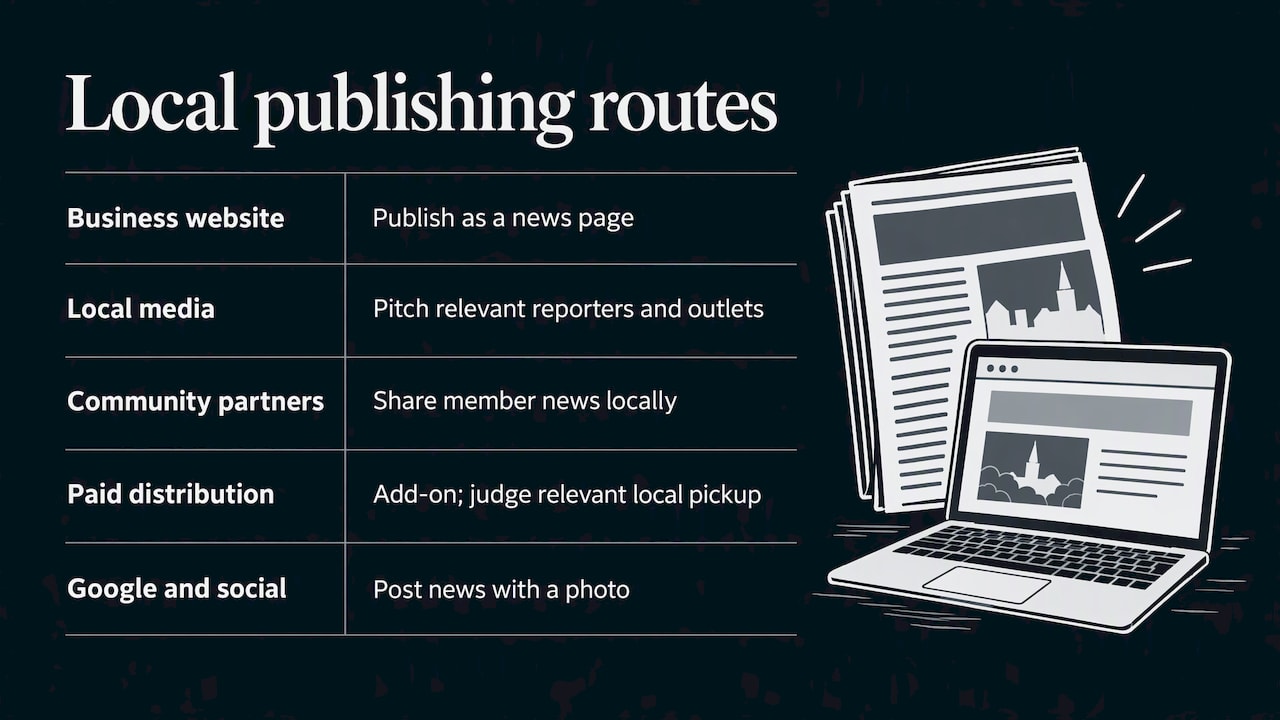
Your Google Business Profile and social channels. Post the news as an update, with a photo, so customers who already search for you see it. For the wider picture, see our guide on local digital outreach for small businesses.
Mistakes that waste money or cause penalties
- Sending releases with nothing to announce. Editors learn to ignore senders who do this.
- Optimized anchor text on every link. This is the exact pattern Google’s spam policies describe.
- Duplicating the same text everywhere. Write a tailored version for your own site and a short pitch for each reporter.
- Inconsistent business details. A different suite number or phone line in each place weakens the signals you are trying to build.
- Buying large syndication packages as a ranking tactic. Promises about hundreds of outlets rarely translate into local customers.
- Ignoring follow-up. A short, polite follow-up a few days later often does more than the release itself.
Our perspective on press releases and local SEO
We work with small and local businesses: home service companies, med spas, dental offices, venues and retailers. Almost all of them ask the same thing sooner or later: should we put out a press release?
Our view is that the release is a tool for telling a true local story, not a ranking trick. A business that opens a second location, wins a community award or sponsors a youth league has something worth sharing, and sharing it well creates mentions that live in the same city as the customers. That is useful. A business that pays to blast a keyword-heavy announcement nobody asked for is spending budget that would work harder elsewhere.
For owners on a tight budget, we usually suggest this order. First, complete and verify the Google Business Profile and clean up listings. Second, make sure the website loads fast and works on a phone, with a clear page for each service and area. Third, collect reviews and respond to them. Only then add press outreach, timed to real news, with a small hand-built media list. Real-time tracking matters here: you want to see whether calls, form fills and branded searches rise after an announcement, so you can repeat what worked and drop what did not.
This is also why we build a custom plan for each client instead of a fixed package. A banquet hall launching a renovated ballroom has different news, different reporters and different goals than a plumber adding emergency service in a new suburb.
— TONY
How to tell whether it worked
A press release is not a one-day event, so track a handful of signals over the following weeks.
- Coverage. Which outlets picked it up, and did they name your business and city?
- Branded search. Do more people search your business name in Google Search Console or your Business Profile insights?
- Profile actions. Calls, direction requests and website clicks from your Google Business Profile.
- Referral traffic. Visits from articles and community pages in your analytics.
- Leads. Form submissions and calls that mention the news or the outlet. Ask new customers how they found you.
If you want to set up this tracking properly, our guides on tracking campaign performance and real-time website analytics are a good place to start.
Need help turning local news into local visibility?
If you would rather have a team handle the pieces that make a release pay off, that is what we do. Ibrand offers SEO, local marketing, web design and real-time performance tracking for small and local businesses, with a custom plan built around your market and your budget. We can help you get the foundations in place, decide whether an announcement is worth making, and measure what it brings in.
FAQ
Are press releases good for SEO?
They can be, indirectly. The release page itself rarely ranks you higher, but coverage, brand mentions and referral traffic that follow can support your visibility. Links you place in a release to influence rankings should use nofollow or sponsored, per Google’s guidance.
What is a press release in SEO?
It is an announcement about real business news, shared with media and published online. In SEO terms, it is valued for the mentions and coverage it can earn, not as a way to plant optimized links. Google’s spam policies warn against using releases for that.
Is local press release distribution worth paying for?
For most small businesses, a hand-built list of local reporters and community groups beats a paid wire package. Paid distribution may fit a major announcement, like a new location. If you buy it, ask how links are tagged and judge it by relevant local pickup.
How often should a local business send a press release?
Only when you have news. For many small businesses that is a few times a year: an opening, an award, an event or a new service. Sending less often, with stronger stories, builds credibility with editors.
Is SEO dead now with AI?
No. HigherVisibility’s research describes search as diversifying rather than dying, and a 2025 survey found AI tools complement traditional search for most users. Accurate, consistent local information helps in both.
Sources
- Spam policies for Google Web Search
- Qualify outbound links for Google
- Creating helpful, reliable, people-first content
- AI, Accuracy, and Reputation: What’s Driving Online Local Search in 2025
- New Study from HigherVisibility Reveals How Search Behavior Is Changing in 2025
- How to Distribute Your Press Release (Square)
Recent Comments