
Yes, show something. For most small and local businesses, the best move is to publish real prices, or at least a “starting at” figure, a range or a few sample packages. Visitors who find no price tend to assume the worst or leave to find a business that tells them. You don’t need a full rate card for every job. You do need to give a buyer enough context to decide whether to call.
This guide is for owners of dental practices, med spas, HVAC and plumbing companies, contractors and venues. It covers what to show, how to show it, and where federal advertising rules apply.
TL;DR
- Pricing is the top information need on business websites, and missing prices push prospects to check a competitor.
- If your jobs are custom, publish “starting at” prices, ranges or sample packages instead of a calculator or a bare “contact us.”
- Any price you advertise must be truthful and not misleading. Put mandatory fees in the number, not behind an icon or at the end.
- Keep prices current, and put them on a page you can edit in minutes.
- Prices you can’t show yet are a reason to show the factors that drive them, not a reason to say nothing.
Table of Contents
- Why a missing price costs you leads
- What to show when every job is different
- When not showing a price is reasonable
- What U.S. rules say about advertised prices
- How to build a pricing page that works
- A worked example
- Our perspective
- Make your pricing page part of a bigger plan
- FAQ
- Sources
Why a missing price costs you leads
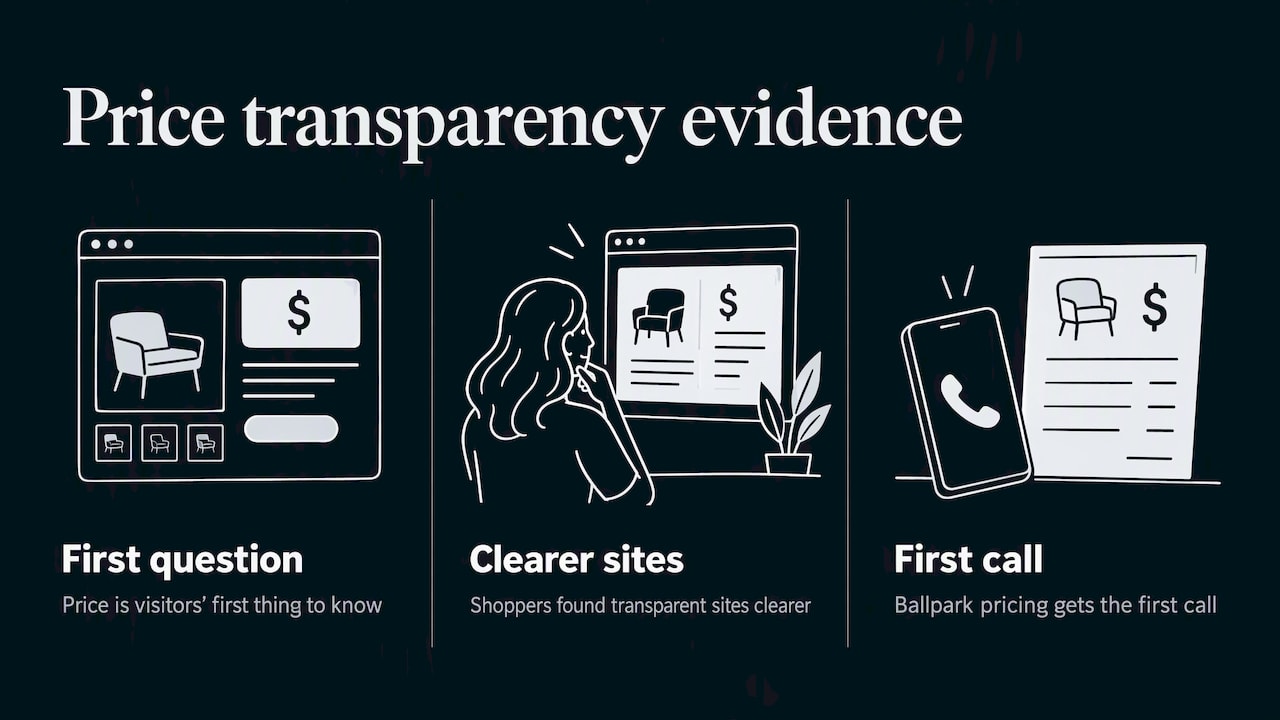
Most owners worry that a visible number will scare people off. The research points the other way. Nielsen Norman Group’s usability studies found that price is the first thing visitors want to know, including on B2B sites, and that sites often hide or obscure it. When people can’t find it, they frequently leave to check a competitor’s offer.
Think about what your visitor is doing. A homeowner with a failed AC unit on a July afternoon is not going to fill out a form to learn whether you cost $200 or $2,000 for a diagnostic. They open three tabs. The business that gives them a ballpark gets the first call. The others get nothing, and you never see the visitor in your analytics as anything but a bounce.
Silence also tells a story. Without a number, many buyers assume the service is too expensive or outside their budget, and they don’t bother to verify. A price, even a wide range, lets the right buyers raise their hand and lets the wrong ones leave early. That second part is a feature: you spend your phone time on people who can actually afford the work.
A European consumer regulator also looked at this from the shopper’s side. A research report commissioned by the Dutch Authority for Consumers and Markets concluded that transparent price communication does not harm purchase decisions, and that shoppers found transparent sites clearer. It is a Dutch study of consumers, not a U.S. study of contractors, so treat it as supporting evidence, not proof for your trade. It still cuts against the idea that honesty about cost loses sales.
What to show when every job is different
“Our work is custom” is true for most service businesses. It is not a reason to show nothing. NN/G’s advice is to offer a price range, a “starting at” figure or representative packages so prospects can qualify themselves. Here are the options, from least to most commitment.
| Approach | Best for | Watch out for |
|---|---|---|
| Exact price list | Standardized services: teeth cleaning, a drain snaking, a Botox unit, a hall rental by the hour | Must be kept current, and must include mandatory fees |
| “Starting at” price | Services with a clear entry level | The floor must be a real price people actually get |
| Price range | Jobs that vary by size or complexity | A range so wide it says nothing |
| Sample packages or scenarios | Bespoke projects: kitchen remodels, weddings, retainers | Label them as examples, not quotes |
| Price factors only | Truly open-ended work | Weakest option; use it only as a bridge to the others |
Exact prices
Use them wherever the service is a product in disguise. A plumber’s flat-rate water heater replacement, a dentist’s new-patient exam, a med spa’s single-session menu and a banquet hall’s Friday rental all fit. Exact prices build the most trust and generate the most qualified calls.
“Starting at” and ranges
If the final price depends on the home, the room or the guest count, say so and give the floor. “Furnace tune-ups from $X” or “Weddings for 100 guests typically run between $X and $Y” works. Add one sentence on what moves the price up or down: square footage, access, materials, season, add-ons. Mean it, too. If nobody ever pays the “starting at” price, it is bait, and buyers can tell.
Sample packages
For larger projects, describe two or three typical scenarios: what the client needed, what was included, what it cost. This is the approach NN/G favors over complicated tools. Their usability expert recommends clear sample packages over time-consuming pricing calculators, which tend to deter engagement. A calculator that asks for twelve inputs and then says “we’ll email you a quote” is worse than no calculator.
When not showing a price is reasonable
There are honest cases for holding back. If scope swings so widely that any figure would mislead, if the work needs a site visit to diagnose, or if you sell large custom projects where the first call is the real start of scoping, a rigid price list can hurt you. In those cases, don’t leave the page blank. Explain how you price (hourly, per project, per month), what a typical engagement includes and what a first consultation costs, if anything.
What doesn’t work is the bare “Contact us for a quote” button as the only answer. Research for the Dutch regulator found that hiding information behind extra clicks is ineffective: only 2.45 percent of consumers clicked an “i” symbol to see additional pricing details. If the number matters, put it where people are already looking.
What U.S. rules say about advertised prices
This is the section to read slowly if you advertise prices to consumers, as dentists, med spas, plumbers and contractors do. I am not a lawyer, and state rules vary, so check specifics with a business attorney or your state attorney general’s office.
The baseline comes from the FTC. Federal law says an ad must be truthful and not misleading, whether it appears on the internet, radio, TV or anywhere else. In practice, that means a price you publish should be the price a customer actually pays. A “$99 service call” that becomes $159 once a mandatory trip fee shows up is the kind of gap that creates complaints and legal risk.
The FTC’s newer fee rule is narrower than many people assume. The Rule on Unfair or Deceptive Fees, effective May 12, 2025, requires total-price disclosure for live-event tickets and short-term lodging. If you run a venue that sells tickets to live events, it applies to you. If you rent a hall for private events or do home repair, that specific rule does not cover you, but the general truth-in-advertising standard still does, and total-price habits are the safest practice.
The FTC’s guidance on digital ads adds a practical point on placement. Its .com Disclosures document says a disclosure needs to be clear and conspicuous, and gives the example of a link that should appear adjacent to the price when further costs apply. Don’t make the visitor hunt.
A short checklist for a compliant price display:
- Include every mandatory charge in the number (trip fees, booking fees, required add-ons).
- State what the price covers and what is optional.
- Put conditions next to the price, not in a footer.
- Date the page or review it on a schedule, and remove expired promotions.
- If a price is a “starting at” figure, make sure real customers get it.
How to build a pricing page that works
A good pricing page for a local business is simple. It does not need a design award. It needs to answer the questions a nervous buyer has.
1. Lead with the most common services
List the three to six things people buy most. Put the price, a one-line description and a call to action beside each one. Everything else can go below under “other services.”
2. Say what is included
Two businesses can quote the same number for very different work. Name what the price includes: parts, labor, materials, cleanup, a warranty, a follow-up visit, taxes where relevant. Name what is not included.
3. Explain the variables
One short paragraph on why prices differ builds more trust than a footnote. “Roof pitch, number of layers to remove and access to the property all affect the cost” reads as expertise, not evasion.
4. Offer a next step for each tier
A button for “Book this service” or “Get an exact quote in 24 hours” turns a price viewer into a lead. Match the call to action to the price type: book directly for flat prices, request an estimate for ranges.
5. Make it findable
Link the pricing page in your main navigation, not only the footer. Make sure it works on a phone, since many local searches happen on mobile. Reference it from your service pages, so each one answers the cost question in context.
6. Mark up prices for search, where it applies
If you sell products online, Google can show price directly in results using structured data. Its documentation lists price and priceCurrency among the properties for product snippets inside an Offer. This is for products. Pure service pricing doesn’t generally qualify for product snippets, so don’t force it. Retailers and anyone selling goods from a site should check their product pages.
A worked example
Imagine a banquet hall that currently says “Call for pricing.” Calls come in from couples who find the quote far above their budget, and the owner spends evenings on the phone with people who were never going to book.
A better page might show three sample events: a 60-guest weekday celebration, a 120-guest Saturday wedding and a corporate dinner. Each lists the room fee, what’s included (tables, linens, setup), and what costs extra (bar, DJ, late hours). Prices are labeled as examples. The result is fewer unqualified calls and a first conversation that starts at “which of these is closest to what you want?” That’s a better call to take.
The same logic works for an HVAC company listing a flat diagnostic fee and “system replacement from $X, most homes between $X and $Y,” or a med spa with a treatment menu and a note on package discounts. The figures are yours to choose, and they should reflect what you actually charge.
Our perspective
We work with small and local businesses on websites, local search and advertising, and we see the same hesitation again and again: the owner is afraid of the number, so the page says nothing. In our experience the fear is bigger than the risk. A price shows a buyer you respect their time. It also forces a useful discipline: if you can’t explain what you charge and why, your marketing will struggle too.
We apply that to ourselves. We believe agency pricing should be clear and tied to the work, and we have written about how to make marketing costs transparent and about testing pricing models over 30 days. Every client gets a custom plan, because every business is different, but custom should never mean hidden.
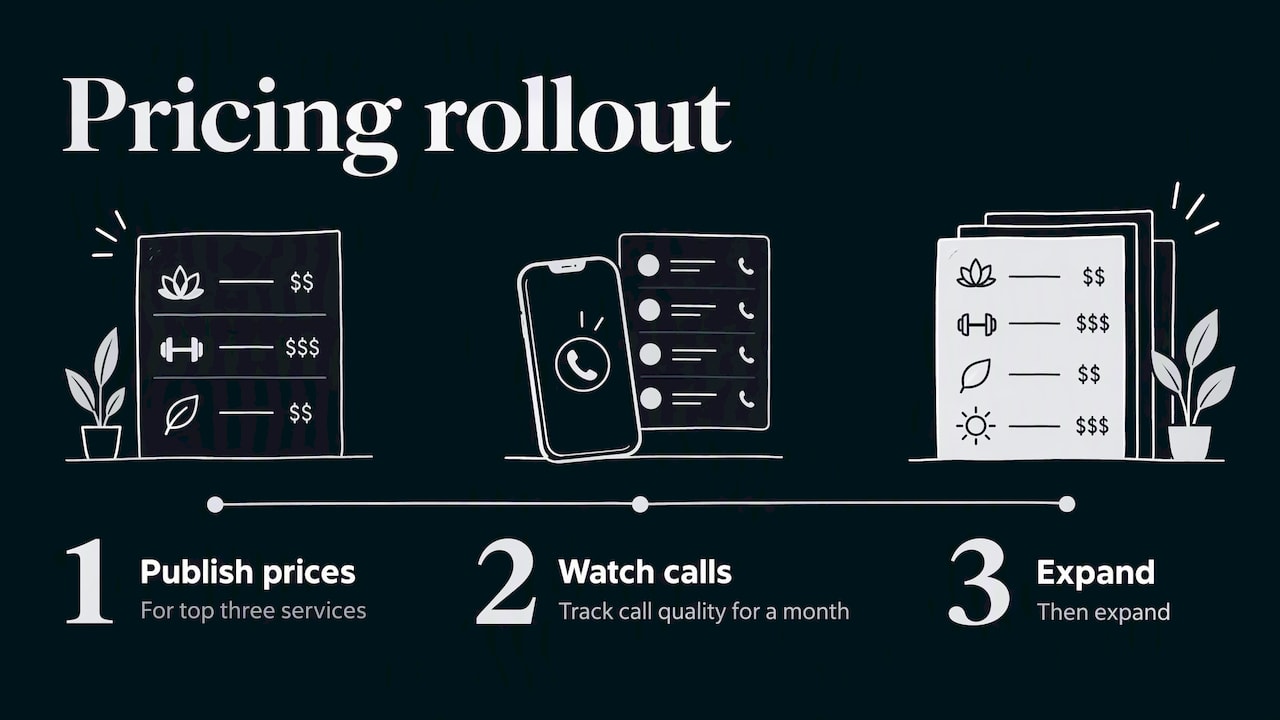
Our advice to owners who are nervous: start small. Publish “starting at” prices for your top three services, watch what happens to call quality for a month, then expand. You can change a web page in ten minutes. You can’t get back the visitor who left to find a business that answered the question.
— TONY
Make your pricing page part of a bigger plan
A pricing page only helps if people reach it. That is where local SEO, a fast mobile-friendly site and a clear Google Business Profile come in. If you want help writing the page, designing it and getting it in front of local buyers, see our services or get in touch through our site. We build a plan around your business and budget, and we can show you where your site loses visitors today. If you are still comparing providers, our small business guide to choosing a marketing agency covers the questions to ask.
FAQ
Should I put prices on my website?
In most cases, yes, at least in the form of “starting at” prices, ranges or sample packages. Pricing is a top information need for business visitors, and leaving it out sends many of them to competitors. Hold back only when scope varies so widely that any number would mislead, and then explain how you price instead.
Will showing prices scare customers away?
It will scare away some who could never afford you, which saves you time. Research commissioned by the Dutch consumer regulator found no evidence that honest, upfront price communication hurts purchase decisions. Frame prices with what is included and the value delivered.
What if my prices change often?
Use “starting at” figures or ranges, date the page and review it on a schedule, such as monthly or quarterly. Keep the page easy to edit. If a price on your site is the one you advertise, customers should be able to pay it, so remove anything outdated promptly.
Are there legal rules about displaying prices?
Yes. The FTC says advertising must be truthful and not misleading, and a separate FTC fee rule covers total-price disclosure for live-event tickets and short-term lodging. State laws differ, and some industries have extra rules, so confirm with an attorney or your state attorney general.
Is a pricing calculator better than a price list?
Usually not. NN/G’s usability expert advises that long calculators often deter engagement and that sample packages or ranges work better. A short estimator can work if it takes a few inputs and gives a real range right away.
Sources
- Pricing information gives B2B sites a competitive advantage, Nielsen Norman Group
- Effective online information research report, Netherlands Authority for Consumers and Markets
- Truth In Advertising, Federal Trade Commission
- The Rule on Unfair or Deceptive Fees: FAQs, Federal Trade Commission
- .com Disclosures, Federal Trade Commission
- Product snippet structured data, Google Search Central
Recent Comments