
Review gating, which means screening customers so only happy ones get asked for public reviews or suppressing negative feedback, is prohibited by Google and regulated by the FTC. Google can remove manipulated content, and the FTC can seek civil penalties for knowing violations. Stop any sentiment-based routing today and switch to one neutral review request sent to every eligible customer.
TL;DR:
- Send the same neutral request with a direct review link to every eligible customer after a real interaction; ask for honest feedback, not praise.
- Google permits removal of spam, obscenity, personal information, or irrelevant reviews, but moderation must apply equally and never depend on star rating or sentiment.
- The FTC rule took effect October 21, 2024, and knowing violations can bring civil penalties; businesses may remain liable when vendors suppress reviews.
- Audit vendor routing logic, moderation rules, logs, permissions, and message templates; reject any system that withholds reviews based on satisfaction scores.
Table of Contents
- 1. What review gating is and how to spot it
- 2. What Google’s policy bans and allows
- 3. The FTC rule on review suppression and gatekeeping
- 4. Five steps to a compliant review request
- 5. What to audit in your review-management vendor
- 6. A governance checklist you can adopt now
- 7. Enforcement cases and what they teach
- 8. Why clean review programs win over time
- 9. How we help you build a compliant review program
- FAQ
- Sources
1. What review gating is and how to spot it
Review gating is any process that decides who gets to leave a public review based on how they feel or what rating they would give. Lawful solicitation is the opposite: you ask every eligible customer, in the same way, for an honest account.
You may already be gating if your setup does any of the following:
- A post-purchase survey sends only high scorers to your Google review page and routes everyone else to a private form.
- Your team asks only customers who seemed satisfied to post a public review.
- A tool holds back low-star reviews while publishing four- and five-star ones.
- Staff discourage unhappy customers from posting publicly.
This can make a rating less representative of customer experience. Regulators are concerned that selectively displaying reviews can mislead consumers.
2. What Google’s policy bans and allows
Google treats gating as fake engagement and rating manipulation. Its Maps content policy disallows discouraging or prohibiting negative reviews, soliciting content that is not based on a real experience, and offering incentives in exchange for reviews. Google’s own examples of fake engagement include:
- Posting from multiple accounts to inflate or deflate a rating
- Tampering with devices to disguise who is posting
- Paying for, or being paid for, reviews
- Selectively soliciting only positive reviews
What Google allows is simple. You may ask customers for genuine reviews when no incentive is offered and you do not steer the rating or the wording. You may also remove reviews that break content rules, as long as you apply those rules equally to praise and complaints. Google states that fake engagement is not allowed and will be removed, so a gated profile risks losing exactly the reviews you worked to collect.
3. The FTC rule on review suppression and gatekeeping
The FTC’s Consumer Reviews and Testimonials Rule took effect on October 21, 2024, and the FTC’s rule Q&A explains how it works in practice. It covers fake or false reviews, incentives conditioned on sentiment, review suppression and deceptive review displays. Suppression includes using unfounded legal threats, intimidation or false public accusations to get negative reviews removed. It also includes claiming displayed reviews represent most or all submissions when reviews were excluded because of rating or negative sentiment.
Two points matter most for owners. First, knowing violations can carry civil penalties, so “everyone in our industry does it” is not a defense. Second, the restriction can apply when a contractor or software vendor performs the gatekeeping for you.
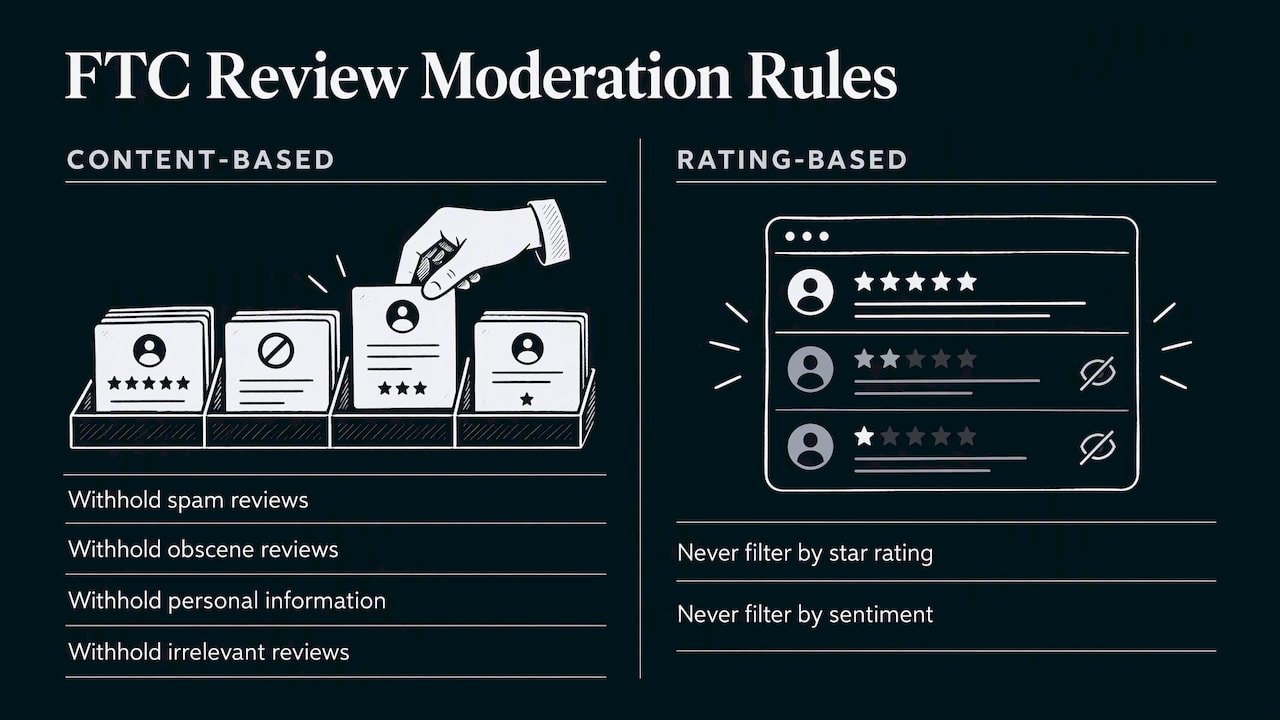
Moderation itself is fine. The FTC’s guide for platforms says legitimate moderation is content-based and viewpoint-neutral. You can withhold reviews for spam, obscenity, personal information or irrelevance. Star rating or sentiment can never be the trigger.
4. Five steps to a compliant review request
Here is a process you can put in place this week:
- Confirm a real customer interaction happened before you send anything.
- Send one neutral request to every eligible customer, by email or SMS, with a direct review link. Our guide to creating a Google review link walks through it.
- Ask for an honest account, not a positive rating, and avoid suggesting wording.
- Send the request soon after the purchase or service, while the experience is fresh, and do not follow up repeatedly.
- Skip incentives. If you ever run one, never tie it to sentiment, disclose it clearly and apply it consistently.
A neutral template: “Thanks for choosing us. We’d value your honest feedback about your experience. You can share it here: [link].”
Pro Tip: Send the exact same message to every customer, including the ones who complained, and keep a copy of it in your records.
When criticism arrives, respond publicly and professionally without pressuring the reviewer to delete or change it. Our templates and timing guide covers that step.
5. What to audit in your review-management vendor
Hiring a tool or agency does not move the liability off your business. The FTC says businesses can be liable for suppression performed through contractors, so ask your vendor for proof of how the system behaves. Request these items:
- Written moderation rules showing the reasons a review can be withheld
- Routing logic, ideally with screenshots, showing who gets a public link
- Dashboard logs and permission settings for who can hide or publish reviews
- Copies of every message template in use
Treat these as red flags: routing that depends on a satisfaction score, reviews that are withheld without explanation, and bursts of unusual posting patterns. If a vendor cannot explain its rules plainly, fix the setup or change vendors. For broader context on how reputation programs are structured, this partner article on business reputation management offers a public-affairs view.
6. A governance checklist you can adopt now
A written program can help document how your business handles reviews if anyone asks questions. Build it in this order:
- Write a dated review policy that lists the uniform reasons a review may be withheld, none of them tied to rating or tone.
- Keep training records for everyone who sends requests or handles moderation.
- Save sample messages, routing-logic screenshots and an audit trail of each moderation decision.
- Schedule policy reviews whenever Google or FTC rules change, a vendor or platform changes, you launch a new campaign or incentive, or you change how reviews are collected or displayed.
Neither Google nor the FTC sets a universal review interval, so these triggers are a sound control practice rather than a mandate. For a wider workflow view, see our overview of online review management.
7. Enforcement cases and what they teach
Two FTC cases show how this plays out:
- Hey Dude: The FTC announced a $1.95 million payment after alleging the company published five-star reviews with little scrutiny while rejecting less favorable ones. Lesson: withheld reviews can mean serious enforcement.
- Fashion Nova: The FTC described a third-party interface that automatically published four- and five-star reviews while withholding many lower-star ones. Lesson: handing control to a vendor is a compliance risk, not a shield.
The takeaway is the same in both: treat positive and negative reviews equally, and document your moderation and vendor controls.
8. Why clean review programs win over time
When we clean up review programs for small businesses, the fixes are rarely dramatic: a written policy, neutral templates and a vendor audit. The payoff is a rating customers can trust, and trust is what turns profile views into calls and visits. Honest, mixed reviews give readers a fuller picture of customer experiences. Shortcuts can create compliance risks, including the removal of reviews or regulatory action.
— TONY
9. How we help you build a compliant review program
We help local businesses replace risky review habits with a program that holds up. Our team handles reputation management and Google Business Profile management. We start by looking at how your reviews are collected today, then give you a clear plan for fixing anything that looks like gating. If you want a second set of eyes, book an audit or consultation with us.

This article is general information, not a substitute for advice from a qualified lawyer. Consult a qualified legal professional about your own circumstances before acting on anything here.
FAQ
What does review gating mean?
Review gating means filtering who is invited to post a public review based on their expected sentiment or rating. Examples include sending only satisfied customers to Google and sending unhappy ones to a private form. It misleads shoppers about real customer experience.
What is Google’s review gating policy?
Google’s Maps policy treats gating as rating manipulation. It disallows discouraging negative reviews, soliciting reviews not based on a real experience, and offering incentives for reviews. Content that breaks these rules can be removed.
Is review gating illegal?
Gating is not labeled a single federal crime, but it can create liability under the FTC Act and the Consumer Reviews and Testimonials Rule. That rule took effect on October 21, 2024, and permits civil penalties for knowing violations, according to the FTC’s rule Q&A. Talk to a qualified attorney about your specific situation.
How often do you need to review policies?
Neither Google nor the FTC sets a fixed interval. Review your policy whenever platform or regulatory rules change, you switch vendors, or you launch a new review campaign or incentive.
Sources
- The Consumer Reviews and Testimonials Rule: Questions and Answers | Federal Trade Commission
- Online Shoe Seller Hey Dude, Inc. to Pay $1.95 Million for Violating FTC’s Mail, Internet, and Telephone Order Rule and Suppressing Negative Consumer Reviews | Federal Trade Commission
Recent Comments