
Yes, add FAQ schema next to your LocalBusiness markup, as long as the questions are visible on the page and follow Google’s structured data policies. The payoff is clearer, machine-readable answers that search engines and AI assistants can lift straight from your page. Schema and Google’s own documentation define the formats you need.
TL;DR:
- Put location specific questions beside that location’s LocalBusiness details; keep broad questions on a dedicated FAQ page and link both page types.
- Ensure every marked up answer appears visibly on the page, and keep the business name, address, phone, and hours consistent with your footer and business profile.
- Add name and address as required LocalBusiness fields, use the most specific fitting business subtype, and validate JSON LD before deploying.
- After launch, inspect the page in Search Console, monitor reports, and audit hours, contact details, and obsolete questions quarterly; rich result display is not guaranteed.
Table of Contents
- What are LocalBusiness and FAQ schema, and why do they matter?
- How do LocalBusiness and FAQ schema work together?
- What is the step-by-step implementation checklist?
- What do copy-ready JSON-LD examples look like?
- How do you validate and test the markup?
- How do you keep markup accurate over time?
- Which publisher resources can you adapt?
- Why implementation matters more than the markup itself
- Need someone to implement and monitor it for you?
- FAQ
- Sources
What are LocalBusiness and FAQ schema, and why do they matter?
LocalBusiness is the schema.org type for a physical business location, and FAQPage is the type for a page of questions with accepted answers. Together they tell search engines who you are, where you are, and what customers usually ask before they call.
- LocalBusiness describes your name, address, phone, hours, and website in a format crawlers read without guessing.
- FAQPage marks up question-and-answer content so an answer can be surfaced directly, as schema.org documents.
- Conversational search benefits from short, clearly labeled answers, which is a strong reason to keep your wording plain.
- Search results real estate can grow when a result shows richer information, though display is never guaranteed.
Google’s documentation treats LocalBusiness as the standard for defining a physical business location. It also notes that LocalBusiness is a subtype of Organization, and it recommends implementing both for a complete picture of the business entity.
How do LocalBusiness and FAQ schema work together?
You have two clean patterns, and the right one depends on how specific your questions are.
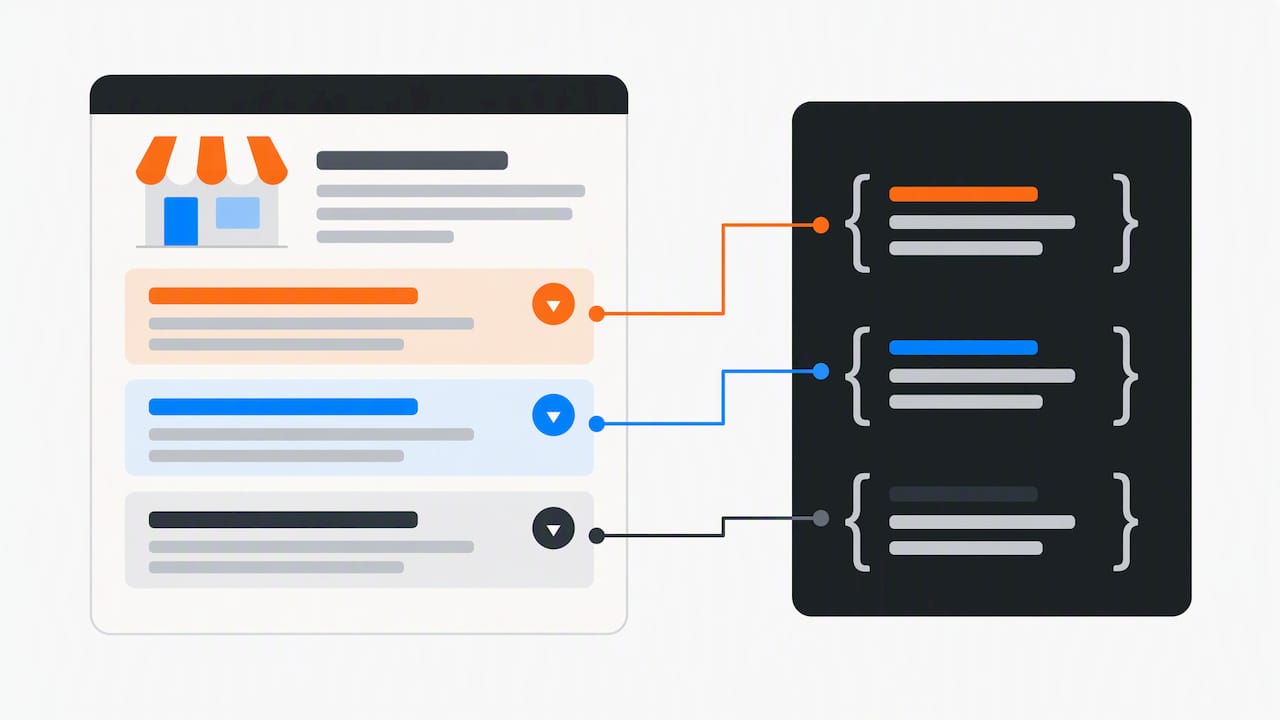
Option A: same page. Put LocalBusiness and FAQPage JSON-LD together on a location or service page when the questions are about that location or service. A plumber’s page for one city can answer “Do you offer emergency visits here?” right beside the business details.
Option B: separate pages. Keep LocalBusiness on each location page and publish general questions on a dedicated /faq page marked as FAQPage. This suits long, site-wide question collections.
Whichever you pick, keep these rules in mind:
- The visible page content must match the marked-up data word for word in substance. Markup that contradicts the page invites problems.
- Use the same business name, address, and phone number everywhere you publish them.
- Choose Option B when answers are not tied to a single location, so you avoid repeating the same questions across dozens of pages.
- Link between the two: your location page can point to the /faq page, and the /faq page can point back to your locations.
If a service is a major draw, you can also describe it with the Service type, which uses the provider property to tie a service back to your business.
What is the step-by-step implementation checklist?
Follow these steps in order, and you will avoid most mistakes.
- Pick your target pages. Choose location pages, service pages, or a dedicated FAQ page.
- Gather canonical business data. Collect your name, address, telephone, url, and openingHoursSpecification. Google lists name and address as required and the others as recommended in its LocalBusiness guidance.
- Choose strong Q&A pairs. Use questions customers really ask, answer each in a few concise sentences, and make sure each one is visible on the page.
- Insert the JSON-LD. Place it in the page head or body. JSON-LD is easier to maintain than microdata because it sits in one block apart from your layout.
- Test before launch. Run staging, then a validator, then deploy, and keep a simple change log of what you edited and when.
Pro Tip: Recommend the most specific LocalBusiness subtype that fits, such as Dentist or Plumber, rather than the generic type. Google’s documentation encourages this.
What do copy-ready JSON-LD examples look like?
Replace every capitalized placeholder with your real details. Here is a combined LocalBusiness and FAQPage block for a service page:
<script type="application/ld+json">
{
  "@context": "https://schema.org",
  "@graph": [
    {
      "@type": "LocalBusiness",
      "name": "YOUR BUSINESS NAME",
      "url": "https://www.example.com/location-page",
      "telephone": "+1-555-555-0100",
      "address": {
        "@type": "PostalAddress",
        "streetAddress": "YOUR STREET ADDRESS",
        "addressLocality": "YOUR CITY",
        "addressRegion": "ST",
        "postalCode": "YOUR POSTAL CODE"
      },
      "openingHoursSpecification": {
        "@type": "OpeningHoursSpecification",
        "dayOfWeek": ["Monday","Tuesday","Wednesday","Thursday","Friday"],
        "opens": "YOUR OPENING TIME",
        "closes": "YOUR CLOSING TIME"
      }
    },
    {
      "@type": "FAQPage",
      "mainEntity": [
        {
          "@type": "Question",
          "name": "YOUR FIRST QUESTION?",
          "acceptedAnswer": {
            "@type": "Answer",
            "text": "YOUR FIRST ANSWER, matching the visible page text."
          }
        },
        {
          "@type": "Question",
          "name": "YOUR SECOND QUESTION?",
          "acceptedAnswer": {
            "@type": "Answer",
            "text": "YOUR SECOND ANSWER."
          }
        },
        {
          "@type": "Question",
          "name": "YOUR THIRD QUESTION?",
          "acceptedAnswer": {
            "@type": "Answer",
            "text": "YOUR THIRD ANSWER."
          }
        }
      ]
    }
  ]
}
</script>
For a split deployment, keep only the LocalBusiness object on the location page and move the FAQPage object to /faq. Reuse these markers each time.
- Business name, address, and phone: copy them exactly as they appear in your footer.
- Hours: match the hours shown on the page and your business profile.
- Canonical URLs: point url to the preferred version of each page.
- Q&A text: paste the same words readers see on the page.
For more templates, our local business schema templates cover additional business types.
How do you validate and test the markup?
Test every change with this sequence:
- Paste your code or page URL into Validator to catch syntax errors and missing properties.
- Fix every error, then retest until the report is clean.
- Deploy to your live site.
- Open Google Search Console, use URL Inspection on the page, and request indexing. Google’s LocalBusiness documentation covers testing in Search Console.
- Monitor the rich results reports over the following weeks for warnings or errors.
The errors we see most often are malformed JSON-LD (a missing comma or quote), absent required LocalBusiness fields, and Q&A text that exists in the markup but not on the rendered page. If an answer is in the code only, remove it or add it to the visible content.
How do you keep markup accurate over time?
Structured data goes stale quietly, so build upkeep into your routine.
- Keep markup identical to visible content, and never mark up hidden or misleading Q&A.
- Mark up only questions and answers your site owns and controls, not unmoderated user answers.
- Audit quarterly: refresh hours, phone numbers, and holiday schedules, and delete obsolete questions.
- Automate with CMS templates or tag manager snippets, then retest after every change.
Pro Tip: Tie your quarterly schema audit to your seasonal hours update, so one calendar reminder covers both.
Our small business SEO checklist pairs well with this routine.
Which publisher resources can you adapt?
We keep a library of ready-to-use material for exactly this job:
- A LocalBusiness template with placeholder fields you swap for your canonical data.
- FAQ snippets you can copy and rewrite in your own voice.
- CMS guidance: embed the JSON-LD through your theme header or a per-page template, replacing each placeholder with your canonical business fields.
- A reminder to validate every adapted template at validator.schema.org, then watch Search Console after launch.
Start from our copy-ready template page, and for a broader plan see our local SEO strategies guide. If your wider business needs resources, such as buying or selling a company, there are also business buyer resources worth a look.
Why implementation matters more than the markup itself
Most advice about this topic treats FAQ schema as a ranking trick. We think that framing is backwards. The markup rewards accuracy and discipline, not cleverness, and the businesses that benefit are the ones whose pages already answer real questions well.
Conventional guides also fall short by stopping at the snippet. A perfect block of code is worthless if your hours changed in March and nobody touched it since. Treat schema as a small, living part of your site that someone owns.
Prioritize in this order. First, get LocalBusiness right on every location page, because that is the foundation. Second, write five honest questions customers actually ask. Third, validate, deploy, and put a quarterly review on the calendar. Skip the temptation to stuff in dozens of questions or to hunt for tricks. Clean, boring, accurate markup is what holds up.
— TONY
Need someone to implement and monitor it for you?
If your developer time is tight, your CMS is awkward, or nobody has time to monitor Search Console, we can handle it. We implement LocalBusiness and FAQ JSON-LD, test it in staging, deploy it, and watch the reports afterward. Request a site review or template installation through our SEO services and we will send you an estimate.
FAQ
Is FAQ schema still relevant for local businesses?
Yes, because it still gives search engines a clean, structured way to read your questions and answers. Display of rich results is never guaranteed, so treat the markup as a clarity signal rather than a promise. Follow Google’s structured data policies to stay eligible.
Can you give an example of FAQ schema?
A FAQPage block holds a mainEntity list, where each item is a Question with a name and an acceptedAnswer containing the answer text. Our combined example above shows question-and-answer pairs you can copy. Check the structure against schema.org’s FAQPage definition.
What does FAQ schema do?
It labels question-and-answer content so search engines can understand it and, where they choose, show answers directly. It does not replace good page content. The visible text must match the markup.
Should FAQ schema go on a service page or a separate FAQ page?
Use the service or location page when the answers are specific to it, and a dedicated /faq page for broad, site-wide questions. Never mark up answers that readers cannot see on the page.
Sources
- Developers
- Schema
- Validator
- Local Business (LocalBusiness) Structured Data | Google Search Central | Documentation | Google for Developers
Recent Comments