
Most American small business owners are surprised to learn that nearly 46 percent of all Google searches are for local information. Competing with larger brands on search engines can feel out of reach, but local SEO levels the playing field for service providers like plumbers and HVAC contractors. This guide outlines clear, realistic steps so your American business can connect with more customers while keeping costs low and results measurable.
Table of Contents
- Step 1: Define Target Keywords And Search Intent
- Step 2: Structure Content For Readability And SEO
- Step 3: Optimize On-Page Elements Strategically
- Step 4: Incorporate Valuable Local References
- Step 5: Verify Results With SEO Performance Tools
Quick Summary
| Key Takeaway | Explanation |
|---|---|
| 1. Identify Target Keywords Effectively | Pinpoint what potential customers search for to tailor your content and improve visibility. |
| 2. Structure Content for Readability | Organize sections logically with headings to enhance user experience and SEO performance. |
| 3. Optimize On-Page Elements Strategically | Use title tags, meta descriptions, and headers to improve search engine rankings and user engagement. |
| 4. Integrate Local Context in Content | Weave in local references to connect with your community and attract nearby customers. |
| 5. Monitor SEO Performance Regularly | Utilize tools to track key metrics, helping refine strategies and enhance overall online visibility. |
Step 1: Define target keywords and search intent
Locking down the right keywords and understanding search intent form the bedrock of effective SEO for local businesses. Your goal is pinpointing exactly what potential customers type into search engines when seeking services like yours.
Start by brainstorming terms a homeowner or business might use when searching for your specific services. A plumber might consider phrases like “emergency plumber near me” or “residential pipe repair”. For each potential keyword, analyze its search intent categories – whether informational, transactional, commercial, or navigational. Keyword research from Carnegie Higher Ed emphasizes matching your content precisely to user expectations. This means if someone searches “how to fix a leaky faucet,” they want instructional content, not just a sales pitch.
Utilize keyword research tools to validate search volume and competition for your identified terms. Look for a sweet spot between high search frequency and manageable competition. Local businesses should prioritize geo-specific keywords that signal immediate purchase intent, like “plumbing services in Chicago” or “HVAC repair Austin TX”.
Here’s a comparison of search intent types relevant for local business keyword targeting:
| Search Intent Type | User Objective | Example Keyword | Content Focus |
|---|---|---|---|
| Informational | Learn or solve a problem | How to fix a leaky faucet | Instructional, detailed guides |
| Transactional | Make a purchase or book a service | Emergency plumber near me | Service pages, booking forms |
| Commercial Investigation | Compare providers or products | Best plumbing services in Chicago | Reviews, comparisons |
| Navigational | Find a specific page or brand | ABC Plumbing website | About, contact, homepage info |
Pro Tip: Regularly update your keyword strategy by monitoring changing search trends and customer language in your specific industry.
Step 2: Structure content for readability and SEO
Creating content that both search engines and human readers love requires a strategic approach to organization and presentation. Your mission is to transform complex information into digestible, engaging content that keeps readers scrolling and search engines ranking.
Start by breaking your content into clear logical sections with descriptive headings. Content structure impacts SEO significantly by helping search engines understand your page’s context and relevance. This means using H2 and H3 headings that naturally incorporate your target keywords while providing clear navigation for readers. Aim for concise paragraphs that rarely exceed 3 to 4 sentences. Readable content strategies demonstrate that shorter paragraphs and straightforward language dramatically improve user engagement. Visual elements like bulleted lists, numbered steps, and strategic paragraph breaks make your content more scannable and user friendly.

Think about your content like a roadmap where each section guides readers smoothly from one concept to another. Use transitional phrases that connect ideas, maintain a logical flow, and keep readers interested. Include relevant examples that illustrate your points and make abstract concepts concrete. Remember that good structure is not just about aesthetics but about creating a seamless reading experience that answers user questions efficiently.
Pro Tip: Use online readability scoring tools to evaluate and refine your content’s complexity and ensure it matches your target audience’s comprehension level.
Step 3: Optimize on-page elements strategically
Mastering on-page SEO is like fine-tuning an engine for maximum performance. Your objective is transforming every webpage element into a strategic tool that signals relevance and quality to search engines while engaging potential customers.
On-page SEO optimization requires meticulous attention to specific elements that communicate your content’s value. Start with your title tags and meta descriptions keywords that precisely match user search intent. Place your primary keyword in the first paragraph and strategically incorporate related terms throughout your content. Pay special attention to headers (H1 and H2 tags) which act as signposts for both readers and search algorithms. Include descriptive alt text for images that incorporates relevant keywords without feeling forced. SEO techniques for web pages emphasize creating content that speaks directly to user questions while maintaining natural language flow.
Remember that optimization is not about keyword stuffing but creating genuine value. Your URL structure should be clean and descriptive with keywords where appropriate. Internal linking helps search engines understand your site’s architecture while keeping readers exploring your content. Think of each page as a comprehensive resource that answers user queries comprehensively and authentically.
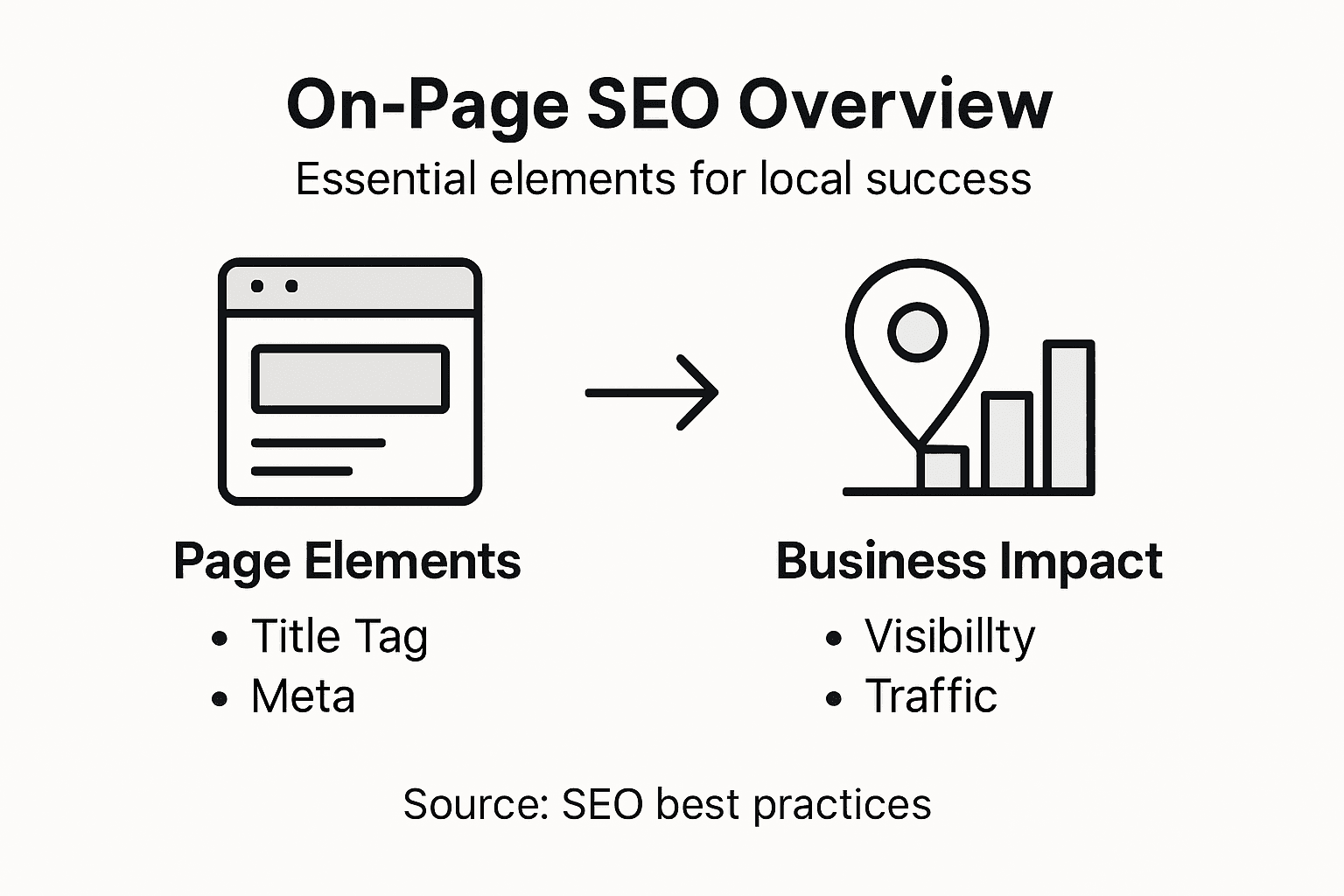
Below is a summary of key on-page SEO elements and their impact on local business websites:
| SEO Element | Purpose | Optimization Tip | Business Impact |
|---|---|---|---|
| Title Tag | Summarizes page topic | Use primary keyword early | Improves click-through rate |
| Meta Description | Attracts users in search results | Write enticing, keyword-rich text | Boosts visibility and engagement |
| Headers (H1/H2) | Organizes content for readers | Integrate keywords naturally | Enhances structure and SEO |
| Alt Text | Describes images for search engines | Relate description to target keywords | Increases image search traffic |
| URL Structure | Defines page address | Keep URLs concise and descriptive | Helps ranking and user recall |
Pro Tip: Run your optimized content through readability and SEO scoring tools to ensure you strike the perfect balance between search engine requirements and human comprehension.
Step 4: Incorporate valuable local references
Connecting your online content to your specific geographic area transforms generic marketing into a powerful local engagement strategy. Your goal is weaving authentic local context into every piece of digital content to attract nearby customers who are actively searching for services in their community.
Local SEO strategies require intentional integration of location-specific details that signal relevance to both search engines and potential customers. This means mentioning local landmarks, neighborhood names, regional events, and community highlights that demonstrate your genuine connection to the area. For instance, a plumber in Phoenix might reference specific desert communities or local home architectural styles unique to Arizona. Local search optimization techniques emphasize creating content that speaks directly to neighborhood concerns and regional characteristics. Include references to local challenges homeowners face such as specific climate issues, common infrastructure problems, or community development trends that impact your service area.
Think beyond just inserting location keywords. Share stories about local projects you have completed, highlight community involvement, and demonstrate your understanding of neighborhood specific needs. Your content should feel like it comes from a trusted local expert who understands the nuanced requirements of your specific market. This approach transforms generic service descriptions into compelling narratives that resonate with local customers searching for trustworthy professionals who truly understand their environment.
Pro Tip: Cross reference your local references with current community hashtags and local news to ensure your content remains fresh and immediately relevant.
Step 5: Verify results with SEO performance tools
Tracking your SEO efforts is not just about collecting data but understanding the story behind the numbers. Your mission is to transform raw performance metrics into actionable insights that continuously improve your digital marketing strategy.
SEO performance monitoring requires a systematic approach using robust analytics platforms. Google Analytics and Google Search Console are your primary reconnaissance tools for understanding how users discover and interact with your content. Look beyond surface level metrics like total visitors to dig into more nuanced data such as average time on page, bounce rates, and conversion paths. Web performance tracking becomes critical in identifying potential roadblocks that might prevent potential customers from engaging with your website. Pay special attention to page load times, mobile responsiveness, and user experience indicators that directly impact your search rankings.
Dont just collect data analyze it strategically. Compare your current performance against previous periods to identify trends and improvement opportunities. Set up custom dashboards that highlight key performance indicators most relevant to your business goals. Remember that SEO is an ongoing process of refinement where small incremental improvements can lead to significant long term gains in online visibility and customer acquisition.
Pro Tip: Schedule monthly performance reviews where you critically examine your analytics data and adjust your SEO strategy based on concrete evidence rather than assumptions.
Unlock Your Local SEO Potential with Expert Support
Struggling to master local SEO strategies like targeted keyword research, content structuring, and on-page optimization can hold your business back from reaching nearby customers ready to buy. This article covers crucial steps like matching search intent and incorporating local references but executing these can feel overwhelming if you lack time or expertise. If boosting local visibility and turning searches into sales is your goal you need tailored digital marketing solutions that get results quickly and efficiently.
At Ibrandmedia we specialize in helping small and medium-sized businesses overcome these exact challenges. Our comprehensive services include SEO optimization designed specifically for local markets, mobile-friendly web design, and real-time performance tracking to ensure every strategy moves the needle. Discover how you can enhance your online presence with hands-on support by exploring our Uncategorized category where we share insights and success stories. Don’t let complexity stall your growth. Take control now and partner with us to unlock a personalized plan that fits your unique business needs and budget. Visit Ibrandmedia today and start transforming your local reach into measurable success.
Frequently Asked Questions
How can I identify the right keywords for my local business?
To identify the right keywords, brainstorm terms that your customers might use when searching for your services. Use these keywords in your content, paying attention to local variations, and revise your selections based on their search volume and competition.
What is search intent, and why is it important for local SEO?
Search intent refers to the goal behind a user’s query, whether they want information, to make a purchase, or compare options. Understanding it helps you create content that meets user needs, such as focusing on instructional guides for informational searches or service pages for transactional intents.
How should I structure my content for better readability and SEO?
Structure your content using descriptive headings (H2 and H3 tags) and concise paragraphs, with each paragraph containing 3 to 4 sentences. Break down information into bulleted lists or numbered steps to improve scannability and keep readers engaged.
What on-page elements should I optimize for local SEO?
Focus on optimizing title tags, meta descriptions, headers, alt text for images, and URL structures. Ensure to include your primary keywords naturally within these elements to help improve visibility in search results.
How can local references enhance my SEO content?
Incorporate local references, such as specific neighborhoods, landmarks, or community events related to your services. By doing this, you create a connection with your audience and increase your relevance in local search results.
How often should I evaluate my SEO performance?
You should evaluate your SEO performance at least once a month to analyze key metrics like traffic, bounce rates, and user engagement. Use this data to adjust your strategy and improve your local visibility over time.
Recommended
- Top SEO Techniques for Small Business Owners in 2025 | Ibrandmedia
- Understanding the Benefits of Local SEO for Small Businesses | Ibrandmedia
- How to Get Found Online: Boost Your Local Business Fast | Ibrandmedia
- Understanding Local SEO Ranking Factors for Businesses | Ibrandmedia
- Complete Guide to User Intent in Content Strategy
Recent Comments