
TL;DR:
- Local search intent is the user’s goal to find nearby products or services that prompt quick action. Optimizing Google Business Profiles, reviews, localized pages, and data consistency enhances local rankings and visibility. AI-driven signals now prioritize clear, accurate, and active local data for better business recommendations.
Local search intent is defined as a user’s goal to find a relevant product, service, or location within a specific geographic area. With 46% of all Google searches carrying local intent, ignoring this concept costs small businesses real foot traffic and real revenue. The standard industry term is “local search intent,” and it sits at the foundation of every effective local SEO strategy. Google’s algorithm reads geographic signals, behavioral cues, and business profile data to decide which businesses appear in the Local Pack. This article covers how search engines interpret those signals, what ranking factors matter most, and what you can do right now to show up when nearby customers are ready to buy.
What is local search intent explained in simple terms?
Local search intent is the reason behind a geographically specific search. When someone types “emergency plumber near me” or “best tacos in Austin,” they are not browsing. They are ready to act. That distinction separates local search from general informational search, and it changes everything about how you should approach understanding local search for your business.

The importance of local search cannot be overstated for brick-and-mortar and service-area businesses. A user searching “coffee shop downtown Chicago” has a clear, immediate need. Google’s job is to match that need with the most relevant, nearby, and trusted business. Your job is to make sure that business is yours.
What are the main types of local search intent small businesses should know?
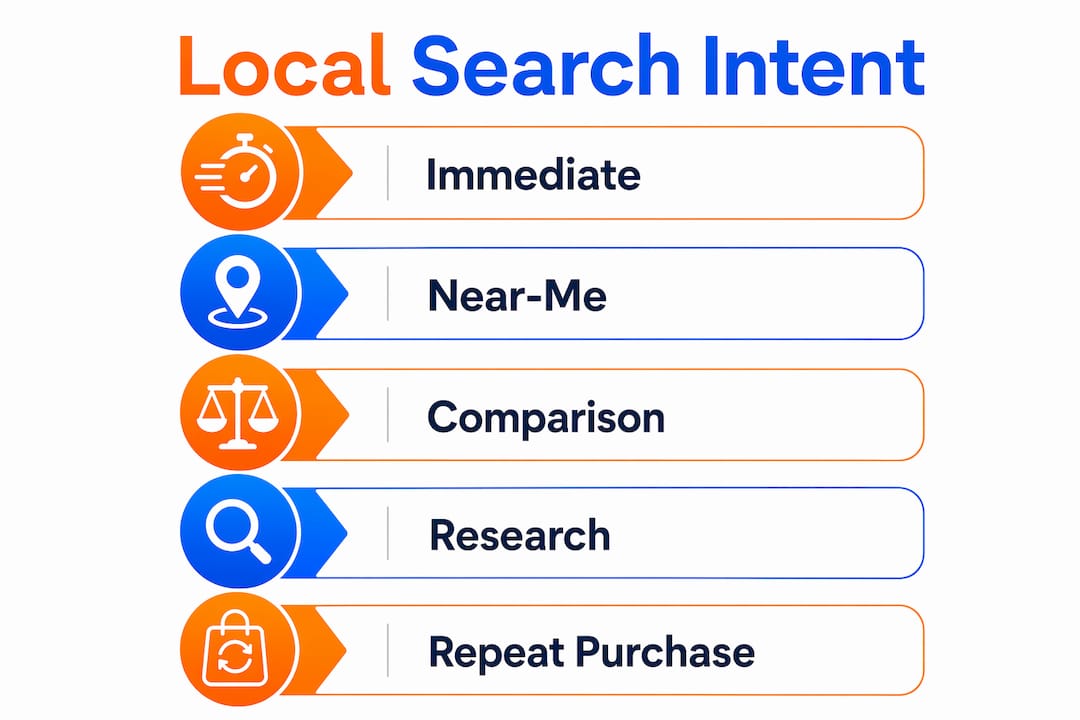
Local search intent includes five distinct types, each reflecting a different stage of customer readiness. Recognizing these types helps you build the right content and target the right keywords.
- Near-me intent: The user wants the closest option right now. Example: “dentist near me.” These searches demand a strong Google Business Profile and accurate location data.
- City-based intent: The user targets a specific city or neighborhood. Example: “web designer in Nashville.” Localized landing pages perform best here.
- Emergency intent: The user needs help immediately. Example: “24-hour locksmith Houston.” Speed, availability, and clear contact information are critical.
- Comparison intent: The user is evaluating options before deciding. Example: “best pizza in Winnipeg.” Reviews, photos, and menu detail drive conversions.
- Visit intent: The user plans a future trip. Example: “farmers market Saturday Portland.” Event posts and updated hours matter most for this type.
Each intent type signals a different level of urgency. Near-me and emergency searches convert fastest. Comparison searches take longer but often result in higher-value customers. Matching your content to the right intent type is one of the most underused elements of local search queries.
Pro Tip: Create a separate page or Google Business Profile post for each intent type your business serves. A plumber can have one page for “emergency plumbing” and another for “bathroom remodel estimates” to capture both urgent and planned searches.
How do search engines determine local search intent and rank local businesses?
Google ranks local results using three core factors: relevance, distance, and prominence. These are not equal in weight, and understanding the breakdown helps you prioritize your time and budget.
Google Business Profile signals carry a 32% weighting in local rankings. That makes your profile the single most powerful lever you control. On-page SEO contributes 19%, review signals 16%, and citation signals 7%. The remaining weight comes from behavioral signals and link authority.
| Ranking factor | Approximate weight |
|---|---|
| Google Business Profile signals | 32% |
| On-page SEO | 19% |
| Review signals | 16% |
| Link signals | 11% |
| Behavioral signals | 10% |
| Citation signals | 7% |
| Other factors | 5% |
Behavioral signals like clicks to call and direction requests feed directly into Google’s Local Pack algorithm. A business that gets more calls and map clicks than its competitors sends a strong trust signal, even without more reviews or backlinks. This is why a fully filled-out profile with a clear phone number and address matters beyond just aesthetics.
Google also functions as a real-world discovery engine, using distance, relevance, and prominence together to serve results dynamically. The algorithm adjusts rankings based on the user’s device, exact location at the time of search, and the specific query type. A search made from a phone two blocks away from your shop will produce different results than the same search made from a desktop across town.
Pro Tip: Log into your Google Business Profile Insights weekly. Track which queries trigger your listing, how many direction requests you receive, and whether call volume changes after you add new photos or posts. These numbers tell you what is working before you spend money on ads.
What practical steps can small businesses take to optimize for local search intent?
Optimizing for local intent starts with your Google Business Profile. Google treats a fully optimized profile as a free storefront, and incomplete profiles are one of the top reasons businesses lose Local Pack positions. Treat your profile like a live website, not a one-time setup.
Here is a practical checklist for getting the fundamentals right:
- Use your real business name. Keyword stuffing in your business name triggers profile suspensions. “Joe’s Plumbing” is compliant. “Joe’s Plumbing Best Emergency Plumber Chicago” is not.
- Select accurate primary and secondary categories. Your primary category is the strongest relevance signal in your profile. Choose the most specific category that describes your core service.
- Add a complete service menu. List every service with a description. Google uses this text to match your profile to relevant queries.
- Upload fresh photos regularly. Profiles with recent, high-quality photos receive more clicks. Aim for at least four new photos per month.
- Post weekly updates. Google Posts keep your profile active and give you a second chance to appear for event-based and comparison searches.
- Maintain NAP consistency. Your Name, Address, and Phone number must match exactly across your website, Google Business Profile, Yelp, Apple Maps, and every local directory. Even small variations confuse Google’s matching algorithm.
Beyond your profile, localized landing pages improve relevance and extend your visibility beyond your physical address. A cleaning company serving three suburbs should have three separate pages, each with neighborhood-specific content, local landmarks, and service details. This technique directly influences how Google measures proximity for service-area businesses.
Review management is equally critical. 87% of consumers read reviews before visiting a local business, and having 150 or more reviews per location improves both Local Pack rankings and AI-generated recommendations. Ask every satisfied customer for a review. Respond to every review, positive or negative. Review velocity, meaning how frequently new reviews arrive, matters as much as total count.
Mobile optimization ties everything together. Most local searches happen on phones, and a slow or hard-to-navigate mobile site kills conversions even after you win the click. Your site needs a tap-to-call button, a visible address, and a load time under three seconds. These are not optional extras. They are the baseline for how to optimize for local intent in 2026.
Pro Tip: Build a simple review request system. After every completed job or sale, send a text or email with a direct link to your Google review page. Businesses that systematize review requests consistently outpace competitors who rely on customers to find the review link on their own.
How does AI impact local search intent and what should businesses watch?
AI has changed how Google surfaces local businesses. The concept of AI triangulation describes how search engines now pull signals from multiple platforms, including your Google Business Profile, your website, third-party directories, and social media, to build a confidence score around your business entity. The stronger and more consistent your data across all platforms, the more likely AI systems are to recommend you.
Google’s AI uses consistent NAP data, active profiles, reviews, and local content to generate AI Overviews and conversational search results. Businesses with weak or inconsistent local data simply do not appear in these results, regardless of how long they have been in business. AI does not give credit for history. It gives credit for clarity.
“Businesses with stronger local SEO foundations get named in AI-driven local results such as recommendations by ChatGPT and Google Gemini. Entity clarity, meaning consistent and accurate business data across the web, is the new currency of local search visibility.”
Emerging trends worth watching include wearable tech and indoor proximity signals. As smartwatches and AR glasses become more common, hyper-local search queries will become even more specific. A user walking past your block may receive a recommendation before they even think to search. Businesses that maintain clean, complete, and consistent local data now will be positioned to capture these future touchpoints.
To future-proof your local SEO strategies, focus on three things: keep all business data consistent across every platform, build a steady stream of genuine reviews, and create content that answers specific local questions your customers actually ask. These three habits compound over time and become harder for competitors to replicate.
Key Takeaways
Businesses that align their content, profiles, and data with specific local search intent types consistently outrank competitors who treat local SEO as a one-time setup task.
| Point | Details |
|---|---|
| Local intent drives real decisions | 46% of Google searches carry local intent, meaning nearby customers are actively looking for businesses like yours. |
| GBP is your top ranking lever | Google Business Profile signals carry a 32% weighting in local rankings, making profile completeness non-negotiable. |
| Reviews build ranking and trust | 87% of consumers read reviews before visiting; 150+ reviews per location improves both AI and Local Pack visibility. |
| Localized pages extend your reach | Dedicated neighborhood landing pages improve relevance and help service-area businesses rank beyond their physical address. |
| AI rewards consistent data | AI triangulation means clean, consistent business data across all platforms directly determines whether AI tools recommend you. |
Why most small businesses get local SEO backwards
Most small business owners I work with spend their first local SEO budget on ads before fixing the foundation. That is the wrong order. A Google ad sends traffic to a profile or website that has no reviews, inconsistent NAP data, and a phone number buried at the bottom of the page. The ad spend is wasted.
The businesses that win local search are not always the biggest or the oldest. They are the most consistent. They update their Google Business Profile every week. They respond to every review within 24 hours. They have a landing page for every city they serve. These are not expensive tactics. They require discipline, not budget.
The other mistake I see constantly is treating prominence as the only factor that matters. Business owners obsess over getting more backlinks while ignoring the fact that their address is listed differently on three different directories. Proximity and relevance are just as powerful as prominence, and they are far easier to control. Fix your NAP consistency first. Build localized pages second. Then pursue reviews and links. That sequence works.
One more warning: never add keywords to your Google Business Profile name. I have seen businesses lose their entire Local Pack presence overnight because of this. The risk is not worth any short-term ranking gain. Use your real registered business name, every time, on every platform.
— TONY
How Ibrand helps small businesses rank for local search
Small businesses that understand local search intent still need the right execution to turn that knowledge into rankings and revenue. Ibrand specializes in exactly that. From Google Business Profile management and NAP consistency audits to localized landing page creation and review strategy, Ibrand builds the local SEO foundation that gets businesses found by nearby customers.
Ibrand’s local SEO services for small businesses are built around the ranking factors that matter most in 2026, including profile optimization, behavioral signal improvement, and AI-ready entity clarity. Whether you are starting from scratch or fixing a profile that has stalled, Ibrand creates a plan specific to your market and your goals. You can also explore Ibrand’s website optimization guide to see how on-page SEO and local intent work together to drive more qualified traffic to your door.
FAQ
What is local search intent?
Local search intent is the user’s goal to find a product, service, or location within a specific geographic area. It is the driving force behind searches like “plumber near me” or “best coffee shop in Denver.”
Why does local search intent matter for small businesses?
46% of all Google searches carry local intent, meaning a large share of potential customers are actively searching for nearby businesses. Appearing in those results directly drives foot traffic and leads.
What are the key elements of local search queries?
The key elements are a service or product term, a geographic modifier (city, neighborhood, or “near me”), and an implied urgency or intent level. These three elements together tell Google exactly what type of business to surface.
How do I optimize my Google Business Profile for local intent?
Use your real business name, select the most accurate primary category, add a complete service menu, upload fresh photos monthly, and post weekly updates. Profile completeness is the single strongest signal you control.
How does AI affect local search rankings?
Google’s AI uses consistent NAP data, active profiles, reviews, and local content to generate recommendations and AI Overviews. Businesses with clean, consistent data across all platforms are far more likely to appear in AI-driven local results.
Recent Comments