
TL;DR:
- Building a personal brand involves creating a credible professional identity focused on a specific audience. Consistent content, digital credibility, and real-world authority over months generate long-term recognition and trust. Clarifying positioning and owning a narrow target area are essential for sustainable branding success.
Personal branding for entrepreneurs is the deliberate creation and management of a unique professional identity that drives trust, visibility, and business growth. The term “personal brand” is the recognized industry standard for this practice. It is not about self-promotion or chasing fame. It is about positioning yourself as the clearest, most credible solution to a specific problem your audience faces. 92% of people trust individuals over corporate brands. That single fact explains why your personal brand is often your most powerful business asset.
What foundational elements define a strong personal brand for entrepreneurs?
Personal branding is fundamentally about owning a specific territory through a consistent intellectual lens, not just a polished headshot or a catchy tagline. The entrepreneurs who build recognizable brands do one thing consistently: they return to the same core ideas, the same audience, and the same problems over time. Recognition builds through repetition, not novelty.
A strong entrepreneurial brand rests on five clear elements:
- Positioning clarity. Define exactly who you serve, what problem you solve, and why you are the right person to solve it. Vague positioning attracts no one.
- A brand statement. Write one sentence that communicates your value. “I help [specific audience] achieve [specific outcome] by [your unique method]” is a proven structure.
- Authenticity. Your personal experience and perspective are your differentiators. Delegating your core strategic claims to a ghostwriter or agency risks diluting the trust you are trying to build.
- A consistent intellectual lens. Every piece of content, every talk, every post should reflect your specific point of view on your industry. This is what makes you memorable.
- Audience specificity. Successful personal branding narrows focus to a specific audience and belief. Broad appeal is the enemy of a strong brand.
Pro Tip: Write your brand statement before you publish a single piece of content. Every post, article, or talk you create should pass one test: does this reinforce my positioning?
Early-stage entrepreneurs should prioritize positioning clarity and a messaging framework before investing in full brand systems. Skipping this step leads to expensive rebrands six months later.

Which content and visibility strategies build a personal brand in 2026?
Consistent content is the engine of a personal brand. Without it, even the sharpest positioning stays invisible. The minimum viable cadence is one LinkedIn post per week, one long-form article per month, and one visibility event per quarter. That combination builds a compounding search and authority footprint over time.
The three pillars that work together are organic content, digital credibility, and real-world authority. Managing all three together creates a self-reinforcing flywheel. Treating them as separate tasks, handled by separate vendors, breaks the compounding effect.
Organic content formats that perform
- Short videos. LinkedIn and YouTube Shorts reward authentic, direct-to-camera expertise. A two-minute video answering one specific question outperforms a polished brand film every time.
- LinkedIn articles. Long-form posts on LinkedIn rank in Google search results. They build both platform authority and organic search visibility simultaneously.
- Email newsletters. A newsletter moves your audience off a rented platform and onto a list you own. It is the highest-trust content format available to entrepreneurs today.
- Podcast appearances. Guest spots on established podcasts deliver third-party credibility and introduce you to pre-qualified audiences you could not reach alone.
Digital credibility: the layer most entrepreneurs skip
Digital credibility includes a personal website with schema markup, author pages on major publications, press coverage, verified directory listings, and AI search optimization. This layer ensures that when a prospect searches your name before a sales call, they find proof rather than silence. Trust-building requires visible, searchable proof before prospects have their first interaction with you.
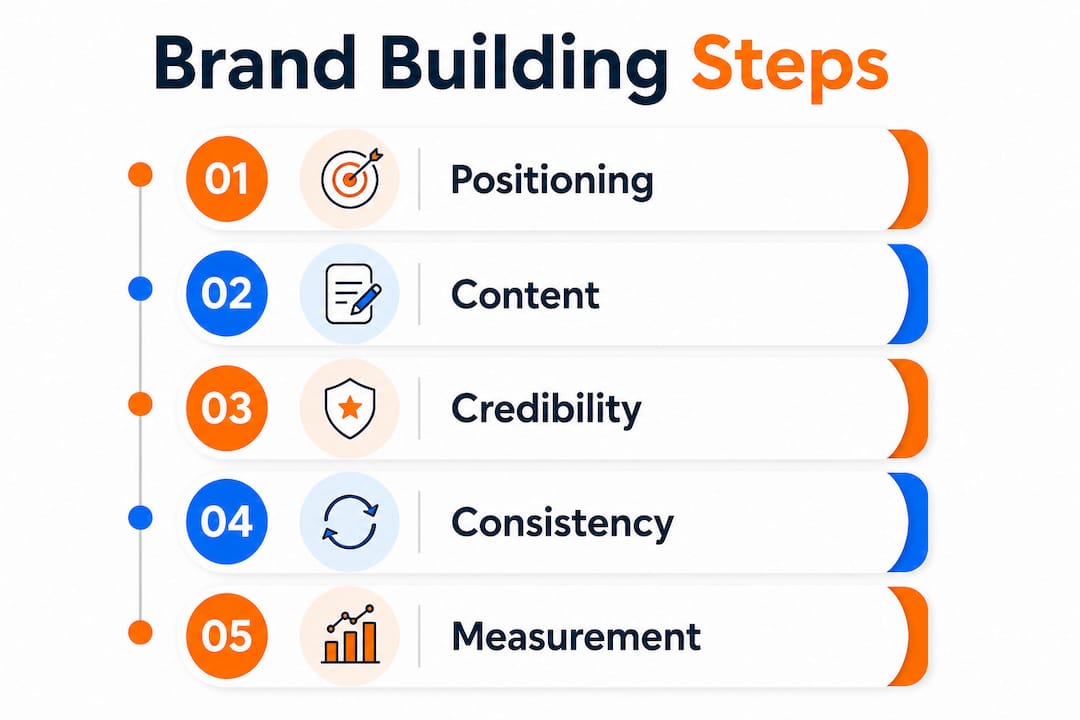
Real-world authority accelerates everything. Speaking engagements, press mentions, and brand partnerships signal credibility to both humans and search algorithms. One well-placed press mention can do more for your brand than thirty social posts.
Pro Tip: Set up a Google Alert for your name and your core topic. When you get mentioned, amplify it across every channel you own. Third-party citations are the most credible content you will ever have.
What tools and time commitment does personal branding actually require?
Building a personal brand requires at least 90 minutes of raw content creation per week. That is the minimum to maintain momentum. Most entrepreneurs underestimate this number and then wonder why their brand is not gaining traction.
The tools you need fall into three categories:
- Content planning. A simple editorial calendar in Notion or Google Sheets works. The goal is to plan topics two weeks ahead so you are never starting from a blank page.
- Scheduling and distribution. Tools like Buffer or native platform schedulers let you batch-create content and publish consistently without daily effort.
- Engagement tracking. Monitor LinkedIn analytics, website traffic via Google Analytics 4, and newsletter open rates weekly. These numbers tell you what resonates before you invest more time in a format.
A proof bank is one of the most underused tools in personal branding. Collect raw material from your daily work: sales call recordings, customer feedback, questions from your inbox, and observations from client projects. This raw material becomes the foundation of authentic content and dramatically reduces the burden of creation.
Burnout is the most common reason entrepreneurs quit their brand-building efforts before results appear. Set one achievable weekly goal, not five. Publish one strong post rather than three mediocre ones. Pacing matters more than volume, especially in the first six months.
Pro Tip: Block 90 minutes every Tuesday morning for content creation. Treat it as a client meeting you cannot cancel. Consistency in scheduling produces consistency in output.
For practical guidance on content strategy for small businesses, Ibrand has published a detailed breakdown of how to plan and distribute brand-building content without a large team.
How do you measure and refine your personal branding strategy?
Foundational brand setup takes 1–2 weeks, but measurable business impact typically arrives within 3–6 months of consistent weekly effort. That timeline surprises most entrepreneurs who expect faster results. Understanding it prevents early abandonment.
The KPIs that actually matter for a personal brand are:
- Inbound lead quality. Are the people reaching out already pre-sold on your expertise? That is the clearest signal your brand is working.
- Search visibility. Does your name appear in Google results for your core topic? Track this monthly.
- Third-party citations. Are other publications, podcasts, or speakers referencing your ideas? This signals authority, not just awareness.
- Speaker and partnership invitations. Inbound invitations to speak or collaborate mean your positioning has reached the right people.
Common pitfalls derail even well-intentioned branding efforts. Separating content, credibility, and authority into siloed vendors is the most expensive mistake founders make. Each pillar feeds the others. When they are managed separately, the compounding effect disappears.
Conduct a brand audit every 90 days. Review your top-performing content, check your search visibility for your name and core topic, and ask three recent clients how they describe what you do. Their language is often sharper than yours.
Founder-led brands deliver substantially better outcomes than non-founder-led peers. That result comes from years of consistent positioning, not from a single campaign. Personal brands compound slowly and most recognizable brands are built through years of repeated messaging refinement. Patience is not optional. It is the strategy.
The personal brand and company brand should be managed as complementary assets. Your personal brand opens doors. Your company brand closes deals. Keeping them aligned, without making one dependent on the other, gives your business long-term resilience.
For a practical framework on building brand awareness as a small business owner, Ibrand’s resource library covers the specific tactics that work at the early and growth stages.
Key Takeaways
A strong personal brand is built on clear positioning, consistent content, and layered digital credibility maintained over a minimum of 3–6 months of weekly effort.
| Point | Details |
|---|---|
| Positioning before content | Define your audience, problem, and unique method before publishing anything. |
| Minimum viable cadence | Publish at least one LinkedIn post per week and one long-form piece per month. |
| Three-pillar approach | Organic content, digital credibility, and real-world authority must be managed together to compound results. |
| Time commitment | Budget at least 90 minutes of content creation per week to maintain momentum. |
| Measure what matters | Track inbound lead quality, search visibility, and third-party citations every 90 days. |
Why most entrepreneurs get personal branding backwards
Most founders I work with start by asking the wrong question. They ask, “What should I post?” when the real question is, “What do I want to be known for?” Those are not the same question, and confusing them wastes months of effort.
The conventional advice says to show up everywhere, post daily, and build a following. That advice optimizes for vanity metrics. What actually builds a business is owning a specific, narrow territory so clearly that the right people immediately recognize you as the answer to their problem. Frequency without positioning is just noise.
The other mistake I see constantly is treating personal branding as a marketing task rather than a founder responsibility. Founder ownership of messaging is not optional. When you delegate your strategic claims entirely, you lose the authenticity that makes people trust you over a faceless company. A ghostwriter can polish your words. Only you can supply the conviction behind them.
The entrepreneurs who build durable brands do something counterintuitive: they get more specific over time, not less. They resist the temptation to pivot toward trending topics. Long-term consistency and positioning depth create durable personal brands. Frequent pivoting undermines recognition, full stop.
My honest advice: commit to a 12-month horizon before you judge results. Build your proof bank, publish consistently, and invest in digital credibility from month one. The flywheel feels slow at first. Then it does not.
— TONY
How Ibrand helps entrepreneurs build lasting digital visibility
Entrepreneurs who have the positioning right still need the technical infrastructure to make their brand discoverable. A personal website without proper SEO, a LinkedIn profile without schema support, and social content without a distribution plan all leave visibility on the table.
Ibrand works with small and medium-sized businesses to build the digital foundation that makes personal branding efforts pay off. From website search optimization to social media management and real-time performance tracking, Ibrand’s services are built for entrepreneurs who want measurable growth without a large in-house team. Every plan is tailored to your business goals, with transparent pricing and a focus on results you can see. If you are ready to make your brand visible where it counts, Ibrand is the partner to get you there.
FAQ
What is personal branding for entrepreneurs?
Personal branding for entrepreneurs is the deliberate practice of building a unique professional identity that communicates your expertise, values, and value proposition to a specific audience. It drives trust, inbound leads, and business growth over time.
How long does it take to see results from personal branding?
The foundational setup takes 1–2 weeks, but measurable business impact typically follows within 3–6 months of consistent weekly effort. Sustainable results require a 12-month commitment, not short-term content bursts.
How much time should an entrepreneur spend on personal branding each week?
A minimum of 90 minutes of raw content creation per week is the recommended baseline. That time covers writing, recording, and engaging with your audience across your primary platform.
What are the biggest mistakes entrepreneurs make with personal branding?
The two most common mistakes are starting with tactics before defining positioning, and separating content, credibility, and authority into siloed vendors. Both break the compounding effect that makes personal branding work.
Does a personal brand help business performance?
Founder-led brands deliver substantially better operational and financial outcomes compared to non-founder-led peers. The mechanism is trust: a visible, credible founder transfers confidence to the company brand and accelerates the sales process.
Recent Comments