
TL;DR:
- Effective web content requires understanding your audience and structuring information for quick scanning and search engine optimization. Regular updates, clear messaging, and strategic keyword placement enhance both readability and search rankings. Focusing narrowly on specific topics and maintaining consistency builds trust and achieves better engagement.
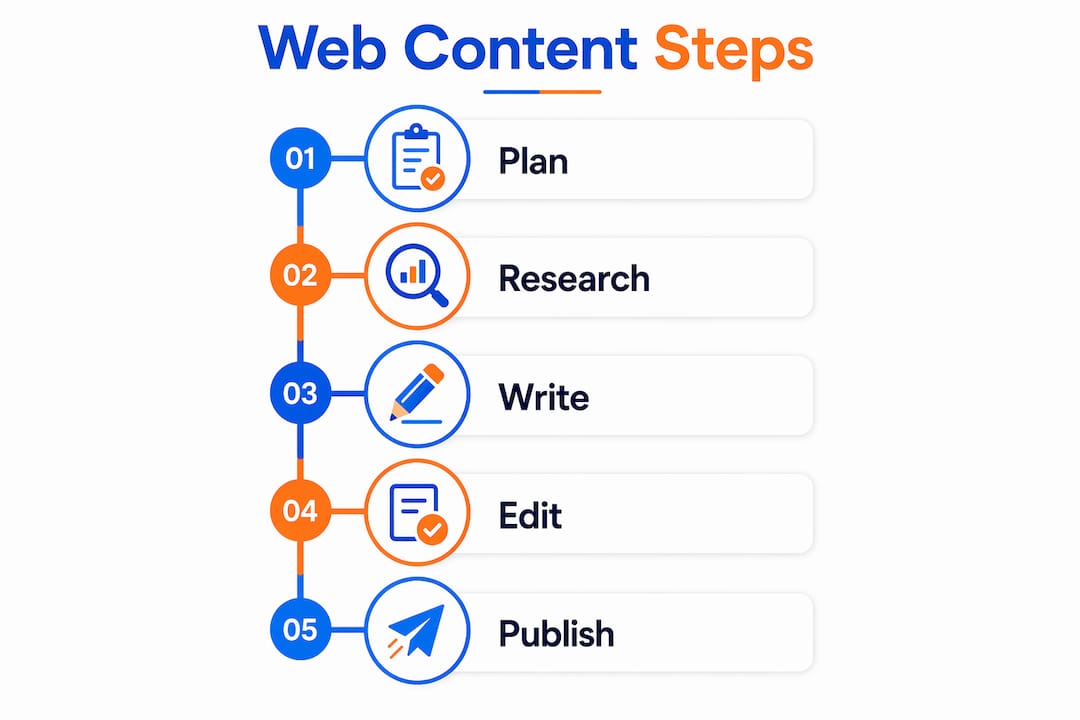
Web content is any text, image, or media published on a website to inform, engage, or convert visitors. Knowing how to write web content that actually works is the difference between a page that ranks and one that sits unread. Effective web copywriting means writing for two audiences at once: real people who scan quickly and search engines like Google that reward clarity and structure. Tools like Grammarly for editing and Semrush for keyword research make the process faster and more precise. This guide walks you through every step, from planning to publishing, so your content earns attention and drives results.
What do you need before writing web content?
Preparation is the step most small business owners skip, and it is the reason their content fails. Before you write a single sentence, you need to know who you are writing for, what they want, and what words they use to find it.

Know your reader first
The most common mistake in web writing is creating content for the organization rather than the user. A content brief that defines your reader persona, the problem you solve, and the action you want them to take keeps every paragraph focused. HubSpot confirms that content briefs prevent disconnected narratives that fail to convert. Write one sentence before you start: “I am writing for [person] who wants [outcome] and needs to [action].” That sentence is your compass.
Research keywords before you write
Keyword research is not optional. Long-tail keywords — phrases of three or more words that match exact user intent — account for 70% of all search traffic. That number means most of your potential visitors are searching for specific phrases, not broad terms. Use Semrush or Google Search Console to find those phrases before you write.
Here is a quick preparation checklist:
- Define your reader persona with one clear sentence covering their problem and goal
- Build a content brief using a template from HubSpot or your own content strategy framework
- Research 3–5 long-tail keywords per page using Semrush or Ubersuggest
- Review competitor pages to find gaps your content can fill
- Set up a simple content calendar in Google Sheets or Notion to track publishing
Recommended preparation tools
| Tool | Best For | Cost |
|---|---|---|
| Semrush | Keyword research and competitor gap analysis | Paid (free trial available) |
| Google Search Console | Tracking real search queries to your site | Free |
| Grammarly | Editing for clarity and grammar | Free and paid tiers |
| Notion or Google Sheets | Content calendar and brief management | Free |
Pro Tip: Before researching keywords, type your topic into Google and read the “People Also Ask” section. Those questions are real user intent signals and make excellent H2 headings.
How do you structure web content people actually read?
Structure is not a design decision. It is a writing decision. Web readers do not read top to bottom. They scan, jump, and leave fast. Users spend only 54 seconds on a page before deciding whether to stay. That means your most important message must appear before the first scroll.
Put the answer first
Lead every page with your core claim or offer. Do not warm up with background history or a welcome paragraph. If you run a plumbing business, your homepage should open with “We fix leaks and unclog drains in Austin, same day.” That is a claim. That is what a reader needs in 54 seconds.
Calls to action belong near the top, not just at the bottom. Research on converting calls to action shows that placing them early increases click rates significantly. Do not make visitors scroll to find out what to do next.
Write for scanning, not reading
Short paragraphs and descriptive headings improve reader comprehension and engagement. The UKRI writing guidelines recommend keeping paragraphs to 2–3 sentences and sentences to an average of 15–20 words. That length keeps ideas clear without losing the reader mid-sentence.
Apply these formatting rules to every page you write:
- Use H2 and H3 headings that answer real questions, not vague labels like “Our Services”
- Keep paragraphs to 2–3 sentences maximum
- Use bullet points for lists of three or more items
- Write in active voice: “We build websites” not “Websites are built by us”
- Avoid jargon. If a 10th grader would not recognize the term, replace it
- Cut filler phrases like “it is important to note” and “in order to”
Pro Tip: Read your draft out loud. If you stumble or run out of breath, the sentence is too long. Cut it in half.
What are the SEO best practices for web content?
SEO and readability are not opposites. The best web content satisfies both at once. Search engines like Google rank pages that answer user questions clearly, use structured data, and load fast. Your job is to write for the reader first, then apply SEO mechanics on top.
How to apply keywords without stuffing
Place your primary keyword in the first 100 words, in at least one H2 heading, and in the meta title. SEO best practices also call for clean, short URLs that include the keyword and schema markup to generate rich snippets in search results. Schema markup sounds technical, but most WordPress plugins like Yoast SEO or Rank Math handle it automatically.
Here is a step-by-step SEO checklist for each page:
- Place the primary keyword in the first sentence or paragraph
- Write a meta title under 60 characters that includes the keyword
- Write a meta description under 160 characters that summarizes the page’s value
- Keep URLs short: use
/web-content-tipsnot/how-to-write-web-content-for-small-businesses-in-2026 - Add 2–3 long-tail keyword variants naturally throughout the body
- Apply FAQ schema if your page includes a question-and-answer section
- Link to 2–3 related internal pages to build topical authority
SEO approach: broad vs. specific keywords
| Keyword Type | Example | Search Volume | Competition |
|---|---|---|---|
| Broad keyword | “web content” | Very high | Very high |
| Mid-tail keyword | “how to write website content” | Medium | Medium |
| Long-tail keyword | “how to write web content for small businesses” | Lower | Low |
| Question keyword | “what is web content writing” | Low | Very low |
Long-tail and question keywords convert better because the searcher already knows what they want. Targeting “how to write web content for a plumbing business” will bring fewer visitors than “web content,” but those visitors are far more likely to contact you.
How do you edit and maintain web content over time?
Publishing is not the finish line. Web content decays. Search rankings drop when content goes stale, and readers lose trust when they find outdated prices, broken links, or old statistics. A maintenance habit is as important as the writing itself.
Edit for clarity before you publish
Run every draft through Grammarly to catch grammar errors and passive voice. Then read it yourself with one question in mind: “Does every sentence earn its place?” Cut anything that repeats a point already made. Remove phrases like “as mentioned above” or “it goes without saying.” Those phrases signal padding, and readers notice.
Maintain a consistent brand voice across every page using a style guide. Shopify’s content writing research confirms that a shared style guide builds trust, especially when multiple people contribute to a website. Your style guide does not need to be long. A one-page document covering tone, preferred vocabulary, and formatting rules is enough to keep everything aligned. You can learn more about why this matters in Ibrand’s guide on brand voice consistency.
Build a content refresh schedule
- Every 3 months: Check your top 5 pages in Google Search Console for ranking drops
- Every 6 months: Update statistics, examples, and any time-sensitive references
- Annually: Rewrite pages that have dropped more than 10 positions in search rankings
- Ongoing: Fix broken links as soon as they appear using a tool like Screaming Frog or Ahrefs
Pro Tip: Set a recurring calendar reminder titled “Content Audit” every quarter. Treat it like a bill payment. Skipping it costs you rankings and credibility.
Avoiding common online marketing mistakes like neglecting content updates is one of the fastest ways to protect the SEO value you have already built.
Key takeaways
Effective web content writing combines audience focus, clear structure, strategic SEO, and consistent maintenance to build trust and drive measurable results.
| Point | Details |
|---|---|
| Start with a content brief | Define your reader persona and goal before writing a single sentence. |
| Lead with your key message | Place your core claim and call to action before the first scroll. |
| Use long-tail keywords | Target specific phrases that match user intent to capture 70% of search traffic. |
| Format for scanning | Keep paragraphs to 2–3 sentences and use descriptive headings throughout. |
| Refresh content regularly | Audit your top pages every quarter to maintain rankings and reader trust. |
What writing web content taught me the hard way
The biggest mistake I see small business owners make is writing for everyone. A homepage that tries to speak to every possible customer ends up connecting with none of them. The most effective pages I have ever written were built around one specific reader with one specific problem.
Writing conversationally means writing as if you are talking to one person across a table, not broadcasting to a crowd. When I shifted from formal prose to direct, plain sentences, engagement went up and bounce rates dropped. The change was not about dumbing content down. It was about respecting the reader’s time.
The second lesson took longer to learn: clarity upfront is not just good for users. It is good for SEO. Google rewards pages that answer the question fast. If your most important point is buried in paragraph four, you are losing both the reader and the ranking. Put your answer in sentence one. Expand from there.
The third lesson is about scope. Most first drafts try to cover too much. One page, one topic, one call to action. That constraint feels limiting until you see how much better the focused version performs. Narrow your scope, deepen your answer, and your content will outperform broader pages every time.
— TONY
Ready to put your web content strategy to work?
Writing great content is only half the equation. Getting it found by the right people requires a solid SEO foundation built specifically for your website.

Ibrand helps small businesses and solo entrepreneurs build that foundation without the guesswork. From optimizing your website for search to structuring content that ranks and converts, Ibrand’s team handles the technical side so you can focus on running your business. Whether you are starting from scratch or improving what you already have, Ibrand offers a personalized plan built around your goals and budget. Explore Ibrand’s SEO for small businesses guide to see exactly what is possible.
FAQ
What is web content writing?
Web content writing is the practice of creating text for websites that informs, engages, and guides visitors toward a specific action. It combines clear language, audience focus, and SEO structure to serve both readers and search engines.
How long should web content be?
Page length depends on the topic and user intent. Most service pages perform well at 500–800 words, while blog articles and guides typically need 1,500–2,500 words to rank competitively in search results.
How do i choose keywords for my web content?
Use tools like Semrush or Google Search Console to find long-tail keywords that match your reader’s exact search intent. Long-tail phrases account for 70% of search traffic and face lower competition than broad terms.
How often should i update my web content?
Audit your top pages every 3 months using Google Search Console. Update statistics, examples, and calls to action every 6 months to maintain search rankings and reader trust.
What makes web content easy to read?
Short paragraphs of 2–3 sentences, descriptive headings, bullet points, and active voice all improve readability. Aim for an average sentence length of 15–20 words and cut any phrase that does not add meaning.
Recent Comments