
TL;DR:
- Most small business owners mistakenly believe a visually attractive website guarantees high conversion rates, but user experience (UX) is the real driver of success. Improving UX elements like page speed, mobile responsiveness, and clear calls-to-action significantly boosts conversions, SEO, and overall marketing ROI. Focusing on continuous, data-driven UX optimization provides a sustainable competitive edge over trendy ad strategies.
Most small business owners assume that a good-looking website automatically means good results. That assumption is costing them real money. User experience (UX) — how intuitive, fast, and satisfying your website feels to a visitor — is the actual driver behind whether someone buys or bounces. While median landing page conversion rates sit around 6.6%, the top 10% of pages convert at 11.5% or higher, and UX is the primary separator between those two groups. This guide explains exactly how UX connects to your digital marketing results and what you can do about it today.
Table of Contents
- What is UX and why is it vital to digital marketing?
- How UX impacts conversions, sales, and SEO
- Essential UX strategies for winning digital marketing
- CRO meets UX: Maximizing ROI through ongoing optimization
- A fresh perspective: Why most small businesses still miss UX’s full revenue potential
- Next steps: Supercharge your digital marketing with proven UX solutions
- Frequently asked questions
Key Takeaways
| Point | Details |
|---|---|
| UX drives conversions | Improving UX can double or even triple your website’s conversion rates. |
| Mobile UX is critical | More than 80 percent of SMB web traffic comes from mobile, so mobile-first design is a must. |
| CRO and UX go together | Ongoing user experience testing and optimization maximize all your digital marketing investments. |
| Benchmarks guide action | Comparing and measuring your UX against industry leaders reveals quick wins. |
| Human-centric wins trust | Focusing on real people over automation builds lasting trust and revenue growth. |
What is UX and why is it vital to digital marketing?
User experience is the total impression a visitor gets when they interact with your website or any digital platform you run. It covers every moment: how fast the page loads, whether they can find what they came for, whether your buttons are clear, and whether the whole journey feels smooth or frustrating.
Many business owners conflate UX with visual design. A beautiful site with confusing navigation is still a bad experience. A plain site that loads in under two seconds, answers the visitor’s question immediately, and makes it dead simple to contact you is outstanding UX. Knowing why UX matters for small business starts with accepting that design is only one layer of the experience.
Here is what UX actually covers in a digital marketing context:
- Page speed: Visitors abandon pages that take more than three seconds to load.
- Mobile friendliness: Your site must display and function perfectly on every screen size.
- Navigation clarity: Users should never have to guess where to click next.
- Content relevance: Pages must match what the visitor was searching for or expecting from your ad.
- Call-to-action (CTA) clarity: Every page should have one obvious next step.
- Form simplicity: Shorter forms with fewer fields convert at dramatically higher rates.
- Accessibility: Text that is readable, contrast that works, and touch targets that are easy to tap.
Google is explicit about this connection. Its official guidelines state:
“Landing pages must match the message in your ads, be easy to navigate, mobile-friendly, and contain unique, valuable content with clear calls-to-action.”
That quote comes directly from Google Ads landing page guidelines. Translation: if your UX is weak, you pay more per click and rank lower in search. Google uses UX signals as a direct input into both ad quality scores and organic rankings. For SMBs with tight marketing budgets, that makes UX not a luxury but a necessity.
How UX impacts conversions, sales, and SEO
Now that we have defined UX, let us look at where it directly shapes your most critical results: sales and search ranking.
The evidence is not subtle. Top converting pages hit 11.5% or more, while the average sits well below that, and desktop pages consistently outperform mobile equivalents by roughly 8 percentage points. That gap is almost entirely explained by UX quality, not traffic volume or ad spend.
Here is a quick comparison between a low-UX and high-UX page setup for a typical SMB:
| Factor | Low UX page | High UX page |
|---|---|---|
| Page load time | 5+ seconds | Under 2 seconds |
| Mobile layout | Broken or cramped | Fully responsive |
| Number of CTAs | 4 or 5 competing buttons | 1 clear primary CTA |
| Form fields | 8 to 10 fields | 3 to 4 essential fields |
| Conversion rate | 2 to 3% | 8 to 12% |
| Google Ad Quality Score | Low (higher cost per click) | High (lower cost per click) |
The SEO connection is equally direct. Good UX reduces bounce rates and boosts search engine rankings, and technical performance metrics matter too. Pages with an Interaction to Next Paint (INP) score above 200 milliseconds drop an average of 0.8 positions in search results. That is not a minor shift. One position lower in search results can cut your click-through rate by 30% or more.

Avoiding common online marketing mistakes like cluttered pages or slow-loading images directly improves both UX and SEO simultaneously. This is the compounding benefit of treating UX as a core business investment rather than an afterthought.
To see the UX design ROI in real numbers, consider four immediate wins small businesses can capture:
- Reduce page load time below two seconds. Use compressed images, a reliable hosting provider, and minimal plugin bloat.
- Remove competing CTAs. Pick one action per page and make it unmissable.
- Simplify your checkout or inquiry form. Every additional required field drops your completion rate.
- Match your ad copy to your landing page headline. Mismatches increase bounce rates instantly, hurting your Quality Score and wasting ad budget.
Each of these changes is achievable without a complete redesign. The ROI on UX improvements consistently outperforms additional ad spend when your current traffic is not converting well.
Essential UX strategies for winning digital marketing
With the importance established, here are the practical methods for harnessing UX in real SMB digital marketing efforts.
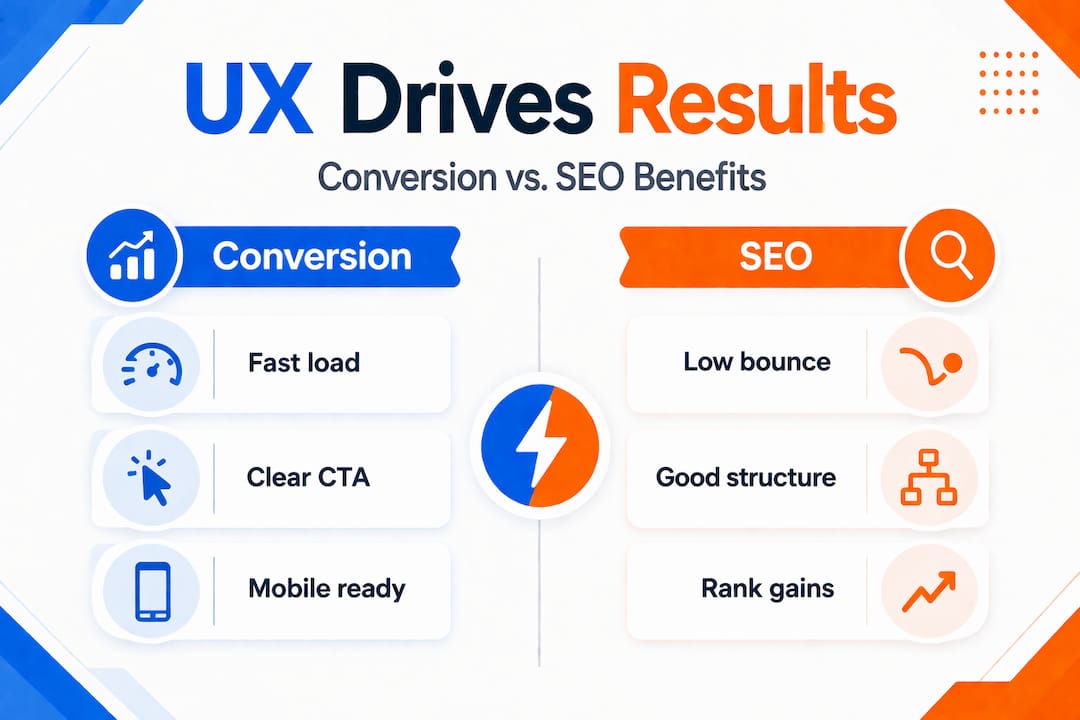
The single most important shift you can make right now is committing to a mobile-first mindset. Mobile UX drives an extraordinary 82.9% of web traffic, and landing pages with a single focused CTA convert 266% better than those with multiple competing options. Those are not incremental improvements. Those are business-changing numbers.
A structured approach to improving website user experience should cover the following areas:
- Heatmap and scroll analysis: Tools like Hotjar or Microsoft Clarity show exactly where users drop off or stop reading. You cannot fix what you cannot see.
- Page speed audits: Google PageSpeed Insights is free and tells you precisely what is slowing your site down. Prioritize anything flagged as “poor” on mobile.
- A/B testing CTAs: Test button color, copy, and placement. Even a simple change from “Submit” to “Get my free quote” can lift clicks significantly.
- Contrast and readability: Body text should be at minimum 16px. Dark text on a light background. Never light gray on white.
- Compression and caching: Large uncompressed images are the number one cause of slow SMB websites.
Here is a benchmark reference for key UX performance metrics to help you assess where your site currently stands:
| Metric | Poor | Acceptable | Top performer |
|---|---|---|---|
| Page load time (mobile) | Over 4 seconds | 2 to 4 seconds | Under 2 seconds |
| Bounce rate | Over 70% | 50 to 70% | Under 40% |
| Conversion rate | Under 2% | 2 to 6% | Over 11% |
| INP score | Over 500ms | 200 to 500ms | Under 200ms |
| Form completion rate | Under 30% | 30 to 60% | Over 60% |
Pro Tip: Run your website through Google PageSpeed Insights right now, on mobile specifically. Whatever your lowest-scoring issue is, fix that first before touching anything else. One targeted fix will deliver more return than ten cosmetic tweaks.
Investing in mobile optimization tips does not require a full rebuild. In most cases, switching to a responsive theme, compressing images, and cleaning up your navigation menu will move the needle significantly within a few weeks.
For businesses running paid ads, conversion rate optimization applied to landing pages directly lowers your effective cost per acquisition. If you currently pay $5 per click and convert at 3%, improving to a 9% conversion rate triples your return from the exact same ad budget.
CRO meets UX: Maximizing ROI through ongoing optimization
Essential strategies in hand, it is time to discuss how continuous UX and marketing refinement unlocks the next levels of growth.
Conversion rate optimization (CRO) and UX are not separate disciplines. They are the same work viewed from two angles. CRO asks “how do we get more visitors to take action?” UX asks “how do we make the experience good enough that taking action feels natural?” The answer to both is the same: understand your real users deeply, test ideas against actual behavior, and refine continuously.
CRO and UX iteration consistently yields 20 to 40% annual revenue lifts for businesses that commit to the cycle. That figure reflects a shift in how top practitioners think about UX value — moving away from surface-level design updates toward deep understanding of user motivations and friction points. The question is no longer “does this look good?” It is “does this solve the actual problem the user arrived with?”
Here is how to build a simple ongoing CRO and UX improvement cycle:
- Set a baseline. Record your current conversion rate, bounce rate, and average session duration. You need a number to beat.
- Identify the top friction point. Use session recordings or heatmaps to find the single page or step where users most commonly drop off.
- Form one hypothesis. “If we replace the three-paragraph intro with a single sentence value statement, visitors will scroll further and click the CTA more.”
- Run a test for two to four weeks. Use A/B testing tools or simply swap the element and track the change.
- Document the result and repeat. Whether you won or lost the test, you learned something. Apply it to the next round.
This process is not glamorous. But it beats redesigning your entire site every two years based on aesthetics and hope.
One critical caution: avoid the trap of over-automating your user interactions. Premature AI self-service frustrates one in three users and erodes the trust you have worked to build. Chatbots that cannot answer real questions, automated email flows that feel robotic, and AI-generated content that misses user intent all damage UX. Technology should serve the human experience, not replace it.
Pro Tip: Before launching any new automation or AI tool on your website, test it yourself as a first-time visitor. If it frustrates you even slightly, it will frustrate your customers far more.
A fresh perspective: Why most small businesses still miss UX’s full revenue potential
Here is something we see repeatedly working with SMBs: they know UX matters, they have read the articles, they nod along in every meeting — and then they spend 90% of their digital marketing budget on ads and barely touch their website experience. The logic seems sound on the surface. More traffic means more sales, right?
Wrong. More traffic to a broken experience means more wasted money. A hundred clicks that convert at 2% give you two leads. Fifty clicks that convert at 12% give you six leads at half the cost. The math is not complicated, but the behavior rarely changes because UX improvements feel slower and less exciting than launching a new ad campaign.
The industry does not help. Tool vendors constantly push new features, new platforms, new AI capabilities. Every week there is a new “game-changer” that promises to transform your results. Meanwhile, the businesses quietly winning online are fixing their navigation menus, cutting their page load times, and testing one CTA against another. Boring, incremental, and incredibly effective.
The UX ROI for small business is not theoretical. It is the multiplier on every other dollar you spend in digital marketing. Improve your UX and your SEO improves. Your ads cost less per conversion. Your email click-throughs convert better. Your social traffic actually results in inquiries. UX is not a line item in your marketing budget. It is the foundation that everything else is built on.
The businesses that outperform their competitors over the next three to five years will not be the ones who chased the most trends. They will be the ones who understood their customers best, removed friction from every interaction, and kept testing until they got it right.
Next steps: Supercharge your digital marketing with proven UX solutions
You now understand why UX sits at the center of every successful digital marketing strategy — and you have a practical framework to start improving it. The next step is turning that knowledge into measurable results.
At ibrand.media, we work with small and medium-sized businesses every day to audit, optimize, and scale their digital presence. Whether you need to optimize your website for search, rebuild your digital foundation with web design essentials, or get a full UX and marketing strategy tailored to your business goals, our team is ready to help. We believe every business deserves a website that actually works — one that converts visitors into customers without breaking the budget. Reach out to start your personalized plan today.
Frequently asked questions
What is the most important UX element for SMB websites?
Mobile-friendliness tops the list, since over 80% of SMB traffic is now mobile, making a responsive, fast-loading mobile experience non-negotiable for any business serious about conversions.
How does UX improve SEO rankings?
Fast, seamless user experiences reduce bounce rates, which directly signals quality to search engines. Pages with poor interaction speeds can drop nearly a full position in rankings, costing significant organic traffic.
Can better UX really raise conversion rates?
Yes. Top-performing sites convert at 11.5% or higher by optimizing UX elements like page speed, CTA clarity, and mobile layout, compared to the industry median of 6.6%.
Should SMBs prioritize UX or more digital ads?
Investing in UX multiplies your ad spend by converting more of your existing clicks into leads and sales. More ad budget on a low-converting site is like pouring water into a leaking bucket.
Is AI or automation a risk for SMB digital UX?
Overuse of automation can frustrate users, with premature AI self-service alienating one in three customers and damaging the trust that drives long-term revenue growth. Always prioritize human-centric strategies first.
Recommended
- Customer journey mapping: a guide to boost online sales – Ibrandmedia
- Ibrandmedia – A Complete Digital Strategy For Your Business
- Why UX design drives 100x ROI for small businesses – Ibrandmedia
- Why Invest in Digital Marketing: Boost Sales Fast | Ibrandmedia
- Tecniche di Storytelling per vendere di più – Stefano Aiello
Recent Comments