
TL;DR:
- Improving user experience can yield up to 100x ROI for small businesses.
- Focus on usability, speed, accessibility, and mobile responsiveness to increase conversions.
- Continuous, small UX improvements outperform expensive redesigns and boost customer retention.
Every $1 you invest in user experience can return up to $100. That number stops most small business owners cold, because UX is rarely treated as a revenue driver. It gets lumped in with aesthetics, pushed to the back of the budget, or ignored entirely until customers start disappearing. User experience is the sum of every interaction someone has with your business online, and it shapes whether they buy, return, or leave forever. This guide breaks down the business case, the proven strategies, the hidden pitfalls, and the practical steps you can take right now to make UX work for your bottom line.
Table of Contents
- What user experience actually means for your business
- How superior UX drives conversions, sales, and loyalty
- Proven UX strategies small businesses can implement now
- Mobile-first, accessibility, and the real-world SMB edge cases
- The uncomfortable truth most SMBs miss about user experience
- Take your next step: Better UX with expert guidance
- Frequently asked questions
Key Takeaways
| Point | Details |
|---|---|
| UX boosts sales and loyalty | A strong user experience drives higher conversion rates, repeat business, and can deliver enormous ROI with even small improvements. |
| Simple strategies work | You don’t need a big budget—basic research, usability tests, and analytics drive powerful results for small businesses. |
| Mobile and accessibility matter | With most traffic on mobile and 25% of users needing accessible design, neglecting these areas means losing customers. |
| Avoid common pitfalls | Overcomplicating your site or ignoring real-user feedback leads to expensive mistakes—keep things usable and customer-focused. |
What user experience actually means for your business
User experience is not about making your website pretty. It is about making it work. Every click, every scroll, every form field, and every second of load time adds up to an impression that either builds trust or destroys it. When customers land on your site, they are making split-second decisions about whether your business is worth their time and money.
The confusion between UX and visual design costs SMBs real money. A beautiful website with confusing navigation, slow load times, or a broken checkout process will lose customers just as fast as an ugly one. The impact of UX on business growth goes far beyond looks. It covers usability, satisfaction, accessibility, and the emotional response a customer has when interacting with your brand online.
Here are the main touchpoints that shape your customers’ experience:
- Site navigation: Can visitors find what they need in three clicks or fewer?
- Mobile experience: Does your site work seamlessly on a phone?
- Page load speed: Slow pages kill conversions before they start.
- Checkout process: Every extra step loses a percentage of buyers.
- Content clarity: Is your value proposition immediately obvious?
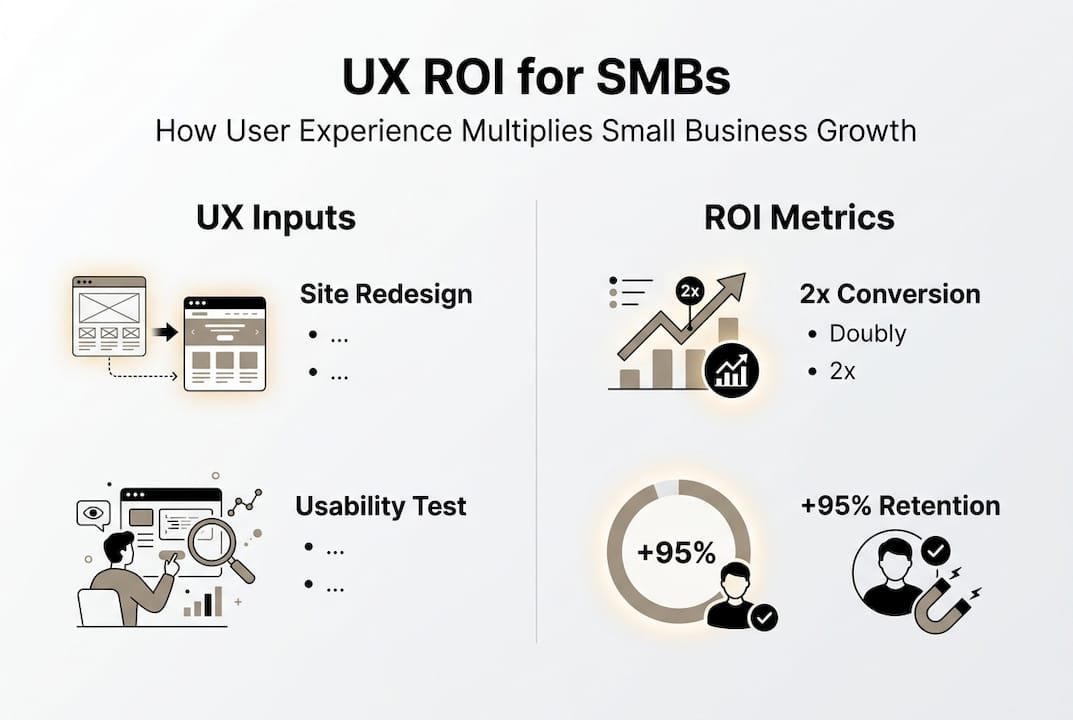
Well-designed UIs can double conversion rates and provide up to 100x ROI on UX investment. For SMBs, that is not a luxury stat. It is a survival stat.
The misconception that UX is a “nice-to-have” is one of the most expensive beliefs a small business owner can hold. Compare the two mindsets:
| UX as a cost | UX as a growth lever |
|---|---|
| One-time redesign expense | Ongoing revenue multiplier |
| Designer’s job, not owner’s concern | Core business strategy |
| Measured in hours spent | Measured in conversions gained |
| Fixed when something breaks | Continuously improved |
| Separate from marketing | Integral to every marketing result |
When you start tracking marketing ROI with UX in mind, the numbers shift fast. Businesses that invest consistently in UX see compounding returns, not just one-time lifts.
How superior UX drives conversions, sales, and loyalty
Let’s talk numbers, because the business case for UX is overwhelming once you see it laid out clearly.
A 5% increase in retention can boost profits by as much as 95%. That is not a typo. Keeping existing customers happy through great experience is one of the highest-leverage moves any SMB can make. And businesses that resolve customer issues faster see compounding loyalty benefits. Champions resolve issues 48% faster and are 2.3x more likely to accelerate projects and growth.

Here is a summary of what the data shows:
| UX metric | Impact |
|---|---|
| Conversion rate lift | Up to 2x with well-designed UI |
| ROI on UX investment | Up to $100 per $1 spent |
| Retention improvement | 5% gain = up to 95% profit increase |
| Issue resolution speed | 48% faster for high-UX businesses |
| Project acceleration | 2.3x more likely for UX champions |
The benefits of online marketing multiply when your UX is solid, because every ad click, every social post, and every email campaign lands on an experience that either converts or wastes your spend. Strong UX also fuels word-of-mouth. Customers who have a smooth, satisfying experience talk about it.
Here is how the chain works in practice:
- Trust is established through clear design, fast load times, and intuitive navigation.
- Conversion happens because the path to purchase is frictionless.
- Repeat business follows because the customer remembers the positive experience.
- Advocacy grows as satisfied customers recommend you to others.
- Revenue compounds without proportional increases in marketing spend.
This is why tracking digital marketing ROI without accounting for UX gives you an incomplete picture. Your ads might be performing well, but if your landing page experience is poor, you are leaving most of that investment on the table.
Proven UX strategies small businesses can implement now
You do not need a six-figure budget or a full design team to improve your UX. Most of the highest-impact changes cost little to nothing. User research, usability testing, heuristic evaluation, and analytics tools are accessible to SMBs right now, and the learning curve is shorter than most owners expect.
Start with these quick-win strategies:
- Run a five-user test: Recruit five real people to navigate your site while you watch. This simple method catches approximately 85% of usability issues without any special software.
- Use free analytics tools: Google Analytics shows you where visitors drop off. Hotjar lets you watch session recordings and see heatmaps of where people click.
- Survey your customers: A three-question survey sent to recent buyers reveals friction points you would never find on your own.
- Build basic buyer personas: Knowing who your user is shapes every design decision. Even a rough sketch of your typical customer changes how you prioritize fixes.
- Audit your mobile experience: Pull up your site on three different phones and walk through the purchase process yourself.
Pro Tip: Set up a free Hotjar account and record 20 user sessions on your most important page. You will likely spot a confusing element or a dead-end click within the first five recordings.
A/B testing does not require expensive software either. Tools like Google Optimize (free) or even simple manual tests where you alternate page versions weekly can reveal which headlines, button colors, or layouts drive more action. The key is testing one variable at a time so you know what actually moved the needle.
For collaboration, tools like Figma offer free tiers that let you wireframe new layouts before spending a cent on development. Avoiding UX mistakes early in the process saves far more money than fixing them after launch.
Mobile-first, accessibility, and the real-world SMB edge cases
Mobile is not the future. It is the present. 52% of web traffic is mobile, and 73% of users will leave a site that is not responsive. If your site is not built for phones, you are turning away the majority of your potential customers before they even read your first sentence.
Responsive design for mobile is no longer optional for SMBs. It is the baseline. But beyond responsiveness, mobile UX means fast load times on cellular connections, tap targets large enough for thumbs, and checkout flows that do not require pinching and zooming.
Accessibility is the other overlooked edge case. Ignoring it excludes roughly 1 in 4 users, which is a significant slice of your potential market. Accessibility is not just about screen readers. It includes color contrast for low-vision users, keyboard navigation for people who cannot use a mouse, and clear language for users with cognitive differences.
Pro Tip: Ask at least two people with accessibility needs to test your site before any major launch. Their feedback will surface issues your team never would have caught.
Here are the most common SMB UX edge cases that cause real damage:
- Overcomplicated site architecture: Too many menu items, buried product pages, and confusing category structures send visitors to competitors.
- Ignoring analytics data: Having the data but never acting on it is the same as not having it.
- Expensive redesign regrets: Launching a full redesign without user testing first is one of the most common and costly mistakes SMBs make.
- Lack of mobile support: A desktop-only experience in 2026 is a business liability.
- Skipping accessibility checks: Beyond the ethical issue, inaccessible sites face legal risk in many markets.
The benefits of mobile-friendly sites extend beyond user satisfaction. Search engines rank mobile-optimized sites higher, which means better UX directly improves your visibility. You can also drive sales with mobile UX by streamlining your mobile checkout and reducing the steps between intent and purchase.
The uncomfortable truth most SMBs miss about user experience
Here is what we see repeatedly: SMB owners either ignore UX entirely, or they throw money at a redesign after a crisis and hope it fixes everything. Neither approach works. SMBs neglect UX due to overwhelm and short-term focus, and that short-term thinking quietly stunts growth for years.
The real problem is not a lack of tools or budget. It is a lack of process. Most UX failures happen because there is no one asking “what does the customer actually experience here?” on a regular basis. UX gets treated as a project with a start and end date, not as infrastructure that needs ongoing attention.
Chasing new technology without fixing the foundation is another trap. AI-powered chatbots and personalization overlays sound exciting, but layering them on top of a confusing, slow, or inaccessible site makes the experience worse, not better. Customers notice when the basics are broken, no matter how many features you add.
Our honest recommendation: start with one friction point. Fix it. Measure the result. Then move to the next one. Steady, customer-focused improvement beats any single redesign project. Treat UX as essential infrastructure, not an afterthought, and the compounding results will follow.
Take your next step: Better UX with expert guidance
Understanding UX strategy is one thing. Executing it without wasting time or money is another. For many SMBs, the fastest path to better results is working with people who have already solved these problems.
At ibrand.media, we help small and medium-sized businesses build online experiences that actually convert. Whether you need web design for small businesses built around real user needs, guidance on optimizing sites for search, or a clear answer to why invest in web design at all, we have resources built specifically for owners like you. You do not have to figure this out alone. Reach out and let us help you turn your website into your best-performing sales tool.
Frequently asked questions
What are the most costly user experience mistakes for small businesses?
The most costly mistakes include neglecting mobile optimization, ignoring accessibility, and overcomplicating site navigation, each of which can cause lost sales and expensive redesigns.
Do I need advanced tools or a big budget to improve my SMB’s UX?
No. Effective UX improvements start with simple steps like free analytics tools, five-user testing, and customer surveys that cost nothing to run.
How much impact does user experience really make on sales?
A well-designed UX can boost conversions up to 2x and increase profits by up to 95% with small improvements in customer retention.
What’s one quick win to improve user experience fast?
Test your site with five real users to catch 85% of typical issues and act on their feedback immediately for fast, measurable improvement.
Recommended
- Why user experience matters: small business growth in 2026 – Ibrandmedia
- What is web design for small businesses: A 2026 guide | Ibrandmedia
- Why Responsive Design Matters for Small Businesses | Ibrandmedia
- Why Invest in Web Design: Complete Guide for SMBs | Ibrandmedia
- Proven steps to improve marketing ROI for small businesses
Recent Comments