
For core, always-on brand work, in-house wins on control and speed. For surge campaigns or specialist skills you need for eight weeks, not eight years, an agency wins. Most companies land somewhere in between: 82% now run some form of internal marketing agency, yet still keep an outside partner for the work that requires fresh eyes or extra hands. The right call depends on how core the work is, how stable your budget is, and how much runway you have to hire.
TL;DR:
- Building an in-house team incurs recruitment and onboarding costs that can take several months to reach full productivity, often making it less suitable for short-term needs.
- Agencies provide immediate access to specialists and rapid deployment for surge campaigns or technical projects, which internal teams would need years to develop.
- Fully in-house operations are best for long-term, stable functions such as brand strategy and customer communications, while hybrid models suit businesses with fluctuating demands.
- Most companies operate a hybrid model, using outside agencies for overflow or expert work, especially in digital marketing functions like SEO, web design, and paid advertising.
- Conducting a detailed cost comparison that includes fully loaded headcount costs versus agency retainers is crucial before shifting more work in-house to ensure economic viability.
Table of Contents
- In-House vs Agency: The Pros, Cons, and Real Cost Math
- Fully In-House, Hybrid, or Embedded: Which Model Fits?
- How Do You Decide Between In-House and Agency?
- Governance Rules Every In-House Team Needs
- What Hiring Managers and Marketers Should Actually Do
- Where Ibrand Fits Into Your In-House vs Agency Decision
- Sources
- FAQ
In-House vs Agency: The Pros, Cons, and Real Cost Math
The in-house vs agency debate usually gets framed as a personality question. It’s really a cost and speed question, and the numbers tell a more specific story than most hiring managers expect.
Building an internal team gives you three things an agency structurally can’t: same-day approvals, direct ownership of your first-party data, and people who understand your product without a briefing deck. Those advantages compound over time. A marketer who has sat through 40 customer calls writes better ad copy than one reading a brand guide for the first time.
The catch is what it costs to get there. SHRM’s research on recruitment costs shows that hiring carries expenses most budget spreadsheets never capture: sourcing time, interview hours across the team, onboarding ramp, and the productivity gap before a new hire is actually useful. A single senior marketing hire can take several months to close and then additional months to reach full output. That’s real money sitting idle before a single campaign launches.
Agencies solve the speed problem by already having the bench built. You’re renting a team that’s spent years on similar accounts, and that experience shows up fastest in specialist work like technical SEO audits or platform migrations that would take an internal generalist months to learn from scratch. Agencies also tend to get better rates from ad platforms and martech vendors, since volume-based discounts from spreading spend across many clients often beat what a single company negotiates alone.
Pros of in-house:
- Full control over daily priorities and creative direction
- Direct ownership of customer data and campaign history
- Institutional knowledge compounds instead of resetting with every contract renewal
Cons of in-house:
- Hiring cost and lead time before the team is productive
- Risk of an operational echo chamber, where the same five tactics get recycled because nobody on the team has seen a different industry’s playbook
- Harder to flex up or down when demand spikes
Pros of agency:
- Immediate access to specialists you’d never justify hiring full time
- Cross-account pattern recognition that catches what internal teams miss
- Surge capacity for launches, rebrands, or seasonal pushes
Cons of agency:
- Less day-to-day control and slower turnaround on small requests
- Account team turnover can quietly erode institutional knowledge
- Retainer costs continue whether or not you’re using full capacity that month
Quick stat: 82% of organizations reported operating an internal marketing agency, according to the Association of National Advertisers, up sharply from a decade earlier. That’s not a fringe strategy anymore. It’s become closer to the default.
The real economic comparison isn’t headcount versus retainer. It’s fully loaded headcount (salary plus roughly 20 to 30% in benefits, plus tools, plus management overhead) against an agency retainer plus the one or two internal roles you’ll still need to manage that relationship. Skip the internal management line and the math looks artificially cheap.
Fully In-House, Hybrid, or Embedded: Which Model Fits?
Three operating models cover almost every real setup, and the right one usually tracks with how stable and central the work is.
- Fully in-house works best for stable, core-to-strategy functions with a long time horizon, typically multiple years. Brand strategy, customer email, and owned-channel content fit here because the work rewards deep product knowledge and doesn’t fluctuate month to month.
- Hybrid keeps strategy and always-on execution internal while sending overflow, specialist audits, or seasonal campaigns to outside partners. This is the most common setup among the 82% of organizations running an internal agency function, since almost none of them run pure in-house with zero outside help.
- Embedded puts agency talent physically or virtually inside your team, often reporting to your internal marketing lead. It gives you agency-level skill with in-house-level responsiveness, but it costs more per hour than a standard retainer and requires real management attention to integrate well.
Mapping functions to models makes the choice concrete. Paid media often starts embedded or agency led because platform algorithms shift fast and specialist knowledge decays if it isn’t used regularly. Creative production frequently goes hybrid, with a small internal team handling always-on assets and an agency brought in for major campaign concepts. Analytics tends to move in-house early since it’s tied to proprietary data you don’t want living outside your walls. Web rebuilds are usually project based and agency led regardless of your steady-state model, because the skill set needed for a typical rebuild rarely matches what you need the remainder of the year.
The MarketingProfs playbook on in-housing notes that companies frequently stage this transition, starting with data and analytics before moving into media and creative as internal capability matures. Trying to bring everything in-house at once is a common way in-housing efforts stall.

How Do You Decide Between In-House and Agency?
Three questions cut through most of the noise. Is the work core to your strategy, or is it a specialist skill you’ll need occasionally? What’s your actual hiring bandwidth over the next two quarters? And how stable is your marketing spend, meaning would a slow quarter leave a new hire underutilized?
Run the break-even math before you decide anything. Add up fully loaded compensation (salary plus 20 to 30% for benefits), amortized recruiting cost, tool and software seats, and a share of management time. Then compare that total against an agency retainer plus the one or two internal roles you’d still need for vendor oversight and creative briefing. National Marketing Awards’ guide recommends running this exact comparison before committing to either model for longer than a single fiscal year.
Operational readiness matters as much as the cost math. Before you bring anything in-house, nail down:
- A one-page RACI for each major workflow, naming who’s Responsible, Accountable, Consulted, and Informed
- Clear approval authority and dollar limits for who can greenlight spend without escalation
- A documentation habit: shared dashboards, a naming convention for campaigns, and a running experiment log
Pro Tip: If you can’t name the single person accountable for a campaign’s final approval in under five seconds, your RACI isn’t done yet. That gap is what turns a promising in-house team into a bottleneck by month three.
Match your decision to your outputs. If the work is core and your horizon is 18 months or longer, start building in-house now and use an agency to fill the gap while you hire. If the need is specialist or short-term, sign a scoped agency engagement instead of a headcount req. If you’re not sure yet, default to hybrid for a year and reassess once you have real usage data.
Governance Rules Every In-House Team Needs
Most in-house teams that stall don’t fail because the hires were bad. They fail because nobody defined who approves what. Cornell’s IT service management guidance on RACI frames this clearly: without a documented owner for each decision, work backs up waiting on people who don’t realize they’re the bottleneck.
Three habits fix most of this:
- Write a RACI for every recurring workflow, not just big launches
- Keep a shared experiment log and consistent campaign naming so institutional knowledge survives staff turnover
- Bring in agencies for quarterly bench audits or specialist reviews even after you’ve gone fully in-house, so your team gets outside perspective without giving up daily control
The Forbes Agency Council’s take on in-house teams makes the integration point directly: teams that aren’t woven into the broader organization’s priorities tend to underperform or get dismantled within a couple of years, regardless of talent quality.
Pro Tip: Schedule an external audit every quarter even if you’ve fully in-housed. A fresh set of eyes from an agency partner catches blind spots your team stopped noticing months ago.
What Hiring Managers and Marketers Should Actually Do
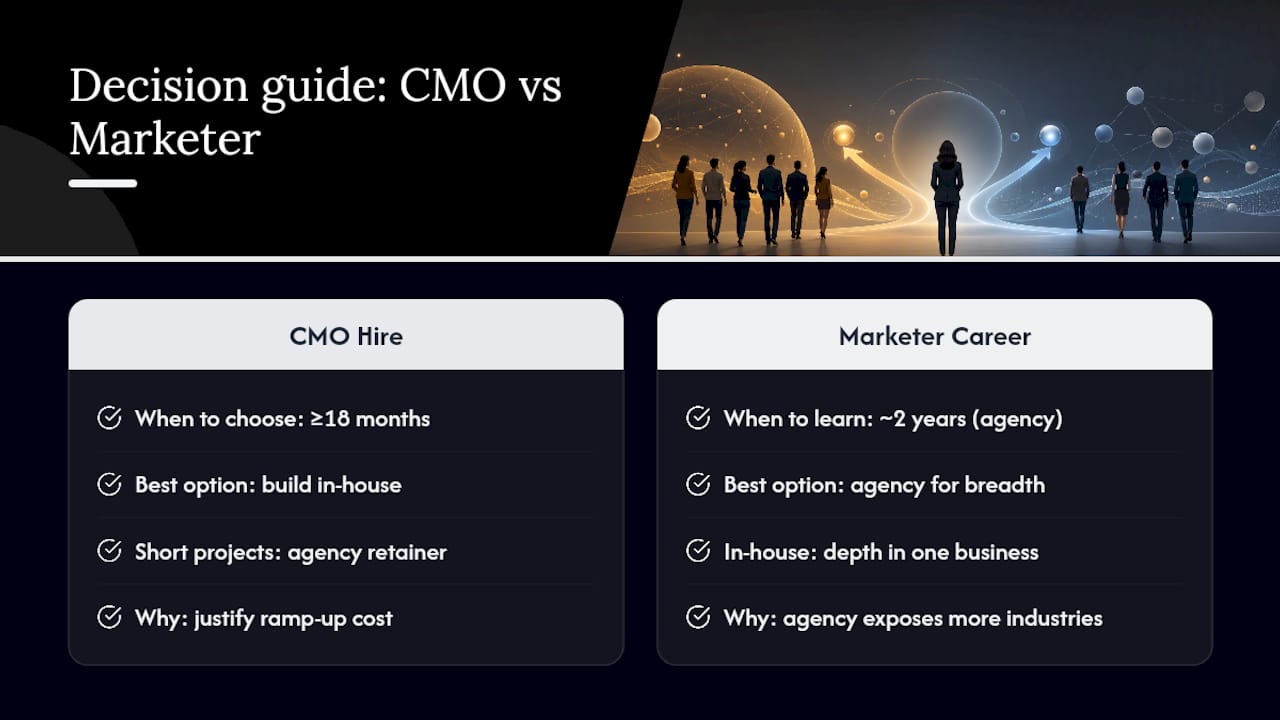
If you’re a CMO, pick your time horizon first. Building in-house makes sense at 18 months or longer, once you can justify the ramp-up cost against sustained need. Anything shorter, and an agency retainer beats a hiring process that won’t even finish before the project does.
If you’re a marketer choosing where to work, agency roles build breadth faster, exposing you to more industries and problems in two years than most in-house jobs will in five. In-house roles build depth: you’ll understand one business and one customer base at a level an agency rarely allows. Neither path is wrong. The mistake is picking one without asking which kind of expertise you’re actually trying to build.
— TONY
Where Ibrand Fits Into Your In-House vs Agency Decision
If your team is running hybrid, which most are, Ibrand is built for exactly that gap: the surge campaign, the local push, the SEO work your in-house team doesn’t have bandwidth for this quarter. You get specialist execution without the hiring timeline, and without locking into the kind of long retainer that makes sense for a national brand but not for a local business watching every dollar.
Ibrand’s services map directly onto the functions that most often get outsourced even inside a hybrid model: SEO optimization, local marketing and Google Business Profile management, web design, paid advertising, and social media management, all with transparent pricing and real-time performance tracking so you can see exactly what you’re getting each month. If you’re a small or local business trying to decide whether to hire your first marketer or bring in support now, start with a custom plan at Ibrand and get expert execution running while you figure out your longer-term hiring plan.
Sources
- In-house agency trend gains steam (Marketing Dive summary of ANA report)
- Marketing in-house vs. agency: outsourcing decision framework (MarketingProfs)
- Building the in-house marketing team of the future (Forbes)
FAQ
What is a disadvantage of using an in-house advertising agency?
The biggest disadvantage is losing outside perspective. Teams that work only on one brand can fall into an operational echo chamber, repeating familiar tactics because nobody on staff has seen how a different industry solves the same problem.
Is in-house or agency better for PR?
Agencies generally handle PR better for most companies because press relationships and crisis response depend on a network built across dozens of accounts over years. In-house PR can work well once a company has enough media volume and internal expertise to justify a dedicated hire.
Is working at an agency worth it for a marketer’s career?
Agency work tends to build broader skills faster since you’re exposed to multiple industries, clients, and problems in a short window. Whether it’s worth it depends on whether you’re optimizing for breadth early in your career or depth later on.
What are the three types of agencies?
Full-service agencies handle strategy, creative, and media under one roof. Specialist agencies focus on a single discipline like SEO or paid social. Agencies of record manage the ongoing relationship and often coordinate specialist partners on a brand’s behalf.
How do I know if hybrid is right for my business?
Hybrid usually fits when your core brand work is stable enough to justify internal ownership, but you still face seasonal spikes or need specialist skills like technical SEO or a website rebuild occasionally rather than year round.
Recent Comments