
TL;DR:
- Customer journeys are complex and non-linear, involving multiple channels, emotions, and touchpoints.
- Mapping and acting on customer journey insights improves retention, conversions, and loyalty.
- Continuous review and updates of journey maps are essential for effective marketing and customer experience growth.
Most business owners picture the customer journey as a clean, straight line: someone sees your ad, clicks through, buys, and done. That mental model is costing you sales. Real customers zigzag. They see your ad on Instagram, forget about you, stumble across a review three weeks later, visit your website on their phone, abandon their cart, get a retargeting email, and finally buy on their laptop. Understanding this complexity is not just an academic exercise. It is a practical tool that reveals exactly where you are losing customers and where you have untapped opportunities to connect, convert, and build loyalty.
Table of Contents
- Defining the customer journey: More than a straight line
- Journey stages and touchpoints: Where customers connect
- Beyond the funnel: Nonlinear journeys and edge cases
- Journey map vs. customer lifecycle: Understanding the difference
- How to make customer journey mapping actionable
- Why the real value of customer journey mapping is in what you do next
- Enhance your marketing by mastering the customer journey
- Frequently asked questions
Key Takeaways
| Point | Details |
|---|---|
| Customer journey definition | It maps the full experience a customer has, including every interaction and emotion along the way. |
| Touchpoints matter | Every touchpoint before, during, and after purchase shapes customer perception and influences sales. |
| Nonlinear paths are normal | Modern customers often take zigzag routes, so mapping must include edge cases, breakdowns, and returns. |
| Action drives value | Turning journey map insights into marketing changes is what leads to improved sales and loyalty. |
Defining the customer journey: More than a straight line
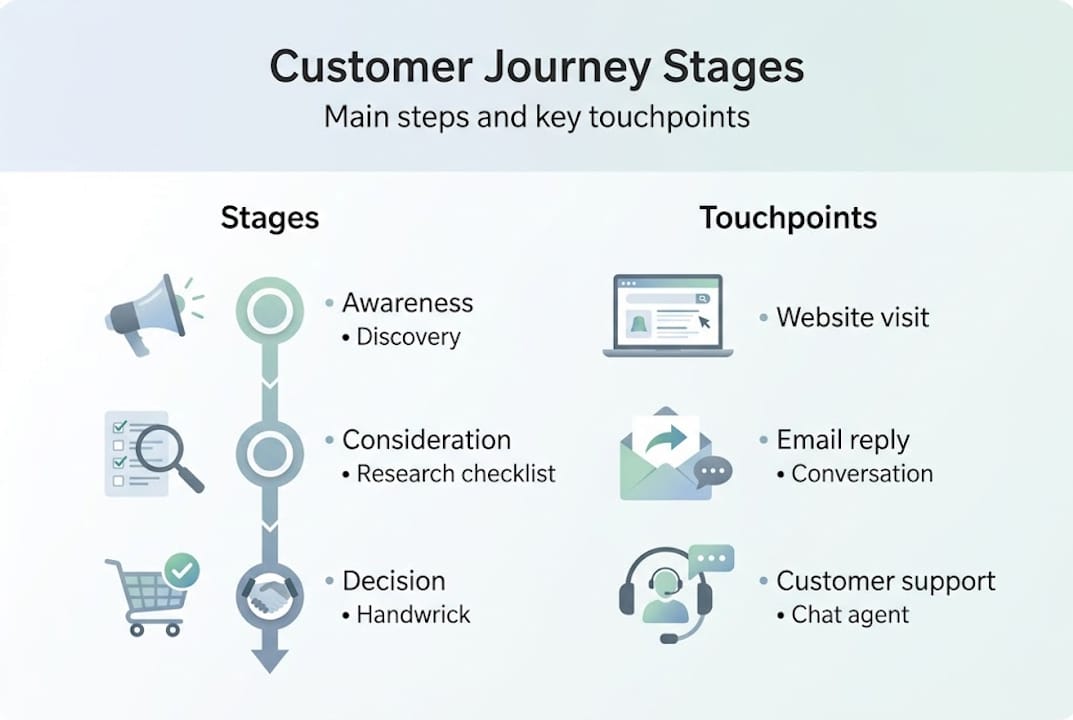
The customer journey covers every step a person takes with your brand, from the very first time they hear your name all the way through repeat purchases and word-of-mouth referrals. It is not a single event. It is a series of experiences layered across time, channels, and emotions.
The core stages most marketers recognize are:
- Awareness: The customer discovers your brand through an ad, search result, social post, or referral.
- Consideration: They research, compare options, read reviews, and weigh whether you fit their needs.
- Purchase: They make a buying decision and complete a transaction.
- Post-purchase: They receive the product or service, interact with support, and form an opinion about the experience.
- Loyalty: Satisfied customers return, subscribe, or recommend you to others.
Understanding digital marketing basics helps you see how each of these stages connects to specific marketing channels and tactics.
Customer journey mapping is a methodology to visualize and improve the customer experience by documenting the journey from the customer’s perspective, including stages, touchpoints, emotions, pain points, and opportunities. The key components of a useful map include your customer persona, the stages listed above, the specific touchpoints at each stage, the emotions your customer feels, and the opportunities you have to improve.
Customer touchpoints are specific moments where customers interact with your brand, and they can occur before, during, and after purchase, spanning digital, human, and service interactions. That means a Google ad, a live chat session, a shipping confirmation email, and a post-sale survey are all touchpoints worth mapping.
“The biggest mistake in journey mapping is assuming that your customer moves through your stages the same way your org chart is structured. They don’t. They move based on their own needs and timing.”
Here is a quick look at what a journey map captures versus what most businesses actually track:
| Journey map element | What most businesses track |
|---|---|
| Customer emotions at each stage | Revenue and conversion rate only |
| Pain points that cause drop-off | Bounce rate (without context) |
| All touchpoints across channels | Last-click attribution |
| Opportunities for improvement | Support ticket volume |
| Persona-specific paths | Aggregate audience data |
The gap between those two columns is exactly where sales opportunities get lost.
Journey stages and touchpoints: Where customers connect
Having established the structure, let’s zoom in on how these journey stages play out and see where your customers might interact with your business.
Touchpoints span three broad categories: digital (website pages, chatbots, email sequences, social media), human (phone support, sales calls, in-store staff), and hybrid (buy online, pick up in store). Each category demands a different response from your marketing team.
Here is a side-by-side look at what a “happy path” journey looks like versus what typically happens in the real world:
| Stage | Happy path | Real-world path |
|---|---|---|
| Awareness | Sees one ad, clicks immediately | Sees ad, scrolls past, sees it again two weeks later |
| Consideration | Reads one review, decides | Reads 12 reviews, visits three competitor sites |
| Purchase | Completes checkout in one session | Abandons cart, returns after discount email |
| Post-purchase | Receives product, satisfied | Contacts support with a question, waits for reply |
| Loyalty | Buys again next month | Goes quiet for six months, then returns |
The real-world path is not an exception. It is the norm for most small business customers.
Here is how to think about touchpoints at each stage:
- Awareness touchpoints: Paid ads, organic search results, social media posts, podcast mentions, and word-of-mouth referrals. Your job here is to be visible and memorable.
- Consideration touchpoints: Product pages, comparison guides, customer reviews, FAQ sections, and live chat. Your job is to answer questions before they become objections.
- Purchase touchpoints: Checkout flow, payment options, trust badges, and cart abandonment emails. Your job is to remove friction.
- Post-purchase touchpoints: Order confirmations, shipping updates, onboarding emails, and support interactions. Your job is to deliver on your promise.
- Loyalty touchpoints: Loyalty programs, re-engagement campaigns, referral incentives, and anniversary emails. Your job is to make customers feel valued.
Pro Tip: Map touchpoints from the customer’s perspective, not your internal process. Ask yourself, “What does the customer see, feel, and do at this moment?” rather than “What does our team do here?”
Tracking marketing success at each touchpoint gives you hard data to back up your mapping assumptions. Without measurement, a journey map is just a guess. You also want to think about building customer loyalty as a deliberate stage with its own touchpoints, not an afterthought. A solid digital marketing guide can help you connect each stage to the right channel and tactic.

Beyond the funnel: Nonlinear journeys and edge cases
Not every customer moves through stages in order. Here is why real customer journeys are more zigzag than funnel.
In digital-first and omnichannel businesses, customers enter, exit, and re-enter at almost any point. Someone might discover you through a YouTube video (awareness), jump straight to a purchase page, get cold feet, leave, see a retargeting ad two weeks later, read three reviews, and then finally buy. That is not a broken funnel. That is a normal human making a considered decision.
Journey mapping should account for non-linear and edge case paths, including abandonment, loops, failures, and recovery scenarios, not just the ideal happy path. Edge cases are where the most valuable insights live. They reveal friction you did not know existed.
Common nonlinear scenarios worth mapping include:
- Cart abandonment: Customer adds items, leaves, and may or may not return. What triggers their return?
- Device switching: Customer researches on mobile, buys on desktop. Is your experience consistent across both?
- Support loops: Customer buys, encounters a problem, contacts support, and either stays or churns based on that experience.
- Competitive detours: Customer visits your site, checks a competitor, comes back. What brought them back?
- Re-engagement after silence: Customer goes quiet for months, then returns. What reactivated them?
“Journeys are shaped by customer intent, not by the funnel you designed. The sooner you accept that, the faster you can build experiences that actually match how people behave.”
Digital marketing for service businesses requires especially careful attention to edge cases because service experiences are harder to standardize than product deliveries. A single bad support interaction can undo months of positive brand building.
Pro Tip: Pull your support logs and look for the most common complaints or questions. Each one is a signal of a broken or missing touchpoint in your journey map. Fix those first.
Journey map vs. customer lifecycle: Understanding the difference
To avoid common mistakes, let’s draw a clear line between journey maps and customer lifecycles, two concepts that are frequently confused.
The customer lifecycle is a higher-level, more predictable relationship framework. The customer journey captures the actual sequence of touchpoints and interactions that can vary by customer and behavior. In short, the lifecycle tells you the general phases of a customer relationship. The journey map tells you what actually happens inside those phases for a specific type of customer.
| Element | Customer journey map | Customer lifecycle |
|---|---|---|
| Focus | Individual customer experience | General relationship stages |
| Variability | High, differs by persona | Low, applies broadly |
| Perspective | Customer-centric | Company-centric |
| Detail level | Touchpoints, emotions, pain points | Phase names and goals |
| Use case | Diagnosing friction, improving UX | Planning campaigns, forecasting |
Why does this distinction matter for your marketing strategy? A few key reasons:
- Campaign targeting: Lifecycle stages help you segment broadly. Journey maps help you personalize messaging at specific touchpoints.
- Budget allocation: Knowing where customers drop off in the journey (not just the lifecycle phase) tells you where to invest.
- Content strategy: Journey maps reveal what questions customers have at each touchpoint, which drives better content decisions.
- Retention efforts: Lifecycle data shows when customers typically churn. Journey maps show why.
Tracking digital marketing success becomes far more precise when you align your metrics to journey stages rather than just lifecycle phases. You stop measuring vanity metrics and start measuring what actually moves customers forward.
How to make customer journey mapping actionable
Now that you know the concepts, here is how to make customer journey mapping a working tool for your business.
Journey mapping becomes actionable when you treat it as a process that uses research and data, including interviews, surveys, analytics, and support logs, to validate what customers actually experience, and then connect those findings to concrete improvements. The map itself is not the goal. The improvements it drives are.
Here are five practical steps to build and use a journey map as a small business:
- Define your customer persona. Pick one specific customer type to start. Give them a name, a goal, and a starting point. Trying to map every customer type at once leads to a map that is too vague to act on.
- List every touchpoint. Go through every channel and interaction point your business has. Include the ones you manage (your website, emails) and the ones you influence but don’t fully control (review sites, social mentions).
- Gather real customer data. Run short surveys, review support tickets, check your analytics, and if possible, interview three to five customers directly. Real data beats assumptions every time.
- Identify emotions and pain points at each stage. Where do customers feel confused, frustrated, or delighted? These emotional peaks and valleys are your highest-priority improvement targets.
- Connect findings to marketing actions. Adjust your ad copy to address awareness-stage doubts. Improve your FAQ page to reduce consideration-stage friction. Automate follow-up emails to strengthen post-purchase loyalty.
Pro Tip: Use journey mapping to diagnose why some customers fall off before converting. If you see a pattern of drop-off at the consideration stage, that is a signal to improve your reviews, add a comparison page, or offer a live chat option.
Tracking campaign performance at each journey stage closes the loop between your map and your results. Without that feedback, you are flying blind.
Why the real value of customer journey mapping is in what you do next
Here is the uncomfortable truth most marketing content skips: most journey maps never get used. Businesses spend time building a beautiful visual, share it in a meeting, and then it sits in a folder while the same friction points keep costing them customers.
Drawing the map is not the goal. Improving experiences is. And that requires a mindset shift from “we mapped it” to “we act on it.”
What gets missed most often is the follow-through. Customer touchpoints and behaviors shift constantly. A map built in January may be outdated by June if you launched a new product, changed your checkout flow, or started a new ad campaign. The map has to live and breathe alongside your business.
The businesses that get the most out of journey mapping are the ones that treat it as a recurring process, not a one-time project. They assign ownership to specific team members, tie journey insights to quarterly goals, and measure whether their improvements actually moved the needle. Tracking marketing ROI at the journey level is what separates businesses that grow from those that stay stuck.
The real differentiator is putting discoveries into practice: tweaking ad copy to match awareness-stage questions, streamlining support to reduce post-purchase frustration, and rewarding loyalty with experiences that feel personal rather than automated. Small improvements at each touchpoint compound fast. A 10% lift in consideration-stage conversion plus a 10% improvement in post-purchase retention adds up to a meaningfully different revenue outcome over a year.
Pro Tip: Schedule a quarterly journey review. Block 90 minutes, pull your analytics, review recent support tickets, and ask one simple question: “Where are customers still getting stuck?” Then fix one thing before the next review.
Enhance your marketing by mastering the customer journey
Understanding the customer journey is only half the battle. Putting that knowledge to work in your actual marketing is where the real gains happen.
At ibrand.media, we help small and medium-sized businesses turn customer insights into marketing strategies that actually drive sales. From optimizing your website for search to building campaigns that meet customers at every stage of their journey, our team creates personalized plans that fit your budget and your goals. Whether you are just starting to think about your customer touchpoints or ready to overhaul your entire digital presence, our local online marketing guide is a great place to start. Let us help you turn your journey map into measurable growth.
Frequently asked questions
What is the difference between the customer journey and the customer lifecycle?
The customer journey is the detailed path and touchpoints a customer experiences, while the customer lifecycle is a higher-level framework showing the general phases of a customer’s relationship with a business. As Gainsight explains, confusing the two leads to campaigns that are too broad to address real friction points.
How can I identify customer touchpoints for my business?
List every way a customer interacts with your business, such as ads, your website, email, customer support, and purchase confirmations. Every interaction before, during, and after purchase counts as a touchpoint worth tracking.
Why do most customer journeys take non-linear paths?
Customers often revisit stages, switch devices, abandon carts, and return due to personal needs or setbacks, making real journeys unpredictable. Edge case paths like abandonment and recovery loops are the norm, not the exception.
What’s one practical first step to start mapping my customer journey?
Start by interviewing customers or reviewing support logs to learn what real experiences and pain points they have. Research and data from actual customers will always produce a more useful map than internal assumptions alone.
Recent Comments