
Choose a retainer when the work never really ends, such as SEO, social media, ads management or content. Choose project pricing when you can describe the finished result today, such as a new website or a one-time rebrand. Most small businesses end up using both: a project to build something, then a retainer to keep it working.
This guide explains how each model works, where each one causes trouble, and how to decide. It also covers the contract terms to check before you sign. It is written for owners who buy marketing, not for agencies setting their own rates.
TL;DR
- A retainer is a recurring fee, usually monthly, for ongoing work and access to a team. A project is one price for one defined result.
- Retainers suit work that compounds over time (SEO, local marketing, social, ads). Projects suit work with a clear finish line (a website, a campaign launch, a brand refresh).
- Projects carry scope-dispute risk. Retainers carry the risk of paying for activity instead of results.
- Whatever you pick, get deliverables, reporting, revision limits, termination terms and asset ownership in writing.
- A hybrid is common: project for the build, retainer for the upkeep, with a change-order clause for anything extra.
Table of Contents
- What each pricing model actually is
- When a project is the right fit
- When a retainer is the right fit
- How to decide: five questions
- A worked example
- What to check in the contract, whichever you choose
- Perspective: what we see with small local businesses
- Budgeting for either model
- How we work with you
- Red flags in either model
- FAQ
- Sources
What each pricing model actually is
A retainer is a recurring payment, typically monthly, for an agreed set of services. Accelo’s explanation of pricing structures notes that retainer agreements often run six months to a year, with the services defined when the agreement is made. NetSuite describes the marketing version as a fixed-fee arrangement, usually billed monthly or quarterly, that buys ongoing services and access to an agency’s expertise and capacity, often with a dedicated team and regular progress reports.
Project pricing covers one piece of work. You pay a quoted price, either at completion or in milestones, and the relationship ends when the work is delivered and accepted.
The real difference is what you are buying. A project buys an outcome. A retainer buys capacity and continuity: someone’s time, attention and accumulated knowledge of your business, every month.
| Project pricing | Retainer pricing | |
|---|---|---|
| What you buy | A defined deliverable | Ongoing work and team access |
| Payment | One fee, or milestones | Recurring, usually monthly |
| Term | Ends at delivery | Often six to twelve months, then renews |
| Best for | Websites, rebrands, one-time launches | SEO, local marketing, social, ads, content |
| Main risk | Scope disputes and change orders | Paying for hours or activity without progress |
| Budget predictability | High for the project, none afterward | High month to month |
| Flexibility | Low once scope is signed | Higher, if priorities can shift inside the agreement |
When a project is the right fit
Project pricing works when three things are true: you know what “done” looks like, the requirements won’t shift much, and you don’t need the agency afterward on a regular basis.
Typical examples for a local business:
- A new website. A 10-page site for a dental practice or HVAC company has a clear page list, a launch date and an acceptance test. If you are weighing this kind of build, our guide to affordable web design for small businesses walks through what to define up front.
- A one-time campaign. A grand-opening push for a banquet hall or a seasonal promotion for a med spa has a start, an end and a budget.
- A single audit or setup. Setting up a Google Business Profile, tracking and a baseline report is a contained job.
The upside is price certainty. You know the number before work starts and can compare quotes line by line.
The downside is scope. Project pricing only stays fair if requirements are precise at the start. One consultant’s cost breakdown makes the same point: fixed-scope pricing suits well-defined work but risks disputes when requirements are vague. In practice, the dispute is rarely about money. It is about whether “a contact page” included a booking system, or whether “three rounds of revisions” included changing the layout.
How to keep a project price honest
- List every deliverable by name and quantity (pages, graphics, ad variations).
- State how many revision rounds are included and what counts as one.
- Define who supplies content, photos and approvals, and by when.
- Put a change-order process in writing: anything outside the list gets a written quote before work begins.
- Tie payments to milestones you can verify, not to calendar dates alone.
The SBA gives similar advice when hiring a copywriter: a good contract specifies revision limits, the cost of each work element, deadlines and what happens if you are unhappy after revisions. The same discipline applies to any creative project.
When a retainer is the right fit
Some marketing never reaches a finish line. Search rankings move because competitors publish, reviews arrive weekly, and ad accounts drift without attention. Work like that fits a retainer because the value comes from continuity.
A retainer usually makes sense when:
- The work compounds. SEO and local search build over months. Our 90-180-360 day SEO timeline shows why stopping after a one-time project often means losing the momentum you paid for.
- The work is recurring. Social posts, email sends, review responses and monthly reporting happen on a rhythm.
- Priorities change. Paid advertising needs constant testing and budget shifts. A fixed project price for “running ads” makes little sense.
- You want a team that knows your business. An agency that has worked with you for a year doesn’t need to relearn your services, seasons or service area each time.
The cost of knowing you well is real, and so is the benefit. One 2026 agency framework observes that longer-tenured accounts are more profitable for the agency because they remove repeated pitch costs and settle into established scope. That is a reason to expect a good agency to treat a long-term client well. It is also a reason to read the renewal terms closely.
The risk with retainers
A retainer can quietly turn into a monthly bill for activity. You pay the same fee whether the month was productive or not. To guard against that, insist on:
- Recurring deliverables named in the agreement (for example, number of posts, pages optimized, ad tests run).
- Meeting counts, reporting depth and who you can reach.
- Revision rules, so “ongoing” doesn’t mean unlimited or undefined.
- A review point, such as a quarterly check on leads, calls or booked jobs against the plan.
One retainer scoping guide lists the same elements: recurring deliverables, meeting counts, reporting depth, stakeholder access and revision rules. Pin them down and the retainer stays something you can measure.
How to decide: five questions
Work through these in order. The answers usually point clearly one way.
- Can you describe the finished result in one paragraph? If yes, lean project. If you can only describe a direction (“more calls from our area”), lean retainer.
- Does the result need upkeep to keep its value? A website needs hosting and updates. A Google Business Profile needs posts, photos and review replies. Upkeep points to a retainer after the project.
- How fast do things change in your market? A plumber in a competitive metro sees ad costs and local rankings shift weekly. A venue with a stable bookings pipeline may need less.
- How much budget certainty do you need? If cash flow is tight, either model can work, but know which cost is fixed. A project’s price is fixed once. A retainer’s price is fixed every month, for the length of the term.
- Do you have someone to manage the work? Projects need a decision maker who supplies content and approvals on time. Retainers need someone to review reports. Without that person, either model stalls.
If you are also deciding whether to hire outside help at all, our in-house vs. agency playbook covers that earlier question.
A worked example
Take a home services company with an outdated website, a half-completed Google Business Profile and no steady lead flow.
- Months 1 to 2, project. Rebuild the site with a defined page list, mobile-friendly layouts, call tracking and a launch checklist. One price, milestone payments, a fixed revision limit.
- Month 3 onward, retainer. Local SEO, profile management, review requests and monthly reporting. Recurring deliverables listed, a three-month review of calls and form submissions, and a notice period for ending.
- Anything extra, change order. A seasonal promotion or a new service page gets its own written quote.
This is the hybrid structure that Digital Applied’s scope framework recommends: a retainer for the recurring work, with one-off or spike initiatives carved into a separate statement of work with its own change-order clause. It keeps the monthly fee steady and stops side requests from eroding it.
What to check in the contract, whichever you choose
The pricing model matters less than the paper behind it. Before you sign, check:
- Scope and deliverables. Named, counted and described.
- Communication expectations. Meeting frequency, response times and your main contact.
- Revision rounds. How many, and what counts as a revision.
- Payment schedule. When invoices go out, and what triggers each payment.
- Out-of-scope procedure. How extra requests are quoted and approved.
- Termination terms. Notice period, minimum term and what happens to work in progress.
- Ownership of creative assets. Logos, copy, photos, ad accounts and website files should be yours.
This list follows NetSuite’s guidance on marketing retainer agreements, which also says a thorough agreement should state the payment schedule, termination clauses and clear ownership of creative assets.
Two practical habits help. First, name one point of contact on your side. The SBA notes that a single contact prevents conflicting feedback and cuts the time spent on the work. Second, insist that ad accounts, analytics and your Google Business Profile are set up in your name, so you can leave without losing them.
Because a contract is a legal document, have an attorney review anything with a long minimum term or unusual termination language before you sign.
Perspective: what we see with small local businesses
Most owners who come to us have been burned by one of two things: a project that ballooned past its quote, or a retainer that produced a lot of reports and few calls. Neither is a flaw in the model. Both are flaws in how the work was defined.
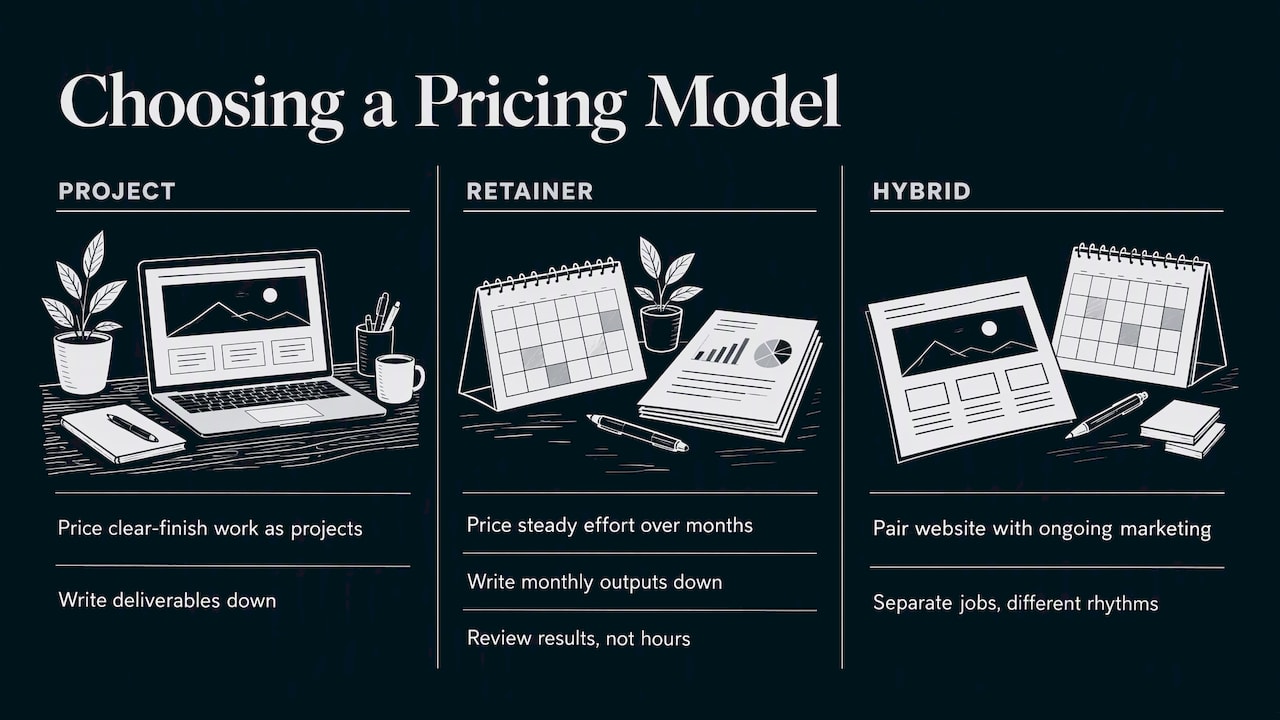
Here is how we think about it. Anything with a clear finish line should be priced as a project, with the deliverables written down. Anything that depends on steady effort over months should be a retainer, with the monthly outputs written down and a review point tied to business results, not to hours. We lean toward a hybrid for most clients, because a website and the marketing that feeds it are different jobs with different rhythms.
We also think pricing should never be a mystery. A plan built for your business, with costs you can see and real-time stats showing what is happening, lets you judge the work yourself instead of taking our word for it. If you want to test a model before committing, our 30-day approach to choosing a pricing model shows how to compare options with real numbers. And our piece on transparent marketing pricing explains what a clear quote should include.
— TONY
Budgeting for either model
A retainer is a fixed monthly line, so it fits neatly into a monthly budget. A project is lumpier: a larger payment or two, then nothing until the next piece of work. Plan for both.
- Set the total first. Decide what share of revenue you can put into marketing before you request quotes. Our small business marketing budget guide shows how.
- Separate build from run. List one-time costs (website, branding, setup) apart from monthly costs (SEO, social, ads management). Ad spend paid to the platforms is a separate line from agency fees.
- Ask what the first 90 days include. Early months of a retainer often involve setup and audits. Ask what you will see by day 30, 60 and 90.
- Keep a reserve for change orders. Even a tight project can need a small extra. Having a cushion avoids rushed decisions.
How we work with you
We are a digital marketing agency for small and local businesses. Our services include SEO, local marketing, web design, advertising, social media management, content creation, email marketing and real-time performance stats. We build a custom plan for each client, which can be a project, a retainer or a mix of both, and we tell you which we recommend and why.
If you want to talk through your situation, start on our main page and request a plan. You will get a recommendation based on your goals, not a one-size package.
Red flags in either model
- A quote with no deliverables. “Website design” or “SEO services” alone is not a scope.
- A long minimum term with no exit. If you can’t leave after a reasonable trial, ask why.
- Reports with no business numbers. Impressions alone don’t tell you whether the phone rang.
- Vague asset ownership. If the agency owns your site files or ad account, switching gets hard.
- Unlimited revisions or unlimited scope. It sounds generous but usually signals that nothing is defined.
FAQ
Is a retainer fee part of the total cost?
Yes. A retainer is the agency’s fee for the agreed services, billed on a recurring schedule. It usually does not include third-party costs such as ad spend, stock photos or software, so ask in writing what is covered and what is billed separately.
Which is cheaper, a retainer or a project?
Neither is cheaper by nature. A project has a lower total if you only need one defined deliverable. A retainer costs more over a year but covers work that needs to continue. Compare what you receive over the same period, not just the headline price.
Can I switch from a project to a retainer later?
Yes, and it is common. Many businesses start with a website project, then move to a retainer for SEO, profile management and reporting once the site is live. Ask the agency up front how the transition works and whether the retainer has a minimum term.
What happens if my project’s scope changes?
The agreement should say. A good contract has a change-order process: you request the extra work, the agency quotes it in writing, and work begins only after you approve. Without that clause, scope changes become disputes.
How long should a retainer contract last?
Retainers often run six to twelve months, according to Accelo’s overview of pricing structures. For work like SEO that takes time to show results, a shorter term with a scheduled review is a reasonable middle ground.
Sources
- Accelo: Retainers vs. Projects, Choosing Your Pricing Model
- NetSuite: Marketing Retainers, What Are They and How Do They Work?
- Jagatjeet: How Much Does a Marketing Consultant Cost?
- U.S. Small Business Administration: When to Hire a Copywriter and How to Work With One
- Digital Applied: Scope Creep Prevention, The Agency SOW Framework
- Toolkit Shelf: Retainer Pricing Without Scope Creep
Recent Comments