
Start by mapping what customers actually value against your business goals. For most companies, subscription, tiered, usage-based, or value-based models cover the majority of real-world cases, and the 5 C’s of pricing framework (customer value, costs, competition, company objectives, channel) is the backbone for choosing among them. Read the model breakdown below, then run one price or packaging test in the near future.
TL;DR:
- Using a single pricing test focused on a well-chosen model and segment can clarify potential revenue impacts and customer reactions within 30 days.
- Small businesses should prioritize simple models like flat-rate or cost-plus initially, especially if operational simplicity or predictable billing is key.
- Hybrid models combining subscription, tiered, or usage-based pricing often outperform single models by capturing more value from diverse customer segments.
- Testing requires tracking core metrics such as lifetime value, churn, and demand elasticity to avoid costly misjudgments.
- Industry patterns suggest SaaS firms favor subscription and tiered pricing, while retail and agencies tend to rely on cost-plus, bundles, and outcome-based models.
Table of Contents
- What Are the Most Common Marketing Pricing Models?
- Which Pricing Model Actually Fits Your Goals?
- How Do You Choose the Right Pricing Model?
- How Do You Test a Pricing Model Before Rolling It Out?
- Which Pricing Model Fits Your Industry?
- How Do Agencies Run Pricing Experiments in Practice?
- What’s the One Pricing Test Worth Running First?
- Want Help Running Your Pricing Experiment?
- Sources
- FAQ
What Are the Most Common Marketing Pricing Models?
A pricing model is simply the structure you use to charge customers, and picking the wrong one costs you more than a few lost sales. It shapes how customers perceive your product, how predictable your revenue looks to investors, and how much operational overhead your billing team carries every month, according to Stripe’s breakdown of pricing structures.
Here’s the full lineup marketers actually use, with a quick read on where each one fits:
- Flat-rate pricing: One price, one product, no tiers. A local landscaping company charging $150 per lawn visit regardless of yard size is flat-rate. Simple to sell, simple to explain, but it leaves money on the table when customer needs vary widely.
- Subscription pricing: Customers pay on a recurring schedule (monthly or annual) for ongoing access. Streaming services and software tools built this model into a trillion-dollar category because it turns one-time buyers into predictable, recurring revenue.
- Tiered pricing: Multiple packages (Basic, Pro, Enterprise) at different price points with different feature sets. Project management software almost always does this, letting a solo freelancer and a 200-person agency both find a plan that fits.
- Usage-based pricing: You pay for what you consume, like cloud storage billed by the gigabyte or an API billed by the call. This model rewards heavy users paying more and light users paying less, which feels fairer but makes revenue harder to forecast.
- Per-user pricing: A subtype of usage-based pricing where cost scales with headcount. Slack and similar team tools charge this way because value scales directly with the number of people using the product.
- Freemium pricing: A free tier draws people in, then a paid tier unlocks advanced features. Dropbox and Spotify built enormous user bases this way, but freemium only works when the free tier is good enough to hook people without cannibalizing the paid product.
- Value-based pricing: Price is set by what the customer believes the outcome is worth, not by what it costs you to deliver. Management consultants who charge based on projected savings rather than hours worked are running value-based pricing. It carries the highest margin potential of any model, but it demands serious customer research to get right, according to the Harvard Business Review’s guide to value-based pricing.
- Cost-plus pricing: Calculate your cost, add a fixed markup, and that’s your price. Retailers and manufacturers lean on this because it’s fast and protects margin, even though it ignores what competitors charge or what customers would actually pay.
- Penetration pricing: Launch deliberately low to grab market share fast, then raise prices once you’ve built a customer base. Streaming services have used this repeatedly to out-hustle incumbents before raising rates later.
- Skimming pricing: The opposite move. Launch high to capture early adopters willing to pay a premium, then lower the price as the market matures. Apple does this with every new iPhone generation.
- Bundle pricing: Package multiple products or services together at a price lower than buying each separately. Fast-food combo meals and software suites both use bundling to lift average order value.
- Dynamic pricing: Prices shift in real time based on demand, time, or inventory. Airlines and ride-share apps are the classic examples, and the trade-off is real revenue lift against real customer frustration when prices spike unpredictably.
- Psychological pricing: Tactics like charm pricing ($19.99 instead of $20) or anchoring (showing a crossed-out “original” price next to a sale price) that shape perceived value without changing the underlying cost structure.
Most growing businesses eventually blend two or three of these. A hybrid approach that pairs subscription stability with usage-based overages, or a tiered structure with bundle add-ons, tends to capture more revenue than any single model run in isolation, especially once your product has more than one distinct value driver.
Which Pricing Model Actually Fits Your Goals?
No pricing model wins on every dimension. The right choice depends on whether you’re optimizing for growth, margin, retention, or operational simplicity, and each model trades one of those for another.
Here’s how the trade-offs break down by objective:
- For growth: Penetration pricing and freemium both sacrifice early margin to build volume fast, but freemium only pays off if your conversion rate from free to paid is high enough to cover the users who never upgrade.
- For margin protection: Value-based and skimming pricing both capture more of what customers are willing to pay, but value-based pricing requires deep customer interviews before launch, while skimming works only when you have a genuine first-mover advantage.
- For retention: Subscription and tiered pricing create sunk-cost stickiness. Customers who’ve built workflows around your tool are slower to churn than one-time buyers, though this cuts both ways. A bad experience in month two can trigger a cancellation that a flat-rate customer would never have bothered to file.
- For simplicity: Flat-rate and cost-plus pricing are the easiest to bill, explain, and support. There’s no tier confusion, no usage disputes, and support tickets tend to run lighter.
- For revenue predictability: Subscription pricing wins clearly here. Usage-based and dynamic pricing sacrifice forecasting accuracy in exchange for capturing more value from your heaviest users.
Operationally, usage-based and dynamic models carry the highest hidden cost. You need billing infrastructure that can track consumption accurately and analytics that can explain price changes to confused customers, and that overhead belongs in your cost calculations from day one, not as an afterthought once you’ve already launched, according to Salesforce’s pricing model comparison. Customer behavior gives you a signal too. Price-sensitive, infrequent buyers respond better to flat-rate or pay-as-you-go structures, while power users who rely on your product daily tolerate (and often prefer) tiered or subscription pricing because it rewards commitment.
How Do You Choose the Right Pricing Model?
The 5 C’s of pricing, a framework taught across marketing curricula, gives you the five inputs that actually matter: customer value (what they’ll pay), costs (your floor), competition (the market context), company objectives (growth versus margin), and channel or context (how and where you sell).
Turn that framework into a process with this checklist:
- Define your primary goal. Are you optimizing for growth, margin, or retention this year? You cannot optimize for all three at once.
- Segment your customers. Price-sensitive small businesses and enterprise buyers rarely respond to the same pricing logic, so map at least two or three distinct segments before you go further.
- Map your value metric. Identify the single unit that best correlates with the value customers get: seats, storage, transactions, projects, whatever it is for your business.
- Shortlist two or three candidate models. Narrow the full list down based on your goal and your value metric, not on what a competitor happens to be doing.
- Estimate unit economics. Run rough numbers on customer acquisition cost, expected lifetime value, and gross margin under each candidate model before you commit.
- Pick your first test. Choose one model, one segment, and one clear success metric, and commit to a defined test window before rolling anything out company-wide.
Competitive pricing analysis belongs in step 4, not step 1. Too many businesses anchor their entire pricing strategy to what a rival charges, which locks you into someone else’s cost structure and customer assumptions instead of your own. Use competitor pricing as one data point among five, not as the starting point.
Pro Tip: Small teams without a data science function should skip complex elasticity modeling and instead run one price change on one segment for one billing cycle. A clean signal from a small test beats a theoretical model built on guesses.
Segmentation deserves its own line item here because it changes everything downstream. A freelancer and an enterprise buyer are not the same customer wearing different budgets. They have different urgency, different decision-making chains, and different tolerance for usage-based billing, and your pricing model has to account for that split before it accounts for anything else.

How Do You Test a Pricing Model Before Rolling It Out?
Before you commit a pricing model company-wide, validate it against five core metrics: lifetime value (LTV), customer acquisition cost (CAC), gross margin, churn rate, and price elasticity (how much demand shifts when price moves). Track all five together. A price increase that lifts margin but doubles churn is not a win.
Run the test itself with one of these approaches:
- A/B tests: Show two customer segments different prices or packages and compare conversion and retention over the same window.
- Staged rollouts: Introduce a new price to a small percentage of new signups before extending it to your full customer base.
- Promotional experiments: Test a limited-time discount or bundle to see how sensitive demand actually is to price, which gives you a real elasticity reading instead of a guess.
- Cohort analysis: Track customers acquired under different pricing structures over three to six months to see which cohort actually sticks around longer.
For small teams without a dedicated data team, a practical minimum is a two-arm test running four to six weeks, with the cohorts and success metrics defined before you launch, not after you see early results, according to Stripe’s guidance on pricing experimentation. If your customer base is too small for statistical confidence, run a targeted pilot with one segment instead of a company-wide A/B split.
The core signal to watch: conversion lift paired with a stable or improving short-term churn rate. If conversion goes up but churn spikes within the first billing cycle, the new model isn’t actually working. It’s just borrowing future cancellations to inflate current signups.
Which Pricing Model Fits Your Industry?
Different business types gravitate toward different combinations, and the pattern is consistent enough to use as a starting shortlist:
- SaaS companies typically combine subscription, tiered, and usage-based pricing, letting customers pick a base tier and pay overages for heavy consumption.
- Agencies and consultants tend to run on retainers, project-based fees, or outcome-based pricing tied to measurable results like leads generated or revenue lifted.
- Ecommerce and retail businesses lean on cost-plus for baseline pricing, bundles to lift average order value, and dynamic or seasonal pricing around holidays and inventory clearance.
- Membership and media businesses almost always run a freemium-to-subscription funnel, using free content to build an audience before converting a percentage to paid tiers.
- Event organizers use early-bird skimming, pricing tickets low for the earliest buyers, then raising prices in stages as the event date approaches and demand firms up.
None of these are rigid rules. A SaaS company selling to enterprise clients might run pure value-based pricing instead of tiered, and a boutique agency might charge flat project fees rather than retainers. The industry pattern is a starting point for your shortlist, not the final answer.
How Do Agencies Run Pricing Experiments in Practice?
A typical agency pricing engagement moves through a defined sequence rather than guesswork. It starts with discovery to understand the client’s customer base and current pricing, moves into value mapping to identify what customers actually pay for, forms a pricing hypothesis, runs a small controlled test, and only then aligns the new pricing with broader campaign messaging.
This workflow generally includes:
- Discovery sessions to understand existing customer segments and current price sensitivity.
- Value mapping to pinpoint the metric that best reflects what customers get for their money.
- A pricing hypothesis built from that mapping, tested on a small segment before wider rollout.
- Performance tracking through real-time dashboards that surface conversion and churn signals as the test runs, rather than waiting for a monthly report.
Pro Tip: If your team can’t commit to reviewing test results at least weekly, your pricing experiment will drift past its intended window and the data will get muddier every extra week you wait.
These steps describe how a marketing agency typically structures pricing work. They’re not a substitute for reviewing your own customer data before committing to any single model.
What’s the One Pricing Test Worth Running First?
If you take one action from this article, make it this: pick a single 30-day experiment. Test a tiered plan against your current flat-rate offer, or test a modest price increase paired with a messaging change that reinforces value. Track conversion and 30-day churn side by side.
You don’t need a data team for this. One spreadsheet and a clear success threshold set in advance is enough. If the signal is ambiguous after 30 days, extend the test rather than guessing at a rollout. Call in outside help once you have a clear hypothesis but lack the bandwidth to run the test cleanly. That’s a resourcing problem, not a strategy problem.
— TONY
Want Help Running Your Pricing Experiment?
An agency can run pricing work the way small businesses actually need it done: fast, transparent, and without locking you into a long-term contract before you’ve seen a result. Where a traditional consultant might spend weeks on a pricing study, Ibrand’s approach pairs a discovery session with a real test plan, then tracks the results through real-time performance tracking so you’re watching conversion and churn as they happen, not reading about them a month later.
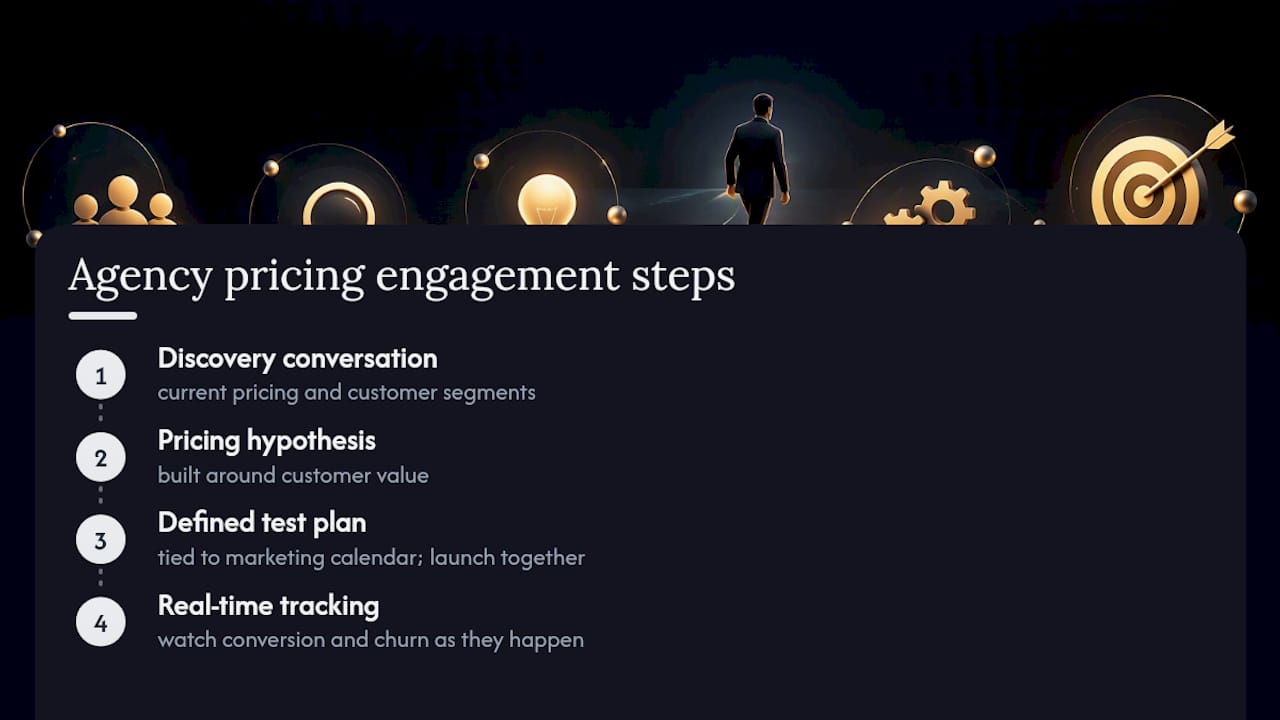
An engagement typically starts with a short discovery conversation about current pricing and customer segments, moves into a pricing hypothesis built around customer value, and ends with a defined test plan tied to the marketing calendar so the pricing change and the campaign message launch together. That’s the same logic covered in this guide, just applied regularly by experienced practitioners. If you’re weighing whether to run this yourself or bring in support, Ibrand’s guide on choosing a marketing agency walks through that decision in more detail.
If you’d rather see the numbers before committing, Ibrand’s page on transparent pricing breaks down what a real engagement costs, and you can request a custom plan directly through Ibrand’s services page to get a pricing workshop scheduled this month.
Sources
For deeper reading, OpenStax’s principles of marketing covers the 5 C’s in full, Maxio’s pricing model guide expands on hybrid strategies, and Babylovegrowth’s guide to color psychology explores how perception shapes pricing decisions.
- OpenStax — The five critical C’s of pricing
- Stripe — Pricing models explained: Types of pricing models and when to use them
- Salesforce — 10 Common Pricing Models: Types, Strategies, and How to Choose
FAQ
What Are the Four Main Pricing Models?
The four most commonly cited pricing models are cost-plus, value-based, competition-based, and dynamic pricing, though most practical guides, including Stripe’s, list closer to ten variations built from these four foundations. Subscription, tiered, and usage-based models are all extensions of value-based or cost-plus thinking applied to recurring revenue.
What Are the 7 Types of Pricing Strategies?
A common seven-strategy list includes cost-plus, value-based, competitive, penetration, skimming, dynamic, and psychological pricing. Each one answers a different strategic question, from covering costs to capturing market share fast to shaping perceived value at the checkout.
What Pricing Models Are Used Most in Marketing?
Subscription, tiered, freemium, and value-based pricing dominate marketing-led businesses because they tie directly to customer lifecycle stages, according to Salesforce’s pricing model comparison. Usage-based and bundle pricing show up heavily in SaaS and ecommerce, where consumption or basket size varies widely between customers.
What Are the 5 C’s of Pricing in Marketing?
The 5 C’s are customer value, costs, competition, company objectives, and channel or context, a framework laid out in OpenStax’s principles of marketing. Together they give you the inputs needed to set a price that covers your costs while still matching what customers are actually willing to pay.
Can an Agency Help Me Choose the Right Pricing Model?
Yes. An agency like Ibrand can run the discovery, testing, and campaign alignment work described in this guide for you, particularly useful if you lack the internal bandwidth to design and monitor a clean price test. Current service pricing is available directly on Ibrand’s website.
Recent Comments