
Month-to-month SEO makes sense if you’re testing a provider, working with a tight budget, or need results in a market that shifts fast, like seasonal retail or local service. It costs less to start than a locked-in retainer, but it also means the provider has less incentive to front-load slow-payoff work like authority building. Budget at least 90 days before judging results, and use the evaluation checklist below before signing anything longer.
TL;DR:
- Month-to-month SEO provides ongoing work across technical, content, on-page, link building, and reporting, with at least 90 days needed to evaluate results.
- A solid plan should include an initial diagnostic, specific monthly tasks, and clear milestones, avoiding vague promises or undefined deliverables.
- Pricing ranges from 150 to over 3,000 dollars monthly, with lower tiers offering automation and foundational fixes, while higher tiers include senior strategy and detailed link-building.
- Short-term, data-driven diagnostics and early results are more valuable than long-term contracts, which primarily serve providers’ cash flow, not your business needs.
- Successful engagements depend on clear scope, ownership rights, measurable goals, and regular performance tracking beyond rankings, including traffic and conversions.
Table of Contents
- What Month-to-Month SEO Means Versus One-Time Projects and Long-Term Retainers
- Monthly Scope Checklist: What a Strong Plan Must Include
- Pricing Bands Explained: What Different Monthly Budgets Realistically Buy
- Pros and Cons: Month-to-Month Versus a Longer Retainer or One-Time Project
- How to Evaluate Proposals and the Red Flags to Watch For
- Realistic Timeline and Expected Milestones
- Ibrand’s Month-to-Month SEO Offering and How It Works
- How to Measure and Evaluate SEO Performance Every Month
- Case Studies and Examples of Successful Month-to-Month Engagements
- What the Data Actually Supports, and Where Standard Advice Falls Short
- Request a 30 to 90 Day Month-to-Month Plan From Ibrand
- Further Reading and Primary Sources
- Sources
- FAQ
What Month-to-Month SEO Means Versus One-Time Projects and Long-Term Retainers
Month-to-month SEO is an ongoing service agreement billed one month at a time, with no fixed end date and (ideally) no penalty for canceling. That’s different from two other common structures you’ll run into while shopping for help.
A one-time project is scoped, priced, and finished. Think of a technical audit, a site migration, or a content overhaul that a freelancer or agency completes in four to eight weeks, then hands off. You get a report or a rebuilt site, and the relationship ends unless you rehire them. A long-term retainer, usually six to twelve months, locks in a fixed monthly fee in exchange for sustained work and, often, a discount versus paying month to month. Providers push these because SEO compounds slowly, and a longer commitment lets them plan link-building campaigns or content calendars that take months to pay off.
Month-to-month sits between the two. You get recurring work without the lock-in, which shifts risk back onto the provider rather than you.
Regardless of billing structure, a legitimate monthly engagement should touch the same core categories every provider worth hiring covers:
- Technical SEO: crawlability, site speed, indexation issues, and structured data, guided by fundamentals in Google’s Search Essentials.
- Content: new pages, blog posts, or landing page updates targeting specific queries.
- On-page optimization: title tags, headers, internal linking, and page-level relevance signals.
- Link and authority building: outreach, digital PR, or citation work to build domain trust.
- Reporting: monthly performance updates tied to traffic, rankings, and conversions.
Industry breakdowns of what a monthly SEO retainer actually buys confirm these five categories are the standard, regardless of whether you’re paying month-to-month or committing to a year. The billing term changes flexibility, not the underlying scope of work.
Some providers insist on a minimum commitment, usually three to six months, even when they call the arrangement “month-to-month” after that point. That’s not automatically a red flag. Building a content calendar or running a link campaign takes real lead time, and a provider protecting their own cash flow isn’t unreasonable. The line gets crossed when a minimum commitment is demanded before any diagnostic work, which is a sign they’re financing their own capacity rather than pricing based on your actual needs.

Monthly Scope Checklist: What a Strong Plan Must Include
A month-to-month SEO plan isn’t just “we’ll work on your site.” It should read like a schedule, with specific tasks assigned to specific windows. Here’s what that breakdown should look like in practice.
Month 1: diagnostic and setup
- Full technical and content audit, covering indexation, site speed, and crawl errors.
- Tracking setup, including Google Search Console access and analytics goals tied to leads or sales, not just traffic.
- Fixes for critical technical issues found in the audit, things actively blocking indexing or causing crawl errors.
- A baseline report establishing where rankings, traffic, and conversions stand before any work started.
That baseline matters more than most buyers realize. Without it, you have no way to prove the engagement worked three months later, and neither does your provider.
Ongoing monthly work
Once the diagnostic phase wraps, the recurring cadence should include content briefs and publishing on a set schedule, on-page optimization for both new and existing pages, internal linking updates as new content goes live, minor technical maintenance to catch new crawl or speed issues, and a monthly report tied to the baseline from month one.
Quarterly or campaign-level work
Some tasks don’t fit a monthly cadence and shouldn’t be forced into one. Outreach and digital PR campaigns for backlinks often run in focused bursts rather than a steady drip. Larger structural changes, like a URL restructuring or a full site migration, get planned and executed as discrete projects layered on top of the regular monthly cadence, not squeezed into a single invoice cycle.
Pro Tip: Ask any provider to show you what “month 1” specifically included for a past client, not what they plan to do for you in the abstract. A provider with real client history will have a concrete example ready. One without much SEO project experience will describe your month 1 in vague, aspirational terms.
Ranking-factor research from Backlinko consistently flags content quality, backlink profiles, and technical health as the areas that move rankings most. A monthly plan that skips one of the three, especially backlinks, is missing a lever that matters.
Pricing Bands Explained: What Different Monthly Budgets Realistically Buy
Price tells you almost everything about what you’re going to get, if you know how to read it. Here’s what shows up at each tier.
Entry-level and platform-based plans ($150 to $1,000 a month)
At this range, you’re usually paying for standardized, partly automated output. Some providers now offer genuine no-contract, month-to-month plans at lower price points by templatizing deliverables and keeping human hours low. You’ll get predictable technical fixes and on-page work, but manual outreach and senior strategic input are limited or absent. This tier suits a small business that needs foundational hygiene, not aggressive competitive growth. Comparing SEO platform options side by side helps clarify what’s automated versus hand-done at this price point.
Mid-market agency plans ($1,000 to $3,000 a month)
This band buys regular content production, ongoing technical maintenance, some outreach or link-building activity, and monthly strategy check-ins with an actual person. Multiple industry pricing studies place average monthly retainers in the low-to-mid thousands, generally in the $500 to $5,000 range depending on provider type and scope, which tracks with what agencies at this tier typically deliver.
Full-service and strategic plans ($3,000+ a month)
Here you’re paying for senior-level strategy, consistent link-building rather than sporadic bursts, and tighter integration between SEO and other channels like paid ads or email. Reporting tends to be more analytical, tying rankings directly to revenue rather than just traffic volume.
When comparing agency, freelancer, and platform pricing, judge by outcome ownership. A freelancer might match agency output at a lower price but disappears if they get sick or busy. A platform is consistent but rigid. An agency costs more but usually has redundancy built in, so one person leaving doesn’t stall your account.
Pros and Cons: Month-to-Month Versus a Longer Retainer or One-Time Project
Each billing structure fits a different business situation, and the right choice depends more on your runway and goals than on which option sounds safer.
Advantages of month-to-month SEO
- Lower upfront risk, since you’re not locked into six or twelve months of fees if the provider underperforms.
- Easier to test a provider’s actual work quality before committing further.
- Flexibility to scale spending up or down as revenue or seasonal demand shifts.
Risks and downsides
- Providers may deprioritize long-payoff work, like sustained link building, because there’s less certainty the client sticks around to see it pay off.
- Frequent churn between providers resets momentum. Every new agency wants to re-audit and re-strategize before producing anything new.
- Some no-contract providers keep prices low by limiting the manual, judgment-heavy work that moves rankings on competitive terms.
Where each option fits
Month-to-month suits businesses testing a new channel, recovering from a specific problem like a Google penalty, or operating with unpredictable cash flow. A longer retainer fits businesses chasing aggressive growth in a competitive niche where sustained authority building pays off over a year or more. A one-time project fits a business that just needs a technical cleanup or a content refresh and has the internal capacity to maintain things afterward.
How to Evaluate Proposals and the Red Flags to Watch For
Before signing anything, whether it’s month-to-month or a longer commitment, put every provider through the same short interrogation.
Questions to ask every provider
- Who specifically does the work? Is it the person pitching you, a junior team member, or an outsourced contractor?
- What are the measurable success metrics, tied to leads or pipeline, not just rankings or traffic?
- What does the 90-day plan look like, with specific deliverables attached to specific weeks?
- What tools and access do you need from us, and will we retain access to Google Search Console and analytics if we leave?
- What happens to the content and any assets built during the engagement if we cancel?
Contract terms to insist on
Content ownership needs to sit with you, not the agency, so a canceled engagement doesn’t strand your blog posts or landing pages. Deliverables should be defined in writing, either as specific outputs (four blog posts a month) or a defined time allocation (twenty hours a month), never left vague. Cancellation terms should specify notice period, typically 30 days, and confirm no penalty fee applies. Reporting access should be direct, meaning you get your own login to Search Console and analytics rather than relying on screenshots the provider chooses to send.
Red flags that should stop you from signing
Vague deliverables (“we’ll work on your SEO”) without a concrete task list. Promises of major ranking improvements for under $750 a month with no evidence of past results at that price point. Any agency insisting on a 12-month minimum before running so much as a basic diagnostic. That last one is the clearest signal something’s off: a fair process runs diagnostic, then a short pilot, then a longer retainer, only after both sides have evidence the relationship works.
Pro Tip: Ask for one client reference specifically for a canceled or downgraded account, not just a happy long-term client. How a provider handles someone leaving tells you more about their contract terms than any pitch deck.
Realistic Timeline and Expected Milestones
SEO doesn’t move on a fixed schedule, but a legitimate month-to-month engagement should hit recognizable checkpoints. Here’s what to expect and, more importantly, what to ask about if you don’t see it.
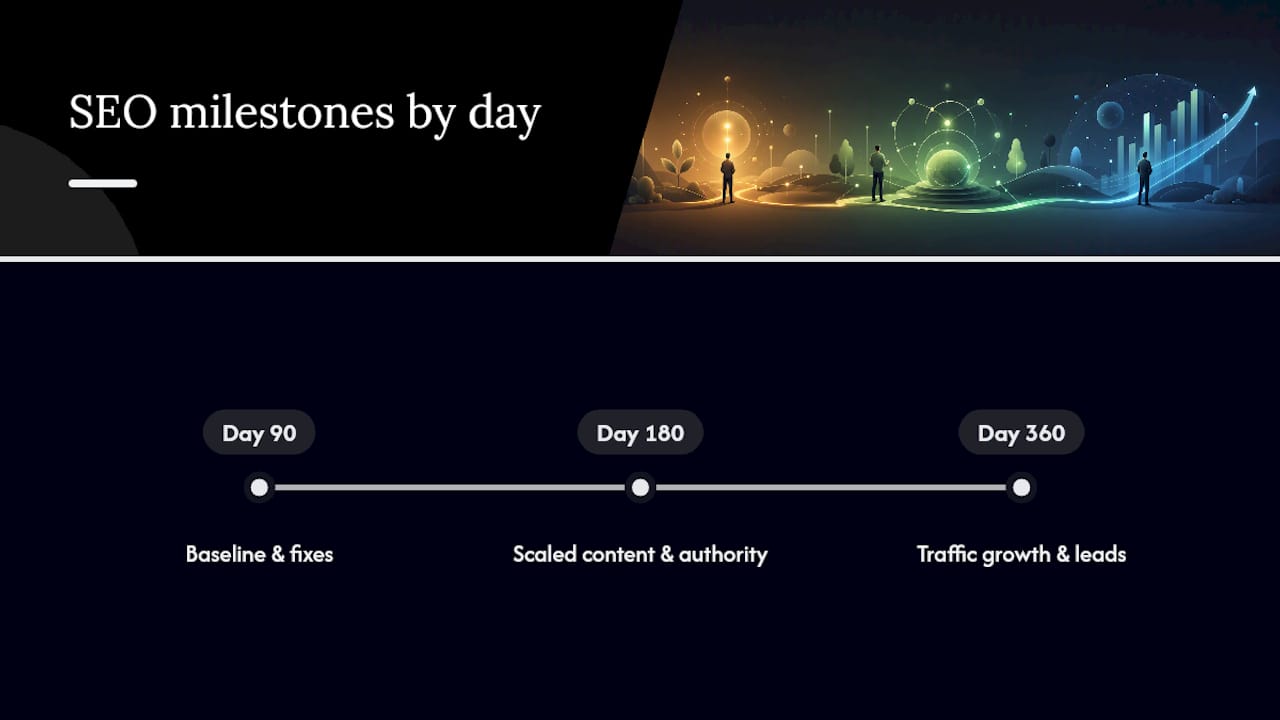
Months 1 to 3 should cover the full technical and content audit, tracking setup, fixes for the most damaging technical issues, the first handful of published content pieces, and a baseline report that gives you something to measure against later. Trustworthy providers set that measurement baseline in the first 30 days specifically so day 90 and day 180 comparisons mean something.
Months 3 to 6 should show content scaling up in volume, improved rankings for lower and mid-difficulty keywords (the ones without massive competition), and the first real authority signals, like new backlinks or improved domain trust metrics.
Months 6 to 12 is where compounding shows up, assuming the earlier months were executed well. Organic traffic should be climbing steadily rather than spiking and dropping, lead quality should improve because you’re now ranking for more specific, purchase-intent terms, and pipeline contribution from organic search should be measurable and growing.
If you’re three months in and haven’t seen a single content piece published or a single technical fix implemented, that’s not a “give it time” situation. That’s a scope problem.
Ibrand’s Month-to-Month SEO Offering and How It Works
Ibrand builds digital marketing plans for small and local businesses around SEO optimization, local search visibility, and transparent, real-time performance tracking, with a custom plan built for each client rather than a one-size template. That approach carries directly into how a month-to-month engagement should run.
Expect it to start the same way any credible engagement should: a diagnostic first, covering your current technical health, content gaps, and competitive position, before any long-term numbers get discussed. From there, a rolling roadmap replaces a rigid annual plan, adjusted as data comes in rather than locked in on day one. Reporting happens on a set cadence tied to the baseline established during the diagnostic, so you can see whether specific fixes and content pushes are actually moving the numbers that matter to your business, not just traffic for its own sake.
How to Measure and Evaluate SEO Performance Every Month
Rankings alone tell you almost nothing about whether SEO is working. A page can rank for a term nobody searches and generate zero value. Judge performance against four layers instead.
Organic traffic by page, tracked in Google Analytics, tells you whether specific content or technical fixes are pulling more visitors, and whether that traffic concentrates on pages tied to revenue or scatters across irrelevant terms.
Search visibility in Google Search Console, which shows impressions, clicks, and average position for the keywords actually driving those numbers. A rising impression count with flat clicks often points to a title tag or meta description problem, not a ranking problem.
Conversion events, meaning form fills, calls, or purchases attributed to organic traffic specifically, not blended with paid or social. Without this, you can’t separate SEO’s contribution from everything else happening on the site.
Technical health, checked monthly through crawl reports and indexation status, catching new errors before they quietly erode the gains from the first three metrics.
Ask your provider to walk through these four categories every month, not just hand you a rankings spreadsheet. If a report only shows keyword positions, push back and ask where the traffic and conversion numbers are.
Case Studies and Examples of Successful Month-to-Month Engagements
The strongest month-to-month engagements share a pattern regardless of industry: a real diagnostic up front, a short pilot period to prove execution quality, and a scope that expands only after early results justify it.
A local service business, for example, typically sees the clearest early wins from Google Business Profile optimization and location-specific landing pages, both of which can move rankings within weeks rather than months, since local search competition is often thinner than national terms. A business selling a specific product category tends to see slower but more durable gains, built through content targeting long-tail, purchase-intent search terms that take longer to rank but convert at a higher rate once they do.
What ties successful engagements together isn’t the industry. It’s the sequencing: diagnostic, then pilot, then scale, with a baseline report at the start so month three and month six numbers mean something concrete instead of just “traffic looks up a bit.”
What the Data Actually Supports, and Where Standard Advice Falls Short
Most SEO buying guides tell you to pick month-to-month for flexibility and a retainer for commitment, then leave it there. That framing skips the real issue: contract length is mostly a financing choice for the provider, not a reflection of what your business actually needs. A twelve-month minimum protects their cash flow and staffing plans. It doesn’t make the work better.
The conventional advice also underrates how much a proper diagnostic should change the conversation. If a provider can tell you exactly what’s broken and what a fix would look like before asking for a signature, that’s evidence they know what they’re doing. If they ask for a year upfront before running a single audit, they’re selling confidence, not expertise.
Prioritize the sequence over the billing term: diagnostic first, a short pilot to test execution, then a longer commitment only once you’ve seen real work. Budget and contract length matter far less than whether the provider ever showed you evidence before asking you to commit.
— TONY
Request a 30 to 90 Day Month-to-Month Plan From Ibrand
An advantage over a traditional agency chasing a year-long signature is the ability to start with a diagnostic and a short, defined window, instead of committing before anyone has looked at your site.

Before reaching out, put together a short brief: your current monthly organic traffic, your top three revenue-generating service pages, your main business goal for the next quarter, and access to your Google Analytics and Search Console accounts. That’s enough for a real diagnostic instead of a generic pitch.
When you get a proposal back, ask specifically for 90-day milestones, direct reporting access rather than curated screenshots, clear cancellation terms with a defined notice period, and confirmation that you retain ownership of any content produced. Ibrand’s SEO optimization services are built around exactly that kind of custom, transparent plan, with real-time tracking so you can see what’s working before deciding whether to expand scope. If you’re ready to see what a diagnostic turns up for your site, request a custom plan and start there.
Further Reading and Primary Sources
For technical grounding, review Google’s own Search Essentials documentation. For pricing context, industry breakdowns of monthly retainer scope and averages and analysis of Google’s algorithm history both help set realistic expectations for cost and pace of results.
Sources
- Search Essentials — Google Developers
- What Does an SEO Monthly Retainer Actually Buy in 2026? | Optimist
- No-Contract SEO Services: Month-to-Month, No Retainer — Mergeflo
- Google algorithm history — Search Engine Journal
- Google ranking factors — Backlinko
FAQ
What Is Monthly SEO?
Monthly SEO is an ongoing service where a provider performs recurring technical fixes, content production, on-page optimization, link building, and reporting on a set cadence rather than as a one-time project. Most legitimate monthly plans cover the same core categories regardless of whether billing is month-to-month or a longer retainer.
Is SEO Dead or Still Evolving?
SEO isn’t dead. Google’s own algorithm update history shows the ranking system changes constantly, which means the tactics shift, but consistent, quality-focused work still drives results.
What Is the 80/20 Rule in SEO?
A well-known principle suggests that a small share of your pages, keywords, or fixes drive most of your organic results, so prioritizing high-impact technical and content work matters more than chasing every possible optimization. Applied to a monthly plan, it means your provider should focus effort on your highest-traffic or highest-conversion pages first rather than spreading thin fixes across the entire site.
What Are the Main Types of SEO Work?
The main categories are technical SEO (crawlability, speed, indexation), on-page SEO (titles, headers, content relevance), content strategy (new pages and articles targeting specific queries), and off-page SEO (backlinks and digital PR). A solid month-to-month plan should touch all four, based on ranking-factor research showing content quality, backlinks, and technical health as the recurring priorities.
How Much Does Ibrand’s SEO Service Cost?
Ibrand builds a custom plan for each client rather than publishing a fixed price list, so current pricing is available by requesting a proposal directly through the Ibrand site. Since scope varies by business size and goals, a diagnostic conversation is the fastest way to get an accurate number.
Recent Comments