
Most small business owners focus on getting more customers, but they overlook a silent revenue killer sitting right in front of them: inconsistent branding. When your logo looks different on Instagram than it does on your website, or your tone shifts from professional to casual without reason, customers notice. They may not say it out loud, but they feel it. That feeling erodes trust. Consistent branding increases revenue by 23 to 33% for businesses that maintain uniform presentation across platforms, which means the cost of inconsistency is not just aesthetic. It is financial. This guide breaks down what brand consistency really means, why it matters for your bottom line, and exactly how to achieve it.
Table of Contents
- What is brand consistency and why does it matter?
- The business impact: Revenue, trust, and recognition
- Key elements of effective brand consistency
- How to achieve brand consistency: Practical steps for SMBs
- Start building a consistent brand with expert digital strategies
- Frequently asked questions
Key Takeaways
| Point | Details |
|---|---|
| Revenue growth potential | Consistent branding can increase your business revenue by up to one-third. |
| Trust and credibility | Uniform branding across platforms dramatically increases customer trust and likelihood to buy. |
| Recognition advantage | Your brand’s visibility and recognition grow up to 3.5 times with strong consistency. |
| Actionable steps | Simple guidelines, asset centralization, and regular audits make consistency achievable for SMEs. |
What is brand consistency and why does it matter?
Brand consistency means presenting your business the same way every time a customer encounters it, whether that is on your website, a social media post, a printed flyer, or a Google search result. It covers your logo, color palette, typography, tone of voice, and the core message you communicate. Think of it like a handshake. If your handshake changes every time you meet someone, people start to wonder who they are really dealing with.
“Familiarity breeds trust. When customers see the same visual and verbal cues repeatedly, their brain registers your brand as reliable and safe to buy from.”
This is not just a theory. 81% of consumers need to trust a brand before making a purchase, and consistent branding is the primary mechanism that builds that trust through repeated, familiar exposure. Without it, even a great product can struggle to convert browsers into buyers.
Understanding why branding matters for your business starts with recognizing that every customer touchpoint is either building or breaking that trust. The core attributes you need to keep uniform include:
- Logo usage: Same version, same proportions, same placement rules across all channels
- Color palette: Stick to your defined primary and secondary colors everywhere
- Tone of voice: Whether formal or friendly, keep it consistent across all written content
- Core message: Your value proposition should not change based on the platform
- Imagery style: Photos, illustrations, and graphics should share a visual language
The importance of branding online is amplified in a digital environment where customers jump between platforms in seconds. Inconsistency at any point in that journey creates friction and doubt.
The business impact: Revenue, trust, and recognition
Now that we know what brand consistency involves, the numbers behind its impact are hard to ignore. This is where the conversation shifts from abstract marketing advice to real business outcomes.
Consistent branding grows revenue by 23 to 33%, and brands that stay consistent are seen as 2.3 times more trustworthy than those that do not. On the flip side, 73% of buyers are less likely to purchase from a brand that presents itself inconsistently. That is nearly three out of four potential customers walking away before they even reach your checkout page.
| Metric | With consistent branding | Without consistent branding |
|---|---|---|
| Revenue growth | Up to 33% higher | Flat or declining |
| Consumer trust | 2.3x more trustworthy | Eroded by mixed signals |
| Brand visibility | 3.5x higher visibility | Harder to stand out |
| Brand recognition | Up to 80% better | Easily forgotten |
| Purchase likelihood | Significantly higher | 73% less likely to buy |
For small and medium businesses, these numbers carry extra weight. You do not have the advertising budget of a national chain, so every impression counts. When your branding is cohesive, you carve out a recognizable niche even in a crowded market.
Understanding digital branding fundamentals helps you see that recognition is not just about being seen. It is about being remembered. SMBs that invest in consistency in marketing report stronger customer loyalty and higher repeat purchase rates, which directly feeds digital branding sales growth over time.
Key business benefits of consistent branding:
- Higher customer lifetime value through repeat purchases
- Lower cost per acquisition as recognition reduces friction
- Stronger word-of-mouth referrals from customers who clearly understand your brand
- Better performance from paid ads when visuals and messaging align
Key elements of effective brand consistency
Knowing the value is one thing. Knowing what to actually keep consistent is another. Not every element of your brand needs to be locked in stone. The smart approach separates core elements from flex elements.
Core elements are non-negotiable. These stay the same no matter what platform, campaign, or audience you are targeting. Prioritize core elements like your purpose, values, color palette, and logo for strict consistency, while allowing flexibility in tone and layouts for different platforms and contexts.

| Element type | Examples | Flexibility level |
|---|---|---|
| Core | Logo, brand colors, mission, tagline | None, always consistent |
| Core | Core value proposition, typography | None, always consistent |
| Flex | Tone of voice | Moderate, adjust per platform |
| Flex | Image style, layout | Moderate, adapt for context |
| Flex | Content format | High, match platform norms |
Over-rigidity can actually backfire. A brand that uses the exact same tone on LinkedIn as it does on TikTok will feel out of place on at least one of them. The goal is coherence, not cloning.
Practical tools that help enforce consistency include:
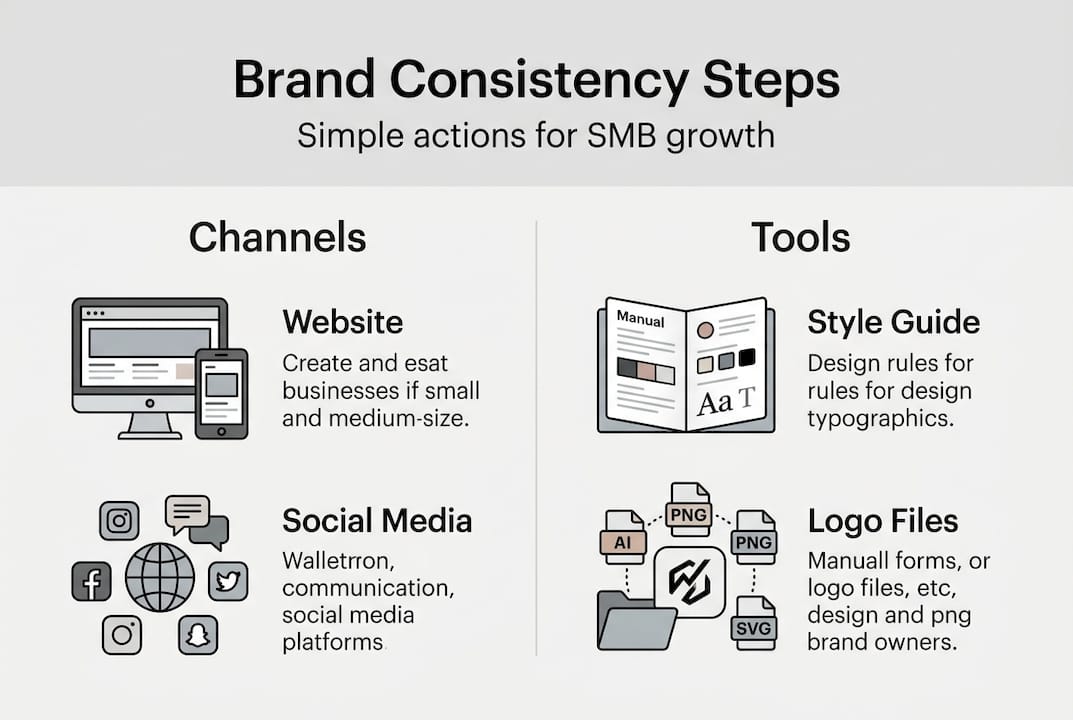
- A simple one-page brand style guide covering logo rules, colors, fonts, and voice
- A centralized asset library (Google Drive or Dropbox works fine for most SMBs)
- Regular team briefings so everyone from your social media manager to your email writer is aligned
Explore branding tips for small business to get a clearer picture of where to start, and use a structured approach to building online brand presence as your foundation.
Pro Tip: Do not wait until you feel “ready” to create a style guide. Even a simple two-page document with your logo files, hex color codes, and a few tone examples will prevent 80% of consistency mistakes your team might make.
How to achieve brand consistency: Practical steps for SMBs
Having a plan is what separates businesses that talk about branding from those that actually benefit from it. Here is a straightforward process you can start this week.
- Audit all your touchpoints. List every place your brand appears: website, social profiles, email signatures, invoices, packaging, ads. Screenshot each one and compare them side by side. Inconsistencies become obvious fast.
- Build a simple style guide. Create a brand style guide covering your visuals, voice, and core messaging. It does not need to be a 50-page document. A clear, usable one-pager beats a detailed guide nobody reads.
- Centralize your assets. Store all approved logos, color codes, fonts, and templates in one shared folder. This removes the guesswork for anyone creating content on your behalf.
- Train your team. Walk anyone who touches your brand through the style guide. This includes freelancers, virtual assistants, and social media managers.
- Use available tools. Platforms like Canva let you set brand kits so every design automatically pulls the right colors and fonts. AI-powered content planners can flag tone inconsistencies before content goes live.
- Schedule quarterly reviews. 90% of consumers expect cross-channel consistency, yet only 30% of businesses with brand guidelines actually use them regularly. A quarterly check-in keeps your brand from drifting.
For SMBs, the fastest wins come from unifying your website, Google Business Profile, and social media graphics first. These are the three places most customers will encounter your brand before making a decision. Dig into online brand building tips and branding tips for success to build momentum from there.
Pro Tip: Set a recurring calendar reminder every 90 days labeled “Brand audit.” Spend 30 minutes checking your top five touchpoints for visual and messaging alignment. Small drift is easy to fix early and expensive to fix later.
Start building a consistent brand with expert digital strategies
You now have a clear picture of what brand consistency is, why it drives real revenue, and how to put it into practice. The next step is making sure you have the right support to execute it without burning out your team or your budget.
At Ibrandmedia, we work specifically with small and medium-sized businesses to close the gap between where their brand is and where it needs to be. From optimizing websites for search to managing your social media management benefits across platforms, our team builds the systems that keep your brand consistent without adding complexity to your day. We provide actionable guides, ongoing support, and automated tools designed for businesses like yours. Reach out today and let us build a plan that fits your goals and your budget.
Frequently asked questions
How often should I update my brand guidelines?
Review your brand guidelines at least once a year, or immediately after a major rebrand or product shift. Only 30% of businesses with guidelines use them regularly, so scheduling a quarterly review keeps yours from becoming outdated.
Can a small business see real ROI from brand consistency?
Absolutely. Businesses that maintain consistent branding see revenue grow by 23 to 33%, and SMB case studies show social engagement can increase by over 1,000% after a focused rebrand effort.
What channels are most important for brand consistency?
Start with your website, social media profiles, and Google Business Profile. 90% of consumers check multiple platforms before buying, so these three need to look and sound like the same business.
Do I need expensive design tools to maintain consistency?
Not at all. Free tools like Canva or a shared Google Drive folder with approved assets are enough for most small businesses to maintain strong visual and messaging consistency.
Is it ever OK to adapt my brand for different audiences?
Yes, and it is actually smart to do so. Keep your core elements locked in, but allow flexibility in tone, layout, and content format to match the norms of each platform or audience segment.
Recommended
- Digital branding drives 23% sales growth for SMBs in 2026 | Ibrandmedia
- Master digital branding fundamentals: 23% revenue boost for SMBs | Ibrandmedia
- Why Consistency Matters in Marketing for Small Business | Ibrandmedia
- What Is Branding – Why It Shapes Small Business Success | Ibrandmedia
- Adward
- Brand Consistency: Building Trust in eCommerce
Recent Comments