
Over 80 percent of American consumers say they feel more loyal to brands that deliver a consistent experience. In a crowded marketplace, even small inconsistencies in marketing can leave customers feeling unsure about what your business represents. Unlocking the full power of your brand means understanding how marketing consistency shapes trust, recognition, and growth for any American small business.
Table of Contents
- Defining Consistency In Modern Marketing
- Brand Identity And Customer Recognition Impact
- Trust Building And Audience Engagement Benefits
- Effects On Conversion Rates And Sales Growth
- Common Pitfalls Of Inconsistent Marketing
Key Takeaways
| Point | Details |
|---|---|
| Consistency in Branding | A unified brand message fosters consumer trust and encourages loyalty across all customer interactions. |
| Impact of Brand Identity | Well-defined brand personas enhance customer recognition and drive loyalty in competitive markets. |
| Trust and Engagement | Establishing trust through consistent communication leads to long-term customer relationships and promotes organic growth. |
| Risks of Inconsistency | Inconsistent marketing undermines brand recognition and can alienate customers, necessitating a cohesive approach across all touchpoints. |
Defining Consistency in Modern Marketing
Modern marketing consistency is more than a buzzword. It represents a strategic approach to presenting a unified brand message across all customer touchpoints. Consumer–brand identification research demonstrates that maintaining consistent brand values directly influences consumer commitment and positive word-of-mouth.
At its core, marketing consistency means delivering a cohesive narrative that resonates with your target audience. This involves synchronizing your visual identity, messaging tone, communication channels, and brand promise. When small businesses maintain a uniform approach, they build trust and credibility. Customers begin to recognize and predict your brand’s communication style, which creates a sense of reliability.
The modern marketing landscape requires businesses to balance uniformity with adaptability. Marketing consistency management strategies highlight the importance of aligning management, merchandise, media, and market technology. This means your brand’s core message stays consistent while your delivery methods evolve with technological and consumer trends. For small businesses, this translates to developing a flexible yet recognizable brand personality that can adjust to different platforms without losing its fundamental identity.
Brand Identity and Customer Recognition Impact
Brand identity is the critical foundation of customer recognition, transforming abstract business concepts into tangible emotional connections. Research examining brand identity initiatives reveals a strong positive association between well-defined brand personas and increased customer loyalty, particularly in competitive market environments.
Customer recognition goes beyond simple visual logos or slogans. It encompasses a comprehensive narrative that communicates your business’s core values, personality, and unique market positioning. When small businesses craft a consistent and authentic brand identity, they create powerful psychological touchpoints that help customers instantly understand and relate to their offerings. Consistent visual elements, communication styles, and brand messaging signal professionalism and reliability.
Brand identity research demonstrates that lifestyle congruence and brand satisfaction significantly influence customer repurchase intentions. Small businesses can leverage this insight by developing a brand identity that resonates with their target audience’s aspirations, values, and lifestyle preferences. This means going beyond superficial marketing tactics and creating a genuine connection that transforms casual customers into loyal brand advocates. By understanding and implementing strategic brand recognition techniques, small businesses can differentiate themselves in crowded marketplaces and build lasting customer relationships.
Trust Building and Audience Engagement Benefits
Trust is the cornerstone of successful marketing for small businesses, transforming casual interactions into long-term relationships. Research exploring brand culture’s impact reveals how a strong brand identity fosters consumer trust by deeply resonating with their core values and personal identity. This connection goes beyond transactional interactions, creating an emotional bond that motivates customers to choose your business repeatedly.
Audience engagement emerges as a critical metric for small business success. When businesses consistently demonstrate reliability, transparency, and authentic communication, they build a powerful psychological framework that attracts and retains customers. This means delivering on promises, maintaining a uniform brand voice across all platforms, and showing genuine understanding of customer needs. Small businesses can achieve this by developing a communication strategy that feels personal, responsive, and genuinely invested in customer experiences.
Electronic word-of-mouth research demonstrates how positive customer interactions can significantly enhance brand attitudes and trust. In the digital age, every customer interaction becomes a potential marketing opportunity. Small businesses can leverage this by encouraging satisfied customers to share their experiences, creating a network of brand advocates who amplify their message. The key is to create memorable, consistent experiences that customers are naturally motivated to discuss and recommend to others. This organic growth strategy transforms traditional marketing approaches, turning customer satisfaction into a powerful, self-reinforcing marketing mechanism.
Effects on Conversion Rates and Sales Growth
Conversion rates represent the critical intersection between marketing strategy and business performance for small enterprises. Color research in branding demonstrates how strategic visual elements can profoundly influence consumer perception and emotional response, directly impacting the likelihood of purchase. Small businesses that understand and implement consistent visual messaging can create psychological triggers that transform casual browsers into committed customers.
Consistent marketing approaches systematically improve sales growth by establishing predictability and reliability in customer interactions. This means maintaining uniform messaging across all platforms, ensuring that your brand’s core value proposition remains clear and compelling. When customers encounter a consistent experience – from website design to social media communication to in-person interactions – they develop a sense of trust that naturally reduces friction in the purchasing process. The psychological comfort of predictability encourages customers to move more confidently through the sales funnel.

Brand logo visibility research highlights how strategic placement and consistent presentation can enhance brand attention and drive sales momentum. For small businesses, this translates into creating a recognizable brand identity that customers can quickly identify and connect with. By developing a cohesive marketing approach that maintains visual, tonal, and messaging consistency, businesses can create a powerful brand recall mechanism. This approach transforms marketing from a mere communication strategy into a sophisticated tool for building customer relationships and driving sustainable sales growth.
Common Pitfalls of Inconsistent Marketing
Brand confusion emerges as the primary risk of inconsistent marketing strategies. Research on brand expression highlights how inconsistent messaging across different platforms can dramatically diminish brand recognition and customer loyalty. Small businesses often unintentionally create fragmented brand experiences by using different visual styles, messaging tones, and communication approaches across websites, social media, print materials, and in-person interactions.
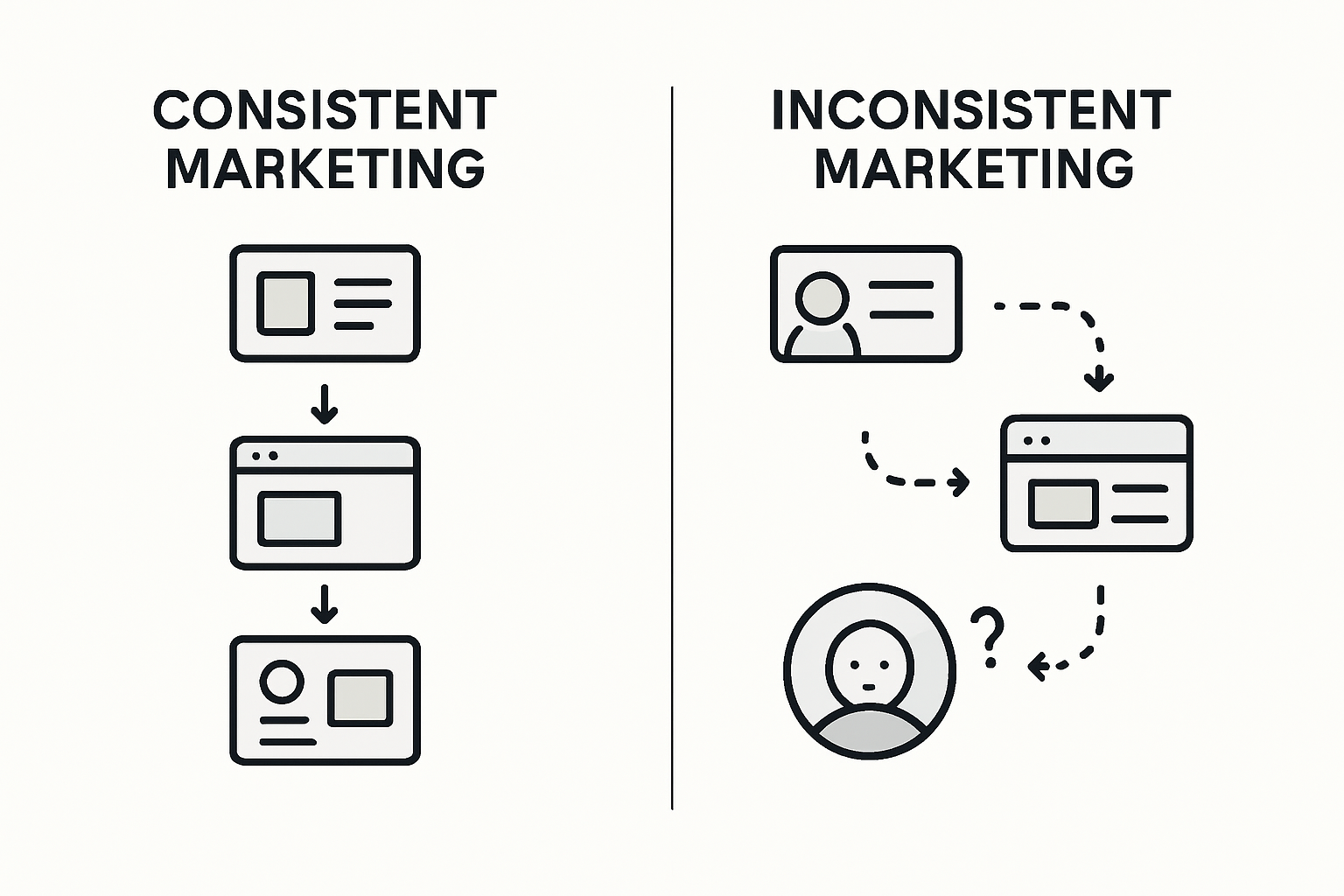
Inconsistent marketing signals unprofessionalism and erodes customer trust. When customers encounter varying brand representations, they struggle to form a coherent understanding of a business’s identity and value proposition. This psychological disconnect can manifest as reduced confidence in the brand, making potential customers hesitant to engage or make purchases. The most vulnerable areas include visual branding elements like logos, color schemes, typography, and messaging tone, where even subtle variations can create a sense of unreliability.
Comprehensive brand identity research demonstrates that marketing inconsistency directly impacts business growth by confusing consumers and undermining loyalty. Small businesses must recognize that every marketing touchpoint represents an opportunity to reinforce their brand narrative. This means developing a comprehensive brand style guide, training team members on consistent communication protocols, and regularly auditing marketing materials to ensure alignment. Successful businesses treat their brand identity as a living ecosystem, where each interaction builds upon and strengthens the overall brand perception, creating a unified and trustworthy market presence.
Elevate Your Small Business with Consistent Marketing That Builds Trust and Drives Sales
Small businesses often struggle to maintain a consistent brand identity that truly connects with customers and boosts conversion rates. This article highlights how inconsistent messaging can create confusion and erode trust, while a unified marketing approach builds credibility and lasting relationships. If you want to overcome these challenges and create a recognizable, reliable brand that resonates with your audience, you need tailored strategies designed to keep your message clear and compelling.
Explore how Uncategorized | Ibrandmedia addresses your unique marketing pain points with customized SEO, local marketing, social media management, and mobile-friendly design all focused on delivering fast results.
Don’t let inconsistency hold your small business back. Partner with ibrand.media today to craft a cohesive brand experience that builds trust, engages your audience, and accelerates sales growth. Visit our site now and request a personalized marketing plan that sets you apart immediately.
Frequently Asked Questions
What is marketing consistency?
Marketing consistency refers to a strategic approach that ensures a unified brand message across all customer touchpoints, including visual identity, messaging tone, and communication channels.
Why is brand identity important for small businesses?
Brand identity is crucial for small businesses as it transforms abstract concepts into emotional connections, fostering customer recognition, loyalty, and trust in a competitive market.
How can inconsistent marketing affect customer trust?
Inconsistent marketing can lead to brand confusion, diminish customer trust, and create a psychological disconnect that discourages customer engagement and loyalty.
What are the benefits of maintaining a consistent marketing strategy?
Maintaining a consistent marketing strategy enhances trust and credibility, improves audience engagement, increases conversion rates, and drives sales growth by creating predictable and reliable customer interactions.
Recommended
- Creating a Brand for Small Businesses: A 2025 Step-by-Step Guide | Ibrandmedia
- Creating a Brand for Small Businesses: A 2025 Step-by-Step Guide | Ibrandmedia
- DIY Digital Marketing Tips for Small Business Success 2025 | Ibrandmedia
- Content Marketing Explained: Understanding Its Core Principles | Ibrandmedia
Recent Comments