
TL;DR:
- Choosing the right keywords begins with defining the page’s business goal and crafting 3–5 seed terms.
- Then, expand these with tools and real queries, filter by intent and business fit, and prioritize long-tail clusters.
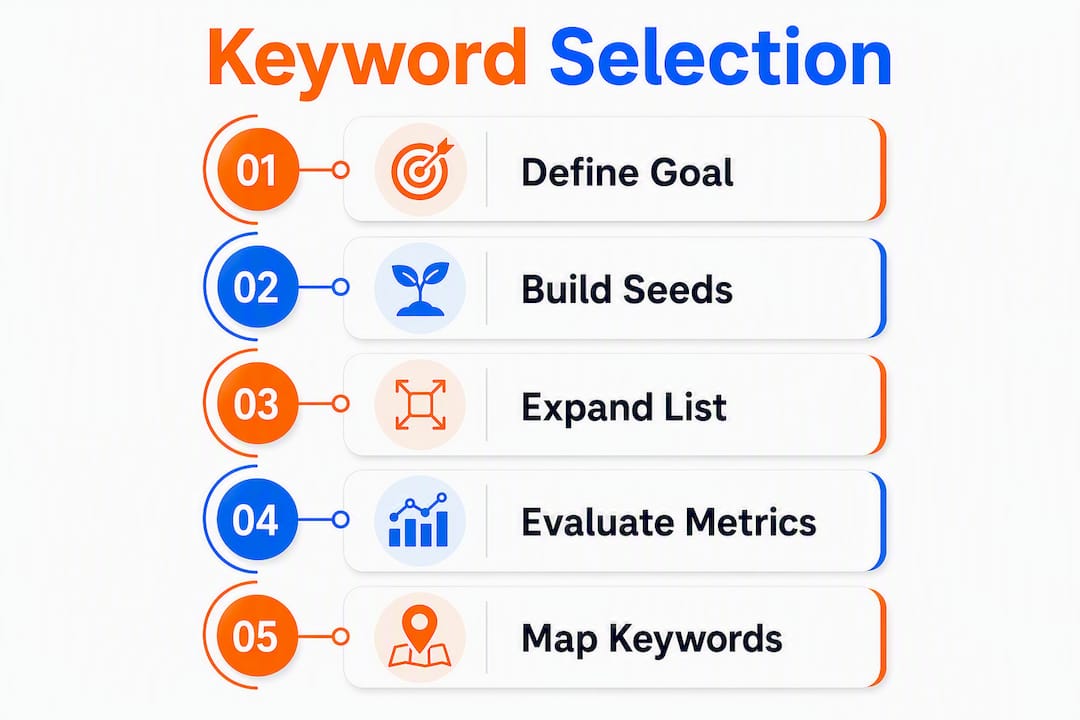
Choosing the right keywords comes down to one workflow: define the page’s business goal, write 3–5 seed terms, expand them with tools and real queries, filter by intent and business fit, prioritize long-tail clusters for quick wins, then map one primary keyword per page. That sequence works whether you’re running an SEO blog, a product landing page, a paid ad campaign, or an academic manuscript. A local bakery, for example, might start with the seed “cupcakes,” expand to “gluten-free cupcakes near me” using Google Autocomplete, confirm transactional intent from the SERP, and map that phrase to a dedicated product page. The whole process takes a few hours the first time and gets faster every round.
Here’s what that workflow covers at a glance:
- Define the goal first. Know whether the page is meant to inform, compare, or convert before you open any tool.
- Build seeds from your own business language, then expand with Google Keyword Planner, Semrush, or Ahrefs.
- Filter by intent and business fit, not just search volume. A keyword that drives buyers beats one that drives browsers.
- Prioritize long-tail terms. Most keywords get 10 or fewer monthly searches, which means the long tail is where most of the specific, high-converting traffic lives.
- Map one primary keyword per page to prevent cannibalization and keep your content focused.
- Track impressions, clicks, and conversions in Google Search Console and GA4, then iterate.
Table of Contents
- How to choose keywords that actually match your goal
- How to build seed keywords and expand them into a full list
- Which metrics actually matter when evaluating keywords
- How to prioritize keywords and map them to pages
- How to audit the live SERP and competitor footprints before committing
- Where to place keywords and how to track results after publishing
- Common mistakes that waste your keyword research effort
- Small-business keyword research: a 30-day checklist
- Key Takeaways
- The part most guides skip
- What Ibrand can do for your keyword strategy
- Useful sources and tools
- FAQ
How to choose keywords that actually match your goal
Before you open a keyword tool, answer one question: What is this page supposed to do? That answer determines every keyword decision that follows. A page built to sell is not the same as a page built to educate, and the keywords that work for one will actively hurt the other.
Defining the page’s business outcome first is the single most important step in keyword selection. A low-volume keyword that converts is almost always more valuable than a high-volume keyword that doesn’t fit the funnel.
The intent-first filter
Every keyword falls into one of four intent categories:
- Informational: The user wants to learn. (“how does sourdough fermentation work”)
- Navigational: The user wants a specific site or brand. (“King Arthur Flour sourdough recipe”)
- Commercial: The user is comparing options before buying. (“best bread flour for sourdough”)
- Transactional: The user is ready to act. (“buy bread flour online”)
Classify each candidate keyword by intent before you run any tools. Sending a transactional keyword to a blog post, or an informational keyword to a product page, is one of the most common and costly mismatches in SEO.
Three questions to ask before committing to a keyword
- What business outcome does this page support? (Lead, sale, email signup, brand awareness?)
- What funnel stage is the reader at? (Awareness, consideration, or decision?)
- Does the page type match the intent? (A product page can’t rank for “what is X” if the SERP is full of guides.)
Reading the SERP to confirm intent
The SERP is the fastest intent-confirmation tool you have. If the top results are product pages, the intent is transactional. If they’re definitions or how-to guides, it’s informational. If they’re listicles comparing brands, it’s commercial. Look for:
- Dominant content format (guides vs. product pages vs. videos)
- Featured snippets (signals that a direct answer wins; optimize for the snippet format)
- Shopping results (strong transactional signal; organic space is limited)
- People Also Ask boxes (reveals related informational sub-questions worth covering)
For small businesses building a search presence, matching intent to page type is the lever that turns keyword rankings into actual revenue. Getting the intent wrong means traffic that bounces, not traffic that buys.
How to build seed keywords and expand them into a full list
Seed keywords are the trunk of your keyword tree. Every long-tail phrase you eventually target grows from them, which means a weak seed list produces a weak keyword strategy. Choose seeds that reflect your actual product categories, service names, or research topics.

Where to find seed keywords
The best seeds come from sources closer to your customers than any tool:
- Product and service categories you already use internally (“wedding photography,” “HVAC repair,” “gluten-free bakery”)
- Support tickets and sales call transcripts — the exact phrases customers use when they describe their problem
- Forum threads and Reddit communities where your audience asks questions
- Competitor H1 headings on pages that rank for terms you want
- Academic abstracts (for researchers) — the controlled vocabulary in published papers in your field
Step-by-step expansion method
- Enter each seed into Google Autocomplete and note every suggested completion.
- Search the seed and mine the People Also Ask box for question-format long-tail variants.
- Run seeds through Google Keyword Planner to get volume ranges and CPC data.
- Use Semrush Keyword Magic Tool to generate hundreds of related phrases grouped by topic cluster.
- Run the same seeds through Ahrefs Keywords Explorer for precise volume estimates and parent topic groupings.
- Check Moz Keyword Explorer for SERP analysis and organic CTR estimates.
- Pull your existing Google Search Console data to find terms you already rank for in positions 5–20 — these are your fastest wins.
Pro Tip: Mine the “searches related to” section at the bottom of a Google results page. It surfaces phrases real users type after an initial search, which often reveals the next logical step in the buyer’s journey.
Tool comparison: when to use which
| Tool | Best for | Strengths | Limitations |
|---|---|---|---|
| Google Keyword Planner | CPC data, ad campaign seeds | Free, direct from Google, accurate CPC | Volume shown as ranges, not exact figures; ad-focused |
| Semrush | Large idea sets, clustering | Keyword Magic Tool, topic clusters, AI Overview checks | Paid subscription required for full access |
| Ahrefs | Precise volume, competitor gap analysis | Keywords Explorer, parent topic grouping, GSC integration | Paid; steeper learning curve for beginners |
| Moz | SERP analysis, organic CTR | Keyword difficulty with CTR data, beginner-friendly UI | Smaller keyword database than Semrush or Ahrefs |
Each tool plays a different role. Google Keyword Planner is the right starting point for CPC and high-level discovery. Semrush and Ahrefs give you the precision and idea volume you need to build a full strategy.
Three worked examples: seed to long-tail
- SEO blog: Seed “keyword research” → long-tail “how to do keyword research for a new website with no traffic”
- Product page: Seed “running shoes” → long-tail “lightweight trail running shoes for wide feet men”
- Academic manuscript: Seed “cognitive behavioral therapy” → long-tail “cognitive behavioral therapy outcomes for adolescent anxiety disorders meta-analysis”
Notice how each long-tail phrase is specific enough to signal exactly who the searcher is and what they need. That specificity is what makes long-tail keywords convert at higher rates despite lower search volumes.
Which metrics actually matter when evaluating keywords
Volume is the first number everyone looks at. It’s also the most overrated. A keyword with 50,000 monthly searches that doesn’t match your page’s purpose is worthless. A keyword with 400 monthly searches from buyers ready to spend is worth a great deal. Here’s how to read the metrics that actually move the needle.
The core metrics and what they tell you
| Metric | What it measures | How to use it |
|---|---|---|
| Search volume | Monthly searches for the exact phrase | Use as a relative gauge, not an absolute target; compare within your niche |
| Keyword difficulty (KD) | Estimated effort to rank on page one | Combine with your domain authority; a KD of 30 means something different for a new site vs. an established one |
| CPC | What advertisers pay per click | High CPC = commercial intent; use as a tiebreaker when two keywords look similar |
| Intent | Informational / commercial / transactional / navigational | Must match your page type — this overrides every other metric |
| SERP features | Snippets, shopping, PAA, AI Overviews | Signals click distribution; a snippet-dominated SERP may deliver fewer organic clicks |
| Opportunity / priority | Low-hanging fruit vs. long-term target | Score by business potential × ranking confidence |
Why volume alone misleads you
A keyword with 10,000 monthly searches sounds attractive. But if the SERP is dominated by a featured snippet that answers the question completely, or by an AI Overview that removes the need to click, the actual traffic available to you is a fraction of that number. Industry research puts zero-click searches at 58.5% for certain query types, meaning more than half of searches on those terms never produce a click to any website.
Volume is a ceiling, not a promise.
How CPC signals commercial intent
High CPC is a reliable indicator of commercial intent. When advertisers are willing to pay $8–$15 per click, they’ve done the math: those clicks convert. If you’re choosing between two keywords with similar volume and difficulty, the one with higher CPC is almost always closer to purchase intent. Use it as a tiebreaker.
Reading keyword difficulty in context
Difficulty scores are one input, not the whole answer. A KD of 45 might be achievable for a domain with strong topical authority in that niche, and completely out of reach for a brand-new site. Always check the actual pages ranking in the top 10: their domain rating, backlink count, and content format tell you more than the score alone.
Pro Tip: If your site is under 12 months old or has a domain rating below 30, filter your keyword list to targets with a KD under 20. You’ll rank faster, build topical authority, and earn the backlinks that eventually let you compete for harder terms.
Key signals to weigh together
- High volume + low difficulty + commercial intent = pursue aggressively
- High volume + high difficulty + informational intent = build a long-term content asset, not a quick win
- Low volume + high CPC + transactional intent = strong candidate for a product or service page
- Any intent + SERP dominated by ads or shopping = consider whether organic is the right channel at all
How to prioritize keywords and map them to pages
A list of 200 keywords is not a strategy. A prioritized map of 20 keywords, each assigned to a specific page with a clear KPI, is. The goal of this step is to turn your expanded list into a working roadmap.
The priority matrix
Score each keyword on two dimensions:
- Business potential: How directly does ranking for this term drive revenue, leads, or another measurable outcome?
- Ranking confidence: Given your current domain authority, content resources, and the SERP competition, how likely are you to reach page one within 90 days?
Plot keywords into four buckets:
- High potential + high confidence = publish now. These are your low-hanging fruit.
- High potential + low confidence = long-term investment. Build toward these with supporting content.
- Low potential + high confidence = fill-in content. Worth doing if resources allow, but not a priority.
- Low potential + low confidence = drop. Don’t waste time here.
The one primary keyword per page rule
Every page on your site should have one primary keyword. Supporting keywords (semantic variants, related phrases) can appear naturally throughout the content, but the page is optimized for one term. This prevents keyword cannibalization, where two of your own pages compete for the same query and split ranking signals.
Semrush recommends grouping keywords into semantic clusters that share the same intent and can be covered on a single page, rather than creating separate pages for every slight variation. The result is more efficient content that serves both traditional search and AI-driven responses.
Worked example: three keywords mapped to three pages
| Page type | Primary keyword | Supporting keywords | Intent | KPI |
|---|---|---|---|---|
| Awareness article | “what is keyword research” | “keyword research basics,” “how keyword research works” | Informational | Time on page, email signups |
| Comparison article | “best keyword research tools” | “Semrush vs Ahrefs,” “free keyword tools” | Commercial | Affiliate clicks, demo requests |
| Product landing page | “keyword research service for small business” | “SEO keyword strategy,” “local keyword research” | Transactional | Form submissions, calls |
Notice that the awareness article targets a broad informational term, while the product page targets a specific transactional phrase. Each page has a different KPI because each page serves a different stage of the funnel. Mapping keywords this way also makes it obvious when you’re missing a page type entirely.
For small business SEO, this mapping exercise often reveals that most of a site’s pages target the same funnel stage, leaving the awareness and consideration stages completely uncovered.
How to audit the live SERP and competitor footprints before committing
You’ve scored and prioritized your keywords. Before you start writing, spend 10 minutes on the live SERP for each target. What you find there will either confirm your choice or save you months of wasted effort.
SERP audit checklist
Run through these checks for every keyword you plan to target:
- Dominant content format: Are the top results long-form guides, product pages, videos, or news articles? Your content needs to match the format the SERP rewards.
- Featured snippet: Is there one? What format does it use (paragraph, list, table)? If you can answer the query more directly and in the right format, you can capture it.
- People Also Ask: What sub-questions appear? These are content gaps you should address on the page.
- Shopping results: If shopping ads dominate above the fold, organic traffic for that term may be minimal.
- AI Overviews: Does Google’s AI answer the query directly at the top? If so, zero-click risk is high and you should optimize for being cited in the AI answer rather than just ranking organically.
- Paid ad density: Four ads above organic results means the commercial intent is high but organic visibility is limited. Consider whether paid is a better channel for this term.
Reading competitor signals
Look at the pages actually ranking in positions 1–5:
- Content format and length: If top results are long-form guides, an 800-word post likely won’t outrank them. Match or exceed the depth the SERP rewards.
- Backlink profile: Use Ahrefs or Moz to check how many referring domains the top pages have. A page with 500 backlinks from authoritative sites is a different challenge than one with 12.
- Brand-owned results: If a major brand owns positions 1–3 and also has a featured snippet, the realistic organic opportunity for an independent site is positions 4–10 at best.
- Content freshness: Are top results recently updated? Some SERPs reward recency heavily; others are stable for years.
When to drop a keyword
Drop it when: the top 5 results are all from brands with domain ratings 40+ points above yours, the SERP is entirely shopping or paid, or a featured snippet plus AI Overview answers the query so completely that there’s no reason to click through. Choose a more specific long-tail variant instead, or target a different page type (a comparison or FAQ page rather than a direct answer page).
A quick gap analysis using Google Search Console’s Performance report plus one check in Ahrefs or Semrush will surface the terms where you’re already close to ranking. Those are almost always better targets than starting from zero.
Where to place keywords and how to track results after publishing
Choosing the right keyword is half the job. Placing it correctly and measuring what happens next is the other half.
On-page placement priorities
- Title tag: Include the primary keyword as close to the front as readability allows. This is the single highest-impact placement.
- H1 heading: Should match or closely mirror the title tag’s keyword.
- First paragraph: Use the primary keyword naturally within the first 100 words.
- URL slug: Keep it short and include the primary keyword (e.g.,
/keyword-research-guide). - Meta description: Include the keyword and a clear benefit or call to action. It doesn’t directly affect rankings, but it drives click-through rate.
- Subheadings (H2/H3): Use supporting keywords and semantic variants naturally. Don’t force the primary keyword into every subheading.
- Image alt text: Describe the image accurately; include the keyword when it fits naturally.
- Structured data: For product pages, FAQs, and how-to content, add the relevant schema markup to increase your chances of earning rich results.
For a practical walkthrough of on-page SEO writing that ties keyword placement to content structure, Ibrand’s guide covers the mechanics in detail.
Minimal tracking dashboard
After publishing, track these metrics in Google Search Console and GA4:
- Impressions: Is Google showing your page for the target keyword?
- Clicks: Are impressions converting to visits?
- CTR (click-through rate): If impressions are high but CTR is low, test a more compelling title tag and meta description.
- Average position: Are you moving toward page one, or stalling?
- Conversions and assisted conversions: Is the traffic doing what you built the page to do?
When to update or promote
Check performance at 30 days and 90 days. Rising impressions with low CTR means the page is visible but the title or meta isn’t compelling enough. Flat impressions after 60 days usually means the page needs more backlinks or internal links pointing to it. A page stuck at position 8–15 after 90 days is a candidate for a content refresh: update the depth, format, and supporting keywords based on what the current SERP rewards.
Optimizing your content isn’t a one-time event. The pages that hold rankings are the ones that get revisited when the SERP shifts.
Common mistakes that waste your keyword research effort
Most keyword research failures aren’t tool failures. They’re judgment failures. Here are the patterns that consistently waste time and budget.
The top mistakes
- Chasing volume over intent. A keyword with 50,000 monthly searches that doesn’t match your page type will drive traffic that bounces immediately. Intent fit beats volume every time.
- Misclassifying intent. Sending a transactional keyword to a blog post, or an informational keyword to a product page, is the most common and most expensive mismatch in SEO.
- Ignoring zero-click and AI Overview results. If the SERP answers the query before anyone clicks, ranking on page one may deliver almost no traffic. Check for AI Overviews and featured snippets before committing.
- Failing to map keywords to pages. A list of target keywords with no page assignment is not a strategy. Every keyword needs a home, and that home needs to be the right page type.
- Creating cannibalizing pages. Two pages targeting the same primary keyword split your ranking signals and confuse Google about which page to show. One primary keyword, one page.
- Ignoring your existing rankings. Mining Google Search Console for terms where you already rank in positions 5–20 is almost always faster than building new content from scratch.
Red-flag SERP signals and what to do about them
- Brand-owned result in position 1 with a featured snippet: The brand will defend that position aggressively. Target a more specific long-tail variant or a different angle (comparison, FAQ, use-case page).
- Shopping-dominated SERP: Organic results are pushed below the fold. Consider whether paid search is a better channel, or target a more informational variant of the query.
- Heavy paid ad density (4+ ads): High commercial intent, but organic space is compressed. Either compete on a long-tail variant or run a paid campaign alongside organic.
- AI Overview that fully answers the query: Optimize the page to be cited within the AI answer rather than just ranking below it. Use clear, direct answers in the first paragraph and structured data where applicable.
Small-business keyword research: a 30-day checklist
This plan is built for solo practitioners and small teams who need a first, measurable keyword campaign without a large agency budget. Run it once and you’ll have a repeatable process.
The core checklist
- [ ] Identify 5–10 seed keywords from your product/service categories and customer language
- [ ] Expand each seed using Google Autocomplete, People Also Ask, and one paid tool (Semrush or Ahrefs)
- [ ] Classify every candidate keyword by intent (informational, commercial, transactional)
- [ ] Score each keyword on business potential and ranking confidence; select your top 10
- [ ] Map each of the top 10 to a specific page (existing or new), with one primary keyword per page
- [ ] Publish or update the pages, placing keywords in title tags, H1s, first paragraphs, and URLs
- [ ] Promote each page with internal links and at least one external outreach or social push
- [ ] Measure impressions, clicks, CTR, and conversions at 30 days in GSC and GA4
30-day weekly roadmap
Week 1: Seed discovery and tool expansion. Pull your GSC data for existing near-win positions. Build a raw list of 50–100 candidates.
Week 2: Intent classification and scoring. Filter the list to your top 10–15 by business potential and ranking confidence. Map each to a page.
Week 3: Content creation or refresh. Write or update pages with correct keyword placement, matching format to the SERP, and adding structured data where relevant.
Week 4: Publish, promote, and set up tracking. Launch the pages, add internal links, and configure your GSC and GA4 dashboard to track the metrics that matter.
When to bring in an agency
If your team can’t dedicate 4–6 hours per week to keyword research and content production, the 30-day timeline stretches into 90 days or longer. At that point, the cost of slow execution (lost rankings, competitors filling the gaps) often exceeds the cost of professional help. Ibrand’s SEO services for small businesses are built specifically for this tradeoff: faster execution, lower cost than a full in-house hire, and a clear 30-day audit-to-implementation path.
Key Takeaways
Choosing the right keywords requires matching intent to page type first, then filtering by business fit and ranking confidence rather than chasing raw volume.
| Point | Details |
|---|---|
| Intent before volume | Classify every keyword as informational, commercial, or transactional before checking search volume. |
| Long-tail focus | 94.74% of keywords get 10 or fewer monthly searches; long-tail terms drive specific, high-converting traffic. |
| One keyword per page | Assign one primary keyword per page to prevent cannibalization and keep ranking signals focused. |
| CPC as a tiebreaker | High CPC signals commercial intent; use it to choose between two otherwise similar keyword candidates. |
| Ibrand’s 30-day path | Ibrand offers a structured audit-to-implementation program for small businesses ready to act on keyword research. |
The part most guides skip
Most keyword guides treat research as a one-time event. Run the tools, pick the terms, publish the content, done. That’s not how it works in practice, and it’s not how the sites that actually hold rankings operate.
The real discipline is iteration. A keyword that looked promising at the research stage sometimes turns out to be zero-click dominated once you check the live SERP. A term you dismissed as too competitive sometimes has a long-tail variant sitting at position 11 in your GSC data, one content refresh away from page one. The tools give you a starting point. The SERP and your own performance data give you the real answer.
There’s also a tendency to over-index on keyword difficulty scores. They’re useful, but they’re averages. A KD of 40 might be achievable for a site with strong topical authority in that niche and completely out of reach for a generalist site. The only way to know is to look at the actual pages ranking: their backlink counts, their content depth, their domain ratings. That manual check takes five minutes and saves months of wasted effort.
The shortcut most small teams miss: pull your GSC data before you open any paid tool. You almost certainly have terms ranking in positions 5–20 that a title tag update and a content refresh could push to page one. That’s faster, cheaper, and more predictable than building new content from scratch. Use CPC as a tiebreaker when two terms look equally attractive. And when the SERP is dominated by an AI Overview, stop trying to outrank it and start trying to be cited in it. Those are the three moves that consistently produce results faster than the standard research-and-publish cycle.
What Ibrand can do for your keyword strategy
Keyword research is where most small businesses stall. The tools are accessible, but the judgment calls — which terms to drop, which pages to build, how to read a SERP for real opportunity — take time to develop. Ibrand cuts that learning curve with a structured 30-day engagement: a keyword audit that surfaces your fastest wins from existing GSC data, a prioritized list of 10–20 targets mapped to specific pages, and full implementation support covering on-page optimization, content structure, and tracking setup.
The result is a working keyword strategy, not a spreadsheet of ideas. Clients typically see measurable movement in impressions and average position within the first 30 days, with conversion-focused pages producing leads before the 60-day mark. Ibrand’s small business SEO program is priced for SMB budgets and built around the same intent-first, business-fit methodology this guide covers. If you’re ready to move from research to results, request a keyword audit and get a prioritized action plan within five business days.
Useful sources and tools
| Tool / Source | Best for | Notes |
|---|---|---|
| Google Keyword Planner | CPC data, ad campaign seeds | Free with a Google Ads account; shows volume ranges rather than exact figures; ideal starting point for paid campaigns |
| Semrush | Large keyword idea sets, topic clustering | Keyword Magic Tool generates thousands of grouped variants; AI Overview and SERP feature checks built in |
| Ahrefs | Precise volume estimates, competitor gap analysis | Keywords Explorer and parent topic grouping; GSC integration for near-win identification |
| Moz Keyword Explorer | SERP analysis, organic CTR estimates | Beginner-friendly interface; smaller database than Semrush or Ahrefs but strong difficulty-plus-CTR data |
| Google Search Console | Existing ranking opportunities | Free; surfaces terms you already rank for in positions 5–20; fastest source of quick wins |
| Seminole State Library: Research Foundations | Academic keyword selection | Practical guidance on choosing search terms for database research and scholarly writing |
| Utah State University: Choosing Keywords | Academic and database research | Step-by-step keyword selection for library database searches; useful for researchers and students |
| NLM MeSH Browser | Medical and life-science keyword vocabulary | Controlled vocabulary for PubMed searches; authoritative source for biomedical keyword standardization |
FAQ
How do I choose the right keyword for a page?
Start by defining what the page is supposed to do (inform, compare, or convert), then match a keyword whose intent aligns with that goal. Confirm the match by checking the live SERP: if the top results are the same page type you’re building, you’ve found the right keyword.
How do I pick keywords when I’m starting from scratch?
Begin with 3–5 seed terms drawn from your product or service categories, then expand using Google Autocomplete, People Also Ask, and a tool like Google Keyword Planner or Ahrefs. Filter the resulting list by intent and business fit before worrying about volume or difficulty.
How do I find keywords I’m already close to ranking for?
Open Google Search Console, go to the Performance report, and filter for queries where your average position is between 5 and 20. Those are your near-win terms. A content refresh and stronger title tag often move them to page one faster than any new content you could publish.
How do I select the best keyword when two options look similar?
Use CPC as a tiebreaker. The keyword with higher CPC is almost always closer to purchase intent, which means it’s more likely to drive revenue even if the volume is slightly lower. Also check which one has a less competitive SERP: fewer brand-owned results and lower backlink counts on the top pages.
Can Ibrand help with keyword research for a small business?
Yes. Ibrand’s SEO program for small businesses includes a keyword audit, a prioritized target list, and full implementation support. The process runs on the same intent-first methodology covered in this guide and is designed to produce measurable results within 30 days.
Recent Comments