
TL;DR:
- Building venue brand awareness in 90 days involves optimizing your Google Profile, capturing attendee contacts, and hosting signature events. Consistent content, clear messaging, and strategic partnerships strengthen recognition and nurture audience loyalty over time. Tracking key metrics like list growth and repeat attendance predicts long-term success without a big marketing budget.
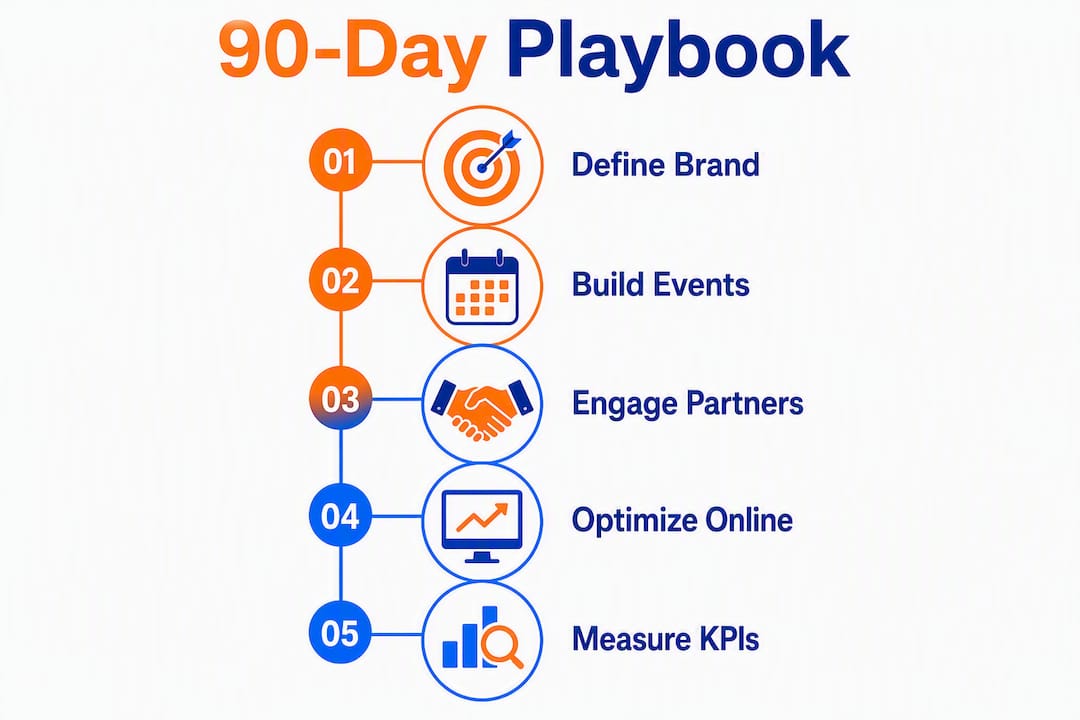
Increasing venue brand awareness is a system you can build in 90 days. The three moves that matter most right now: optimize your Google Business Profile so planners can find you, capture every attendee’s contact info at the door, and schedule one signature owned event. Everything else compounds from there.
**Your first 7 days:
**
- Claim and fully complete your Google Business Profile (hours, photos by event type, booking link)
- Set up a text-to-join sign at the entrance and add a list-capture step to your checkout flow
- Write your venue’s one-line identity (see Section 2 below)
Days 8–30:
- Publish at least three event-focused posts on your GBP and social channels
- Reach out to two local partners (a photographer, a florist, a promoter) about a co-hosted event
- Add UTM parameters to every link you share so you know what drives traffic
Days 31–90:
- Host your first signature owned event and capture contacts at the door
- Launch a simple email sequence to new subscribers (welcome, upcoming events, early-access offer)
- Run a 2-week Meta awareness ad targeting your zip code and event type
- Review your KPIs: list growth, repeat-attendance rate, and cost per booking by channel
- Adjust programming and promotion based on what the numbers show
None of these require a big budget. The venues that build an owned local audience sell more shows without paying for reach every single time.
Table of Contents
- What does your venue actually stand for?
- How to build signature events that make your room a destination
- Which local partners actually move the needle for venues?
- How do planners and guests find your venue online?
- What social content actually converts attention into bookings?
- How do you design packages that shorten the path to “yes”?
- What KPIs tell you if your venue’s awareness is actually growing?
- How do you turn one-off event pushes into a compounding system?
- Key Takeaways
- The part most venue owners get backwards
- How Ibrand helps venues grow recognition and fill their calendar
- Useful sources and further reading
- FAQ
What does your venue actually stand for?
Most venues skip this step and pay for it later with unfocused marketing that attracts the wrong crowd. A sharply defined brand identity is the fastest way to stand out in a crowded local market, and it filters your audience before they ever walk through the door.

Start by picking a defensible niche. Not “we host all events” but something specific: intimate jazz nights for 80 people, corporate off-sites with full AV, or outdoor weddings with a rustic-industrial edge. The narrower the niche, the stronger the referral network you build around it.
Once you have the niche, build three messaging anchors:
- Headline UVP: One sentence that says what you offer and for whom. (“The only rooftop venue in [City] built for live music and private buyouts.”)
- Vibe words: Two or three adjectives that describe the feeling of being there. (“Warm, raw, electric.”)
- Booking pitch: One sentence a planner can repeat. (“We handle setup, AV, and catering coordination so you focus on the event.”)
“Emotional connection and a distinct vibe outperform generic amenity lists. Venues should sell the emotion of the event, not the square footage.” — Eventbrite
Visual consistency matters just as much as the words. Your logo, color palette, and photography style should look the same on Instagram, your website, and the PDF you email to planners. A quick checklist: consistent logo placement on all materials, a defined color palette used in every graphic, and event photos shot in the same style (lighting, angle, crop). Good visual storytelling in branding is what makes a venue feel like a brand rather than a rental space.
Mini workshop: Write this sentence and pin it above your desk: “[Venue name] is the [niche descriptor] venue in [city] for [target customer] who want [core feeling or outcome].” If you can’t fill in every blank without hesitating, your brand identity needs more work before you spend a dollar on ads.
Pro Tip: Test your identity on the next five inquiries. If the same type of client keeps calling, your messaging is working. If you’re getting random inquiries that don’t fit, revisit your vibe words and headline UVP.
How to build signature events that make your room a destination
Owned programming is the single best way to build habit and repeat attendance. Instead of promoting someone else’s show, you create the reason people come back.
Types of signature programming:
- Recurring nights (monthly jazz series, weekly open-mic): Build calendar habit and give regulars a reason to subscribe to your list.
- Open houses for planners: Invite wedding and corporate planners for a walk-through with food and drink. One extra wedding booking per month from better local visibility can significantly increase annual revenue for some venues.
- Pop-ups and collabs: Partner with a local chef, artist, or brand for a one-night event that draws their audience into your room.
- Genre or theme series: A “Rooftop Sunsets” summer series or a “Holiday Corporate Happy Hour” package creates a brand within your brand.
Event planning checklist:
- Lock the date and format at least 6 weeks out
- Confirm vendors, AV, and staffing 4 weeks out
- Send the first email/SMS to your list 3 weeks out
- Post on GBP and social 2 weeks out, then again 3 days before
- Set up door capture (text-to-join sign, QR code, or tablet sign-up)
- Send a post-event email within 24 hours with a next-event teaser
Promotion sequence for an owned event:
- Email/SMS your existing list first (they convert at the highest rate)
- Post on your GBP as an event listing
- Share on Instagram and Facebook with a short video teaser
- Reach out to your partner network for cross-promotion
- Run a targeted Meta ad in the final 10 days if ticket sales need a push
Pro Tip: At the door, have one staff member dedicated to list capture. A simple sign that says “Text EVENTS to [number] for early access to our next show” converts first-timers into repeat buyers better than any social follow.
Which local partners actually move the needle for venues?
The right partnerships put your venue in front of pre-qualified audiences without paid media costs. The key is choosing partners whose audiences overlap with yours, not just whoever is nearby.
Partners worth pursuing:
- Local businesses: — A nearby restaurant, hotel, or boutique can cross-promote to their customer list in exchange for a mention or a package deal.
Short outreach email template:
Follow up once after 5 days if you don’t hear back. Track every outreach in a simple spreadsheet: partner name, date contacted, response, outcome, and bookings attributed.
Pro Tip: Host a quarterly “familiarization tour” for local planners. Feed them, show them the space in different setups, and give them a printed one-pager with your packages. Planners who have been inside your venue recommend it far more often than those who only saw photos.
How do planners and guests find your venue online?
Your Google Business Profile is the most important local SEO asset you have. Venues with optimized GBP listings and many photos see far higher call and tour-request volumes than those with sparse profiles. Listings with more than 100 photos and virtual tours get higher engagement and more calls, and 360-degree tours increase the time planners spend interacting with a listing.
GBP checklist:
- Complete every field: hours, phone, website, booking link, service area
- Upload photos organized by event type (weddings, corporate, concerts, private parties)
- Add a virtual tour or 360-degree walkthrough
- Post a GBP event or update at least twice a month
- Reply to every review within 48 hours, positive or negative
For your event pages, use descriptive titles with long-tail modifiers (“outdoor wedding venue with rooftop in [City]”) and add event schema markup so Google can display your events in search results. A venue SEO strategy that combines GBP optimization with structured event pages consistently outperforms venues that rely on social alone.
Priority website fixes:
- Mobile load speed under 3 seconds (test with Google PageSpeed Insights)
- A clear “Request a Tour” or “Check Availability” CTA above the fold on every page
- Photo galleries organized by event type, not just a generic grid
- A dedicated page for each event category you host (weddings, corporate, social events)
UTM tracking: Add UTM parameters to every external link (GBP, directories, partner sites, social bios). Use a consistent naming convention: utm_source=gbp&utm_medium=listing&utm_campaign=venue-awareness. Check Google Analytics monthly to see which sources drive actual booking inquiries, not just traffic.
Running Meta for demand generation and Google for demand capture typically reduces cost per booking by 35–50% compared with a single-channel approach. Meta builds demand; Google captures it.
What social content actually converts attention into bookings?
Short-form video is the highest-ROI content format for venues right now. Event highlights, backstage clips, and artist takeovers drive discovery and can be repurposed directly into paid ads without additional production cost.
Priority content types:
- Event highlight Reels (30–60 seconds): Capture the energy of the room, not just the stage.
- Behind-the-scenes setup clips: Show the transformation from empty room to full event. Planners love this.
- Artist or vendor takeovers: Let a performer or caterer post from your account for a day. Their audience follows.
- Post-event recaps: A 90-second video recap with attendee reactions is shareable and builds FOMO.
Simple weekly content calendar:
| Day | Content | Owner |
|---|---|---|
| Monday | Behind-the-scenes from last event | Social manager |
| Wednesday | Upcoming event post or story | Booking manager |
| Friday | Short Reel or highlight clip | Staff or contractor |
| Sunday | UGC repost or attendee photo | Social manager |
To generate UGC, create a branded hashtag and display it prominently at the venue. Offer a small incentive (early access, a drink ticket) for guests who post and tag you. That content can then be repurposed into paid ads with social media management tools that pull top-performing organic posts into ad campaigns.
Pro Tip: At every event, spend 10 minutes capturing three specific shots: the room at capacity from a high angle, one close-up of a guest reaction, and a 15-second walkthrough of the space during setup. Those three clips cover 80% of your content needs for the following week.
How do you design packages that shorten the path to “yes”?
The goal of a package is to remove friction, not just bundle services. When a planner can see exactly what they get and what it costs, the decision gets faster.
| Package Type | What’s Included | Typical Add-Ons |
|---|---|---|
| Wedding | Venue rental, tables/chairs, basic AV, coordinator on-site | Catering, floral, photo booth, extended hours |
| Corporate event | Full AV setup, projector, Wi-Fi, breakout space | Catering, branded signage, live streaming |
| Private party | Venue rental, bar setup, sound system | DJ, custom lighting, photo backdrop |
Pricing tips:
- Present value before price. Lead with what the package includes, then the investment.
- Anchor with a mid-tier option. Most buyers choose the middle package when three are presented.
- Avoid percentage discounts on your base rate. Instead, add value (a free hour, a complimentary upgrade) to protect your pricing integrity.
Promotions that reward your list:
- Presale access to popular dates for email subscribers (48-hour head start before public release)
- VIP perks for repeat bookers (priority scheduling, a dedicated contact, a small credit)
- Seasonal specials tied to your signature programming calendar
Your booking flow should have one clear next step on every page: “Request a Tour,” “Check Availability,” or “Get a Quote.” A planner who has to hunt for the CTA will move on to the next venue. Visual content templates can help you present packages consistently across PDF proposals, your website, and social posts.
What KPIs tell you if your venue’s awareness is actually growing?
Track four numbers every month. Everything else is noise until these are healthy.
| KPI | What It Measures | How to Track |
|---|---|---|
| Owned list growth | New email/SMS subscribers per month | Email platform (Mailchimp, Klaviyo) |
| Repeat-attendance rate | % of attendees who return within 90 days | Ticketing or CRM data |
| Inquiry response time | Minutes from inquiry to first reply | CRM or inbox timestamp |
| Cost per booking by channel | Total spend ÷ bookings per source | UTM data + booking records |
Venues that reply to inquiries within five minutes convert at 3–4x the rate of slower responders. If you can’t staff that manually, set up an automated reply that confirms receipt and sets expectations within 60 seconds.
Simple attendee survey (send within 24 hours of the event):
- How did you hear about us? (dropdown)
- How likely are you to return? (1–10 scale)
- Would you recommend this venue to a friend? (1–10 scale)
- What would make your next visit better? (open text)
Questions 2 and 3 give you a rough NPS. Track it monthly. A score that trends up means your brand awareness and experience are both improving.
For your GBP, check monthly: profile views, direction requests, calls, and website clicks. These are leading indicators of local discovery. Pair them with UTM data from your booking platform to connect visibility to revenue. Ibrand’s performance tracking approach ties these metrics into a single dashboard so you’re not toggling between five tools.
How do you turn one-off event pushes into a compounding system?
The venues that win long-term treat marketing as a continuous system, not a series of last-minute event pushes. Three leading indicators tell you if the system is working: owned list growth, repeat-attendance rate, and cost per booking by channel. When all three trend in the right direction, you’re building an audience that buys on trust.
90-day calendar (weekly priorities):
- Week 1–2: Complete GBP, set up UTM tracking, install list-capture at the door
- Week 3–4: Launch first email sequence to existing contacts; post 3x/week on social
- Week 5–6: Host first signature owned event; capture contacts; send post-event email within 24 hours
- Week 7–8: Reach out to 4 local partners; schedule one co-hosted event for Week 10–12
- Week 9–10: Run first Meta awareness ad (2-week test, geo-targeted to your zip code)
- Week 11–12: Review all KPIs; double down on the channel with the lowest cost per booking
Recurring operations templates:
- Weekly content sprint (Monday, 30 min): Pull last week’s best-performing post, plan three new posts, schedule them.
- Monthly partnership outreach (first Monday): Email two new potential partners using the template from Section 4.
- Booking-response SLA: First reply within 5 minutes (automated), full proposal within 24 hours.
A mid-sized music venue that committed to this cadence for one quarter saw repeat attendance climb and cost per ticket sold drop, simply because their email list was doing work that previously required paid ads. The list became the asset; the ads became optional amplification. Venue marketing as a system compounds in a way that single-event promotion never does.
Pro Tip: Set a monthly list-growth target before the quarter starts. Even a goal of 50 new subscribers per month creates accountability and forces you to think about capture points at every event.
Key Takeaways
Increasing venue brand awareness compounds fastest when you treat list growth and repeat-attendance rate as operating metrics, not afterthoughts, and build every event around capturing and converting your local audience.
| Point | Details |
|---|---|
| Start with GBP and list capture | Optimize your Google Business Profile and set up door-capture before spending on ads. |
| Own your programming | Signature recurring events build habit and reduce reliance on paid reach each time. |
| Reply within 5 minutes | Venues that respond to inquiries within five minutes convert at 3–4x the rate of slower responders. |
| Track two core metrics | Owned list growth and repeat-attendance rate predict future booking ease better than impressions alone. |
| Ibrand builds the system | Ibrand offers SEO, local marketing, social management, and performance tracking tailored to venue owners ready to grow. |
The part most venue owners get backwards
Most venue owners spend 90% of their marketing budget promoting individual shows and almost nothing building the audience that would make every future show easier to sell. That’s the backwards part.
The conventional wisdom says “market the event.” The smarter move is to market the room. When someone follows your venue, joins your list, or books a tour, they’re not buying a ticket to one night. They’re opting into a relationship with a space they trust. That relationship is worth far more than any single transaction, and it compounds every month you invest in it.
The venues I see struggle most are the ones that treat every event like a cold-start. They rebuild their audience from zero each time because they never captured anyone’s contact info, never gave people a reason to return, and never told a consistent story about what the space stands for. The venues that grow steadily do the opposite: they define a niche, they own a list, and they show up consistently enough that their audience starts doing the marketing for them.
One more thing worth saying plainly: brand awareness for a venue is not about impressions. It’s about recognition among the right people. A thousand followers who never book mean less than 200 email subscribers who show up every month. Build the 200 first.
How Ibrand helps venues grow recognition and fill their calendar
Venue owners who want faster results without hiring a full marketing team work with Ibrand for exactly this reason: you get SEO, local marketing, social media management, and real-time performance tracking under one roof, without a long-term agency retainer that locks you in before you’ve seen results.
Ibrand’s venue-specific work covers local search optimization (GBP, event schema, directory citations), social content strategy, and the performance dashboards that tell you which channels are actually driving bookings. The starting point is a free audit of your current digital presence: what’s working, what’s missing, and where the fastest wins are.
If you’re ready to stop rebuilding your audience from scratch before every event, request your free venue audit and get a prioritized action plan within 48 hours.
Useful sources and further reading
The sources below back the claims in this article and are worth bookmarking for ongoing reference.
- Venue Marketing 101: How to Fill Your Room Every Night — The foundational case for treating list growth as a core operating metric; practical tactics for door capture and email activation.
- Local SEO for Event Venues | GMBMantra — Detailed GBP optimization guidance specific to event venues, including photo strategy and virtual tour recommendations.
- The Complete Guide to Marketing Your Event Venue in 2026 | Venyrs AI — Covers paid strategy (Meta + Google combination), inquiry response benchmarks, and cost-per-booking analysis.
- Pro Event Venue Marketing Strategies | Eventbrite — Strong on emotional branding, content strategy, and why vibe beats amenity lists.
- How events can build your brand awareness — Useful perspective on events as brand-building tools, not just revenue events.
- How to increase brand awareness with events | Ticketpass — Practical tactics for using ticketed events to grow recognition and capture audience data.
Recommended tools and directories:
- Google Business Profile (free, highest-priority local listing)
- Mailchimp or Klaviyo for email/SMS list management
- WeddingWire, The Knot, and Cvent for wedding and corporate directory listings
- Google Analytics with UTM tracking for attribution
Want the 90-day workbook or the content calendar template referenced in this article? Contact Ibrand to request the full implementation kit.
FAQ
How can you increase brand awareness for a venue quickly?
The fastest moves are optimizing your Google Business Profile, capturing attendee contacts at the door, and hosting one signature owned event. These three actions build visibility, grow your list, and create shareable moments without requiring a large budget.
How do you measure brand awareness at an event?
Track repeat-attendance rate, new list subscribers captured at the event, and post-event survey scores (likelihood to return and likelihood to recommend). Pair those with GBP metrics like profile views and direction requests to connect awareness to real discovery.
What are the four stages of brand awareness for a venue?
Venues typically move through unawareness, recognition (the name rings a bell), recall (the venue comes to mind unprompted for a specific event type), and preference (the venue is the first call a planner makes). Most marketing tactics target recognition; owned programming and consistent content push audiences toward recall and preference.
How do you create awareness for a new venue or restaurant?
Start with a complete Google Business Profile, a defined niche and visual identity, and one launch event that gives local media and planners a reason to visit. Capture every contact at the door and follow up within 24 hours with a next-steps email.
How often should a venue post on social media to build awareness?
Three to four times per week is a sustainable baseline. Prioritize short-form video (Reels, TikTok) for discovery and use static posts or Stories for event reminders and UGC reposts. Consistency over 90 days outperforms a burst of daily posts followed by silence.
Recent Comments