
TL;DR:
- Customer experience is the top driver of loyalty, revenue, and brand reputation across industries. Improving CX reduces churn, increases spending, and encourages referrals, directly boosting business growth. Tracking key metrics like CSAT and NPS helps companies measure, act, and improve overall customer perceptions effectively.
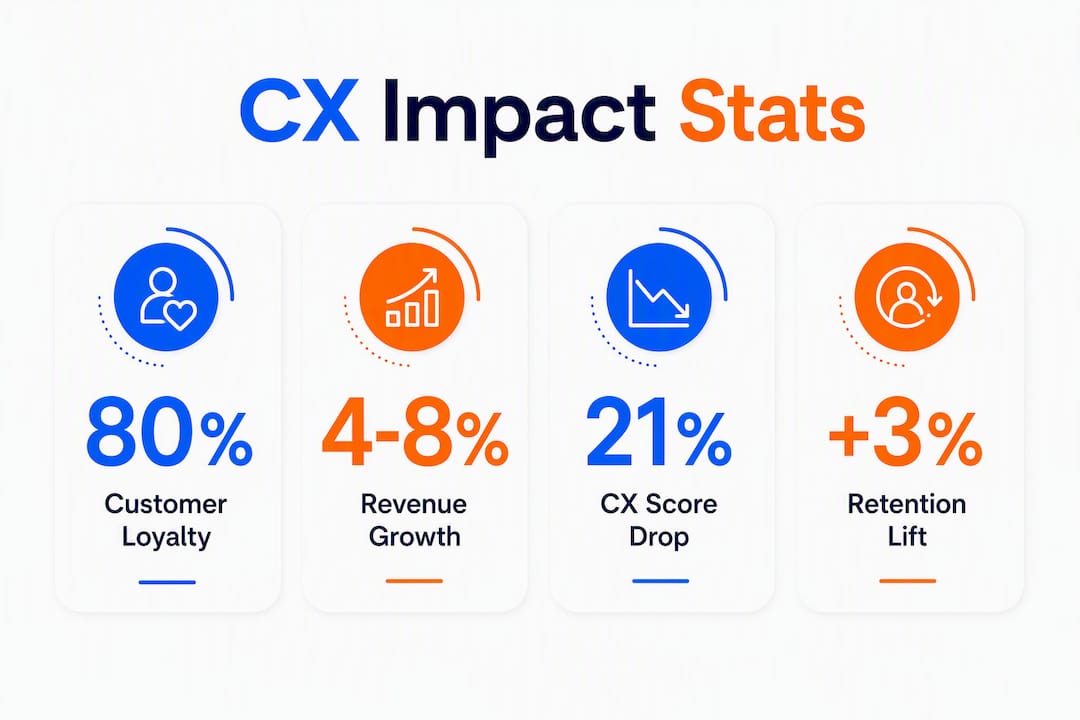
Customer experience is the leading driver of customer loyalty, revenue growth, and brand reputation across virtually every industry. 80% of customers say the experience a company provides is as important as its products or services. That single figure reframes the competitive game: your product gets you in the door, but experience determines whether customers stay, spend more, and tell others.
The business consequences of CX quality are immediate and measurable:
- Customers who have a positive experience are far more likely to become repeat buyers and brand advocates.
- Higher customer lifetime value (CLV) follows from lower churn, not from acquisition spending.
- Customers with strong emotional connections to a brand spend more and resist competitor offers.
- Word-of-mouth referrals from satisfied customers lower your cost of acquisition over time.
- Over half of customers will switch to a competitor after a single bad experience.
The gap between what customers expect and what most brands actually deliver is widening. 21% of brands scored lower on CX quality in 2025 than the year before. That is not a warning sign for the industry in the abstract. It is a concrete opening for any business willing to act now.
Table of Contents
- What is customer experience, and how does it differ from customer service?
- How does strong CX affect your business outcomes?
- How does CX link to your bottom line?
- What CX metrics should you track, and how often?
- What are the most effective ways to improve customer experience?
- What should you budget and how long will results take?
- What are the most common CX mistakes to avoid?
- What does the research say about CX impact?
- Key Takeaways
- The CX investment most businesses get wrong
- How Ibrand helps you turn CX insight into measurable growth
- Useful sources for further reading
- FAQ
What is customer experience, and how does it differ from customer service?
Customer experience (CX) is the sum of every perception a customer forms across every interaction with your brand, from the first ad they see to the support email they send six months after purchase. It covers marketing, the buying process, the product itself, onboarding, billing, and post-purchase follow-up. Customer service is one component of that whole, specifically the moments when a customer needs help and your team responds.
CX vs. customer service at a glance:
- Scope: CX spans the entire customer journey; customer service covers reactive support interactions.
- Ownership: CX is a cross-functional responsibility (marketing, product, ops, support); customer service is typically owned by a support or success team.
- Timing: CX is always happening; customer service is triggered by a customer need.
- KPIs: CX uses NPS, CLV, churn rate, and CSAT across the journey; customer service tracks resolution time, first-contact resolution, and ticket CSAT.
- Goal: CX aims to shape perception and loyalty over time; customer service aims to resolve a specific problem.
Here is what that looks like in practice. A customer finds your business through a Google search, clicks a clean and fast website, buys with minimal friction, receives a clear confirmation email, and then gets a proactive check-in three days later. When they do have a question, your support team resolves it in one contact. Each of those moments is a CX touchpoint. The support call is customer service. Together, they form the experience.

How does strong CX affect your business outcomes?
CX leaders grow revenue faster than their competitors, according to Bain & Company. That gap compounds over time because the underlying drivers, retention, referrals, and pricing power, all reinforce each other.
The business impacts stack up across several dimensions:
- Higher CLV: Loyal customers buy more often and accept modest price increases without defecting.
- Lower churn: Reducing churn by even a few percentage points has an outsized effect on revenue because retaining a customer costs significantly less than acquiring a new one.
- Higher conversion: A frictionless buying experience converts more prospects without additional ad spend.
- More referrals: Satisfied customers recommend your brand, cutting your cost per acquisition.
- Better pricing power: Customers who trust your brand are less price-sensitive and more resistant to competitor discounts.
IBM positions CX as an emotional bond that differentiates brands in crowded markets and drives CLV well beyond any single transaction. That framing matters for managers who tend to think of experience as a soft metric. The emotional connection a customer feels toward a brand is a measurable predictor of repeat purchase, referral behavior, and willingness to pay a premium.
Consider a mid-size e-commerce retailer that audited its post-purchase touchpoints and found that customers who received a personalized follow-up email soon after purchase had a higher repurchase rate than those who did not. No new product. No price change. Just a better experience at one touchpoint. The importance of customer experience shows up fastest in the metrics you are already tracking.

Pro Tip: Before investing in new CX technology, map your highest-volume customer touchpoints and score each one for friction. Fixing friction at existing touchpoints almost always delivers faster ROI than adding new channels.
How does CX link to your bottom line?
The financial case for CX investment is straightforward once you connect three numbers: retention rate, average revenue per user (ARPU), and acquisition cost. Improving retention by even 1–2% generates incremental revenue without touching your marketing budget, because you are keeping revenue you already earned.
A simple way to frame it for leadership: Δ retention rate × ARPU × customer base = incremental annual revenue. If your business improves retention by a few percentage points, that results in additional customers retained and incremental revenue that would otherwise have been lost. Pair that with the fact that acquiring a new customer costs significantly more than retaining an existing one, and the ROI case becomes hard to argue against.
Illustrative retention lift model (2,000-customer base, $1,200 ARPU):
| Retention lift | Customers retained | Incremental annual revenue |
|---|---|---|
| +3% | 60 | $28,800 |
The numbers in that table assume no change in ARPU. In practice, retained customers often increase their spend over time, so the actual revenue impact tends to be higher. Brands that invest in CX and close the feedback loop consistently report that modest improvements compound into substantial gains over a multi-year horizon.
Three financial levers to track alongside retention:
- Reduced support cost: Customers who have clear, low-effort experiences generate fewer support tickets, directly cutting operational cost.
- Higher upsell and cross-sell rate: Trust built through good experience makes customers more receptive to additional offers.
- Lower acquisition cost: Referrals from loyal customers reduce paid acquisition spend over time.
What CX metrics should you track, and how often?
The right measurement set depends on your business model, but most companies benefit from tracking a core set of four to five metrics consistently rather than chasing every available data point.
| Metric | Definition | When to use | Sample target |
|---|---|---|---|
| NPS (Net Promoter Score) | % promoters minus % detractors; measures loyalty and referral intent | Quarterly relationship survey | +30 or above for most industries |
| CSAT (Customer Satisfaction Score) | Post-interaction rating; measures satisfaction at a specific touchpoint | After purchase, support, or onboarding | 80%+ satisfied |
| CES (Customer Effort Score) | How easy was it to complete a task; predicts churn risk | After support interactions or key self-service steps | Low effort (score of 2 or below on a 1–5 scale) |
| Churn rate | % of customers lost in a period | Monthly or quarterly | Varies by industry; track trend |
| CLV (Customer Lifetime Value) | Projected total revenue from a customer relationship | Quarterly; segment by cohort | Rising trend over time |
A peer-reviewed study in the Journal of the Academy of Marketing Science found CSAT is predictive for 12 distinct downstream outcomes and functions as a reliable long-term leading indicator. That makes it the single most defensible metric to anchor your measurement program around, especially if you are just starting out.
The measurement process, step by step:
- Define objectives first. Decide what business question you are answering before choosing a metric. “Why are customers churning in month 3?” is a better starting question than “What is our NPS?”
- Gather quantitative data. Deploy surveys at moments that matter: post-purchase, post-support, and at 30/60/90-day intervals for subscription businesses.
- Gather qualitative data. Read open-text responses, monitor reviews, and conduct short customer interviews quarterly. Numbers tell you what is happening; qualitative data tells you why.
- Analyze by segment. Aggregate scores hide problems. Break data by product line, channel, customer tenure, and geography.
- Act on findings. Assign an owner to every identified issue and set a resolution deadline.
- Close the loop. Follow up with customers who flagged a problem. Asking for feedback, acting on it, and telling customers what changed builds trust faster than any loyalty program.
For reporting cadence, run NPS quarterly and CSAT monthly at key touchpoints. Churn and CLV should be reviewed monthly by whoever owns revenue. Qualitative feedback should be synthesized and shared with leadership at least once a quarter. Assign metric ownership clearly: CX or operations owns NPS and CSAT; finance owns CLV and churn; support owns CES. Shared ownership of digital marketing success tracking across teams prevents the siloed measurement problem that kills most CX programs.
What are the most effective ways to improve customer experience?
Improvement tactics fall into two buckets: quick wins you can execute this week, and longer programs that require planning, budget, and cross-functional coordination.
Quick wins (days to weeks):
- Audit your top three friction points. Where do customers drop off, complain, or contact support most? Fix those first.
- Standardize your response templates for the five most common support inquiries. Consistency reduces effort for both customers and agents.
- Add a CSAT survey to your post-purchase confirmation email. One question, one click. You will have data within days.
- Review your website’s mobile load speed and checkout flow. Slow pages and confusing forms are the most common CX killers in e-commerce. A step-by-step UX audit can surface these in hours.
- Respond to every negative review on Google and Yelp within 24 hours. Public, professional responses signal that your brand listens.
Longer programs (3–12+ months):
- Journey mapping: Document every touchpoint from awareness to renewal. Identify gaps, redundancies, and moments of high emotional impact. This is the foundation for any serious CX program.
- Personalization at scale: Use purchase history and behavioral data to tailor communications. Even basic segmentation, such as sending different onboarding sequences to different customer types, measurably improves retention.
- Omnichannel continuity: Customers who start a conversation on chat and finish it by phone should not have to repeat themselves. Building continuity across channels requires integration work but pays off in CES scores.
- Employee experience investment: Frontline staff who feel supported and empowered deliver better experiences. This is not a soft HR point; it is a direct CX input.
- AI and automation: Chatbots and automated workflows can reduce response time and handle high-volume, low-complexity inquiries. BCG identifies the need for an agentic CX layer that preserves continuity and trust when customers interact across AI-driven channels.
Pro Tip: When piloting a chatbot, start with one use case only, such as order status or FAQ responses. Set a clear escalation path to a human agent for anything outside that scope, and measure CSAT on bot-handled conversations separately from human-handled ones. If bot CSAT drops below your human baseline, pause and retrain before expanding.
Personalization does not require a sophisticated tech stack to start. A retailer that added a customer’s first name and most recent purchase category to its re-engagement emails saw a meaningful lift in open rates and click-through within the first 30 days, with no new platform investment. Small, consistent improvements in how you communicate build the kind of repeat customer behavior that compounds over years.
What should you budget and how long will results take?
Setting realistic expectations prevents the most common CX investment failure: abandoning a program before it has time to show results.
Timeline by phase:
- Quick wins (days to 4 weeks): Survey setup, response template standardization, friction-point fixes on existing pages, and review response protocols can cost little and produce early data to build the business case.
- Medium-term programs (3–9 months): Journey mapping, CSAT program rollout, chatbot pilots, personalization campaigns, omnichannel integration. These require dedicated ownership and modest tooling investment.
- Long-term transformation (12+ months): Culture change, enterprise platform migrations, full omnichannel orchestration, AI-driven personalization at scale. These require executive sponsorship and sustained budget.
Typical cost buckets:
- Tools and licensing: Survey platforms (Qualtrics, Medallia, or simpler tools like Typeform), CRM integrations, and analytics dashboards. Costs range from free tiers to enterprise contracts.
- People and training: Internal CX ownership, frontline training, and cross-functional coordination time. Often the largest hidden cost.
- Consultancy and program management: External expertise for journey mapping, measurement design, or platform selection.
- Integration and engineering: Connecting data sources, building feedback loops into existing systems, and enabling omnichannel continuity.
The most effective approach is to phase investment deliberately. Start with quick wins that generate data, use that data to build the business case for medium-term programs, and reserve large platform investments until you have evidence of what actually moves your metrics. Aligning with current marketing trends can also help prioritize where customer expectations are shifting fastest.
What are the most common CX mistakes to avoid?
Most CX programs fail not because of bad strategy but because of predictable, avoidable execution errors.
Red flags to watch for:
- Siloed measurement: Each team tracks its own metric with no shared view. Marketing celebrates NPS while support is drowning in tickets. No one sees the full picture.
- Vanity metrics: Tracking survey response rates or social media followers instead of churn, CLV, or CSAT at key moments.
- No closed-loop process: Collecting feedback and doing nothing visible with it. Customers who flag problems and hear nothing are more likely to churn than customers who never complained at all.
- Over-reliance on one metric: NPS alone does not tell you where the experience is breaking down. Use a balanced set.
- Ignoring qualitative signals: Open-text responses, support transcripts, and review comments contain the “why” behind the numbers. Skipping them leaves the most actionable insights on the table.
- Sporadic “wow” moments: One exceptional experience does not build loyalty. Consistency beats occasional surprises every time. Dependable, low-effort interactions are what customers actually remember.
Dos and don’ts for managers:
- Do assign a named owner to every CX metric. Shared ownership means no ownership.
- Do share CX data with frontline employees. They cannot improve what they cannot see.
- Don’t launch a survey program without a plan for acting on results. Survey fatigue is real, and customers who respond and see no change stop responding.
- Don’t let a single bad quarter kill a CX program. Behavioral change takes time to show up in metrics.
Empowering frontline staff to resolve issues without escalation prevents a large share of CX failures before they become churn events. Aligning support teams to profitability is one of the highest-leverage investments a manager can make.
What does the research say about CX impact?
The evidence base for CX investment is strong and growing. Here are the key findings and what they mean for your business:
- Salesforce State of the Connected Customer: 80% of customers rate experience as being equally important as the product itself. The takeaway: your product is table stakes; experience is the differentiator.
- Bain & Company (via SmartSurvey): CX leaders grow revenue 4–8% faster than competitors. The takeaway: CX is not a cost center. It is a growth driver with a measurable rate advantage.
- Zendesk: Over half of customers will switch after one bad experience. The takeaway: churn risk is not gradual. A single friction point can end a customer relationship permanently.
- IBM: CX functions as an emotional bond that maximizes CLV beyond transactional interactions. The takeaway: loyalty is emotional, not rational. Brands that create emotional connection outperform those that compete on price alone.
- Journal of the Academy of Marketing Science: CSAT predicts 12 downstream business outcomes and is a reliable long-term leading indicator. The takeaway: if you track only one metric, make it CSAT at your highest-volume touchpoints.
- BCG: The rise of AI agents requires brands to build an agentic CX layer with five governing rules: presence, guidance, a live data layer, continuity, and trust. The takeaway: AI is not just a support efficiency tool. It is reshaping how customers discover and evaluate brands, and your CX architecture needs to account for that now.
- SmartSurvey: 21% of brands scored lower on CX quality in 2025 than the year before, even as expectations rose. The takeaway: standing still is moving backward. The competitive gap between CX leaders and laggards is widening every year.
Key Takeaways
Strong customer experience directly drives retention, revenue growth, and competitive advantage, and the businesses that measure and act on CX data consistently outperform those that treat it as a secondary concern.
| Point | Details |
|---|---|
| CX is a revenue driver | CX leaders grow revenue 4–8% faster than competitors, per Bain & Company. |
| Churn risk is immediate | Over 50% of customers will switch after a single bad experience, making friction-point fixes urgent. |
| CSAT is your anchor metric | CSAT predicts 12 downstream business outcomes and is the most defensible metric to start with. |
| Retention math is compelling | A 3% retention lift on a 2,000-customer, $1,200-ARPU business generates $28,800 in incremental annual revenue. |
| Ibrand accelerates the work | Ibrand’s SEO, web design, and analytics services map directly to the quick wins and measurement steps in this guide. |
The CX investment most businesses get wrong
The conventional wisdom on CX says: invest in the customer-facing layer, train your support team, and send a satisfaction survey. That advice is not wrong. It is just incomplete in a way that costs businesses real money.
The programs that actually move retention metrics share one trait that rarely makes it into the standard playbook: they treat CX as an operational discipline, not a marketing initiative. That means assigning metric ownership, building closed-loop processes into existing workflows, and making CX data visible to the people who can act on it, including frontline staff, not just leadership.
The businesses that see the fastest results tend to start small and specific. A single CSAT touchpoint at the moment of highest customer anxiety, say, right after a first purchase or a support escalation, generates more useful signal than a quarterly relationship survey sent to the entire list. That signal, acted on quickly and communicated back to the customer, builds the kind of trust that shows up in retention numbers within 60–90 days.
Governance matters more than most managers expect. Without a named owner, a reporting cadence, and a clear escalation path for negative signals, even well-designed CX programs drift. The question to answer before you launch anything is: who is accountable when the CSAT score drops? If the answer is “everyone,” the real answer is no one.
How Ibrand helps you turn CX insight into measurable growth
Knowing why customer experience matters is the starting point. Executing the fixes, especially the ones tied to your website, search visibility, and digital presence, is where most small and mid-size businesses stall. Ibrand’s services are built for exactly that gap.
Ibrand works with small and medium-sized businesses to improve the digital touchpoints that drive first impressions and repeat visits: website optimization for search, UX and web design improvements that reduce friction, social media management that keeps your brand responsive and visible, and performance analytics that connect activity to revenue. These are not abstract services. They map directly to the quick wins and measurement steps in this guide.
Relevant services for CX-focused businesses:
- SEO and local marketing: Get found by the right customers before a competitor does.
- Web design and UX: Fix the friction points that kill conversion and damage first impressions.
- Social media management: Maintain a consistent, responsive presence where customers expect to find you.
- Performance analytics: Track the metrics that matter, not just traffic, so you can prove ROI to leadership.
If you want to see where your digital CX is losing customers, request a free diagnostic from Ibrand. You will leave with a prioritized list of fixes and a clear picture of what each one is worth to your retention rate.
Useful sources for further reading
The sources below back the claims in this guide and are worth reading directly if you are building a business case or designing a measurement program.
| Source | Best for | Annotation |
|---|---|---|
| SmartSurvey: Why Customer Experience Is Important | Building the business case | Covers headline stats on CX impact, retention economics, and practical feedback program design. Read this first. |
| Salesforce: What Is Customer Experience? | Defining CX for leadership | Clear definition, business impact summary, and the 80% customer expectation stat. Good for executive presentations. |
| IBM: Customer Experience | Understanding emotional loyalty | Explains the psychological and emotional basis for CX differentiation and CLV. Useful for culture and brand conversations. |
| Zendesk: Customer Satisfaction | Churn risk and switching behavior | Data on how quickly customers leave after a bad experience. Use this to quantify churn risk in your business case. |
| Journal of the Academy of Marketing Science | Justifying CSAT as your core metric | Peer-reviewed evidence that CSAT predicts 12 downstream outcomes. Cite this when leadership questions the value of satisfaction tracking. |
| BCG: The New Rules of CX in the Age of AI | Preparing for AI-era CX | Covers the agentic CX layer concept and five rules for competing when customers interact via AI agents. Read this if you are planning automation investments. |
FAQ
Why is customer experience so important for business?
Customer experience directly determines whether customers stay, spend more, and refer others. 80% of customers rate experience as equally important as the product itself, and CX leaders grow revenue 4–8% faster than competitors.
What are the 5 C’s of customer experience?
The 5 C’s is not a single standardized framework with one canonical definition; different practitioners use different versions. A widely cited version covers: Clarity (clear communication at every touchpoint), Consistency (reliable experience across channels), Convenience (low-effort interactions), Connection (emotional bond with the brand), and Continuity (seamless experience across sessions and channels).
What are the 3 E’s of customer experience?
The 3 E’s framework, used in some CX training contexts, refers to Effectiveness (did the customer accomplish their goal?), Ease (how much effort did it take?), and Emotion (how did the interaction make them feel?). These three dimensions map closely to CES, CSAT, and NPS respectively.
Why does customer experience matter more than ever in 2026?
Customer expectations keep rising while 21% of brands scored lower on CX quality in 2025 than the year before. At the same time, AI-driven discovery is changing how customers find and evaluate brands, raising the stakes for every digital touchpoint.
How do you measure customer experience effectively?
Start with CSAT at your highest-volume touchpoints, add NPS quarterly for relationship-level loyalty, and track churn monthly. A peer-reviewed study confirms CSAT is predictive for 12 downstream business outcomes, making it the most reliable anchor metric for most businesses.
Recent Comments