
Link building is the process of getting other websites to link back to yours, and it remains one of the most powerful ways to improve your site’s visibility in Google search results. Backlinks are among Google’s top ranking signals alongside content quality and user experience, which means a strong link profile can push your pages higher in search results, drive referral traffic, and build your site’s credibility over time. Think of each backlink as a vote of confidence from another site — the more credible the voter, the more weight that vote carries.
Table of Contents
- What is link building, and how does a backlink work?
- Why link building still matters for your SEO
- What makes a backlink actually valuable?
- Which link-building tactics actually work today?
- What tactics should you avoid?
- How do you run a small link-building campaign?
- How do you measure whether link building is working?
- How is link building changing in 2026?
- Your starter checklist for this week
- Key Takeaways
- The part most beginners get wrong about link building
- Ibrand’s SEO services can handle the heavy lifting
- Useful sources and further reading
- FAQ
What is link building, and how does a backlink work?
A backlink (also called an inbound link or incoming link) is simply a hyperlink on someone else’s website that points to a page on yours. From your site’s perspective, every link pointing in from the outside world is a backlink. According to Wikipedia’s backlink entry, the concept is directly analogous to academic citation: the quantity, quality, and relevance of backlinks are among the factors search engines use to estimate how important a page is.
The anatomy of a backlink
Every backlink has four components worth knowing:
- Source page: The external page where the link lives.
- Target URL: The specific page on your site the link points to.
- Anchor text: The clickable, visible words that form the link (e.g., “best running shoes for beginners”). Search engines read anchor text to understand what your linked page is about.
- Link attribute: The HTML tag that tells search engines how to treat the link. A
dofollowlink passes authority; anofollowlink carries a hint to be more cautious, though Google now treats nofollow as a hint rather than an absolute block, meaning nofollow links can still contribute to referral traffic and broader visibility signals.
A simple example: if a cooking blog writes “check out this pasta recipe guide” in an article, your site just earned a backlink with the anchor text “pasta recipe guide” from a relevant source page.
Common link types you’ll encounter:
- Editorial links — a writer cites your content naturally as a reference
- Resource page links — your page is listed on a curated “best resources” page
- Profile links — your URL appears in a business directory or author bio
- Social mentions — links shared on social platforms (usually nofollow, but still valuable for traffic)
Why link building still matters for your SEO
Links affect rankings, referral traffic, and brand credibility — all three at once, which is rare for a single tactic.

Search engines use links to discover new pages and to judge how trustworthy those pages are. A page with strong backlinks from relevant, authoritative sites tends to rank higher than a comparable page with few or weak links. Referral traffic from a well-placed link can be persistent and often converts better than cold organic traffic, because the visitor already has context from the referring site. And as your link profile grows, the compounding domain-level benefits typically become visible between months 6 and 12.
Links also feed into Google’s E-E-A-T framework (Experience, Expertise, Authoritativeness, Trustworthiness). Earning backlinks from reputable sources signals to search engines that real people and real publishers find your content credible enough to cite.
Statistic callout: Position 1 in Google captures roughly 39% of clicks, while position 3 drops to about 10% and position 10 falls to around 2%. Moving from page two to the top three is not a marginal gain — it’s a traffic multiplier.
Pro Tip: When evaluating a link opportunity, ask whether the referring page actually sends visitors who would care about your content. A link from a niche blog with 5,000 engaged monthly readers can outperform a link from a high-authority site whose audience has zero overlap with yours.
Links are also becoming relevant beyond traditional search. AI-driven surfaces like ChatGPT and Perplexity increasingly pull from credible, well-cited sources. A strong backlink profile, paired with structured data and authoritative content, improves the odds your site gets cited in those AI-generated answers.
What makes a backlink actually valuable?
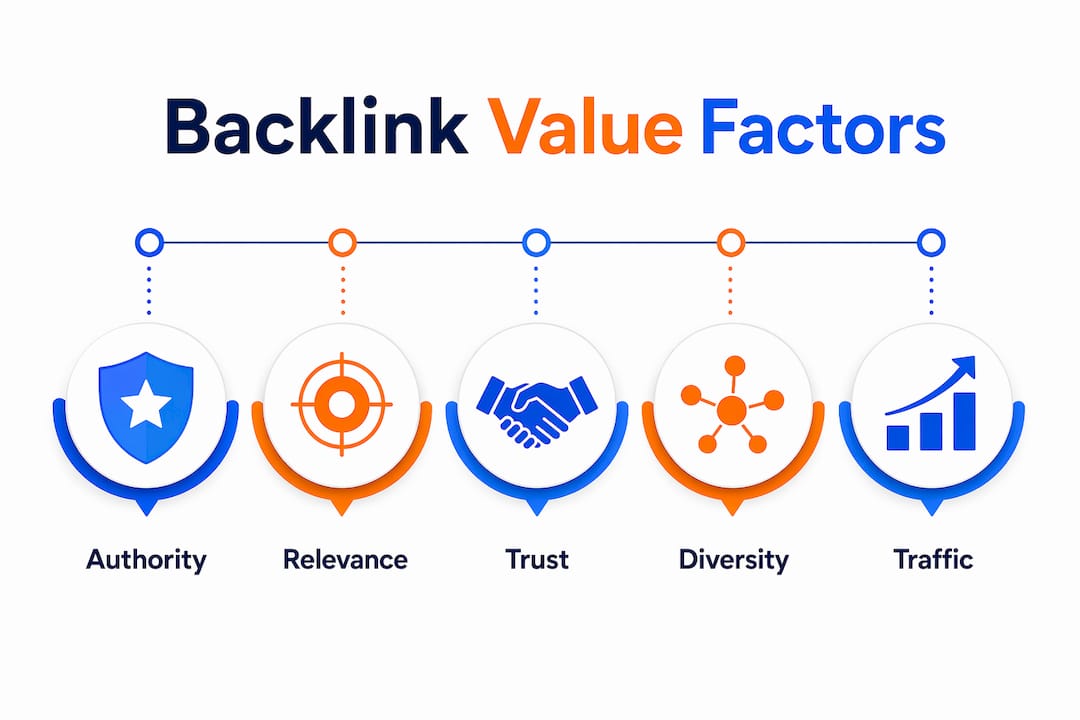
Relevance and authority are the two factors that matter most — everything else is secondary.
Backlinks from authoritative sites on a given topic are highly valuable, and the relevance of both the linking site and the specific linking page amplifies that value further. A single editorial link from a relevant, high-authority site typically outperforms dozens of links from low-quality domains. Here’s what to look at when sizing up a link opportunity:
- Topical relevance: Does the linking site cover the same subject area as your page? A link from a fitness site to your gym equipment page carries far more weight than the same link from an unrelated tech blog.
- Domain authority proxy: Tools like Moz’s Domain Authority (DA) or Ahrefs’ Domain Rating (DR) give you a rough sense of a site’s link equity. Neither is a Google metric, but both correlate with ranking power.
- Page-level authority: A link from a highly linked-to page on a strong domain is worth more than a link buried in a forgotten corner of the same site.
- Anchor text: Descriptive, relevant anchor text helps search engines understand what your linked page covers. Exact-match anchor text used too aggressively can trigger spam filters, so keep it natural.
- Link placement: A link in the body of an article, surrounded by relevant content, carries more weight than a footer link or a sidebar widget.
- Editorial context: Was the link placed because the content genuinely earned it, or was it paid for or self-inserted? Editorial links — where a writer chose to cite you — carry the strongest signal.
- Link attributes: Prioritize dofollow links for authority transfer, but don’t dismiss nofollow links from high-traffic, relevant pages. The referral traffic alone can be worth it.
Quick scorecard for evaluating a link opportunity (0–10 per factor):
- Topical relevance of the linking site
- Authority proxy (DA/DR)
- Placement quality (body vs. footer/sidebar)
- Expected referral traffic volume
- Editorial context (earned vs. placed)
A link scoring 7+ across all five factors is worth pursuing hard. Below 4 on relevance or authority, move on.
Which link-building tactics actually work today?
The highest-return tactics right now are digital PR, linkable asset creation, targeted outreach, guest content on relevant publications, resource page inclusion, and broken link reclamation. White-hat practices prioritize earning links through digital PR and data-driven content rather than volume-based schemes.
| Tactic | Pros | Cons | Effort Level |
|---|---|---|---|
| Digital PR / original research | Strong editorial links, brand exposure | Requires data or a newsworthy angle | High |
| Linkable asset creation | Passive link accrual over time | Upfront content investment | Medium–High |
| Targeted outreach | Scalable, relationship-building | Low response rates without personalization | Medium |
| Guest content | Builds authority and relationships | Time-intensive; quality control matters | Medium |
| Resource page inclusion | Relevant, often long-lasting links | Requires a genuinely useful page to pitch | Low–Medium |
| Broken link reclamation | Helpful framing for outreach | Requires finding broken links at scale | Medium |
What each tactic looks like in practice:
Digital PR means creating something genuinely newsworthy — an original survey, a data study, a compelling visual — and pitching it to journalists and bloggers. A local business might survey 500 customers about a relevant trend and pitch the results to industry publications.
Linkable assets are pages built specifically to attract links: comprehensive guides, free tools, calculators, or original research. A well-built resource page can earn links passively for years. For content creation support, platforms like Valiz can help you produce the kind of digital storytelling that earns editorial pickup.
Targeted outreach involves identifying pages that would logically link to your content and sending a personalized pitch. The key word is personalized — a generic blast email gets ignored.

Broken link reclamation means finding links on other sites that point to dead pages, then suggesting your content as a replacement. It’s a helpful framing that tends to get better response rates than cold pitches.
Modern link building has become closely aligned with digital PR, with relationship-driven outreach producing the strongest long-term editorial endorsements. Paid placements exist and are sometimes used, but they carry real risk. Google’s guidelines require sponsored or paid links to carry a rel="sponsored" attribute. Undisclosed paid links can trigger manual penalties, and the risk scales with how obvious the pattern is.
What tactics should you avoid?
Avoid any tactic that prioritizes volume over quality or tries to manipulate link signals artificially. Black-hat link building is manipulative and can lead to penalties — search engines have become increasingly effective at identifying and discounting or penalizing unnatural link patterns.
Common red flags that signal a risky or manipulative link scheme:
- Buying links in bulk from link farms or private blog networks (PBNs)
- Participating in link exchanges (“I’ll link to you if you link to me” at scale)
- Using automated tools to blast your URL across comment sections, forums, or directories
- Keyword-stuffed anchor text repeated across dozens of low-quality sites
- Links from sites with no topical connection to yours
The rule of thumb: If someone is offering you 50 links for $99, those links will cost you far more in lost rankings than they will ever gain you. Cheap bulk links are a high-risk bet against your site’s long-term health.
When search engines detect unnatural patterns, the response ranges from algorithmically devaluing those links to issuing a manual penalty that tanks your rankings until you clean up the profile. If your site has accumulated spammy links through past practices or negative SEO, start with a careful audit and attempt to remove the worst offenders by contacting the linking sites. The Google Search Console disavow tool is a last resort — use it only after documented removal attempts, and keep records of every step.
How do you run a small link-building campaign?
A five-step starter campaign: audit your current links, create one strong asset, build a prospect list, send outreach, then measure results.
-
Audit your existing backlink profile. Use a tool like Ahrefs, Moz, or Google Search Console to see what links you already have, which pages they point to, and whether any look spammy. This gives you a baseline and flags problems before you start building.
-
Create one linkable asset. Pick a format your audience actually shares: a detailed how-to guide, an original data piece, a free template, or a tool. One strong asset beats ten mediocre blog posts for link acquisition. If you need inspiration for niche outreach approaches, Ibrand’s guide on digital marketing for builders shows how industry-specific content can anchor a link campaign.
-
Build a prospect list of several targets. Look for resource pages, relevant blogs, journalists who cover your topic, and sites that link to similar content. Tools like Ahrefs’ “Link Intersect” or Moz’s Link Explorer help identify who links to your competitors but not to you.
-
Send personalized outreach. A strong outreach email has three parts: a specific compliment on their work (shows you actually read it), a clear explanation of what you’re offering and why it fits their audience, and a single, low-friction ask. Follow up once, about five to seven days later, if you hear nothing. Two touches is the ceiling — more than that crosses into spam.
-
Track placements and measure results. Log every outreach contact, response, and placement in a simple spreadsheet or a CRM tool like Pitchbox or BuzzStream. Give new links 6–12 weeks before expecting to see ranking movement.
Budget guidance: In-house link building costs primarily in time — plan for 5–10 hours per week for a small campaign. Freelance link builders typically charge $50–$150 per hour or $150–$500 per placed link, depending on quality. Agency retainers for link building range widely but often start around $1,000–$2,500 per month for small-business campaigns. For a small team, starting in-house with one strong asset and a manageable number of outreach targets per month is a realistic, low-cost entry point.
How do you measure whether link building is working?
Track referring domains, link quality, organic rankings, and referral traffic — not raw link count.
Key metrics to monitor:
- Referring domains: The number of unique sites linking to you. Growing this number matters more than total link count, since 100 links from 100 different domains is stronger than 100 links from one site.
- Domain Rating / Domain Authority: Third-party authority proxies (Ahrefs DR, Moz DA) that give a rough sense of your site’s overall link equity. Treat them as directional, not definitive.
- Organic keyword rankings: Track the specific pages you’re building links to. Movement on target keywords is the clearest signal that links are doing their job.
- Referral traffic: Check Google Analytics for sessions arriving via backlinks. High-quality links from relevant sites often send consistent, converting traffic.
| Signal | When to expect it | What it tells you |
|---|---|---|
| Link indexed by Google | 1–4 weeks | The link exists and is crawlable |
| Initial ranking movement | 6–12 weeks | Authority is beginning to transfer |
| Compounding domain benefit | 6–12 months | Cumulative link equity lifting multiple pages |
| Referral traffic | Ongoing from placement | Link is on an active, visited page |
| SERP position 1 click share | ~39% of clicks | Top-3 ranking is worth pursuing aggressively |
Recommended tools by category:
- Backlink index: Ahrefs, Moz Link Explorer, or Google Search Console (free, limited)
- Outreach CRM: Pitchbox, BuzzStream, or a simple Google Sheet for small campaigns
- Analytics: Google Analytics 4 for referral traffic; Google Search Console for ranking and indexing data
For a broader view of how link building fits into your overall off-page strategy, Ibrand’s off-page SEO guide covers the full playbook.
How is link building changing in 2026?
Link building has converged with digital PR, and the gap between the two is closing fast. Relationship-driven outreach and original research now produce the strongest long-term editorial endorsements, while volume-based tactics continue to lose ground.
Key shifts shaping link building right now:
- Quality over quantity is now the default standard. White-hat approaches that prioritize value for the end user consistently outperform volume-based strategies, and sustainable link profiles generate natural editorial links over time.
- Original research is the highest-leverage linkable asset. A proprietary survey or dataset gives journalists and bloggers a reason to cite you that no amount of outreach can manufacture.
- AI and LLM citation signals are emerging. Search and AI systems consider citations, structured data, and context alongside backlinks. Getting cited in AI-generated answers increasingly depends on the same signals that drive traditional rankings: credible sources linking to you, structured markup, and named authors with transparent credentials.
- Author signals matter more. Publishing named authors with detailed bios and industry citations on your linkable assets improves editorial pickup and strengthens E-E-A-T signals.
- LinkedIn and content distribution are part of the link-building loop. A strong LinkedIn content strategy amplifies your assets to the journalists and editors most likely to cite them.
Pro Tip: Treat every piece of original research or data you publish as a PR pitch, not just a blog post. Send it directly to three to five journalists who cover your topic before it goes live. Early coverage creates the first links, and those links attract more links organically.
Your starter checklist for this week
Start with the lowest-effort, highest-impact actions first: audit what you have, then build one asset before worrying about outreach volume.
- [ ] Run a backlink audit using Google Search Console or Ahrefs to see your current referring domains and flag any spammy links
- [ ] Identify one page on your site worth building links to (your best-performing content or a key service page)
- [ ] Create or commission one linkable asset tied to that page (a guide, a data piece, a free template)
- [ ] Build a list of 10–20 prospect sites: resource pages, relevant blogs, or journalists who cover your topic
- [ ] Write and send five personalized outreach emails this week; schedule follow-ups for five to seven days out
- [ ] Set up a simple tracking spreadsheet: columns for prospect, contact, date sent, response, and placement
- [ ] Review your small-business backlink strategy to see how other small businesses have applied these steps
Six tasks. One week. That’s a real campaign start, not a plan that sits in a doc.
Key Takeaways
Link building works when you prioritize relevance and authority over volume, track the right metrics, and give campaigns enough time to compound.
| Point | Details |
|---|---|
| Backlinks are a top ranking signal | A single editorial link from a relevant, authoritative site outperforms dozens of low-quality links. |
| Expect results on a realistic timeline | Initial ranking movement typically appears in 6–12 weeks; compounding domain benefits build over 6–12 months. |
| Track referring domains, not raw links | Unique linking domains, organic rankings, and referral traffic are the metrics that reflect real campaign progress. |
| Avoid volume-based schemes | Black-hat tactics like link farms and bulk purchases risk penalties that can undo years of SEO work. |
| Ibrand supports small-business link building | Ibrand’s SEO services help small businesses build credible link profiles without the guesswork of going it alone. |
The part most beginners get wrong about link building
Most guides frame link building as a numbers game — get more links, rank higher. That framing leads beginners straight into the tactics that hurt them most: bulk outreach, low-quality directories, and paid link schemes that look fine for a few months until they don’t.
The more accurate frame is that link building is reputation management at scale. Every link you earn is a publisher saying, publicly and permanently, “this source is worth citing.” That’s a fundamentally different standard than “this site paid us” or “this site asked nicely enough times.”
What that means practically: the asset you create matters more than the outreach volume you hit. A genuinely useful guide, an original data study, or a free tool that solves a real problem will attract links with far less friction than a mediocre page backed by aggressive outreach. The best link builders spend 70% of their time on the asset and 30% on the pitch — most beginners flip that ratio and wonder why response rates are terrible.
The other thing worth saying plainly: patience is not optional. A link that goes live today will likely take 6–12 weeks to move your rankings, and the domain-level compounding that makes link building truly powerful takes closer to a year to show up clearly in your data. Campaigns that get abandoned at month three almost never get credit for the work they did.
Ibrand’s SEO services can handle the heavy lifting
Building a credible link profile takes time, the right assets, and consistent outreach — three things most small-business owners don’t have in surplus. Ibrand works with small and medium-sized businesses to build link profiles that actually move rankings, combining SEO optimization for small businesses with targeted outreach and content strategy tailored to your industry and audience.
The approach is straightforward: audit your current profile, identify the highest-value link opportunities for your specific market, and execute outreach that earns editorial placements rather than buying risky ones. No long-term lock-in required to get started. If you want a clear picture of where your site stands and what a realistic link-building plan looks like for your business, request a custom SEO plan from Ibrand today.
Useful sources and further reading
These are the primary references used in this guide, plus recommended tools for continuing your research:
- Google Search Central — The official source for Google’s guidelines on links, link attributes, and what constitutes a link scheme. Read this before any outreach campaign.
- Moz: What Are Backlinks in SEO? — Clear explanation of backlink fundamentals, E-E-A-T, and authority proxies like Domain Authority.
- Ahrefs: What Is Link Building? — Covers the four core link-building methods and the emphasis on earned, white-hat links.
- Backlinko: Backlinks Guide — Detailed breakdown of dofollow vs. nofollow attributes and how to evaluate link quality.
- Yoast: What Is Link Building in SEO? — Good overview of modern link building as digital PR, including AI search considerations.
- Wikipedia: Backlink — Foundational definition and the PageRank context that explains why links matter algorithmically.
Recommended tools to try:
- Ahrefs or Moz Link Explorer — For auditing your backlink profile and researching competitor links
- Google Search Console — Free, direct data on which sites link to you and how Google sees your pages
- Pitchbox or BuzzStream — Outreach CRM tools for managing prospect lists and follow-up sequences
- Google Analytics 4 — For tracking referral traffic from specific backlinks
FAQ
What is link building in simple words?
Link building is the process of getting other websites to add links that point to your site. Each link acts as a vote of confidence that helps search engines decide how trustworthy and relevant your pages are.
What does a link builder do?
A link builder identifies websites worth earning links from, creates content or assets worth linking to, and contacts site owners or journalists to pitch those resources. The goal is to earn editorial placements that improve the site’s authority and rankings.
What is the difference between link building and SEO?
SEO covers everything that affects your search visibility — content, technical setup, site speed, and links. Link building is one specific part of SEO focused on earning backlinks from other sites to strengthen your site’s authority.
How much should I pay for link building?
Freelance link builders typically charge $50–$150 per hour or $150–$500 per placed link, depending on quality. Agency campaigns for small businesses often start around $1,000–$2,500 per month. Avoid any offer of bulk links at very low prices — the penalty risk far outweighs the short-term gain.
Recommended
- How Smart Search Backlink Strategies Help Small Businesses Outrank Big Competitors | Ibrandmedia
- Off-Page SEO Methods: Complete Guide for 2025 | Ibrandmedia
- Optimizing Websites for Search: A Guide for Small Businesses 2025 | Ibrandmedia
- On-Page SEO Basics: Complete Guide for Businesses | Ibrandmedia
Recent Comments