
TL;DR:
- Email marketing offers contractors the highest return on investment, generating up to $40 for every dollar spent.
- Implementing five essential automated sequences and effective list segmentation can significantly boost revenue and client engagement.
Email marketing for contractors is the highest-ROI digital channel available, returning $36–$40 for every $1 spent on home service campaigns. That figure dwarfs Google Ads, which averages around $8 per $1. Contractor email lists also open at 28–35% compared to the 19% industry average, meaning your past clients actually read what you send. The industry term for this practice is permission-based email marketing, and when it runs on automated sequences built around the contractor sales cycle, it becomes a repeatable revenue engine. This guide covers the five core sequences, list segmentation, platform selection, and the mistakes that kill results.
What are the essential email sequences contractors must implement?
Five automated sequences cover the full contractor client lifecycle. Each one targets a specific moment in the customer relationship, and each one generates revenue that generic newsletters never will.
-
Welcome sequence. Send this the moment a new contact joins your list. Introduce your company, show past project photos, and set expectations for future communication. A strong welcome sequence builds trust before a job is ever booked.
-
Estimate follow-up. Send within 10–14 days of the quote. Most contractors send one quote and wait. A two-email follow-up sequence that addresses common objections and reinforces your value closes significantly more jobs.
-
Post-job review request. Timing is everything here. Review requests within 2 hours of job completion get a 42% response rate. Contractors with systematic follow-ups also see 40% more referrals. Send a short, personal email asking for a Google review and a referral in the same message.
-
Seasonal maintenance reminder. A roofing contractor sends a gutter-cleaning reminder every september. An HVAC company sends a furnace tune-up prompt in october. These emails feel like a service, not a sales pitch, and they book jobs that would otherwise go to competitors.
-
Win-back and reactivation. One reactivation campaign sent to 1,200 dormant contacts generated $60,000 in booked work. Clients who used you two or three years ago already trust you. A single “we miss you” email with a seasonal offer is often enough to bring them back.
Pro Tip: Start with just the estimate follow-up and post-job review sequences. Those two alone will generate measurable revenue within 30 days and require less than two hours to set up.
How can contractors segment their email list to increase sales?
Segmented campaigns generate 760% more revenue than generic blasts sent to an entire list. That number is not a rounding error. It reflects a fundamental truth: a property manager and a homeowner have completely different priorities, budgets, and timelines.
Effective segmentation for contractor email campaigns falls into three categories:
- Project type. Separate commercial clients from residential. A commercial property manager wants pricing efficiency and scheduling reliability. A homeowner wants quality photos, warranties, and neighborhood references. Sending the same email to both groups wastes the message.
- Customer recency. Divide your list into active clients (jobs in the past 12 months), warm contacts (1–3 years ago), and cold contacts (3+ years). Each group needs a different tone and offer. Active clients get loyalty rewards and referral asks. Cold contacts get a reintroduction and a reason to call.
- Buyer persona. Segmenting by job type and buyer persona increases bid list inclusion rates. A homeowner who hired you for a kitchen remodel is a strong candidate for a bathroom renovation offer. A commercial client who used your electrical services may need HVAC work next quarter.
Segmentation does not require a complex system. A spreadsheet with three columns, project type, last job date, and contact type, gives you enough data to send targeted emails that feel personal rather than mass-produced.
What tools and platforms fit contractor budgets?

Basic email marketing software costs $15–$129 per month depending on list size and features. The right choice depends on whether you need a standalone marketing tool, a field service platform with email built in, or both.
| Platform type | Best use case | Approximate monthly cost |
|---|---|---|
| Entry-level marketing platform | Small lists, simple newsletters, basic automation | $15–$25 |
| Mid-tier marketing platform | Segmentation, advanced automation, A/B testing | $49–$79 |
| Field service platform with email module | Job-triggered transactional emails, scheduling confirmations | $129+ |
| Combined dual-system setup | Full marketing campaigns plus transactional job emails | $60–$160 total |
The dual-system approach is the professional standard. Field service platforms like Jobber handle transactional emails tied to job status, invoices, and appointment reminders. A dedicated marketing platform handles broad campaigns, seasonal promotions, and reactivation sequences. Trying to run both functions through one tool early on compromises the customer experience on both ends.
Pro Tip: If you are just starting out, use your field service platform for job emails and a free-tier marketing tool for campaigns. Upgrade the marketing tool only when your list exceeds 500 contacts or your automation needs grow.
Mailchimp Standard starts at approximately $20 per month for 500 contacts. ActiveCampaign Plus starts at $49 per month for 1,000 contacts and includes stronger automation logic. Jobber’s marketing module is included in plans starting at approximately $129 per month. For affordable contractor marketing, the dual-system setup delivers the best return at the lowest combined cost.
How to build and automate a contractor email system step by step
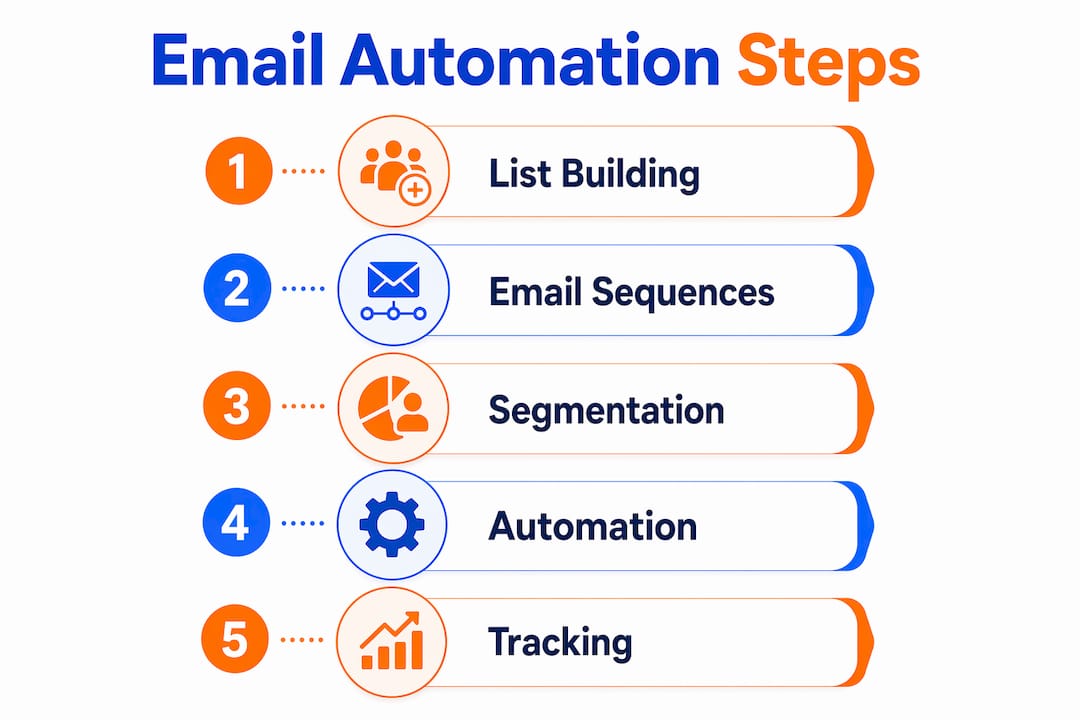
Building a working email system takes less time than most contractors expect. The process has five clear steps.
-
Extract your existing contacts. Pull every client email from your invoicing software, CRM, or even your inbox. A 5,000-contact list can generate $15,000–$25,000 annually with just 3–4 campaigns per month. Most contractors already have 200–500 contacts sitting unused.
-
Segment before you import. Before uploading to your email platform, tag each contact by project type, recency, and persona. This takes one afternoon and makes every future campaign more effective.
-
Write your five core sequences. Keep each email under 200 words. Use a subject line that states the benefit directly. “Your free furnace check before winter” outperforms “Fall Newsletter” every time.
-
Set your send schedule. One to two emails per month maintains brand presence without triggering unsubscribes. Automated sequences run independently of your manual sends, so your total contact frequency stays manageable.
-
Clean your list every 90 days. Removing inactive subscribers who have not opened an email in 90 or more days protects your sender reputation and improves deliverability for everyone else. Before removing them, send a single re-engagement email with a direct offer. Keep those who respond, remove those who do not.
Pro Tip: Automated email workflows generate 30 times higher returns than one-off campaigns while making up only 2% of total emails sent. Set them up once and let them run.
Consistency matters more than volume. Contractors with long sales cycles benefit most from a steady, predictable presence in the inbox. Clients who hear from you regularly are far more likely to call you when a project comes up, even if they ignored the last three emails.
What mistakes should contractors avoid in email marketing?
The most common failure in contractor email campaigns is inconsistency. Sending three emails in january and then nothing until june trains your list to forget you. When you finally send again, open rates drop and unsubscribes spike.
Four mistakes consistently undermine results:
- Sending the same email to everyone. A generic blast to your full list ignores the segmentation data you already have. Homeowners and commercial clients need different messages. Sending one version to both groups reduces response rates for both.
- Measuring only opens and clicks. Opens and clicks are signals, not outcomes. The real metrics are booked jobs, revenue per campaign, and referral conversions. Track those numbers and you will know exactly which sequences pay for themselves.
- Ignoring CAN-SPAM compliance. Every commercial email must include a physical postal address, a working unsubscribe link, and an honest subject line. Violations carry fines up to $51,744 per email. Compliance is not optional.
- Writing newsletters instead of offers. A newsletter about your company history serves you, not the client. Every email should answer one question: “What does this do for the person reading it?” A seasonal discount, a maintenance tip, or a referral reward all pass that test. A company update does not.
Tracking email marketing ROI by revenue and bookings, rather than vanity metrics, gives you the data to cut what does not work and scale what does.
Key takeaways
Email marketing for contractors works because it targets warm contacts who already trust you, runs on automation, and costs a fraction of paid advertising while returning multiples more in revenue.
| Point | Details |
|---|---|
| ROI far exceeds paid ads | Home service email marketing returns $36–$40 per $1 spent versus $8 for Google Ads. |
| Five sequences cover the full cycle | Welcome, estimate follow-up, review request, seasonal reminder, and reactivation drive the most revenue. |
| Segmentation multiplies results | Segmented campaigns generate 760% more revenue than generic blasts sent to an unsorted list. |
| Dual-system setup is the standard | Use field service software for job emails and a dedicated platform for marketing campaigns. |
| List hygiene protects deliverability | Remove contacts inactive for 90+ days and run a re-engagement email before cutting them. |
Why most contractors are sitting on a goldmine they never use
I have worked with contractors who spend thousands on Google Ads every month while their client list sits completely untouched in their invoicing software. That list is the most valuable marketing asset they own. Every contact on it already hired them once, which means the trust barrier is gone.
The contractors who grow fastest are not the ones with the biggest ad budgets. They are the ones who treat email as a permanent part of their sales process, not a one-time promotion. They send the estimate follow-up every time. They ask for the review within hours of finishing the job. They send the seasonal reminder in september and october without fail. That discipline, applied consistently, compounds over time.
My honest advice: do not build 20 automations on day one. Start with the estimate follow-up and the post-job review request. Those two sequences alone will change your close rate and your review count within a month. Once you see the results, adding segmentation and seasonal campaigns feels obvious rather than overwhelming.
The contractors who tell me email “doesn’t work” are almost always the ones who sent two newsletters two years ago and gave up. Email works. The system just has to run.
— TONY
How Ibrand helps contractors build a complete digital presence
Email campaigns perform best when they send traffic to a website that converts. If your site is slow, hard to navigate, or invisible in local search, even a well-written email sequence will underdeliver.
Ibrand works with local contractors to build the digital foundation that makes every marketing channel more effective. From local SEO for small businesses that puts your company in front of buyers searching right now, to web design that turns email clicks into booked calls, Ibrand covers the full picture. Contractors who pair strong email campaigns with a well-optimized website see compounding results across both channels. If you want to know where your digital presence stands today, Ibrand offers a free review to get you started.
FAQ
What is a realistic ROI for contractor email marketing?
Home service contractors average $36–$40 in revenue for every $1 spent on email marketing. That return is roughly four to five times higher than Google Ads.
How often should contractors send marketing emails?
One to two emails per month is the recommended frequency for contractors. That cadence maintains visibility without triggering unsubscribes or spam flags.
What is the best first email sequence for a contractor to set up?
The estimate follow-up sequence is the highest-priority starting point. Sending it within 10–14 days of a quote closes more jobs with almost no manual effort.
Do contractors need to follow CAN-SPAM rules?
Yes. Every commercial email must include a physical address, a working unsubscribe option, and an accurate subject line. Non-compliance carries fines up to $51,744 per email.
How do I grow my contractor email list quickly?
Start by extracting every client email from your invoicing software, CRM, and inbox. Most contractors already have 200–500 usable contacts they have never emailed for marketing purposes.
Recent Comments