
TL;DR:
- Marketing analytics involves collecting and analyzing data across channels to optimize decisions and drive measurable outcomes.
- AI has transformed marketing in 2026 by enabling real-time campaign adjustments, predictive targeting, and personalized content delivery.
Marketing analytics is the systematic practice of collecting and analyzing data across marketing channels to optimize decisions and improve performance. The role of analytics in marketing has expanded far beyond tracking clicks and impressions. Today, it connects every customer touchpoint to measurable business outcomes like Customer Acquisition Cost (CAC), Customer Lifetime Value (CLV), and campaign ROI. Platforms like Salesforce and AI-powered tools like ThoughtSpot now give marketers the ability to act on data in real time, not just review it after the fact. If you are a marketing professional or small business owner, understanding how data-driven marketing strategies work is no longer optional. It is the difference between guessing and growing.
What is the role of analytics in marketing and campaign success?
Marketing analytics is the practice of measuring, analyzing, and optimizing performance data across every channel where your brand shows up. That includes paid ads, email campaigns, organic search, social media, and your CRM. The goal is not just to collect numbers. It is to connect those numbers to decisions that move revenue.
Most marketing teams start with descriptive analytics, which answers “what happened?” You ran a Facebook campaign and got 500 clicks. Fine. But diagnostic analytics asks “why did it happen?” and predictive analytics asks “what will happen next?” Prescriptive analytics goes one step further and recommends what you should do about it. Each layer adds strategic value that the previous one cannot deliver alone.

The challenge most teams face is fragmented data. Your ad platform reports one conversion number, your CRM reports another, and your email tool has its own attribution model. Unified data architecture across acquisition, behavior, and revenue is what separates teams that can make confident growth decisions from those that are constantly second-guessing their numbers. Customer Data Platforms (CDPs) exist specifically to solve this problem by pulling all those sources into one coherent view of the customer journey.
The impact of data analytics on marketing is clearest when you look at attribution. Knowing which channel, which message, and which audience segment actually drove a conversion lets you reallocate budget with confidence. Without that, you are spreading spend based on gut feel.
Pro Tip: Start by auditing your current data sources before buying any new analytics tool. If your CRM, ad platforms, and website analytics are not connected, no dashboard will give you accurate attribution.
How has AI transformed marketing analytics in 2026?
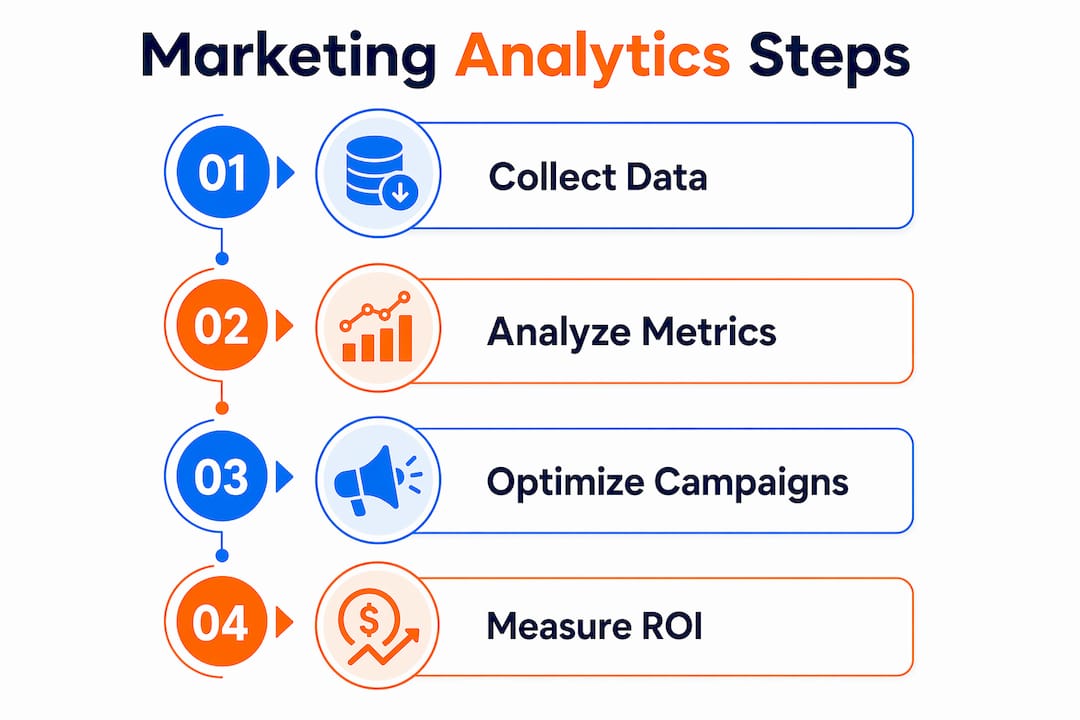
The shift from periodic reporting to continuous optimization is the defining change in marketing analytics right now. AI agents in marketing now monitor campaigns, adjust bids, reallocate budgets, and personalize content without waiting for a human to review a weekly report. This is not automation in the old sense. These systems learn from live data and make decisions at a speed and scale no analyst team can match.
Here is how that transformation plays out in practice:
- Real-time bid optimization. AI agents adjust paid search and social bids based on live conversion signals, not yesterday’s data. A local dental practice running Google Ads, for example, can have its budget automatically shifted toward the highest-converting appointment times without manual intervention.
- Predictive audience targeting. Machine learning models trained on first-party CRM data identify which prospects are most likely to convert, letting you focus spend on high-probability leads rather than broad audiences.
- Personalized content delivery. AI tools analyze behavioral signals to serve different ad creatives or email content to different segments automatically, improving relevance without multiplying your workload.
- Privacy-compliant measurement. The W3C’s Attribution Level 1 specification enables aggregate ad performance reporting using differential privacy techniques, so you can measure campaign effectiveness without tracking individual users across the web.
The foundation underneath all of this is first-party data. 71% of publishers recognize first-party data as a key driver for better advertising, and that number reflects a broader market reality. With third-party cookies effectively gone, the data you collect directly from your customers through your website, email list, and CRM is your most durable measurement asset. It is also the only data you fully control for personalization and privacy compliance.
Pro Tip: Treat consent as a live signal, not a one-time checkbox. Automated consent enforcement across your systems means your AI models always train on compliant, current data, which protects you legally and improves model accuracy.
What are the common challenges in implementing marketing analytics?
Most marketing analytics failures are not technology failures. They are architecture and process failures. The tools exist. The problem is that data sits in silos, teams lack the skills to interpret it, and privacy regulations add compliance complexity that many small businesses are not equipped to handle.
The most common obstacles break down like this:
- Fragmented data architecture. Acquisition data lives in your ad platforms, behavioral data lives in Google Analytics or Mixpanel, and revenue data lives in your CRM or e-commerce platform. Without a unified layer connecting them, your attribution is always incomplete.
- Consent and regulatory complexity. GDPR, CCPA, and evolving state-level privacy laws mean that what data you can collect, store, and use changes constantly. Manual consent management does not scale. Automated governance tools are now a requirement, not a luxury.
- Cross-channel attribution gaps. A customer sees your Instagram ad, reads your blog post, and then converts through a Google search. Most standard attribution models credit only the last click. Modern analytics platforms use data-driven attribution to distribute credit more accurately across the full journey.
- Skills gaps in small teams. Many small business owners have access to analytics tools but lack the time or training to extract meaningful insights from them.
| Challenge | Practical solution |
|---|---|
| Siloed data across platforms | Implement a CDP or use a connector tool like Segment to unify sources |
| Manual consent management | Use automated consent platforms that propagate preferences across systems |
| Last-click attribution bias | Switch to data-driven attribution in Google Analytics 4 or a similar platform |
| Limited internal analytics skills | Use self-service tools like ThoughtSpot that support natural language queries |
The good news for small businesses is that you do not need to solve all of these at once. Start with one unified source of truth for your most important metric, whether that is CAC, conversion rate, or revenue per campaign. Build from there.
How can you apply analytics to improve marketing ROI?
Applying marketing analytics to real decisions starts with knowing which metrics actually connect to business outcomes. Vanity metrics like impressions and follower counts feel good but rarely drive strategy. The metrics that matter are the ones tied to revenue.
Follow this sequence to build an analytics-driven marketing practice:
- Define your core metrics. Pick three to five metrics that directly reflect business health: CAC, CLV, conversion rate by channel, and revenue attributed to marketing. Track these consistently before adding complexity.
- Map your customer journey. Use your analytics platform to identify where prospects drop off. If 60% of your email subscribers click through but only 5% convert on the landing page, the problem is the page, not the email. Analytics tells you where to fix things.
- Run structured tests. A/B test one variable at a time: subject lines, ad headlines, landing page layouts. Let data determine the winner before scaling spend. This is how analytics drives campaign success rather than just measuring it after the fact.
- Use predictive analytics for budget allocation. Tools trained on your historical data can forecast which channels will deliver the best return next quarter. This is especially useful for small businesses with limited budgets that cannot afford to spread spend thin.
- Leverage self-service dashboards. Platforms like ThoughtSpot let non-technical marketers query data using plain language, which removes the bottleneck of waiting for a data analyst to pull a report. Faster insights mean faster decisions.
The role of analytics in growth becomes concrete when you look at local business examples. A dental practice that tracks which Google Ads campaigns generate actual appointment bookings, not just website visits, can cut wasted ad spend by 30 to 40 percent and reinvest it in the campaigns that fill chairs. The same logic applies to any local service business. Tracking campaign performance at the outcome level, not just the click level, is what separates profitable marketing from expensive guessing.
Personalized marketing built on first-party analytics data consistently outperforms broad campaigns because it matches the right message to the right person at the right moment. That is not a theoretical benefit. It is a measurable lift in conversion rates that shows up in your numbers within weeks of implementation.
Key takeaways
Marketing analytics works because it connects every marketing action to a measurable business outcome, giving you the evidence to spend smarter, target better, and grow faster.
| Point | Details |
|---|---|
| Unified data is non-negotiable | Connect your ad platforms, CRM, and website analytics before investing in advanced tools. |
| AI enables continuous optimization | AI agents adjust bids, budgets, and content in real time, replacing slow manual review cycles. |
| First-party data is your foundation | Own your customer data through email lists and CRM to stay compliant and competitive post-cookie. |
| Start with three to five core metrics | CAC, CLV, and conversion rate by channel give you the clearest picture of marketing health. |
| Consent must be automated | Manual consent management creates compliance gaps; automated systems keep your data clean and legal. |
Why most businesses are still leaving analytics on the table
94% of Chief Data and Analytics Officers expect their influence to grow over the next 12 months, and 78% say AI has already increased their decision-making power. Those numbers describe enterprise-level organizations. Most small businesses are not even close to that level of analytics maturity, and honestly, they do not need to be. But they do need to start.
What I have seen consistently is that small business owners treat analytics as something they will “get to later,” after the campaign launches, after the website is redesigned, after the busy season ends. Later never comes. The businesses that grow are the ones that build measurement into the campaign from day one, even if that measurement is just tracking which ad drove a phone call.
The shift from reporting to autonomous decision-making is real, and it is accelerating. But the businesses that will benefit most from AI-driven analytics are the ones that already have clean, unified data. If your data is a mess now, AI will just make your bad decisions faster. Strong data architecture is not a technical problem. It is a strategic priority.
My honest advice: do not wait until you can afford a full analytics stack. Start with Google Analytics 4, connect it to your ad accounts, and pick one metric to improve each quarter. The discipline of measuring consistently matters more than the sophistication of your tools. Human judgment still decides what to measure and why. Technology just helps you do it faster.
— TONY
How Ibrand can help you turn analytics into growth
Understanding the role of analytics in marketing is one thing. Building the infrastructure to act on it is another. Ibrand works with small and medium-sized businesses to set up SEO and digital marketing systems that are built for measurement from the start. That means tracking the metrics that matter, connecting your channels to a single performance view, and running campaigns that generate data you can actually use. If you want to know exactly which marketing activities are driving revenue for your business, Ibrand builds the systems that show you. Track your digital marketing ROI with a strategy designed around your goals, not generic templates.
FAQ
What is the role of analytics in marketing?
Marketing analytics measures and connects data from ads, email, CRM, and web channels to business outcomes like CAC, CLV, and campaign ROI. It gives marketers the evidence to make smarter budget and strategy decisions.
How does analytics improve campaign success?
Analytics identifies which channels, messages, and audiences drive conversions, allowing you to reallocate budget toward what works and cut what does not. Structured A/B testing guided by data consistently improves conversion rates over time.
What analytics tools work best for small businesses?
Google Analytics 4, paired with your ad platform data and a CRM, covers the core needs for most small businesses. Self-service tools like ThoughtSpot add natural language querying for teams without dedicated analysts.
Why is first-party data critical for marketing analytics in 2026?
First-party data collected directly from your customers through your website, email list, and CRM is the only data source that remains fully usable after third-party cookie deprecation. It also supports privacy compliance under GDPR and CCPA.
How does the role of analytics in dental marketing differ from other industries?
The core principles are the same, but dental marketing analytics focuses on appointment bookings as the primary conversion metric rather than e-commerce transactions. Tracking which ads generate actual booked appointments, not just clicks, is the critical distinction for local dental practices.
Recent Comments