
TL;DR:
- Digital visibility provides small businesses with a sustainable online presence that outperforms short-term ad campaigns. It builds trust, enhances discoverability, and drives long-term growth through consistent information, reviews, and local SEO strategies. Focusing on foundational credibility signals yields outsized results compared to ongoing advertising efforts.
Most small business owners assume that the fastest route to new customers is buying more ads. Pour money in, get leads out. But that logic breaks down fast when budgets run dry and the traffic stops overnight. Digital visibility is foundational for SMBs because it enables discoverability, builds trust, and drives sustainable leads without ongoing ad spend. This article breaks down exactly what digital visibility is, why it outperforms ads for long-term growth, and how you can build it affordably starting today.
Table of Contents
- Why digital visibility is more valuable than ads
- How digital visibility powers discovery and trust for your business
- Local SEO: the digital visibility multiplier for SMBs
- Measuring what counts: tracking digital visibility and its ROI
- The uncomfortable truth most experts won’t tell you about digital visibility
- Ready to boost your business’s digital visibility?
- Frequently asked questions
Key Takeaways
| Point | Details |
|---|---|
| Visibility drives trust | Being found online makes customers far more likely to trust and contact your business. |
| SEO beats short-term ads | Digital visibility produces sustainable leads after ad campaigns end, saving money. |
| Local SEO maximizes reach | Optimizing your profiles and reviews can grow website traffic and direct calls by over 100%. |
| Track what matters | Watch reviews, search rankings, and map listings—not just sales—for visibility growth. |
| Consistency wins long-term | Regular, small actions to boost your online presence compound over time for lasting results. |
Why digital visibility is more valuable than ads
Let’s get the definitions straight first, because the difference matters a lot when you’re deciding where to put your marketing dollars.
Digital visibility refers to how easily your business can be found across the web, including search engines, map listings, review platforms, social media, and directories. Digital ads, by contrast, are paid placements that push your business in front of people only for as long as your budget lasts. Stop paying, stop showing up.
The contrast is stark. Ads give you a short burst of attention. Visibility gives you a presence that works around the clock, seven days a week, long after you’ve finished setting it up. Think of ads as renting a billboard and visibility as owning the building behind it.
According to SMB website trends, 64% of small business traffic comes from social channels, and 72% of SMBs find SEO effective for generating business. Yet many of those same businesses still pour their budgets into ads while barely investing in organic visibility. That’s a costly mismatch.
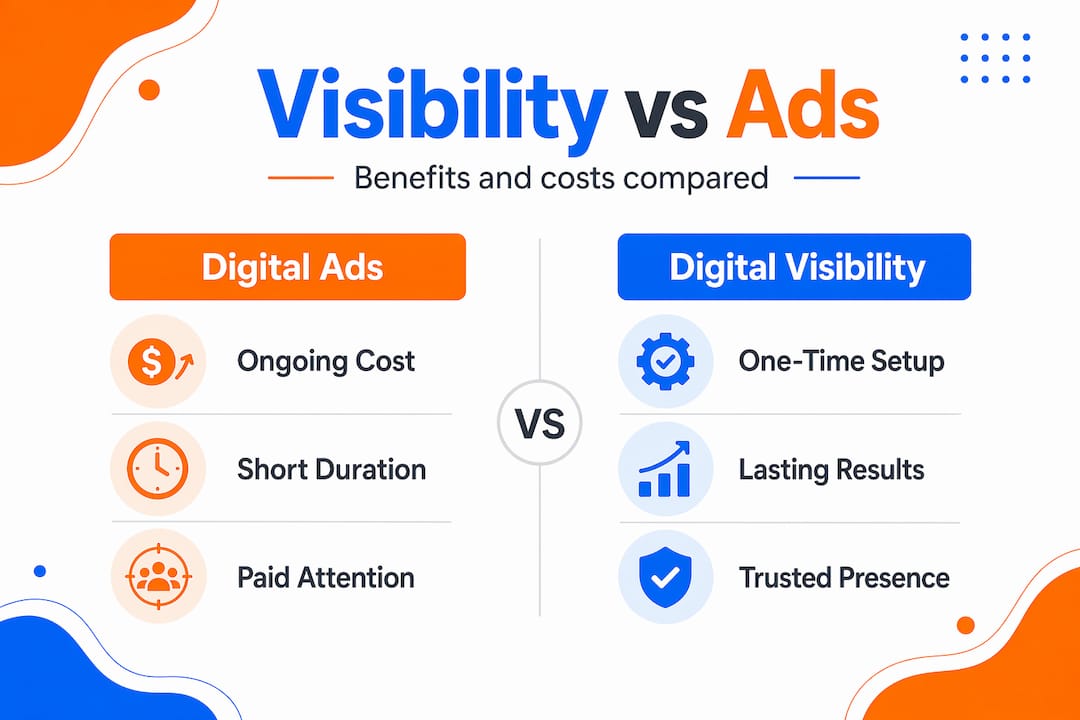
Here’s why digital marketing matters so deeply for small businesses right now. Visibility compounds. Every blog post you publish, every review a customer leaves, every directory listing you claim adds another layer to your online presence. Those layers don’t disappear when your credit card stops getting charged.
Ways visibility builds customer trust and brand value:
- Appearing consistently in search results signals reliability and authority
- Showing up in the Google local map pack puts you front and center for nearby buyers
- Positive online reviews create social proof that no ad creative can replicate
- Consistent business information across the web builds credibility with both algorithms and humans
- Being visible on multiple channels (search, social, maps) reinforces brand familiarity
| Factor | Digital ads | Digital visibility |
|---|---|---|
| Cost model | Ongoing per click or impression | Largely one-time setup plus maintenance |
| Results timeline | Immediate but stops when budget ends | Slower to build but lasts indefinitely |
| Trust factor | Low (customers know it’s paid) | High (organic results feel earned) |
| Long-term ROI | Declining without more spend | Compounds over time |
| Best for | Short-term launches or promotions | Sustainable, budget-conscious growth |
Understanding the benefits of online advertising doesn’t mean ignoring it entirely. Ads have their place, especially for promotions or new product launches. But for most SMBs with limited budgets, building visibility first creates a much sturdier foundation.
How digital visibility powers discovery and trust for your business
Understanding the difference between visibility and ads is just the start. Here’s how digital visibility actually goes to work for your business, powering continuous discovery and trust even when you’re not actively promoting anything.
When a potential customer searches for a service you offer, they don’t just look at the first result and click. They scan. They check reviews. They look for a recognizable name or a business that shows up in multiple places. That multi-touch behavior means that your visibility across several platforms matters far more than a single ad impression.
“Digital visibility is foundational for SMBs as it enables discoverability, builds trust, and drives sustainable leads without ongoing ad spend.” Why Digital Visibility Matters More
One of the most powerful trust signals you can build is a consistent NAP, which stands for Name, Address, and Phone number. When your business details match exactly across Google, Yelp, Facebook, your website, and every other directory you’re listed on, search engines reward you with higher rankings. More importantly, customers trust you more because your information is clear and consistent everywhere they look.
Key visibility factors that drive trust and conversions:
| Visibility signal | Why it matters | How to improve it |
|---|---|---|
| Search rankings | First-page presence drives clicks | Regular SEO updates and content |
| Review volume and quality | Social proof for purchase decisions | Actively ask satisfied customers to review |
| NAP consistency | Builds trust with Google and customers | Audit and update all directory listings |
| Local map pack presence | Puts you directly in front of local buyers | Fully optimize your Google Business Profile |
| Social media mentions | Broadens reach and reinforces brand | Stay active and respond to comments |

The role of online reviews for business is impossible to overstate. A business with 50 quality reviews looks dramatically more trustworthy than a competitor with a polished website but zero reviews. That trust gap translates directly into more clicks, more calls, and more sales. And understanding why reviews matter goes beyond just star ratings. The act of responding to reviews, good and bad, shows potential customers that real humans run your business and that you care about your reputation.
Pro Tip: Claim, verify, and fully optimize every local business profile you can find. Google Business Profile, Apple Maps, Bing Places, Yelp, and niche directories in your industry are all fair game. Each one is a door through which a new customer can walk in.
Local SEO: the digital visibility multiplier for SMBs
Once trust and discoverability are in place, you can multiply results with targeted, affordable local SEO tactics. Local SEO refers to the practice of optimizing your online presence so that nearby customers find your business when they search for what you offer.
The numbers here are genuinely striking. Businesses that appear in the Google local map pack see 126% more traffic and 93% more calls and directions compared to those that don’t. That’s not a marginal improvement. That’s a different category of performance entirely.
Local SEO delivers these results because it connects buyers who have high purchase intent, people literally searching “plumber near me” or “best pizza in [your city],” with businesses that have proven their local credibility. There are no wasted impressions on uninterested browsers. Every impression is a potential customer with a specific need.
How to optimize your local SEO in six practical steps:
- Claim and fully complete your Google Business Profile. Every field matters: category, hours, photos, services, and business description. A complete profile outperforms an incomplete one every time.
- Ensure NAP consistency across all platforms. Run an audit using a tool like Moz Local or BrightLocal to find mismatches and correct them systematically.
- Add schema markup to your website. Schema is a type of code that tells search engines exactly what your business is, where it’s located, and what it does. It’s invisible to visitors but very visible to algorithms. Optimizing your Google Business Profile is the first step.
- Keep your hours accurate and updated. Nothing destroys trust faster than showing up to a business during listed hours to find it closed. Update holiday hours especially.
- Actively request reviews from satisfied customers. Send a follow-up email or text with a direct link to your review page. Make it frictionless. The easier you make it, the more reviews you’ll get.
- Create locally relevant content. Write blog posts, guides, or FAQ pages that mention your city, neighborhood, or region. Local context signals strengthen your relevance for nearby searches.
Forms of visibility local SEO helps you appear in:
- Google local map pack (the three businesses shown with a map in search results)
- Organic local search results below the map pack
- Voice search queries on devices like Alexa or Google Home
- AI-generated search responses that pull from credible, structured local sources
- Review platforms when customers search for business comparisons
Local SEO mechanics are clear: optimizing your business profile, maintaining NAP consistency, collecting reviews, and implementing schema markup are all proven methods that help your business appear in map packs and AI responses.
Pro Tip: Businesses with 50 or more reviews are 266% more likely to appear in the local map pack. If you have 10 reviews right now, you don’t need a new ad campaign. You need a review strategy. Start there before spending another dollar on ads.
For a detailed breakdown of how to rank better in local searches, check out this guide on optimizing Google My Business and this resource on improving Google visibility.
Measuring what counts: tracking digital visibility and its ROI
To truly know your progress, you need to track visibility and its impact on real business results. This is where many small business owners go wrong. They only measure direct sales or ad click-through rates, missing the bigger picture of how visibility contributes to growth over time.
Digital visibility produces results across multiple touchpoints before a customer ever calls or buys. Research shows that the average conversion involves 3.4 different channels assisting along the customer journey. That means someone might see your Google listing, read a review on Yelp, and then visit your social media page before finally calling you. If you only track the last click, you’ll undervalue everything that made the sale possible.
Additionally, 22% of conversions are cross-channel, meaning privacy and attribution challenges make it even harder to see the full impact of your visibility efforts using standard tracking alone.
Key metrics and free tools to track digital visibility:
- Google Search Console: Monitor your organic search rankings, which keywords drive clicks, and how your visibility changes over time
- Google Business Profile Insights: See how many people found you in searches, requested directions, or called directly from your listing
- Review count and average rating: Track these monthly across all platforms to see whether your reputation is growing
- Website traffic from organic search: Measure this in Google Analytics to understand how many visitors come from non-paid sources
- Inbound calls: Use a call tracking number or simply ask new customers how they found you
Understanding Google Maps optimization is particularly valuable because map pack performance is one of the clearest, most direct measures of local visibility success.
Pro Tip: Don’t just track direct sales from last-click attribution. Set up a simple monthly report that covers search rankings, review count, map pack appearances, and organic website traffic. Watching these metrics grow over three to six months tells you far more about your visibility health than any single day’s ad performance.
The uncomfortable truth most experts won’t tell you about digital visibility
Most articles about digital visibility stop at tactics. Claim your profile. Get reviews. Use keywords. Good advice, sure. But there’s a harder truth worth sitting with.
Digital visibility isn’t a project you complete. It’s a compounding strategic asset that rewards consistency and punishes neglect. The businesses that win long-term online aren’t necessarily the ones with the biggest budgets. They’re the ones that show up, again and again, in credible and consistent ways.
Here’s what almost no one talks about: AI search tools and smart algorithms are now favoring businesses with structured, credible information over those that just have lots of backlinks. That’s a massive shift. A small business with a perfectly maintained Google Business Profile, 60 solid reviews, and consistent hours across every directory can outrank a competitor who spends ten times more on ads and link-building campaigns.
Reviews compound in a way that few other marketing actions do. Businesses with 50+ reviews are 266% more likely to appear in the local map pack. That’s not a small edge. That’s a transformational advantage sitting right in front of most business owners who haven’t prioritized it.
The real mistake we see most often is small business owners spreading their limited time and budget across too many tactics without mastering the fundamentals first. They run Facebook ads but haven’t claimed their Google Business Profile. They post on Instagram but have zero reviews on their listing. They invest in a beautiful website but ignore the Google Business Profile guide that would have brought them free traffic tomorrow.
Our honest take: stop chasing the next tactic and commit to the basics. Consistent information. A steady flow of reviews. Regular content updates. These actions feel unsexy, but they build the kind of compounding visibility that eventually makes your business the obvious choice in your market.
Pro Tip: If your budget is tight, invest it in credibility signals first: reviews, profile completeness, and NAP consistency. These actions cost almost nothing and deliver outsized long-term results compared to any ad spend at the same dollar amount.
Ready to boost your business’s digital visibility?
Building lasting digital visibility doesn’t have to be overwhelming or expensive. Every step you take, from optimizing your local listings to gathering a few more reviews each month, adds real compounding value to your business.
At ibrand.media, we help small and medium-sized businesses build affordable, sustainable online presence without burning through ad budgets. Whether you’re just getting started or want to take your current visibility to the next level, our resources and services are designed to get you real results. Explore our guide on SEO for small businesses to see exactly where to begin, or check out our practical tips on optimizing websites for search to make sure your site is working as hard as you are. When you’re ready to connect with nearby customers, our local marketing guide walks you through every step of the process.
Frequently asked questions
What is digital visibility, exactly?
Digital visibility means how easily customers can find and trust your business online, spanning search results, map listings, reviews, and social mentions. It is foundational for SMBs because it drives sustainable leads without continuous ad spend.
How does digital visibility actually bring in more customers?
Boosting your local SEO and maintaining credible, complete profiles makes your business show up more often in searches, which directly leads to more traffic and phone calls. Businesses in the local map pack see 126% more traffic and 93% more calls compared to those outside it.
Do online ads help, or should I focus on visibility?
Ads can provide a quick boost during product launches or promotions, but visibility persists post-spend as a durable asset. For most small businesses with limited budgets, building visibility first creates a stronger and more cost-effective long-term foundation.
What’s the fastest way to boost digital visibility right now?
Claim and fully complete your Google Business Profile, then actively request reviews from satisfied customers. This combination is the fastest, lowest-cost path to immediate visibility improvement, especially since optimizing your profile directly helps you appear in map packs and AI search responses.
What’s the most important metric to track digital visibility?
Track your map pack presence, inbound calls, review count, and organic search rankings together rather than any single number. Multi-touch attribution data shows that an average of 3.4 channels assist in each conversion, so watching all your visibility metrics tells the full story of your growth.
Recent Comments