
TL;DR:
- Most small business guides oversimplify digital ad funnels as linear, ignoring complex, non-linear buyer behaviors. Tracking micro-conversions and using incrementality testing help understand real customer journeys and improve advertising efficiency. Flexibility and ongoing testing are essential to adapting to modern, fragmented consumer paths.
Most small business owners assume a digital ad funnel works like a vending machine: put money in at the top, and sales come out at the bottom in a neat, predictable sequence. The reality is far messier. Consumer journeys are non-linear and fragmented, meaning your potential customer might see your Facebook ad on Monday, forget about you, stumble across your Google search ad Thursday, visit your site from a friend’s text link Saturday, and finally buy on Sunday after seeing a retargeting ad. This guide breaks down digital ad funnels into plain language, shows you how to map real buyer behavior, and gives you actionable steps to improve your results.
Table of Contents
- What is a digital ad funnel?
- Mapping intent and funnel stages: Practical framework
- Building flexibility: Why real ad funnels aren’t linear
- Retargeting: Matching messaging to buyer intent at each stage
- Measuring impact: Incrementality and smarter funnel validation
- What most digital ad funnel guides miss: Real-world lessons for SMBs
- Take your digital funnels to the next level with expert help
- Frequently asked questions
Key Takeaways
| Point | Details |
|---|---|
| Digital funnels aren’t linear | Most buyers move unpredictably between stages, so your funnel must be flexible and track non-linear behavior. |
| Focus on micro-conversions | Measuring only end sales misses key actions; track small wins in each funnel stage for smarter optimization. |
| Retarget by intent | Use separate retargeting messages and budget for low, medium, and high intent audiences to maximize relevance and results. |
| Validate with incrementality | Incrementality and control tests reveal if your ads truly drive extra results, not just ‘claim’ conversions. |
| Use funnels as a guide, not a rule | Treat funnel stages as a planning tool but adapt measurement to reflect how real buyers behave and interact. |
What is a digital ad funnel?
A digital ad funnel is a model that describes the path a stranger takes from first seeing your ad all the way to becoming a paying customer. Think of it as a journey map with distinct checkpoints. A marketing funnel maps how prospects move from seeing an ad to converting, with each stage focused on reducing drop-offs and moving people closer to a decision.
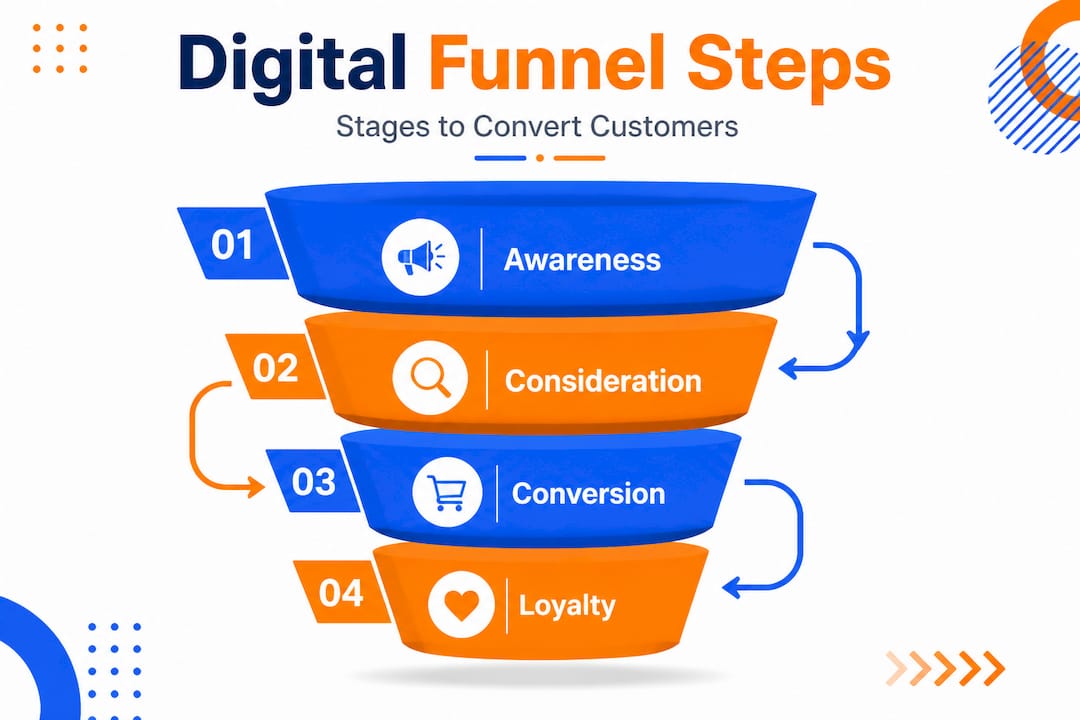
The classic funnel breaks into four stages:
- TOFU (Top of Funnel): Awareness. The goal here is reach. You want as many qualified strangers as possible to know your business exists. Ads at this stage are broad, often video or display formats, and success looks like views, impressions, and clicks.
- MOFU (Middle of Funnel): Consideration. The prospect knows you exist and is now weighing options. Your job is to educate, build trust, and stand out from competitors. Blog content, comparison guides, email sequences, and testimonial ads work well here.
- BOFU (Bottom of Funnel): Conversion. This is where a prospect is close to buying. Ads here are specific, offer-driven, and direct. Think discount codes, free consultations, or limited-time deals.
- Retention and loyalty. After a sale, the funnel doesn’t end. Keeping customers and turning them into repeat buyers is often cheaper than acquiring new ones.
The traditional model visualizes this as a neat triangle narrowing from wide at the top to a point at the bottom. That mental image is useful for planning, but it rarely reflects what actually happens. Funnels are not purely linear for modern buyers, and flexible, iterative approaches are what actually produce results.
Here is a quick comparison of how traditional and modern funnel behavior differ:
| Behavior | Traditional funnel | Modern buyer reality |
|---|---|---|
| Stage progression | Linear, step by step | Non-linear, jumps and backtracks |
| Device usage | Single device | Multiple devices per session |
| Channel exposure | One or two channels | Five or more touchpoints |
| Time to convert | Predictable timeline | Days, weeks, or months |
| Drop-off points | Predictable stages | Random and hard to forecast |
Understanding these differences matters if you’re investing in online advertising basics or running digital ads for service businesses. The gap between the classic model and reality is exactly where budget gets wasted.
Mapping intent and funnel stages: Practical framework
Once you understand the funnel’s structure, it becomes crucial to connect what users actually do on your site and ads to where they sit in the buying process. This is where micro-conversions come in. A micro-conversion is any small, meaningful action a prospect takes before the final purchase, such as clicking a button, watching a video for more than 30 seconds, downloading a free resource, or spending more than two minutes on your pricing page.

Digital ad funnels should measure micro-conversions, not just final sales, because they give you earlier signals that your funnel is working or breaking down before revenue is affected.
Here’s a practical breakdown of micro-conversions by stage:
| Funnel stage | Micro-conversion examples | What it signals |
|---|---|---|
| TOFU (Awareness) | Video view, ad click, blog page visit | Initial interest |
| MOFU (Consideration) | Newsletter signup, whitepaper download, case study read | Active evaluation |
| BOFU (Conversion) | Pricing page visit, contact form submit, cart add | Purchase intent |
| Retention | Repeat visit, loyalty program signup, referral link click | Ongoing engagement |
To actually put this to work, follow these steps when optimizing landing pages and offers for each intent stage:
- Audit your existing tracking. Open Google Analytics or your ad platform and list every action you’re currently measuring. Identify gaps where you’re not capturing intent signals.
- Define one key micro-conversion per funnel stage. Don’t try to track everything at once. Pick the single most predictive action at each stage and start there.
- Build stage-specific landing pages. A TOFU visitor needs education, not a buy-now button. A BOFU visitor needs a clear, friction-free path to purchase. Matching the page to the intent stage is one of the highest-ROI moves you can make.
- Test your offers. TOFU offers might be a free guide or a quiz. MOFU offers work well as a demo or comparison tool. BOFU offers should be direct and time-sensitive.
- Review your website conversion tips regularly. Page speed and design friction kill conversions silently.
Pro Tip: Don’t wait for a sale to judge a campaign. Track which earlier micro-conversions most reliably lead to eventual purchases, then optimize aggressively for those middle-step actions. You can use this data to find your funnel’s true leverage points.
For a deeper look at connecting these steps to your customer journey, the guide on mapping customer journey touchpoints offers a practical starting point. Pair that with specific online advertising tips tailored for small businesses to get even more traction.
Building flexibility: Why real ad funnels aren’t linear
With clear steps for mapping intent and tracking micro-conversions, the next focus is understanding why so few buyers behave predictably through funnel stages. The answer is in the data, and the numbers are striking.
“87% of consumers switch digital activities at least once per hour, and 42% describe their own purchase path as random.” — MiQ study, 53 million households
That means nearly half of your potential customers don’t even know why they ended up buying what they bought. They weren’t following your funnel. They were living their lives and your ad happened to show up at the right moment, on the right device, after several earlier exposures you may have already forgotten to measure.
Here are the most common non-linear behaviors you should plan for:
- Channel-switching. A prospect sees your Instagram ad, Googles your brand name, reads a review on Yelp, and then clicks a retargeting ad on YouTube. Each channel touched a different stage, but none of them operated in isolation.
- Device-hopping. Someone researches on their phone during lunch, compares options on a work laptop in the afternoon, and converts on a tablet at home that evening. If your tracking doesn’t connect sessions across devices, you’ll misread your funnel data entirely.
- Stage-skipping. A strong referral or viral post can send someone directly to BOFU without ever seeing a TOFU ad. This looks like a “direct” conversion, but it’s really earned trust doing the heavy lifting.
- Backtracking. A prospect gets to the checkout page, leaves, revisits your MOFU content again a week later, and then converts. If you treat this as a “new” MOFU visitor, your data becomes misleading.
Adapting to this reality means revisiting your customer journey mapping process to account for backward movement, not just forward progress.
Pro Tip: Set up your analytics and ad dashboards to track both forward movement and backward movement across funnel stages. If you see large numbers of prospects dropping from BOFU back to MOFU, that’s a signal your offer or landing page needs work, not your targeting.
Retargeting: Matching messaging to buyer intent at each stage
Understanding buyer behaviors also changes how you design retargeting. Retargeting means serving ads specifically to people who have already interacted with your business in some way, whether they visited your website, watched a video, or engaged with a previous ad.
The biggest mistake SMBs make with retargeting is treating everyone the same. Serving a “BUY NOW” ad to someone who only read a blog post once is a mismatch. Staged retargeting with exclusions by intent increases relevance and reduces wasted budget significantly.
Here is how to match retargeting messages to buyer intent:
- Low intent (TOFU retargeting). These are people who visited your site once, scrolled briefly, and left. Serve them educational content, brand stories, or problem-awareness ads. The goal is to move them to MOFU, not push for a sale they’re not ready for.
- Medium intent (MOFU retargeting). These visitors spent real time on your site, viewed multiple pages, or engaged with your email sequence. Show them testimonials, case studies, comparison content, or a free trial offer. Trust-building is the priority.
- High intent (BOFU retargeting). These people visited your pricing page, added a product to their cart, or submitted a partial form. Hit them with a direct offer: a discount, a bonus, or a limited-time deal. This is the group most likely to convert with one more nudge.
One detail most small businesses miss: exclusions matter as much as inclusions. Once someone converts, remove them from your TOFU and MOFU retargeting lists immediately. Continuing to show them awareness-level ads wastes budget and can actually confuse or annoy a customer you already won.
The cost of poor segmentation is real. Companies often waste 20 to 50% of their retargeting budget on poorly segmented lists, showing the wrong message to the wrong person at the wrong time. Checking your retargeting strategies on a regular basis keeps your spend efficient and your messaging relevant.
Measuring impact: Incrementality and smarter funnel validation
With targeting and funnel structure in place, the final step is understanding whether your funnel actually drives business results beyond what surface-level reports show. This is where incrementality comes in.
Incrementality means measuring how many extra conversions your ads actually caused, compared to what would have happened without them at all. Incrementality is best measured using a control-versus-test approach, comparing a group exposed to your ads against a group that was not, to estimate the true causal lift your campaigns produce.
Here’s a simple way to run a basic incrementality test for a campaign:
- Divide your target audience randomly into two groups. Group A sees your ads. Group B sees no ads or sees a neutral placeholder ad.
- Run the campaign for at least two to four weeks. Shorter periods don’t give enough data to account for normal purchase timing variation.
- Compare conversion rates between the two groups. The difference in conversion rate between Group A and Group B is your incremental lift.
- Calculate incremental cost. Divide your ad spend by the number of incremental conversions to find your true cost per result.
- Use the data to reallocate budget. Channels or stages with low incremental lift should receive less budget. High-lift areas deserve more investment.
This approach is far more reliable than relying on last-touch attribution, which gives all the credit for a conversion to the very last ad a person clicked before buying. That model systematically over-credits BOFU ads and under-credits the awareness and consideration stages that actually built the relationship.
A strong habit for tracking campaign performance is to review incrementality tests quarterly, especially when you change your ad mix, add new channels, or adjust your budget.
Pro Tip: Don’t let perfect attribution modeling become a distraction. Incrementality testing with even a basic control group gives you far more actionable insight than spending weeks perfecting a multi-touch attribution model that still relies on assumptions.
What most digital ad funnel guides miss: Real-world lessons for SMBs
Here’s what we’ve seen consistently across working with small and medium-sized businesses: most funnel guides treat stages as fixed boxes when they should treat them as flexible signal categories. The funnel is a planning tool, not a guarantee.
The bigger trap is attribution obsession. Business owners spend enormous energy trying to figure out which exact ad “caused” a sale, when the real question is: which combination of touchpoints, messages, and timing is producing the most efficient growth? Traditional funnel models can be overly simplified, and using funnel stages as planning scaffolds combined with cross-channel and incrementality methods gets you far closer to the truth.
The honest lesson is this: your funnel will always be messier than any diagram suggests. Buyers come in sideways, disappear for weeks, return from unexpected channels, and convert on timelines you didn’t plan for. Accepting that is not a defeat, it’s a strategic advantage. When you build measurement habits around testing and iterating rather than finding the “perfect” model, you start catching the real signals that predict growth.
Review your digital marketing success metrics regularly, connect them to stage-specific goals, and treat every campaign as a test you can learn from.
Pro Tip: Instead of searching for the perfect attribution model, build a habit of running small tests at each funnel stage every quarter. Over time, you will accumulate practical knowledge about what actually moves your specific customers forward, and that knowledge is more valuable than any model.
Take your digital funnels to the next level with expert help
Building a funnel that actually converts takes more than theory. It takes consistent measurement, smart audience segmentation, and the right creative for each stage. That’s where having expert guidance makes a real difference.
At ibrand.media, we help small and medium-sized businesses build and optimize digital ad funnels that match how real buyers behave. Whether you need help learning how to track campaign performance, reach more local buyers through marketing to local customers, or get a full walkthrough of our online advertising guide, we’ve built resources specifically for businesses at your stage. Our team offers personalized plans, transparent pricing, and real-time tracking so you can see what’s working and adjust fast. The funnel is yours to build. We’re here to make it sharper.
Frequently asked questions
What are the main stages of a digital ad funnel?
The main stages are awareness (TOFU), consideration (MOFU), conversion (BOFU), and sometimes retention or loyalty, each with a distinct goal of moving prospects closer to becoming customers. Common stage naming follows this TOFU-to-BOFU structure with optional retention extensions.
Can customers move backwards or skip stages in the funnel?
Yes, buyer journeys frequently overlap channels and don’t follow a linear sequence, meaning many people skip stages entirely or return to earlier ones before converting.
How can I track if my digital ads really drive sales?
Use incrementality testing, which compares conversion rates between audiences exposed to your ads and a control group that wasn’t, to calculate the true causal lift your campaigns produce.
Why should I use retargeting at different funnel stages?
Staged retargeting using intent signals and exclusions matches the right message to where a prospect actually is in their decision process, improving relevance and preventing wasted ad spend.
Is attribution modeling still important for small business ad funnels?
Attribution is useful context, but measuring micro-conversions at each funnel stage alongside incrementality testing gives small businesses far more actionable and reliable insights than last-touch attribution alone.
Recommended
- Understanding Online Advertising: A 2025 Guide for Small Business | Ibrandmedia
- Online Advertising Basics: Complete Guide for SMBs | Ibrandmedia
- Paid Advertising Explained: Simple Guide for Small Businesses 2025 | Ibrandmedia
- Effective Online Advertising Tips for Small Businesses 2025 | Ibrandmedia
- Optimize local campaigns with targeted advertising route planning
Recent Comments