
TL;DR:
- Voice search differs significantly from text search, emphasizing local intent, reviews, and structured data.
- To optimize results, speak naturally, include specific details, and verify information before scheduling.
- Dentists who maintain accurate GBP profiles, gather recent reviews, and use FAQ content rank higher in voice results.
Over 8.4 billion voice assistants are in use worldwide, and a growing share of people are using them to find local services like dentists. But here’s what most people miss: voice search does not work the same way as typing into Google. The results are different, the ranking factors are different, and the experience is completely different. If you are still searching for a dentist the old way, you are likely getting slower, less accurate results. This guide walks you through exactly how voice search works, how to phrase your queries for the best outcome, and what to do after your device speaks a dentist’s name.
Table of Contents
- How voice search works for finding dentists
- Optimizing your voice searches: What works best
- How dentists appear in voice search results
- Taking action: Getting the best dentist and a smooth booking
- Why traditional search advice falls short for voice — and what actually helps patients
- Take your next local search further
- Frequently asked questions
Key Takeaways
| Point | Details |
|---|---|
| Voice searches are local | Over three-fourths of voice queries for dentists are focused on nearby practices and personalized needs. |
| Conversational queries work best | Asking full, natural questions leads to the most accurate results from your voice assistant. |
| Google profiles and reviews matter | Dentists with strong reviews and updated business profiles are most likely to be featured in voice search answers. |
| Take action immediately | Voice search often lets you call and book with local dentists directly, saving time and effort. |
How voice search works for finding dentists
When you type “dentist near me” into Google, you get a list of ten or more options. When you ask your phone the same question out loud, you usually get one answer. That single result is not random. It is the product of a complex system that weighs your location, the time of day, business ratings, and how well a dental practice has structured its online presence.
Voice search is built around conversational, local-intent queries. Instead of short keyword fragments, people speak in full sentences: “Who is the best family dentist open on weekends near downtown?” The voice assistant processes that natural language, identifies the intent (find a local dentist), and pulls from real-time business data to deliver one confident answer.
Here is what makes voice search for dentists unique:
- Location awareness: Your device uses GPS to narrow results to dentists within a practical distance.
- Business hours: Voice assistants filter for practices that are currently open or match your timing request.
- Ratings and reviews: Higher-rated practices with more reviews tend to surface first.
- Structured website content: Dental practices with clear, organized websites are easier for voice AI to read and recommend.
- Google Business Profile (GBP) data: Up-to-date GBP listings are the backbone of most voice results.
A critical fact worth knowing: 76% of voice searches have local intent. That means the majority of people asking their voice assistant a question are trying to find something nearby, not just browsing information.
“Voice search is not a shortcut to the same results. It is a different channel with different rules, and local businesses that understand those rules win.”
For dental practices, this has major implications. The SEO strategies for dentists that work for text search need to be adapted for the way voice assistants pull and present information. Practices that invest in dental practice online marketing with voice in mind are far more likely to be the one answer your device reads aloud.
Optimizing your voice searches: What works best
Understanding the technology is just the start. Here is how you can get the most out of it in practice.
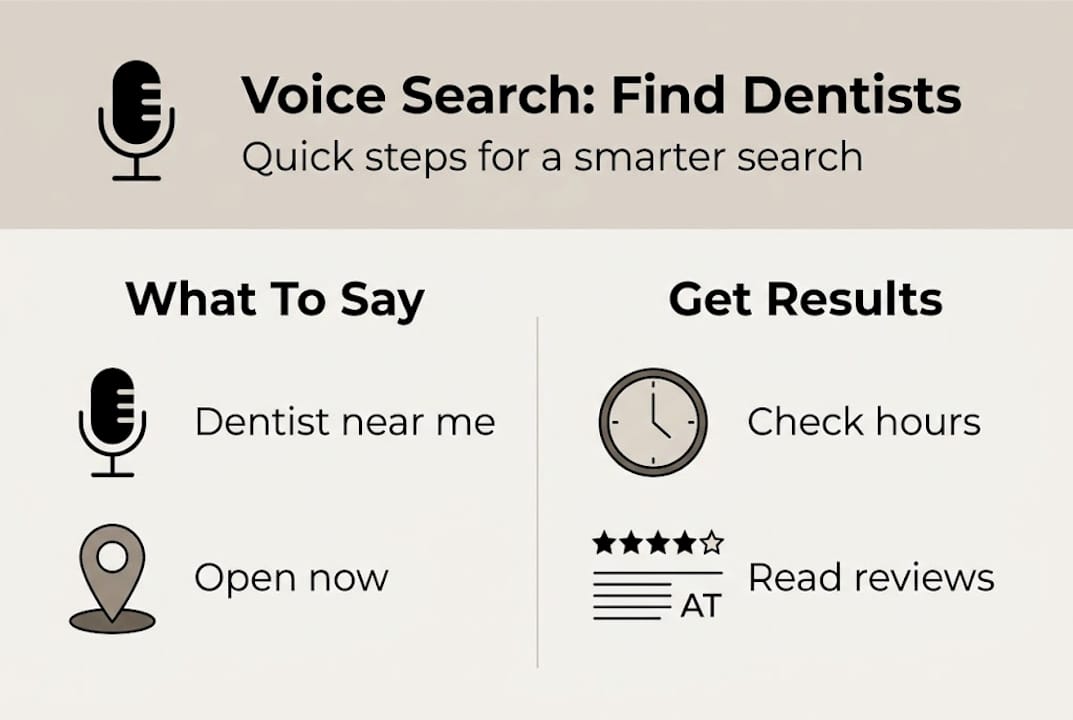
The single biggest mistake people make with voice search is speaking to their device the same way they type. Voice assistants are designed for natural conversation, and they actually perform better when you treat them that way. Voice queries for dentists are 3 to 5 words longer on average than text searches, and that extra detail helps the assistant narrow down exactly what you need.
Here is a step-by-step approach to getting better dentist results from your voice assistant:
- State the service first. Begin with what you need: “Find a pediatric dentist” or “I need an emergency dentist.”
- Add your location. Say “near me” or name your neighborhood, street, or city.
- Include timing. Add “open now,” “open this Saturday,” or “available for a same-day appointment.”
- Ask a question. Phrasing your query as a question often triggers more accurate results: “Which dentist near Oak Street accepts Delta Dental insurance?”
- Be specific about the service. General queries return general results. Specific queries return specific answers.
Common mistakes to avoid:
- Saying only “dentist” with no other context
- Forgetting to mention your location when GPS is off
- Using technical terms the assistant may not recognize (say “teeth cleaning” not “prophylaxis”)
- Not following up when the first result does not feel right
Pro Tip: If you need urgent care, ask your voice assistant something like “Find a dentist for emergency tooth pain near Main Street open right now.” The more specific your request, the more targeted the answer. You can also check out affordable dental marketing tips if you are a practice owner looking to show up in these results, or explore ways to improve local search rankings to understand what makes certain dentists rise to the top.
How dentists appear in voice search results
With the right voice tactics in hand, it helps to know what actually determines which dentist you hear as a result.
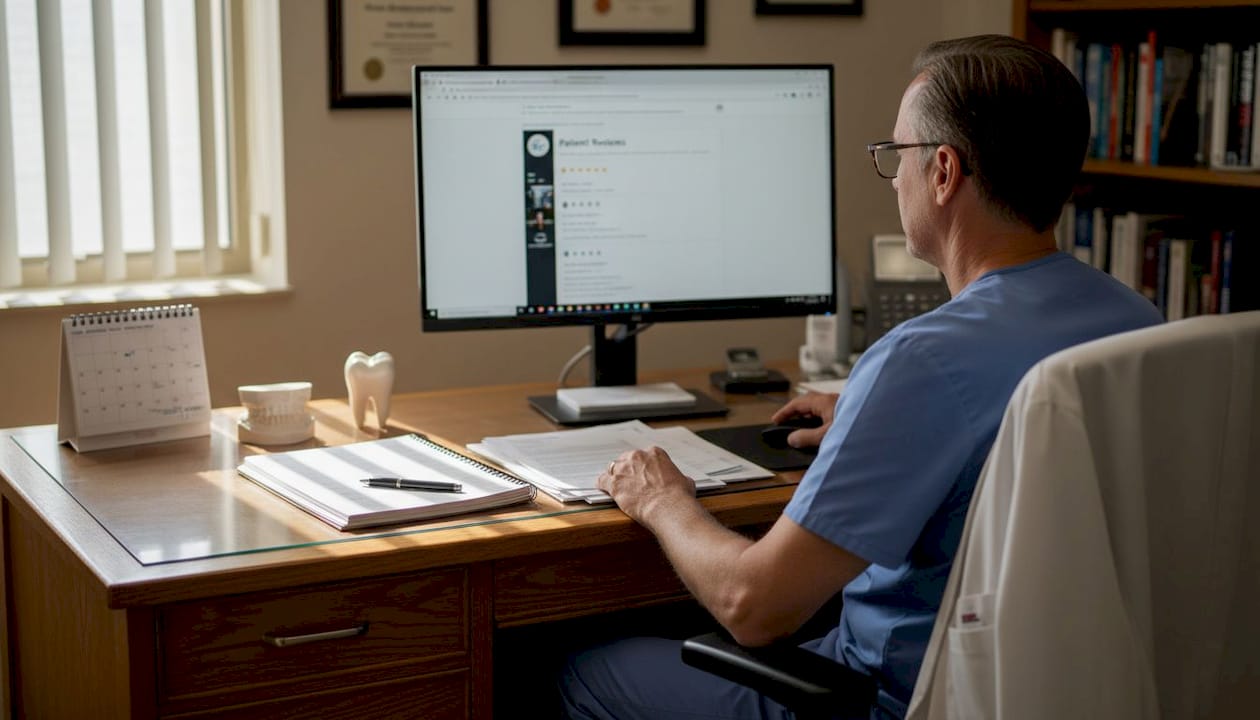
Voice assistants do not browse the web the way you do. They rely on natural language processing, GBP data, reviews, and structured content to identify the most relevant local dentist for your query. Think of it as a very fast, very opinionated research assistant that has already done the vetting for you.
Here is what separates dentists who appear in voice results from those who do not:
- Complete Google Business Profile: Name, address, phone number, hours, and services must all be accurate and current.
- Positive, frequent reviews: Not just a high rating, but a steady stream of recent feedback. A dentist with 200 reviews from three years ago may rank lower than one with 50 reviews from the past six months.
- FAQ content on their website: Voice assistants love question-and-answer formatted content because it mirrors how people speak.
- Mobile-friendly website: Slow or hard-to-read sites get deprioritized.
- Consistent NAP data: Name, address, and phone number must match across all platforms.
| Factor | Text search impact | Voice search impact |
|---|---|---|
| Google Business Profile | High | Critical |
| Recent reviews | Moderate | Very high |
| Website FAQ content | Low | High |
| Mobile page speed | Moderate | Critical |
| Keyword optimization | High | Moderate |
Pro Tip: Encourage your dentist to ask for reviews after each visit. A practice with consistent, positive feedback is far more likely to be the name your voice assistant reads aloud. If you are a dental practice owner, reviewing essential dentist website tips and investing in reputation management for dentists can directly improve your voice search visibility.
Taking action: Getting the best dentist and a smooth booking
Knowing how results show up leads directly to how you can turn a quick voice search into the right appointment.
Hearing a dentist’s name from your voice assistant is step one. What you do next determines whether you actually get the care you need quickly. Here is a practical sequence to follow after your device gives you a result:
- Verify the details. Ask your assistant to confirm the address, phone number, and hours. Say “What are their hours today?” or “Are they accepting new patients?”
- Call directly. 28% of voice searches result in a direct call to the business, which is a much higher conversion rate than website clicks. Calling is faster and often gets you an appointment sooner.
- Check reviews before you commit. Ask your assistant to show reviews, or do a quick visual scan on your phone before booking.
- Confirm insurance and pricing. A quick call to ask about accepted insurance plans saves you from surprises at the front desk.
- Book and confirm. If the practice offers online booking, your assistant may link you directly. Otherwise, call and ask for a confirmation text or email.
| Action | Do this | Avoid this |
|---|---|---|
| Verifying info | Ask your assistant to confirm hours | Assuming the listing is current |
| Booking | Call directly for fastest response | Waiting for an online form reply |
| Checking reviews | Ask for recent reviews, last 6 months | Relying only on star rating |
| Insurance check | Call and ask before your visit | Assuming all plans are accepted |
| Follow-up | Request a confirmation message | Showing up without confirmation |
For dental practices, the dental blog benefits of publishing helpful content and the value of dental video marketing strategies both contribute to a stronger voice search presence over time.
Why traditional search advice falls short for voice — and what actually helps patients
Most search advice you read online was written for a world of ten blue links. That world still exists for text search, but voice search operates on a completely different model. When your device gives you one answer, the old advice about ranking on page one becomes irrelevant. There is no page one. There is only the answer.
What actually moves the needle for voice searchers is simpler and more human than most SEO guides admit. Fresh reviews matter more than backlinks. An accurate phone number matters more than a perfectly optimized title tag. A dental practice that answers its phone quickly will convert more voice-driven callers than one with a beautiful website that loads slowly.
The urgent shift to mobile speed and to a zero-click AI ecosystem means that patients who ask specific, well-phrased questions get better answers faster. You do not need to be a tech expert. You just need to speak clearly, be specific, and act on the result. Practices that understand this, and invest in writing for SEO locally, are the ones patients hear first.
Take your next local search further
Voice search is one of the fastest ways to find a trusted local dentist, but getting consistently great results takes a little know-how. Whether you are a patient trying to find the right care or a dental practice trying to be the answer your community hears, the principles are the same: be specific, stay current, and make it easy for people to reach you.
At ibrand.media, we help local businesses show up where it counts. From optimizing your local website to building a full SEO for local businesses strategy, our guides and services are built for practices that want real results without the guesswork. Explore our resources and take the next step toward stronger local visibility today.
Frequently asked questions
How accurate are voice assistants for finding local dentists?
Voice assistants are highly accurate for local dentist searches because they use real-time GBP data and prioritize local intent to surface the most relevant match in your area.
What should I say to my voice assistant to find a dentist open now?
Use natural language like “Find a dentist near me open now” for the best results, since voice queries are longer and conversational and deliver more accurate matches than short keyword phrases.
Why do voice search results often show only one dentist?
Voice search is designed to give a single authoritative answer, selected based on local relevance, strong GBP data, and positive reviews rather than presenting a ranked list like text search does.
Can I book a dental appointment directly from a voice search?
Yes, 28% of voice searches lead to a direct call, making it easy to book appointments from your mobile device right after your assistant gives you a result.
Recommended
- SEO strategies for dentists to attract patients in 2026 | Ibrandmedia
- 7 Affordable Marketing Strategies for Dentists | Ibrandmedia
- Master Dental Practice Online Marketing for Local Growth | Ibrandmedia
- 7 Essential Dentist Website Design Tips for More Patients | Ibrandmedia
- How to rank on Google: expert strategies for Boca Raton businesses
Recent Comments