
TL;DR:
- Small businesses should focus on specific target audiences based on needs and motivations, not just demographics.
- Combining customer analysis, interviews, surveys, and competitor research effectively identifies your ideal audience.
- Niche targeting drives stronger engagement, loyalty, and lower customer acquisition costs for small businesses.
Most small businesses assume their product or service is for everyone. That sounds optimistic, but it’s one of the most expensive marketing mistakes you can make. When your message tries to speak to everyone, it resonates with no one, and your budget quietly disappears into campaigns that don’t convert. Audience identification for small businesses involves analyzing current customers, running surveys, studying competitors, and using analytics tools to build buyer personas grounded in real demographics, psychographics, and behaviors. Get this right, and every dollar you spend on marketing works harder. This guide gives you practical frameworks, expert-backed methods, and actionable steps to find and reach the people most likely to buy from you.
Table of Contents
- Understanding what a target audience really means
- Core methods to identify your target audience
- Comparing broad versus niche audience strategies
- Building and evolving dynamic buyer personas
- Our take: Why tiny niches unlock big results for small businesses
- Unlock your audience: Next steps with ibrand.media
- Frequently asked questions
Key Takeaways
| Point | Details |
|---|---|
| Precision beats generalization | Focusing on a well-defined audience yields better engagement and ROI than targeting everyone. |
| Qualitative research matters | Interviewing customers reveals pain points and motivations you can’t find in survey data alone. |
| Start small, scale smart | Begin with a niche market for greater loyalty and expand as you establish a strong reputation. |
| Personas must evolve | Regularly update your buyer personas as your business and market environment change. |
Understanding what a target audience really means
A target audience is not just “women aged 25 to 45” or “local homeowners.” Those are demographics, and demographics alone are a shallow starting point. A true target audience is a specific group of people defined by shared needs, motivations, and behaviors. They have a problem your business solves, and they’re actively looking for a solution.
The mistake most small business owners make is confusing a broad market with a target audience. Your market might be “pet owners in Chicago,” but your target audience is “first-time rescue dog owners in Chicago who feel overwhelmed and want professional training support.” That specificity changes everything about how you write ads, design your website, and choose where to show up online.
One powerful technique is the “chain-of-whys.” Start with a surface-level description of your customer and keep asking why until you hit a real motivation. Why does someone hire a house cleaner? Because they’re busy. Why are they busy? Because they work long hours and have young kids. Why does that matter? Because they feel guilty about not keeping the house clean and want to feel like a good parent. Now you’re marketing to an emotion, not just a task.
As target market experts point out, the best audience definitions are built around shared needs and use cases, not just demographics or firmographics. You should also combine micro and macro strategies:
- Micro (niche) targeting: Highly personalized messaging for a small, specific group. Great for building loyalty and early traction.
- Macro (broad) targeting: Wider awareness campaigns for a larger segment. Works better once you’ve proven your message converts.
- Revisit regularly: Your audience evolves. A profile that worked two years ago may no longer reflect who’s actually buying from you.
- Use real data: Don’t build personas from assumptions. Pull from actual customer interactions, reviews, and sales records.
“A target market is defined by shared needs and use cases, not just demographics. Use the chain-of-whys to uncover real motivations, and revisit your audience profiles as your market evolves.”
When you’re just starting out, targeting local audiences effectively is often the fastest path to early wins. Local specificity lets you compete with bigger brands on relevance rather than budget. To go deeper on how to identify your target market, start with the customers you already have.
Core methods to identify your target audience
Knowing what a target audience is and actually finding yours are two different things. Here’s a step-by-step process that works for small businesses and local service providers with limited time and resources.
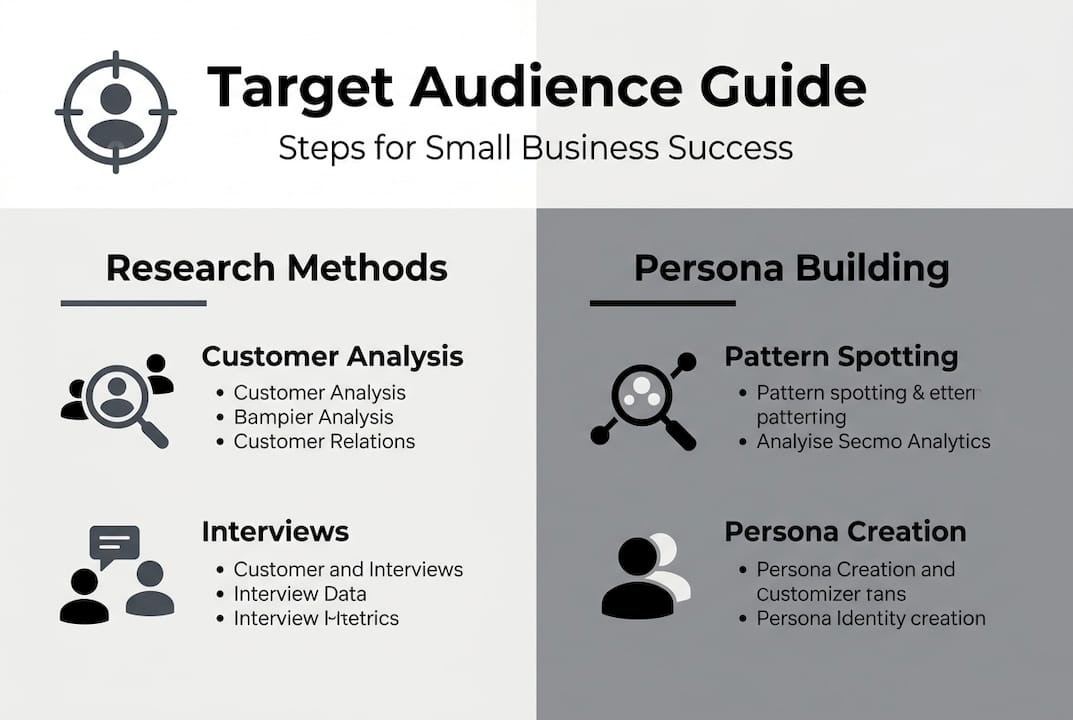
- Analyze your current customers. Look at who’s already buying from you. What do they have in common? Age, location, job type, buying frequency? Your CRM or even a simple spreadsheet can reveal patterns you’ve never noticed.
- Conduct direct interviews. Talk to 10 to 15 of your best clients one-on-one. Ask about their biggest frustrations before finding you, what made them choose your business, and what they’d miss most if you disappeared. This is your most valuable research.
- Run short surveys. Use tools like Google Forms or Typeform to gather broader input. Keep surveys under 10 questions and focus on pain points and decision triggers.
- Study your competitors. Look at their reviews, social media comments, and who engages with their content. You’ll find unmet needs and underserved segments hiding in plain sight.
- Use analytics tools. Google Analytics, Meta Audience Insights, and your email platform’s data all tell you who’s engaging with your content and what they care about.
This process is backed by solid research. Audience identification methods consistently show that combining customer analysis, surveys, competitor research, and analytics gives the clearest picture of your real audience.
The most underrated step is the interview phase. Qualitative buyer interviews with 10 to 15 ideal clients consistently outperform large surveys for service providers. This is the “Lighthouse Client” model: identify clients who had an urgent pain, a real budget, and a willingness to act. These people reveal your best messaging and your most profitable positioning.
Pro Tip: Don’t ask customers what they want. Ask them to walk you through the moment they realized they had a problem. That story is your best marketing copy.
Once you spot patterns across multiple interviews, you’re ready to build your first persona. Your marketing channel selection should follow directly from where these personas spend their time. For a broader look at applying these insights, explore digital marketing strategies for service providers that match your audience profile. You can also explore rapid audience research techniques if you need results faster.
Comparing broad versus niche audience strategies
Now that you know how to identify potential audiences, let’s weigh the trade-offs between casting a wide net and narrowing your focus. Both approaches have merit, but for most small businesses, the order in which you use them matters enormously.
Broad targeting builds awareness but dilutes your messaging and reduces ROI. When you try to appeal to everyone, your ads become generic, your copy loses punch, and your conversion rates suffer. Niche targeting, on the other hand, yields higher engagement, stronger loyalty, and better returns because your message speaks directly to a specific person’s specific problem.
| Factor | Broad targeting | Niche targeting |
|---|---|---|
| Reach | High | Low to medium |
| Message relevance | Low | High |
| Cost per acquisition | Higher | Lower |
| Brand loyalty | Weaker | Stronger |
| Best for | Established brands | Growing small businesses |
| Risk level | Higher budget waste | Lower, more controlled |
Consider a local pet groomer. Targeting “all pet owners” means competing with every groomer in the city. But targeting “owners of rescue dogs with anxiety” lets you craft messaging around calm environments, patient handling, and trauma-informed grooming. That’s a story only the right customer will respond to, and they’ll tell their friends.
Passionate niche audiences become brand ambassadors, and smaller beachhead markets reduce both competition and customer acquisition costs. Starting small isn’t a limitation. It’s a strategy.
Here’s when to broaden or narrow your focus:
- Narrow your focus when you’re launching, testing a new service, or trying to dominate a local market.
- Stay niche when your referral rate is high and word-of-mouth is working.
- Broaden gradually once you’ve built credibility and proof in your niche.
- Avoid broad targeting if your budget is limited and you need measurable ROI fast.
Building loyal customers almost always starts with serving a specific group exceptionally well, not by trying to please everyone at once.
Building and evolving dynamic buyer personas
After choosing your targeting focus, it’s time to bring your research to life with actionable buyer personas. A persona is not a fictional character. It’s a pattern you’ve observed across real customers, given a name and a face so your whole team can align around it.

A strong persona includes more than demographics. It captures psychographics (values, fears, goals), buying triggers (what pushes them to act), and preferred channels (where they look for solutions). Here’s a simple example:
| Trait | Description | Marketing insight |
|---|---|---|
| Name | Maria, 38 | Relatable, not generic |
| Role | Small business owner | Speaks to time pressure |
| Pain point | Wasting money on ads that don’t convert | Lead with ROI messaging |
| Goal | Predictable monthly leads | Emphasize consistency |
| Preferred channel | Instagram and Google Search | Focus budget there |
| Buying trigger | Sees a competitor succeeding | Use social proof |
Once you have a draft persona, don’t assume it’s correct. Buyer personas should evolve dynamically, and you should test small campaigns to validate assumptions before scaling. Here’s how:
- Run a small paid ad campaign targeting your persona’s demographics and interests.
- Track click-through rates, conversions, and time on page.
- Compare results against your assumptions. Did the right people respond?
- Adjust the persona based on what the data tells you, not what you hoped.
- Repeat the test every quarter or after any major business change.
Pro Tip: Schedule a persona review every six months. Set a calendar reminder now. Markets shift, customer priorities change, and a persona that felt accurate last year may be steering you wrong today.
As market research experts consistently emphasize, revisiting profiles as markets evolve is not optional. It’s part of the job. Use your targeting strategies for local customers to test persona assumptions in a low-cost, high-feedback environment. And when it’s time to refresh your approach, revisiting how you’re updating audience personas can save you from chasing the wrong segment for months.
Our take: Why tiny niches unlock big results for small businesses
Here’s something most marketing guides won’t tell you: the businesses that grow fastest aren’t the ones with the biggest audiences. They’re the ones with the most specific audiences.
We’ve seen small businesses pour money into broad Facebook campaigns targeting “adults 18 to 65” and wonder why nothing converts. Then they shift to a tight niche, spend less, and see three times the results. The math isn’t magic. Specific people respond to specific messages. Generic messages get ignored.
The deeper issue is that most business owners are afraid to narrow down. They worry that a smaller audience means fewer sales. But case studies for service providers show the opposite. Niche audiences become loyal advocates who refer others, reduce your need for paid ads, and lower your cost to acquire each new customer.
The other mistake is treating your persona as a finished product. Your audience is a living thing. It changes as your business grows, as competitors enter the market, and as customer expectations shift. The businesses that stay ahead are the ones that keep asking questions, keep interviewing customers, and keep updating what they know. A static persona is a slow leak in your marketing strategy.
Unlock your audience: Next steps with ibrand.media
If you’ve made it this far, you now have a clear picture of how to find, define, and refine your target audience. The next step is putting that knowledge to work in your actual marketing.
At ibrand.media, we help small businesses and local service providers turn audience insights into campaigns that actually convert. Whether you need SEO for small businesses that attracts the right search traffic, or a full marketing to local customers guide to sharpen your local presence, we build strategies around your specific audience, not generic templates. Our team works with you to identify your best customers, craft messaging that resonates, and choose the channels where your audience actually spends time. Let’s build something that works.
Frequently asked questions
What’s the difference between a target audience and a buyer persona?
A target audience is a generalized segment you aim to reach; a buyer persona is a detailed, data-driven profile representing your ideal customer. Buyer personas should evolve dynamically and be tested with real campaigns before you scale.
How often should I update my target audience?
Review and adjust your audience profiles at least every 6 to 12 months or whenever market shifts or business changes occur. As market research shows, regularly revisiting profiles as markets evolve keeps your messaging accurate and effective.
What’s the best way to find my ‘Lighthouse Clients’?
Interview 10 to 15 of your best clients, focusing on those with urgent needs and a clear willingness to pay for your service. Qualitative buyer interviews consistently outperform large surveys for identifying the clients who drive the most value.
Is niche targeting better for small businesses than broad targeting?
Niche targeting often yields stronger initial growth, loyalty, and lower customer acquisition costs. Passionate niche audiences create brand ambassadors and reduce competition, so expand broadly only after you dominate a niche.
What tools can help with target audience identification?
Use analytics platforms, CRM data, social listening software, and competitor research tools to uncover audience insights. Audience identification works best when you combine multiple data sources rather than relying on just one.
Recent Comments