
TL;DR:
- Personalized marketing uses customer data to create relevant, individualized messages that boost loyalty and revenue. It requires connected data, AI tools, and ongoing feedback to scale effectively while maintaining trust and compliance. Businesses that adopt genuine personalization strategies outpace competitors in engagement, cost efficiency, and customer retention.
Personalized marketing is the strategic use of customer data to deliver tailored messages and experiences that resonate on an individual level, moving beyond generic campaigns to create genuine relevance. The industry term for this practice is “one-to-one marketing,” and it has become the defining competitive advantage for businesses that want to grow in 2026. Platforms like Klaviyo, Emarsys, and Salesforce have made personalization accessible to companies of every size, not just enterprise brands with massive budgets. The businesses choosing this approach are seeing measurable gains in engagement, loyalty, and revenue that generic broadcast campaigns simply cannot match.
Why choose personalized marketing over generic campaigns?
Personalized marketing works because it replaces the assumption that all customers want the same thing with the reality that they do not. Customers expect recommendations that reflect their actual preferences, communication timing that matches when they are receptive, and continuity across every channel they use. When a business meets those expectations, the interaction stops feeling like advertising and starts feeling like service.

The contrast with generic campaigns is stark. A mass email promoting a winter coat sale to your entire list treats a customer in Miami the same as one in Minneapolis. A personalized version factors in location, past purchase history, and browsing behavior to send the right offer to the right person at the right time. That specificity is what drives clicks, purchases, and return visits.
The importance of personalized campaigns also shows up in customer lifetime value. Relevant experiences make customers spend more per transaction, return more frequently, and recommend the brand to others. Those three behaviors compound over time into a revenue advantage that no amount of discounting can replicate.
Pro Tip: Before building any personalization program, audit what customer data you already collect. Most businesses have more usable data sitting in their CRM, email platform, and website analytics than they realize.
How personalization builds loyalty
Brands that excel at personalization are 71% more likely to report improved customer loyalty, according to Deloitte data. That figure is not a coincidence. When customers feel understood, they stop shopping around. Loyalty is the direct result of relevance delivered consistently over time.
The forms of personalization that drive loyalty most effectively include tailored discount offers, product recommendations based on purchase history, and lifecycle messaging that acknowledges where a customer is in their relationship with the brand. A first-time buyer needs a different message than a customer who has purchased six times. Treating them identically is a missed opportunity every single time.
- Tailored discount offers tied to individual purchase history
- Product recommendations based on browsing and buying patterns
- Lifecycle-aware messaging that shifts tone and content by customer stage
- Channel preference matching so messages arrive where customers actually engage
What business outcomes does personalized marketing deliver?
The financial case for tailored marketing is grounded in efficiency, not just revenue. AI-powered personalization reduces cost to serve by 20 to 30%, according to McKinsey research. That reduction comes from eliminating wasted spend on audiences who were never going to convert and from shortening the path from awareness to purchase.
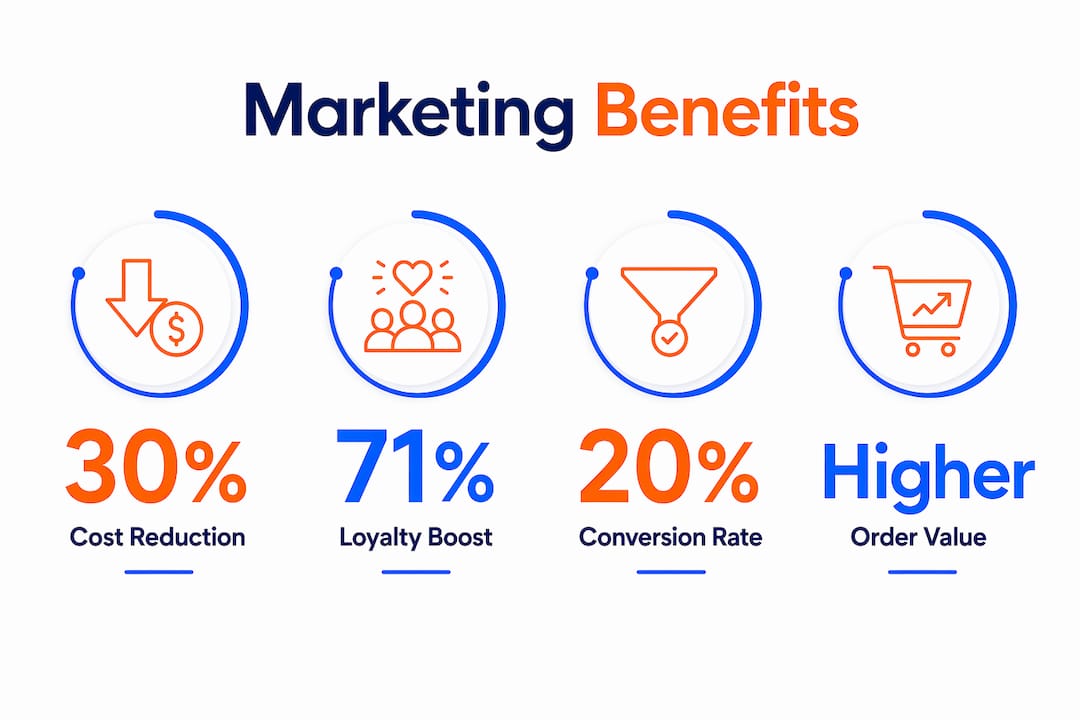
Conversion rates improve because relevance removes friction. When a customer sees a product recommendation that matches what they were already considering, the decision to buy requires less persuasion. The message does the work that a sales team would otherwise need to do manually.
| Business Outcome | What Personalization Delivers |
|---|---|
| Revenue growth | Higher average order value and repeat purchase frequency |
| Cost efficiency | 20 to 30% reduction in cost to serve via AI-matched messaging |
| Conversion rate | Reduced friction through relevant, timely offers |
| Customer retention | Stronger loyalty from consistent, contextual engagement |
| Marketing ROI | Precise segmentation reduces wasted ad spend |
Exclusive discounts tailored to preferences are the number one form of personalization influencing purchase decisions, according to Klaviyo’s 2025 Future of Consumer Marketing Report. That finding matters because it tells businesses exactly where to start. You do not need a sophisticated AI stack on day one. You need to know what your customers buy and offer them more of it at the right moment.
Pro Tip: Track revenue per recipient on your email campaigns, not just open rates. This single metric reveals whether your personalization is actually driving purchases or just getting clicks.
How does AI enable personalization at scale?
The biggest obstacle to personalized marketing has always been content volume. Writing a unique message for every customer segment, product category, and lifecycle stage requires more creative capacity than most marketing teams have. Generative AI removes this content bottleneck, enabling dynamic, real-time creation of individualized experiences at a scale that was previously impossible.
AI tools like those built into Klaviyo, HubSpot, and Adobe Experience Cloud now handle send-time optimization, product recommendation logic, and content variant generation automatically. A small business team of two can run personalization programs that would have required a team of twenty just five years ago. Forbes estimates the AI personalization opportunity at $2 trillion across industries, which signals how much value is still uncaptured by businesses that have not yet adopted these tools.
The foundation that makes AI personalization work is connected data. Successful personalization requires synchronized data from marketing, commerce, service, and operations. When those data sources are siloed, the customer experience becomes fragmented. A customer who just filed a complaint should not receive a promotional upsell email two hours later. A unified customer data platform (CDP) prevents those disconnects.
- Connect your CRM, email platform, e-commerce system, and customer service data into one view
- Use AI to automate send-time optimization based on individual engagement patterns
- Deploy generative AI for dynamic subject lines, product descriptions, and offer copy
- Set governance rules that prevent AI from sending messages that conflict with recent customer interactions
Pro Tip: Start with one connected data source before expanding. Connecting your e-commerce platform to your email tool alone unlocks browse abandonment, post-purchase, and win-back automations that most businesses leave inactive.
What are the privacy risks of personalized marketing?
Personalization becomes a liability when it crosses from relevant into intrusive. Excessive personalization risks feeling invasive, and that perception damages trust faster than any generic campaign ever could. The line between “this brand understands me” and “this brand is watching me” is thinner than most marketers acknowledge.
Governable personalization with compliance guardrails is not optional in regulated industries like healthcare, finance, and insurance. Auditability, consent management, and purpose limitation are the three structural requirements that keep personalization programs legal and trustworthy. Businesses that skip these steps face regulatory risk and, more practically, customer churn when people feel their data is being misused.
Auditability by design means logging identity state, permissions, content decisions, and measurement outcomes so you can answer why a specific customer received a specific message within hours. That capability is not just a compliance requirement. It is a quality control mechanism that helps you catch personalization errors before they become customer complaints.
- Build explicit consent collection into every data capture point
- Apply purpose limitation so data collected for one use is not repurposed without permission
- Use platform guardrails in tools like Salesforce Marketing Cloud or Klaviyo to restrict AI outputs
- Track customer trust alongside conversion metrics, because short-term gains can mask long-term trust erosion
How to start a personalized marketing strategy that works
Most personalization programs fail not because of technology but because of segmentation mistaken for personalization. Grouping customers into five buckets and sending slightly different emails to each bucket is not personalization. It is segmentation with better branding. True personalization meets the customer’s need right now, based on their current context and behavior.
Here is a practical sequence for businesses adopting personalized marketing for the first time:
- Consolidate your customer data. Connect your e-commerce platform, CRM, and email tool so you have a single view of each customer’s purchase history, engagement behavior, and preferences.
- Define segments by lifecycle stage. New customers, active buyers, lapsed customers, and high-value loyalists each need fundamentally different messaging strategies.
- Prioritize timing and channel. Match your messages to when and where each customer is most likely to engage, using behavioral data rather than assumptions.
- Use generative AI for content scale. Tools like Klaviyo AI or HubSpot’s Content Assistant let small teams produce personalized copy variants without hiring additional writers.
- Measure what matters. Track revenue per recipient, repeat purchase rate, and customer satisfaction scores alongside open rates and click-through rates.
The advantages of tailored marketing compound over time. A business that starts with basic lifecycle emails and gradually adds behavioral triggers, predictive recommendations, and dynamic content will outperform competitors running static campaigns within two to three campaign cycles. You can explore how small business marketing trends are shifting toward personalization to understand where the competitive pressure is coming from.
Pro Tip: Run an A/B test comparing your current best-performing generic campaign against a personalized version targeting just your top 20% of customers. The revenue difference will make the case for full personalization investment faster than any strategy document.
Key takeaways
Personalized marketing outperforms generic campaigns because it delivers the right message to the right person at the right time, producing measurable gains in loyalty, conversion, and cost efficiency.
| Point | Details |
|---|---|
| Loyalty advantage | Brands excelling at personalization are 71% more likely to report improved customer loyalty. |
| Cost efficiency | AI-powered personalization cuts cost to serve by 20 to 30% through precise targeting. |
| Technology foundation | Connected data platforms and generative AI are required to scale personalization without losing quality. |
| Privacy requirement | Consent management and auditability are non-negotiable for sustainable, trustworthy personalization. |
| Starting point | Consolidate customer data first, then layer in AI tools and lifecycle-based segmentation. |
Personalization is a mindset, not just a feature
I have worked with dozens of small and mid-sized businesses on their marketing strategies, and the pattern I see most often is this: a business invests in a personalization tool, sets up a few automated emails, and then wonders why the results are underwhelming. The technology was fine. The thinking behind it was not.
Personalization is not a feature you turn on. It is a commitment to genuinely understanding your customers well enough to say something relevant to them at the right moment. The businesses that get this right are not necessarily the ones with the biggest budgets or the most sophisticated AI stacks. They are the ones that ask, before every campaign, “Does this message reflect what we actually know about this person?”
The quality of your data matters more than the quantity. A clean, well-connected dataset of 5,000 customers will outperform a bloated, fragmented list of 50,000 every time. I have seen businesses triple their email revenue not by growing their list but by actually using the behavioral data they already had.
The other mistake I see constantly is treating personalization as a one-time setup. Customer preferences shift. Lifecycle stages change. A message that was perfectly timed six months ago may now be irrelevant or even annoying. The businesses that win long-term are the ones that build feedback loops into their personalization programs, monitoring trust and satisfaction alongside conversion metrics. Building customer loyalty online requires that kind of ongoing attention, not a one-time campaign.
AI will keep improving the scale and precision of what is possible. But the businesses that use it thoughtfully, with clear consent practices and genuine customer empathy, will be the ones still earning trust five years from now.
— TONY
Ready to put personalization to work for your business?
Ibrand specializes in helping small and medium-sized businesses build digital marketing strategies that actually connect with their customers. From SEO for small businesses to social media management and targeted advertising, Ibrand builds the connected marketing infrastructure that makes personalization possible at any budget.
If you are ready to move beyond generic campaigns and start delivering experiences your customers actually respond to, Ibrand’s team can map out a personalized plan built around your specific audience, goals, and growth stage. The gap between where your marketing is now and where it could be is smaller than you think. Explore Ibrand’s social media management services to see how personalized campaigns integrate across every channel your customers use.
FAQ
What is personalized marketing?
Personalized marketing is the practice of using customer data to deliver tailored messages, offers, and experiences that match individual preferences and behaviors. It moves beyond mass messaging to create one-to-one relevance at scale.
How does personalized marketing improve customer engagement?
Personalized marketing improves engagement by matching content, timing, and channel to each customer’s actual preferences and lifecycle stage. Emarsys research shows that customers respond more strongly when recommendations reflect their real interests and communication arrives when they are receptive.
What ROI can businesses expect from personalized marketing?
McKinsey research cited by Klaviyo shows AI-powered personalization reduces cost to serve by 20 to 30%, while Deloitte data shows personalization leaders are 71% more likely to report improved customer loyalty. Both metrics translate directly into higher marketing ROI.
Is personalized marketing safe from a privacy standpoint?
Personalized marketing is safe when built on explicit consent, purpose limitation, and auditability. CIO research highlights that regulated industries require baked-in compliance guardrails, including logging of content decisions and permissions, to maintain legal and ethical standards.
Can small businesses afford personalized marketing?
Small businesses can start with personalized marketing using tools like Klaviyo or HubSpot at accessible price points. Connecting an e-commerce platform to an email tool alone unlocks behavioral automations that deliver personalization without requiring a large team or enterprise budget.
Recent Comments