
TL;DR:
- Consistent brand presentation can increase revenue by up to 33 percent.
- Building systems and regular audits ensure long-term brand consistency.
- Operational mindset and accountability drive effective branding beyond just design guidelines.
Consistent brand presentation across platforms can increase revenue by 10-33%, yet most small and medium-sized businesses treat branding as a one-time task rather than an ongoing system. The result? Customers encounter different logos, mismatched messaging, and conflicting contact details depending on where they find you, and that confusion costs real money. If you’ve ever wondered why some businesses feel instantly trustworthy while others seem scattered, the answer usually comes down to consistency. This guide breaks down exactly what brand consistency means, why it matters for your bottom line, and how to build it without a massive budget or a full-time brand manager.
Table of Contents
- The business impact of brand consistency
- What brand consistency looks like in practice
- Common pitfalls and challenges for SMBs
- Building a consistent brand: proven strategies and quick wins
- A fresh perspective: what most guides miss about brand consistency
- Connect your brand strategy with expert support
- Frequently asked questions
Key Takeaways
| Point | Details |
|---|---|
| Consistency boosts sales | Brand consistency can increase SMB revenue by up to 33% according to recent studies. |
| Trust drives buying | 81% of customers need to trust a brand before they make a purchase. |
| Visual and NAP matter | Unified visuals and consistent Name, Address, and Phone information are must-haves. |
| Common pitfalls exist | Growth and siloed teams often challenge brand consistency and require proactive solutions. |
| Systems over guidelines | Ongoing brand audits and digital asset management are more effective than simple guidelines alone. |
The business impact of brand consistency
Numbers rarely lie, and the data on brand consistency is striking. Consistent brand presentation across every platform, from your website to your email signature, can lift revenue by 10-33%. That’s not a rounding error. For a business doing $500,000 a year, that’s potentially $50,000 to $165,000 in additional revenue from something as controllable as how you present your brand.
Trust is the engine behind those numbers. 81% of customers say they need to trust a brand before they’ll make a purchase. Consistent branding builds that trust by signaling reliability. When your logo, colors, and tone feel the same everywhere, customers subconsciously register that you’re organized, professional, and dependable. Inconsistency sends the opposite signal.
“68% of organizations attribute 10-20% revenue growth directly to brand consistency.” This isn’t a soft marketing metric. It’s a measurable business outcome.
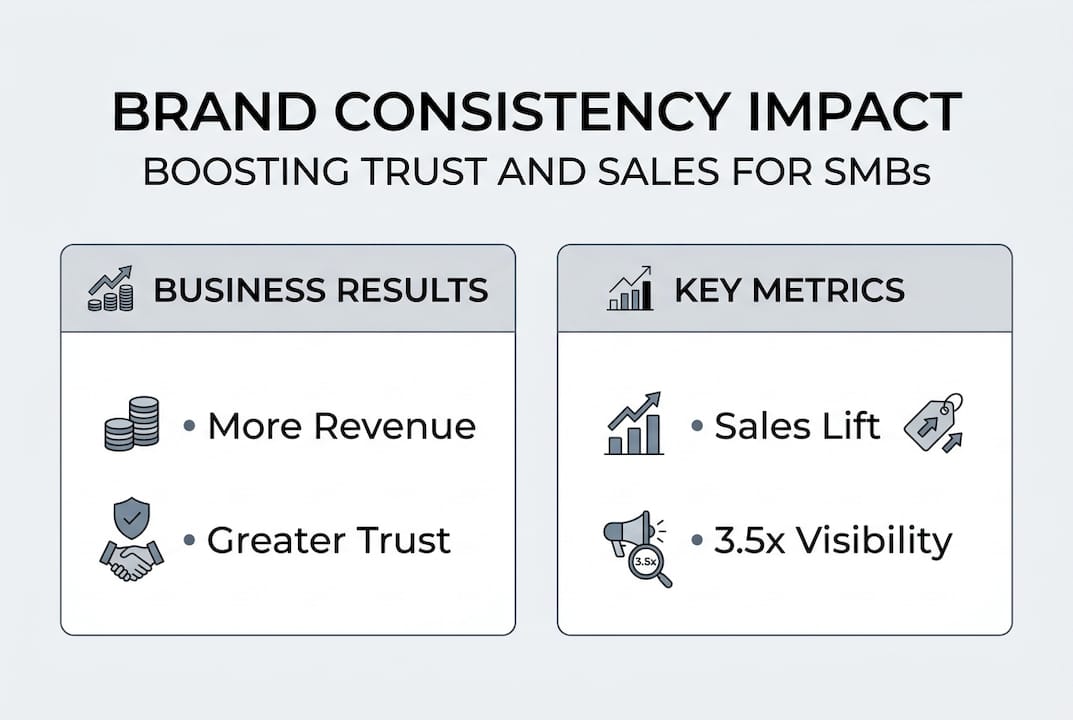
Visibility is another underrated benefit. Consistent branding creates 3.5x more brand visibility compared to fragmented approaches. More visibility means more touchpoints, and more touchpoints mean more opportunities to convert browsers into buyers.
Here’s a quick look at what the research shows:
| Metric | Impact of consistent branding |
|---|---|
| Revenue lift | 10-33% increase |
| Customer trust requirement | 81% need trust before buying |
| Brand visibility gain | 3.5x more recognition |
| Organizations reporting growth | 68% link 10-20% growth to consistency |
| Customer confusion from inconsistency | 71% report confusion |
For SMBs, this data points to a clear opportunity. You don’t need a Fortune 500 budget to benefit. You need a repeatable system. Understanding brand consistency and trust as a connected strategy is the first step toward turning these numbers into your own results. And branding consistency in marketing is one of the highest-leverage investments you can make at any stage of growth.
Key takeaways from the data:
- Consistent brands earn more customer trust faster
- Higher visibility reduces the cost of acquiring new customers
- Revenue gains are measurable, not just theoretical
- Inconsistency actively erodes your professional image
What brand consistency looks like in practice
With the “why” established, it’s crucial to understand exactly what brand consistency means on a practical, day-to-day level. It’s more than just using the same logo everywhere.
Visual consistency means your logo, color palette, and fonts stay the same across every platform. A brand guide with specific hex codes, font names, and logo usage rules removes guesswork for anyone creating content on your behalf. Without it, your Facebook posts might use a slightly different shade of blue than your website, and customers notice that disconnect even if they can’t articulate why.
Messaging consistency covers your tone, voice, and the way you respond to customers. Whether someone reads your website, gets an email from you, or sees a social media reply, the personality behind the words should feel identical. Formal on your site but casual on Instagram? That gap confuses people.

NAP consistency (Name, Address, Phone number) is especially critical for local businesses. NAP consistency for local SEO directly affects how Google ranks you in local search results. If your address is listed differently on Yelp, Google, and your website, search engines lose confidence in your listing and your rankings suffer. As key mechanics show, unified visuals, tone, and NAP data across every touchpoint are the foundation of a credible brand.
| Element | Consistent SMB | Inconsistent SMB |
|---|---|---|
| Logo usage | Same version everywhere | Multiple outdated versions in use |
| Brand colors | Hex codes documented and followed | Colors vary by platform or designer |
| Business info | Identical NAP on all directories | Different addresses or phone numbers |
| Tone of voice | Same personality across all channels | Formal on web, casual on social |
| Response style | Templated, on-brand replies | Ad hoc, varies by team member |
Here’s how to audit your brand consistency right now:
- Google your business name and review every listing for NAP accuracy
- Screenshot your logo from five different platforms and compare them side by side
- Read three months of social posts and check if the tone matches your website copy
- Ask someone unfamiliar with your brand to describe it after visiting your site and social profiles
- Document any gaps and prioritize fixes by customer visibility (website first, then Google, then social)
Pro Tip: Create a one-page brand sheet with your logo files, hex codes, font names, and a few sample phrases that reflect your tone. Share it with every contractor, designer, or team member who touches your brand. This single document eliminates most consistency errors before they happen. For more on building brands online, start with the assets customers see most.
Common pitfalls and challenges for SMBs
Even with a clear plan, SMBs hit real-world obstacles. Here’s what to watch out for and how to stay ahead.
Growth is one of the biggest consistency killers. When you add a new product line or service, it’s easy to create new materials without checking whether they match your existing brand. Rapid growth changes, new team members, and expanded offerings all create opportunities for your brand to fragment without anyone noticing until the damage is done.
Siloed teams are another major risk. When your social media manager, web developer, and sales team all operate independently without shared brand guidelines, you end up with three different versions of your brand in the market. Siloed teams and global adaptation consistently rank among the top causes of brand inconsistency in growing businesses.
External partners compound the problem. Freelancers, agencies, and platform-specific designers often bring their own style preferences. Without clear documentation, they’ll make judgment calls that drift from your brand standards. Avoiding talent challenges when working with external contributors starts with giving them the right tools upfront.
Localization creates its own complexity. If you serve multiple regions or languages, adapting your brand for local markets without losing core consistency is genuinely hard. LATAM outsourcing benefits include access to culturally aware talent who can help bridge this gap without sacrificing brand integrity.
Common branding mistakes SMBs make:
- Using outdated logo versions on older platforms or printed materials
- Writing website copy in one tone and social captions in another
- Letting team members create their own email signatures without a template
- Failing to update business listings after a move or phone number change
- Skipping brand onboarding for new hires or contractors
- Treating brand guidelines as a one-time document rather than a living resource
Pro Tip: Schedule a quarterly brand audit. Set a recurring calendar reminder to check your top five customer touchpoints (website, Google Business Profile, Facebook, Instagram, and email templates) against your brand guide. A 30-minute review every three months prevents months of drift from becoming a full rebrand. For practical brand building tips, consistency checks should be part of your regular operations, not a crisis response.
Building a consistent brand: proven strategies and quick wins
Knowing the pitfalls makes action easier. Here’s a practical roadmap SMBs can use to achieve brand consistency without overspending.
Start with your highest-traffic touchpoints. For SMBs, prioritizing your website, Google Business Profile, and social media accounts delivers the fastest visibility gains. These are the platforms where most customers form their first impression of your business. Getting these three aligned is a bigger win than perfecting your business card.
Systems beat guidelines every time. A brand guide sitting in a folder no one opens is useless. Systems like DAM and governance (digital asset management tools, approval workflows, and regular scorecards) keep consistency alive as your team grows. Tools like Canva for Teams, Google Drive with organized brand folders, or dedicated DAM platforms give everyone access to the right assets instantly.
Here’s your step-by-step quick-start checklist:
- Create or update your one-page brand sheet (logo, colors, fonts, tone examples)
- Update your Google Business Profile with accurate NAP and current visuals
- Audit your website homepage for outdated logos, colors, or messaging
- Refresh your social media profile images and bios to match your current brand
- Build three to five message templates for common customer interactions (email replies, social DMs, review responses)
- Set up a shared folder with approved assets for anyone creating content
- Schedule your first quarterly brand audit for 90 days from today
For online brand building tips, the businesses that sustain consistency longest are those that build it into their workflow rather than treating it as a separate project. Navigating cultural consistency across markets adds another layer, but the same principle applies: systems and regular reviews outperform one-time efforts every time.
Pro Tip: Don’t wait until your brand feels “broken” to review it. The best time to audit is when things are going well, because that’s when you have the bandwidth to make thoughtful improvements rather than reactive fixes.
A fresh perspective: what most guides miss about brand consistency
Most brand consistency guides focus on logos and color palettes. That’s the easy part. The harder truth is that brand consistency is an operational mindset, not a design project.
The businesses we see struggle most aren’t those without brand guidelines. They’re the ones with beautiful guidelines that nobody follows because there’s no system enforcing them. Real consistency comes from repeatable processes: approval workflows, asset libraries, regular audits, and accountability. Systems over guidelines alone is the principle that separates brands that stay consistent through growth from those that fragment the moment a second team member joins.
There’s also the measurement gap. Most SMBs never check whether their branding is actually consistent. They assume it is. Building a simple scorecard (rating each major touchpoint monthly) turns brand consistency from a feeling into a trackable metric. That’s where the real ROI lives. Consistent branding and SMB growth are inseparable once you start measuring both.
Connect your brand strategy with expert support
You’ve learned why and how to pursue brand consistency. Now it’s time to put the right tools and support behind that strategy.
At ibrand.media, we help small and medium-sized businesses build and maintain consistent brand presences across every channel that matters. Whether you need to invest in social media management to keep your messaging aligned, sharpen your visibility with SEO for small business, or follow our website optimization guide to make your site your strongest brand asset, we have practical, affordable solutions built specifically for businesses like yours. Consistent branding doesn’t have to be complicated when you have the right partner.
Frequently asked questions
How does brand consistency increase revenue?
Consistent branding makes your business more recognizable and trustworthy, which is why SMBs report 10-33% higher sales after aligning their brand across platforms.
What are the first steps to fix inconsistent branding?
Start by updating your website and Google Business Profile with accurate information, then align your colors, fonts, and messaging across all platforms using a quick-win approach that prioritizes high-traffic touchpoints first.
How does NAP consistency help SEO?
Keeping your Name, Address, and Phone number identical across all directories and platforms signals credibility to search engines, directly improving your local search visibility and ranking.
What risks come from inconsistent branding?
71% of customers report confusion when a brand looks or sounds different across channels, which erodes trust and causes potential buyers to choose competitors instead.
Are simple branding guidelines enough?
No. Guidelines only work when paired with systems like digital asset management and regular brand audits that keep your team accountable as your business grows.
Recommended
- Why brand consistency builds trust and drives SMB growth | Ibrandmedia
- Why Consistency Matters in Marketing for Small Business | Ibrandmedia
- Earn Customer Trust Online: Step-by-Step for SMBs – Ibrandmedia
- Building Online Credibility: Keys to Attracting Customers | Ibrandmedia
- Nectar Blog | Brand Storytelling in Ecommerce: Driving Lasting Engagement
- How trust drives premium brand loyalty in luxury markets – Corrado Manenti
Recent Comments