
TL;DR:
- Content strategy involves planning, governing, and measuring content as a business asset aligned with company goals. It includes defining topics, structure, workflows, and ownership to avoid content clutter and ensure strategic relevance. Success hinges on clear governance, SMART objectives, and continuous measurement linked to tangible business outcomes.
Content strategy is the planning, creation, governance, and measurement of content treated as a business asset, not a series of disconnected posts or campaigns. Every business publishing content online is already making content decisions. The question is whether those decisions are deliberate or accidental. A documented content strategy answers what you publish, for whom, through which channels, and how you measure whether it worked. Marketers who understand this distinction stop producing content for its own sake and start producing content that compounds in value over time.

What is content strategy and why does it matter?
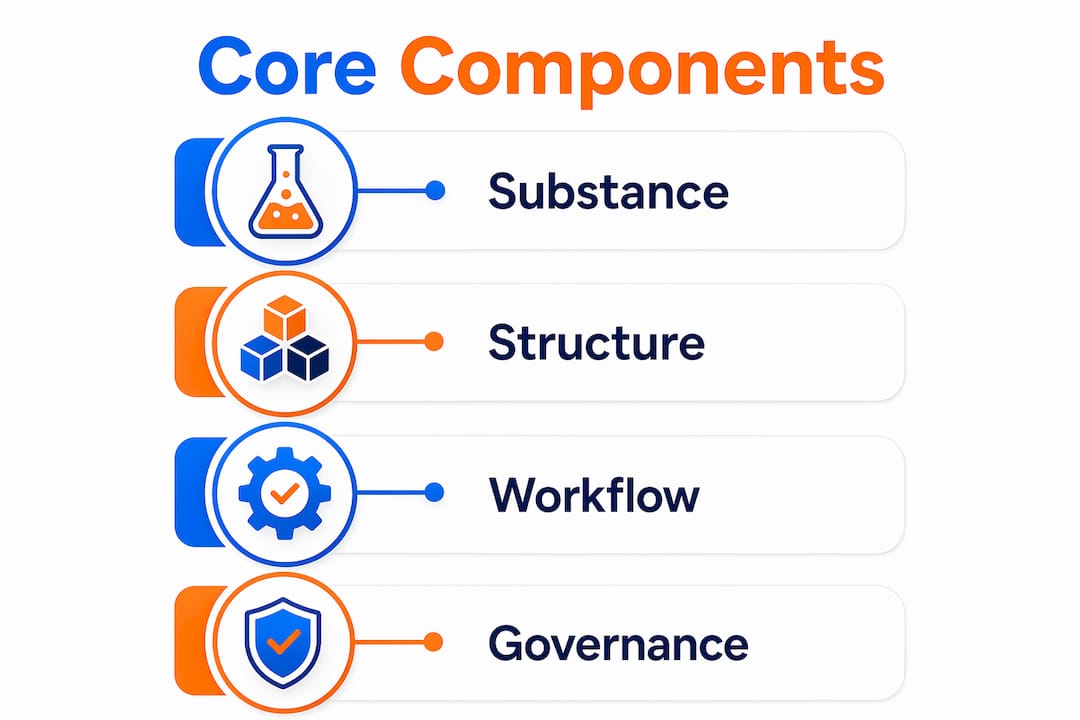
Content strategy is the high-level plan that connects your content decisions to your business goals. Kristina Halvorson, one of the field’s most cited practitioners, frames it across four quadrants: substance, structure, workflow, and governance. Substance covers what topics and messages you address. Structure determines how content is organized and formatted. Workflow defines who creates, reviews, and approves content. Governance sets the rules that keep everything consistent over time.
This framework matters because most businesses treat content strategy as synonymous with a content calendar. A calendar tells you when to publish. Strategy tells you why, for whom, and what success looks like. Confusing the two produces what practitioners call a “content pile”: a growing archive of posts that lacks coherent audience focus and strategic purpose.
The role of content strategy extends beyond marketing. It touches product communication, customer support documentation, onboarding materials, and brand voice. When those elements align under a single strategic framework, the business communicates consistently at every touchpoint.
What are the core components of a content strategy?
A practical content strategy covers the full content lifecycle: conception, publishing, distribution, and long-term maintenance. Most marketers focus only on creation and miss the governance and measurement stages where real value is either captured or lost.
The standard workflow moves through six stages:
- Audience research and persona development — Define who you are creating content for, what problems they face, and what formats they prefer.
- Goal setting with SMART criteria — Specific, Measurable, Achievable, Relevant, and Time-bound goals replace vague intentions like “grow our blog.”
- Content audit and gap analysis — Catalog existing content, identify what performs well, and map gaps against audience needs.
- Editorial planning — Build a calendar that assigns topics, formats, owners, and deadlines.
- Creation and distribution — Produce content and publish it through the right channels at the right frequency.
- Measurement and iteration — Track performance against your SMART goals and optimize continuously.
Governance deserves its own emphasis. It includes style guides, approval workflows, and clearly assigned ownership for each content type. Without governance, even well-planned content drifts in tone, accuracy, and alignment as teams grow or change.
Pro Tip: Assign a named owner to every content type in your strategy document. If no one is accountable for a blog post series, a social channel, or a measurement dashboard, that content type will eventually go unmaintained.
| Component | What it covers |
|---|---|
| Substance | Topics, messages, and formats aligned to audience needs |
| Structure | How content is organized, labeled, and linked |
| Workflow | Who creates, edits, approves, and publishes content |
| Governance | Style guides, compliance rules, and ownership assignments |
| Measurement | KPIs, reporting cadence, and optimization loops |
How does content strategy differ from content marketing?
Content marketing is the execution layer. Content strategy is the planning and governance layer above it. Without strategy, marketing is scattered; without marketing, strategy has no output. The two disciplines are complementary but distinct, and conflating them is one of the most common mistakes marketers make.
Content design is a third related discipline worth separating out. Content design focuses on the clarity, accessibility, and usability of individual pieces of content. It asks: is this page readable? Does this form make sense to a first-time user? Content strategy asks: should this page exist at all, and does it serve a documented business goal?
Here is how the three disciplines compare:
| Discipline | Primary focus | Key tools | Success metric |
|---|---|---|---|
| Content strategy | Planning, governance, alignment | Audits, SMART goals, style guides | Business outcomes, content ROI |
| Content marketing | Audience attraction and conversion | Blog posts, email, social media | Traffic, leads, engagement |
| Content design | Clarity and usability of content | User testing, plain language guides | Comprehension, task completion |
The most effective organizations treat these as connected disciplines rather than competing ones. Strategy sets the direction. Marketing executes the campaigns. Design ensures each piece of content actually works for the reader. Separating them creates silos; integrating them creates a content ecosystem that performs at every stage of the customer journey.
Pro Tip: When briefing a content team, separate the strategy brief (goals, audience, governance) from the marketing brief (channel, format, deadline). Mixing them produces content that is tactically correct but strategically aimless.
Why is content strategy important for business growth?
Content strategy is critical for SEO and owned media effectiveness, according to Harvard Business School professor Sunil Gupta. Owned media, meaning content your business controls rather than rents, compounds in value when it is planned strategically. A blog post optimized for a specific search query continues generating traffic years after publication. A social post without strategic intent disappears in hours.
Beyond SEO, the importance of content strategy shows up in three measurable business outcomes:
- Brand consistency. Governance rules prevent different teams from publishing contradictory messages, which erodes trust with both search engines and human readers.
- Efficiency. A documented strategy eliminates redundant content creation. Teams stop producing the fifth version of the same explainer article because no one checked what already existed.
- Accountability. SMART goals and business outcome accountability distinguish effective strategy from vanity metrics. Tracking page views without connecting them to leads or revenue tells you nothing useful.
“Content strategy is a living system connecting vision, decision-making, operations, and measurement. It evolves with goals and audience needs.” — Content Science Review
This framing is particularly relevant in 2026, as AI-generated content floods every channel. Businesses with documented strategies and governance frameworks can distinguish their content through consistency, depth, and measurable relevance. Those without strategy are competing on volume alone, which is a race no human team can win.
How to create a content strategy: a practical step-by-step process
Building a content strategy from scratch is more manageable when you treat it as a series of decisions rather than a single document. The standard workflow covers audience research, goal setting, auditing, planning, creation, and measurement. Here is how to execute each stage without overcomplicating it.
Step 1: Define your audience with specificity. Generic personas like “small business owners” produce generic content. Build personas around specific problems, search behaviors, and content preferences. Interview three to five real customers if you have access to them.
Step 2: Set SMART goals before creating anything. A goal like “increase organic traffic by 30% in six months through 12 new long-form articles” is measurable and time-bound. “Grow our content presence” is not a goal. It is a wish.
Step 3: Conduct a content audit. Catalog every piece of existing content, note its performance data, and classify each item as keep, update, consolidate, or remove. This step alone often reveals that 40% of a site’s content is either redundant or underperforming.
Step 4: Build an editorial calendar with ownership assigned. Every item on the calendar needs a topic, a target keyword or audience question, a format, a deadline, and a named owner. A calendar without ownership is a wish list.
Step 5: Establish governance before you scale. Write a style guide covering tone, terminology, formatting rules, and approval steps. Define who has final sign-off on each content type. Governance and ownership failures are the leading cause of strategy drift in growing teams.
Step 6: Measure against your SMART goals and iterate. Set a monthly review cadence. Pull data on the metrics tied to your goals, not every available metric. Adjust topics, formats, or distribution channels based on what the data shows.
Pro Tip: Use a shared content strategy document, not just a calendar. Tools like Notion, Airtable, or a simple Google Doc work fine. The format matters less than the discipline of keeping it updated and visible to everyone involved.
Key takeaways
A documented content strategy is the difference between content that builds business value and content that fills space.
| Point | Details |
|---|---|
| Strategy vs. calendar | A content calendar schedules publishing; strategy defines purpose, audience, and measurement. |
| Four core quadrants | Substance, structure, workflow, and governance form the foundation of any practical framework. |
| Governance prevents drift | Assigning named owners and approval workflows keeps content aligned as teams grow. |
| SMART goals drive ROI | Measurable goals tied to business outcomes replace vanity metrics and improve focus. |
| Strategy and marketing work together | Content strategy sets direction; content marketing executes it. Both are required for results. |
Why most content strategies fail before they start
Most content strategies I have reviewed fail at the same point: governance. Teams invest real effort in audience research and editorial calendars, then skip the step of assigning ownership. Six months later, the calendar is abandoned, the style guide was never finished, and three different writers are using three different brand voices across the same website.
The uncomfortable truth is that content strategy is not primarily a creative challenge. It is an organizational one. The question “who owns this?” is more important than “what should we write?” I have seen small teams with modest budgets outperform larger competitors simply because one person was accountable for the measurement dashboard and ran a monthly review.
The other pattern I notice is an over-reliance on tracking marketing ROI through surface metrics. Marketers report page views and social impressions to leadership, leadership nods, and no one asks whether any of it generated a lead or a sale. Connecting content performance to revenue is harder than counting clicks, but it is the only measurement that earns continued investment.
Balancing strategic planning with agile execution is the real skill. A strategy document that takes three months to write and then sits unchanged for a year is not a strategy. It is a report. Effective content strategy is reviewed, challenged, and updated on a regular cycle, especially as platforms, algorithms, and audience behaviors shift.
— TONY
How Ibrand can help you put strategy into action
Building a content strategy that actually connects to revenue takes more than a template. Ibrand works with small and medium-sized businesses to develop content strategies grounded in audience research, SMART goal frameworks, and SEO for small businesses that drive local and organic traffic. The process covers everything from initial audits to governance setup and monthly performance reviews.

If your current content efforts feel scattered or hard to measure, Ibrand’s team can map your existing content, identify gaps, and build a plan tied to specific business outcomes. The goal is not more content. It is content that works. Reach out to Ibrand to request a custom content strategy consultation and see what a structured approach looks like for your business.
FAQ
What is content strategy in simple terms?
Content strategy is the plan that governs what content a business creates, for whom, and how its success is measured. It treats content as a business asset rather than a marketing afterthought.
How is content strategy different from content marketing?
Content strategy provides the planning and governance framework. Content marketing is the execution layer that produces and distributes content within that framework. Both are necessary, but they serve different functions.
What are the main elements of a content strategy?
The core elements are substance, structure, workflow, and governance, as defined by Kristina Halvorson’s framework. These are supported by audience research, SMART goals, editorial calendars, and performance measurement.
How do you measure content strategy success?
Effective measurement ties content performance to specific business outcomes such as leads generated, conversion rates, or organic search rankings. Vanity metrics like page views are only useful when connected to a measurable business goal.
How long does it take to build a content strategy?
A foundational content strategy covering audience research, goal setting, a content audit, and governance documentation can be completed in four to six weeks. Execution and iteration are ongoing from that point forward.
Recent Comments