
TL;DR:
- Most small business owners mistakenly believe that increasing posting frequency constitutes a content strategy. A true content strategy is a deliberate plan encompassing planning, creation, distribution, and maintenance aligned with specific business goals. Focusing on purpose, audience needs, and measurable outcomes ensures content efforts produce meaningful results and long-term growth.
Most small business owners assume content strategy means posting more often. It doesn’t. Content strategy explained properly is a deliberate framework for planning, creating, distributing, and maintaining content that serves your specific business goals. Without it, you’re producing content that keeps you busy without actually moving the needle. This guide breaks down what a real content strategy looks like, how to build one without burning out, and why getting this right is one of the most effective things you can do for your online visibility.
Key takeaways
| Point | Details |
|---|---|
| Strategy beats frequency | Publishing more content without a plan produces noise, not results. |
| Four core components | Every solid strategy covers substance, structure, workflow, and governance. |
| Audience first, always | Define who you’re writing for before deciding what or where to publish. |
| Distribution is not optional | Plan how content gets promoted before you write a single word. |
| Measure what matters | Track conversions and engagement, not just page views or follower counts. |
Content strategy explained: what it actually means
The industry term for what most people casually call “content strategy” is exactly that. But what most people misunderstand is the scope. A full content strategy covers the entire content lifecycle, from initial planning through publishing, distribution, and ongoing maintenance, while keeping everything aligned with your business goals and your audience’s needs.
Think of it as the operating system beneath your marketing. Content marketing is what you produce and promote. Content strategy is the logic that decides why, what, for whom, and how.
The most cited framework comes from content strategist Kristina Halvorson, who organized the work into four key quadrants:
- Substance: What topics you cover and what message you send
- Structure: How content is organized, formatted, and connected
- Workflow: Who creates, reviews, and publishes content and when
- Governance: The standards, decisions, and policies that keep quality consistent
This four-part model matters because it stops you from treating content as a one-off task. Instead, it becomes a repeatable system where each piece has a clear purpose, a defined home, and a process behind it.
Pro Tip: Before you create anything new, audit what you already have. Many small businesses are sitting on valuable content that just needs updating, reformatting, or better distribution to perform well.

Content strategy also sits at the intersection of SEO and audience understanding. Topical authority in SEO is not built through keyword lists alone. It is built by deciding which subjects your brand will own deeply, in what formats, and in what sequence. That is content strategy doing the work that keywords alone cannot do.
Setting goals and knowing your audience
You cannot build an effective content strategy without two things: clear goals and a real understanding of your audience. Most small businesses skip one or both, then wonder why their content does not convert.
Here is how to build that foundation correctly:
- Set SMART goals. Your goals need to be specific, measurable, achievable, relevant, and time-bound. “Get more traffic” is not a goal. “Increase organic blog traffic by 30% in six months” is. Clear, goal-tied content prevents random marketing acts that feel productive but produce nothing.
- Build audience personas. Go beyond demographics. Document what your ideal customer searches for, what questions they ask before buying, and what content they trust. Behaviors and needs beat age ranges and zip codes every time.
- Map content to customer value. Every topic you choose should connect to something your audience genuinely cares about. If you sell bookkeeping software, a guide on “how to prepare for tax season” serves both your reader and your funnel.
- Let data guide your choices. Check which pages already drive traffic and conversions on your site. Use that signal to double down on what works instead of guessing what might.
The shift from “what do we want to say” to “what does our audience need to hear” is where most small businesses unlock real growth. Your preferences are not the point. Your customer’s questions are.
Pro Tip: Run a quick search for the questions your customers ask most. The search suggestions Google surfaces are a direct window into what your audience wants answered right now.
Building your content plan and workflow
Knowing your goals and audience is step one. Step two is deciding what to produce, when, and how to keep the machine running without burning yourself out. This is where building a content plan becomes non-negotiable.
Choosing your content mix
Not every piece of content serves the same purpose. A healthy mix across a typical month might look like this:
- Awareness content: Blog posts, short videos, social content that introduces new people to your brand
- Consideration content: Comparison guides, case studies, FAQ pages that help people evaluate your offer
- Decision content: Testimonials, product demos, free trials, and pricing pages that convert
Spreading your effort across these categories means your content works at every stage of the buyer journey, not just at the top of the funnel.
Content calendar essentials
| Calendar element | What it includes | Why it matters |
|---|---|---|
| Publishing cadence | Frequency per channel per week or month | Sets realistic expectations and prevents gaps |
| Theme or campaign | Monthly focus tied to a business goal | Keeps content connected and purposeful |
| Seasonality triggers | Holidays, industry events, product launches | Helps you plan timely content in advance |
| Owner and status | Who is responsible and where it is in the process | Prevents bottlenecks and missed deadlines |
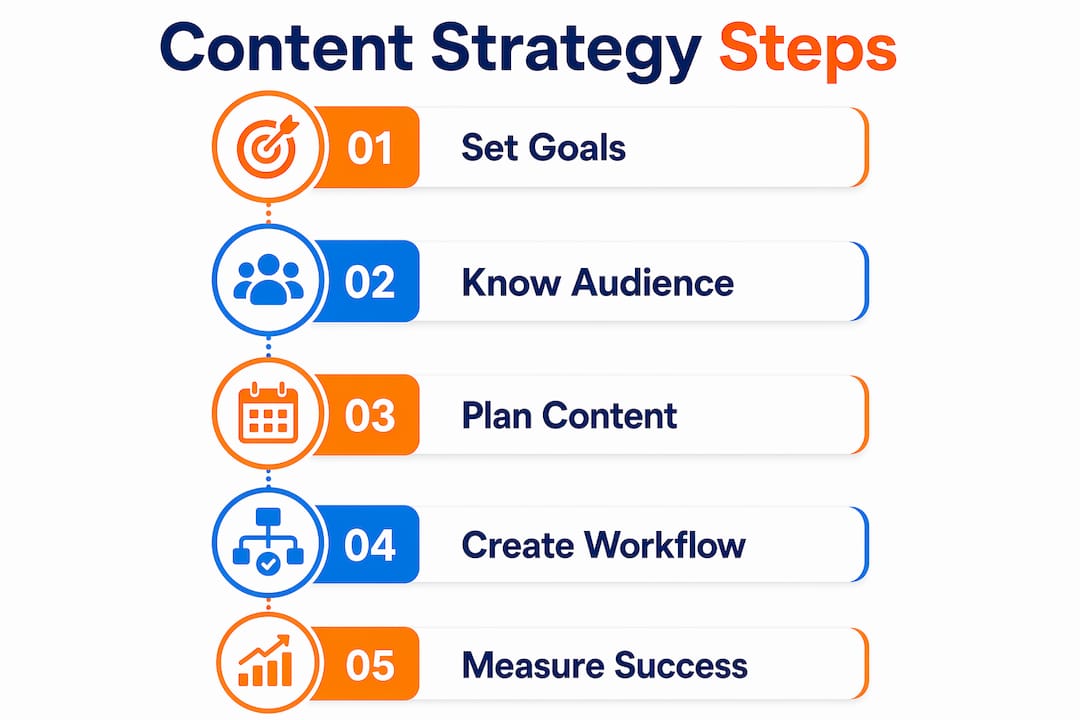
Governance defines who approves what and what quality standards apply. Without it, content stalls in review limbo or gets published inconsistently. Even a two-person team needs a simple approval step documented somewhere.
Pro Tip: Batch your content creation. Write three blog posts in one sitting, then distribute them across the month. You will produce better work and protect your schedule from constant context switching.
Documented content patterns and playbooks reduce the mental overhead of deciding how to approach every new piece. A simple template for “how we write a product blog post” or “how we structure a case study” means your team spends less time reinventing the wheel and more time producing content that performs.
Distribution and measuring what works
Creating great content and then waiting for people to find it is one of the most common and costly mistakes small business owners make. Distribution as a core strategy stage means you plan promotion before the piece is even finished, not as an afterthought.
Choosing the right channels
Your audience tells you where to show up. A B2B service business might get more traction on LinkedIn and email than on Instagram. A local retail shop might find Google Business posts and neighborhood Facebook groups more valuable than a polished YouTube channel. Pick two or three channels where your audience actually spends time and go deep there before expanding.
What to measure
Vanity metrics like total followers or raw page views feel good and tell you almost nothing useful. The KPIs that connect to business growth include:
- Conversion rate: What percentage of readers take the action you wanted
- Organic traffic growth: Are more people finding you through search over time
- Email signups or lead form completions: Is your content building your list
- Time on page and scroll depth: Are readers actually engaging with your content or bouncing immediately
- Return visitor rate: Are people coming back, which signals trust and relevance
Pro Tip: Set up a simple monthly review. Pull three to five numbers, compare them to the previous month, and ask one question: which piece of content drove the most meaningful action? Then plan to create more content like that.
Mapping each piece of content to a specific goal, funnel stage, and internal linking path gives your SEO strategy real structure. It also makes measurement cleaner because you know exactly what each piece was supposed to do.
Common pitfalls and how to avoid them
Even well-intentioned small business owners fall into patterns that undercut their results. Here is where things tend to go wrong, and what to do instead.
- Posting without purpose. If you cannot answer “what do I want the reader to do after reading this,” the piece is not ready. Content quality and relevance now outweigh publishing volume for more than 70% of marketers in 2026. One well-planned post beats five unfocused ones.
- Ignoring the funnel. Not every piece should push for a sale. Readers at the awareness stage need education. Push conversion content too early and you lose them.
- No approval process. Even solo operators benefit from a “draft, rest, review” process before publishing. A simple checklist (does this serve the reader, does it match our voice, does it link to relevant content) catches most problems.
- Treating AI as a replacement. AI-assisted content workflows work best when a human shapes the strategy, adds real experience, and reviews the output. AI speeds up production. It does not replace judgment.
- Chasing trends instead of building authority. Trending topics drive temporary spikes. A content cluster strategy built around the subjects your business genuinely owns creates compounding SEO authority over time.
The through line in all of these pitfalls is the same. Strategy gets skipped in favor of speed. And every time it does, effort goes in without results coming out.
My honest take after years of watching this play out
I have seen more small business owners lose months of effort to content that was well-written but strategically hollow. The posts existed. The topics were fine. But nothing connected to a goal, a funnel stage, or a keyword cluster that mattered. The result was content that looked like activity and produced nothing.
What actually turns things around is not more content. It is explicit connection. When I work through a strategy with a small business, the single most clarifying question is: “What do you want someone to do after reading this, and does everything in this piece serve that outcome?” Most of the time, the honest answer is “we never asked that.”
Governance matters more than most people think. I have watched teams produce excellent drafts that sat in review for three weeks because nobody owned the approval step. That is not a content problem. It is a systems problem, and a documented workflow fixes it.
Quality and relevance will always beat volume. The shift toward authority and trust in 2026 content marketing is not a trend. It is a correction. Audiences have become very good at ignoring content that does not serve them. If your content earns attention and rewards it, you build something competitors cannot easily copy. That is the real payoff.
Treat your content strategy as a living document, not a one-time project. Revisit it every quarter, adjust based on what the data tells you, and keep asking whether each piece earns its place.
— TONY
Ready to put your content strategy to work?
Understanding the framework is one thing. Executing it consistently while running a business is another challenge entirely. That is where Ibrand comes in.
Ibrand works with small and medium-sized businesses to build content and SEO strategies that are grounded in your specific goals, your audience, and your capacity. From local SEO services that drive real foot traffic and online leads, to social media management that keeps your brand visible and consistent, Ibrand offers the kind of hands-on support that turns strategy into results. You can also explore practical guidance on content marketing for small businesses to see exactly how these pieces fit together for businesses like yours.
FAQ
What is content strategy in simple terms?
Content strategy is a plan for what content you create, who it serves, and how it connects to your business goals. It covers the full lifecycle from planning to distribution and ongoing measurement.
How is content strategy different from content marketing?
Content marketing is the practice of creating and sharing content to attract customers. Content strategy is the framework that decides what to create, why, for whom, and how to maintain it consistently over time.
How do I start building a content strategy?
Start by setting specific, measurable goals and defining your audience clearly. Then map your content topics to customer needs, choose two to three channels, build a simple calendar, and track performance monthly.
How often should I publish content as a small business?
Consistency beats frequency. A realistic publishing cadence you can maintain for six months outperforms a burst of daily posts followed by silence. Start with what is sustainable and build from there.
What metrics should I track for content strategy success?
Focus on conversion rate, organic traffic growth, lead form completions, and time on page. Avoid optimizing for follower counts or raw page views unless they directly connect to a business outcome you care about.
Recommended
- Content Marketing Explained: Understanding Its Core Principles | Ibrandmedia
- Role of Content Marketing for Small Business Growth | Ibrandmedia
- Creating Engaging Social Content: A Guide for Small Businesses 2025 | Ibrandmedia
- Understanding Why Content Marketing Works for Small Businesses | Ibrandmedia
Recent Comments