
A local backlink is a link to your website from another site tied to your area or your trade: a chamber of commerce, a neighborhood news site, a supplier, a charity you sponsor. The best ones are earned through real local relationships, not bought, and a handful from the right places will do more for a plumber, dentist or banquet hall than hundreds from random sites. Below is what counts, nine ways to earn links in your own market, and how to tell whether they are working.
TL;DR
- A local backlink comes from a site connected to your city, region or industry. Relevance and a real audience matter more than the raw number of links.
- Earn them through things you already do: sponsorships, partnerships, events, suppliers, local press and useful pages on your own site.
- Buying links for ranking purposes is link spam under Google’s policies. Skip it and put the budget into relationships and content.
- Check progress in Google Search Console’s links report, then watch calls, direction requests and form leads, not just link counts.
- If you would rather hand the work off, we run local SEO and link building for small businesses.
Table of Contents
- What local backlinks are and why they matter
- What makes a local link worth having
- Nine ways to earn local backlinks without buying them
- Why you should not buy local backlinks
- Contacting local sites: a short outreach routine
- How to tell whether it is working
- What a realistic first 90 days looks like
- Let us handle the link building
- FAQ
- Sources
What local backlinks are and why they matter
A backlink is a link from one website to another. Search engines read links as a vote of confidence: someone other than you thought your business was worth pointing to. A local backlink is that vote coming from a source with a geographic or topical connection to you.
For a home service company, that might be the local home builders association. For a med spa, a nearby wellness studio’s “partners” page. For a venue, a wedding planner’s vendor list or the convention bureau’s event page.
These links help for two reasons. First, they send actual visitors: someone reading a neighborhood blog’s “best places for a rehearsal dinner” list can click straight through. Second, they tell Google that your business is part of the community it is trying to serve. Our guide to improving local search rankings covers the wider picture, and our explainer on link building covers the basics if the term is new to you.
Where links help most
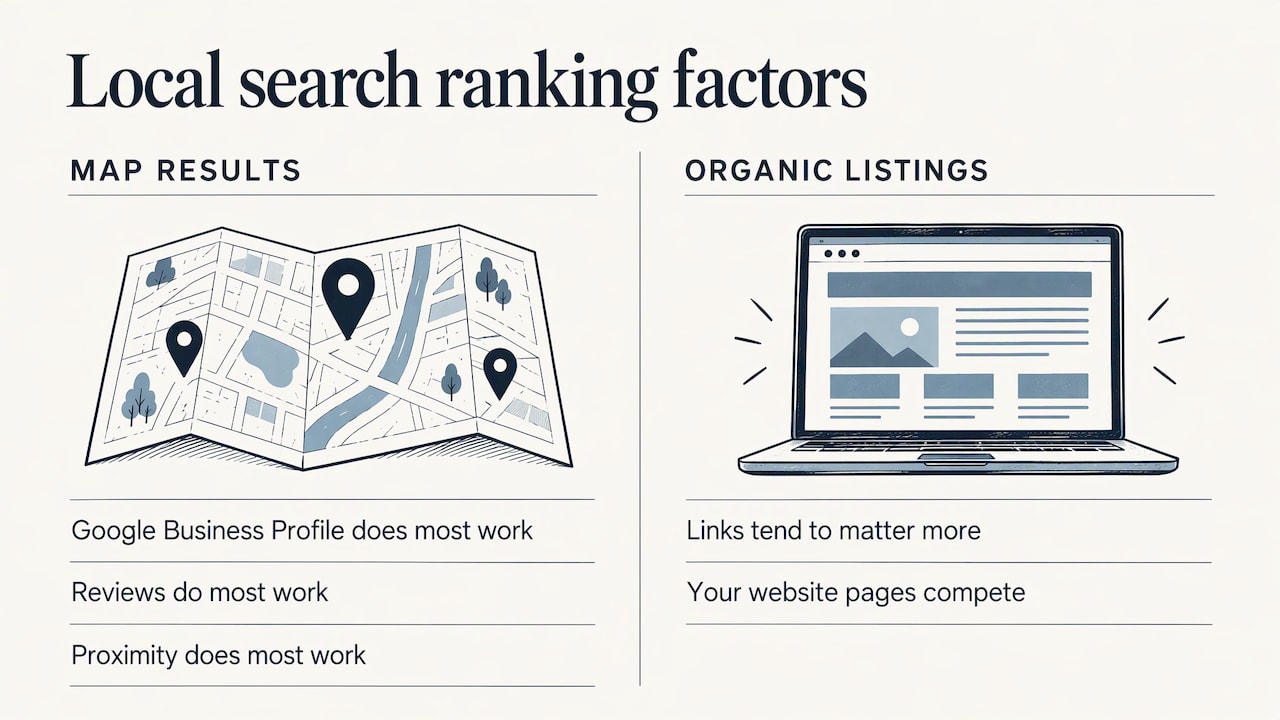
Local search has two main surfaces: the map results (the “local pack”) and the regular organic listings below. Your Google Business Profile, reviews and proximity do most of the work in the map results. Links tend to matter more for organic results, where your own website’s pages compete. That is why links belong in a plan alongside a well-kept Google Business Profile, accurate local citations and strong service pages, not instead of them.
What makes a local link worth having
Not every link is equal. Before you spend an hour chasing one, run it through four questions:
- Is it relevant? It should relate to your place (your town, county, neighborhood) or your trade (HVAC, dental, events).
- Does the site have real readers? A page with local traffic, an active newsletter or a social following beats an abandoned directory.
- Is the link editorial? The best links sit inside a sentence, a story or a partner listing that a human chose to write.
- Would it exist without SEO? If the page would be there and people would click even if search engines did not exist, it is a good link.
That last test also explains why a large number of weak links rarely beats a small number of strong ones. Ten links from respected organizations in your service area usually do more than a hundred from sites no one in your town has heard of.
Nine ways to earn local backlinks without buying them
These are ordered roughly from easiest to most effort. Most small businesses can start with the first four this week.
1. Check what you already have
Before building anything new, look at who already links to you. Google Search Console has a links report showing the sites that link to you most and your top-linked pages. Note which are local. You may find a past customer, a supplier or an old news mention you never knew about.
Then look for unlinked mentions. Search your business name in quotes along with your city. When a local site names you without linking, send a short, friendly note asking if they would add your website address. It is the fastest link you will ever earn.
2. Claim the memberships and listings you already qualify for
Chambers of commerce, business improvement districts, trade associations, merchant groups and tourism boards often list members with a link to their website. If you are already a member, check that your profile exists and points to the right page. If you are not, the membership fee often buys you a link, a directory listing and introductions at the same time.
Trade-specific bodies work the same way. Plumbers, HVAC contractors, dentists and home builders each have state or regional associations, many with a “find a member” page.
3. Sponsor something locally
Youth sports teams, charity runs, school fundraisers, community festivals and library events all publish sponsor pages. Sponsorship is a real expense with a real purpose, and the link is a by-product of that goodwill. Ask before you pay: will the sponsor page link to your website, and does it list sponsors on the event site, not just on a flyer?
Google’s spam policies treat links exchanged for goods or services as link spam when they exist primarily to manipulate rankings, so keep sponsorships genuine. Support causes you actually care about, and treat any link as a bonus.
4. Trade referrals with neighboring businesses
Businesses that serve the same customers at different moments are natural partners. A venue and a caterer. A roofer and a gutter installer. A dentist and an orthodontist. Each can list the other on a “trusted vendors” or “partners” page because they would recommend each other anyway.
Venue owners have an especially strong version of this: photographers, florists, DJs, planners and rental companies all want to be seen at your location, and you want to be seen with them. Our guide to SEO for venues goes deeper on this.
5. Host or join a local event
A free workshop, an open house, a charity drive or a booth at a street fair gives local organizers, bloggers and news calendars something to list. Submit the event to community calendars and neighborhood newsletters. Each listing can carry a link back to the event page on your site.
A med spa might run a skincare night with a local boutique. An HVAC company might offer a free “get your home ready for winter” talk at the library. A banquet hall might hold a vendor open house for wedding planners.
6. Pitch local press with a real story
Local reporters need stories. Hiring milestones, a new location, a community project, a seasonal tip from an experienced technician or a restoration of a historic building are all fair game. A press release alone rarely earns coverage, but a sharp pitch with a local angle sometimes does. We explain what still works in our piece on press releases for local SEO.
Keep pitches short, name the local angle in the first line and offer a photo or an interview. Reporters link more readily to a source they can quote.
7. Publish something locals will cite
Pages that answer a local question get linked. Examples:
- A plumber’s guide to which pipes are common in your city’s older neighborhoods and what repairs cost in that context.
- An HVAC contractor’s explanation of local permit requirements.
- A venue’s planning guide with local vendors, parking details and noise rules by neighborhood.
- A dentist’s guide to school-year checkup scheduling in your district.
Such pages work because they are useful and specific to a place. Writing them well takes effort; our guides on writing for SEO as a local business and content strategy for small business owners show how to structure them.
8. Partner with local schools, nonprofits and clubs
Scholarships, discount programs for teachers or first responders, donated services and volunteer days often come with a mention on the organization’s website. These links are hard for competitors to copy because they rest on relationships, not tactics.
9. Collaborate with local bloggers and creators
Neighborhood bloggers, food and lifestyle creators and community newsletter writers cover local businesses. Offering a genuine experience, such as a tasting, a tour or a consultation, can lead to honest coverage. Be open about what you provided. Google’s spam policy lists sending someone a product in exchange for a link-bearing post as a violation when done for ranking purposes, so ask for an honest review, not a link, and let them decide how to cover you.
Why you should not buy local backlinks
The temptation is real, because sellers promise quick results. But Google’s spam policies list buying or selling links for ranking purposes as link spam, including exchanging money for links. Sites that break the policies can rank lower or drop out of results.
If a paid placement is truly an advertisement, it can be marked as such with a rel attribute such as sponsored. That is a legitimate way to advertise, but it is not a ranking strategy. The simplest rule: if a link would not exist and get clicks without money changing hands, do not pay for it.
Contacting local sites: a short outreach routine
Most links come from a message someone actually reads. A workable routine:
- Build a list. Aim for 20 to 30 local targets: partners, associations, event pages, local publications and sites that already mention your competitors’ trade.
- Find the right person. Look for an editor, event coordinator or webmaster, not a generic inbox.
- Lead with value. Say who you are, where you are, and what you are offering: a story, an event listing, a resource or a partnership.
- Make the link easy. Include the exact page you want linked and a sentence they can use.
- Follow up once after a week or two, then move on.
- Say thanks and keep the relationship warm. A source who likes you will link again.
Expect most messages to go unanswered. The goal is a steady pace, a few contacts each week, not a single blast.
How to tell whether it is working
Links are a means. What you want is more of the calls, bookings and quote requests that come from local search. Track in this order:
- New links. Review the Search Console links report monthly for new local referring sites.
- Referral traffic. In your analytics, check which outside sites send visitors, and whether they browse or leave.
- Rankings for your key local searches. Check the service-plus-city phrases you care about, such as “emergency plumber” or “wedding venue” plus your town, from the area you serve.
- Business results. Count phone calls, direction requests, form fills and booked consultations. Those are the numbers that pay your bills.
Allow several months. Links earned through relationships and events accumulate slowly, and ranking changes follow with a lag. Our Google rankings overview explains what else influences local visibility so you can read the results fairly.
What a realistic first 90 days looks like
If you have a few hours a week, here is a pace that works for most local service businesses.
Month one: audit existing links, fix any membership or directory profiles, and ask for links where you are already mentioned. Make sure your website has a page for each main service and each service area, so there is something worth linking to.
Month two: pick two sponsorships or partnerships to pursue, and send introductions to five neighboring businesses. Submit any upcoming event to community calendars.
Month three: publish one locally useful resource, pitch it to a handful of local editors and associations, and review what worked. Double down on the source types that responded.
That adds up to a modest number of links, but they are the kind that stay put and that a competitor cannot easily buy.
Our view on local link building
Most small business owners we talk to think of link building as a technical chore. We see it as an extension of what a local business already does: showing up in the community. The strongest links come from the relationships you have, so the job is to find them, document them and make sure each one points to the right page on your site.
That is why we build a custom plan for each client, not a template. A banquet hall needs links from planners and vendors. A dentist needs links from schools, health groups and neighborhood publications. An HVAC company needs links from builders, suppliers and home-focused local media. Our approach is collaborative and tied to real-time performance tracking, so you can see what the work is doing for your calls and bookings.
Our advice is to choose a few quality links over a pile of cheap ones, and to measure results in leads. If you want the groundwork done properly, that is the work we do.
TONY
Let us handle the link building
Local link building takes steady effort: finding the targets, writing the outreach, following up and measuring the result. IBrand Media offers SEO optimization and local marketing for small and local businesses, with real-time stats so you can follow performance, and a custom plan for each client. If you would rather spend your hours on customers, tell us about your business and we will build a plan around your market.
See our SEO and local marketing services or read how smart backlink strategies help small businesses outrank bigger competitors.
FAQ
How many local backlinks does a small business need?
There is no fixed number. What matters is that your links are relevant, come from real sites and outpace the businesses you compete with for the same searches. Look at who ranks above you for your main local search and see where their links come from, then aim to earn similar sources of your own.
How do I get local backlinks quickly?
Start with the links closest to hand: unlinked mentions of your business, your chamber or trade association profile, sponsor pages for events you already support and partner pages from neighboring businesses. Those can be secured in days. Links from local press and new content take longer.
Is buying backlinks illegal?
Google’s guidelines, not the law, are what you would break. Its spam policies describe buying or selling links for ranking purposes as link spam, and sites that violate them can lose rankings. Paid placements should be marked with a sponsored attribute, and US advertising disclosure rules can also apply to paid content.
Do local directories count as backlinks?
Yes, many directory listings include a link, and consistent listings help search engines confirm your name, address and phone number. Pick directories that are well kept and relevant to your area or trade. Our guide to why local citations matter explains which to prioritize.
How do I see who links to my website?
Open the links report in Google Search Console. It lists the sites that link to you most and your most linked pages. Check it monthly and note which new links are local.
Recent Comments