
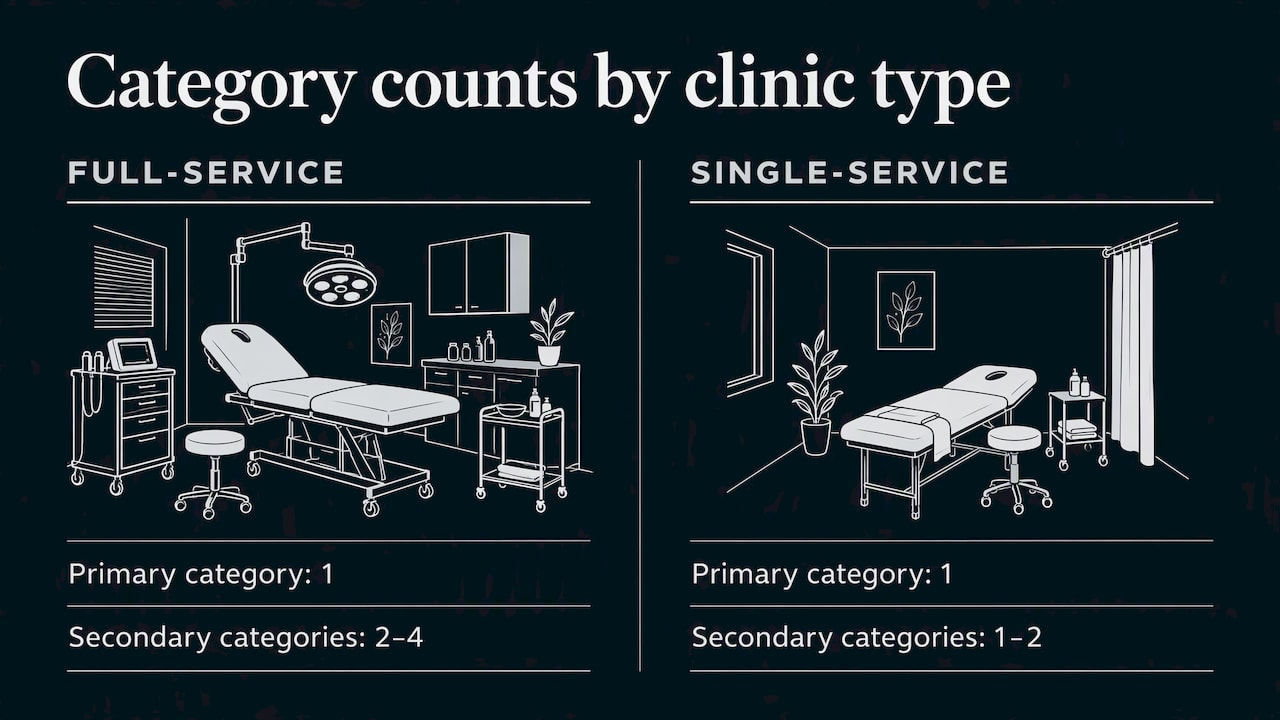
Choose one primary category that describes your med spa as a whole, then add only the few secondary categories that match real, separate parts of the business. Google’s own guidance tells you to describe the core business with as few categories as possible. For most full-service med spas, that means a medical-spa style primary category and two to four honest secondaries, such as skin care or laser hair removal, if you truly offer them. Everything else belongs in your services, description and website, not in the category list.
This guide walks through how to choose, what to add, what to leave out, how to check what you have today, and how to fix a category setup that is quietly holding your listing back.
TL;DR
- Your primary category is the one that describes the whole business. For a full-service med spa, pick the medical-spa style category if it is offered in your category list.
- Use as few secondary categories as possible, and only for distinct services you really provide, such as laser hair removal or skin care.
- Categories are not keywords. Treatments like Botox, fillers or microneedling go in your services list, description and website pages.
- Google does not let you create custom categories. If the exact fit is missing, choose the next most general one that is still accurate.
- Changing categories can trigger re-verification, so change them deliberately and check your profile afterward.
Table of Contents
- Why categories matter more than most med spa owners think
- How to choose your primary category
- Secondary categories: add few, add accurately
- What does not belong in categories
- What to do when the right category is not in the list
- How to check and change your categories
- A 30-minute category audit
- Common category mistakes med spas make
- Categories, services and descriptions: who does what
- Connect your categories to your website
- Need a second pair of eyes on your profile?
- FAQ
- Sources
Why categories matter more than most med spa owners think
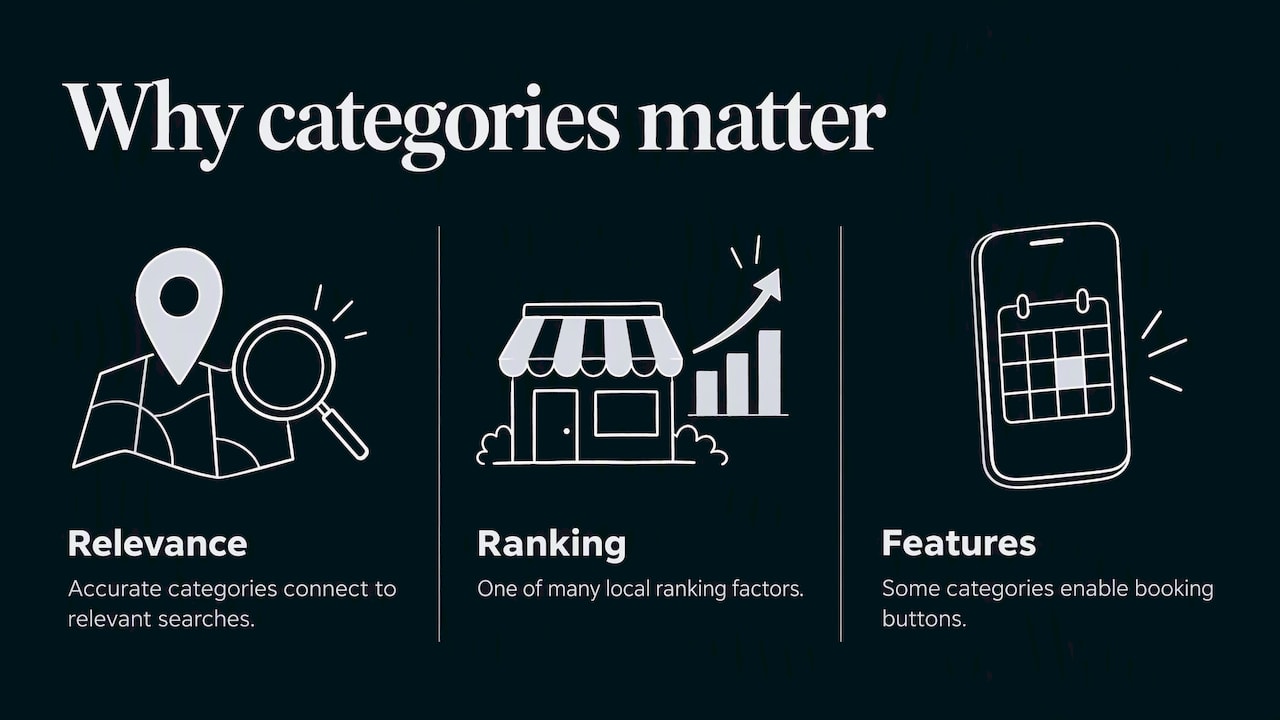
A Google Business Profile is built on a few fields that tell Google what you are. The category is the field that does the heaviest lifting. According to Google’s category guidance, accurate and specific categories connect a business to relevant searches, and they are one of many factors affecting local ranking. Note the wording: one of many. Categories will not rescue a profile with no reviews, thin content or a wrong pin, but a wrong category can hold back a profile that is otherwise strong.
For med spas this matters for a particular reason. Your business sits between several neighboring types of company: a day spa, a beauty salon, a dermatology office, a cosmetic surgery practice, a laser clinic. A person searching for injectables or laser treatment near them does not want a nail salon. Google is trying to sort these businesses into the right buckets, and your categories are the clearest signal you give it.
Categories also affect what your profile can do. Google notes that, depending on the category, it may enable special features such as booking buttons, which are available for health and beauty businesses. If you pick a category outside that group because it sounded close enough, you may lose features you would have wanted.
How to choose your primary category
Google’s instruction is simple: pick a primary category that describes your business as a whole. Not your most profitable treatment, not the thing you want to be known for next year, and not the treatment you advertise most this month. The whole business.
For a typical med spa, that whole is a medically supervised aesthetic practice offering a range of treatments: injectables, skin treatments, laser services, facials and sometimes body contouring. The category list contains a medical-spa style option, and that is the one that matches this description for most owners. Check the exact name in the category dropdown, because Google’s list can change over time.
A few rules of thumb help here:
- Match what a stranger would call you. If a patient would describe you as a med spa, your primary category should say so.
- Resist the pull of a bigger-sounding category. A med spa that is not a dermatology practice should not list a dermatologist category to look more clinical. It misdescribes the business, and it can send the wrong searchers to you.
- Pick the whole, not the part. If injectables are 70 percent of revenue but you also run laser, facials and skin care, the whole is still the med spa.
- Be honest about licensing. If your practice really is a physician-owned cosmetic surgery or dermatology clinic with a med spa wing, you may have a different primary. That is a business-identity question, not a marketing trick.
Single-service clinics are a different case
If you run a clinic that does one thing, such as an injector-only studio or a laser hair removal center, your whole business is that one thing. The primary category should reflect it. A full-service primary on a narrow clinic invites searchers who then find you do not offer what they wanted.
Secondary categories: add few, add accurately
Google says to add secondary categories for special departments or services, not for every product or service you sell. Its advice is to use as few categories as possible to describe the overall core business. That line is the opposite of what many owners assume. More categories do not mean more reach. They can blur the picture of what you are.
There is a second point worth knowing. In its guidelines for representing your business, Google says it may implicitly include more general categories based on the specific category you select. So you can skip secondaries that would simply repeat something broader that is already covered.
Which additional categories may fit a med spa
The question most med spa owners ask is which extras are reasonable. These are the ones that commonly fit, each with the test to apply before adding it:
| Possible secondary category | Add it when | Skip it when |
|---|---|---|
| Skin care clinic | Facials, peels, microneedling or other skin treatments are a clear, regular part of your menu | You only offer one occasional skin treatment |
| Laser hair removal service | You own laser equipment and laser hair removal is a standing service with its own appointments | You subcontract it rarely or have discontinued it |
| Facial spa | Facials are a major, separately booked service | Facials are a minor add-on to injectables |
| Wellness or weight-loss related category | You run a genuine program with licensed providers | You offer a single product on request |
| Cosmetic surgery related category | A licensed surgeon actually practices at your location | The surgeon only consults off-site or occasionally |
The test is the same each time. Does this represent a special department or service that you deliver here, on a regular basis, to the public? If the answer is yes, it can earn a place. If you would have to stretch to justify it, it will confuse the profile more than it helps.
Because Google can add or retire category names, treat the labels above as examples of what to look for in the dropdown, not a fixed official list. Type a few words into the category field and read the suggestions Google offers for your business.
Use the narrowest honest number
A practical target for a full-service med spa is a primary plus two to four secondaries. A single-service clinic often needs just the primary and one or two secondaries. If your list has grown past that, go through it line by line and remove anything you cannot defend with a service you deliver today.
What does not belong in categories
Google states that businesses should avoid using categories as simple keywords, or to describe attributes. Its examples are things like a swimming pool or on-site services. The idea, in the guidelines’ framing, is that categories say what the business is, not what it happens to have.
For a med spa, this means:
- Treatments are not categories. Botox, fillers, chemical peels, microneedling and body contouring belong in your services list, your description and your treatment pages.
- Features are not categories. Free consultations, financing, bilingual staff and evening hours are attributes or description details.
- Locations are not categories. Your service reach is handled elsewhere in the profile, and your city belongs on your website pages.
The same logic applies to your profile name. Keep it as your real business name. Stuffing treatments and cities into the name is a pattern Google’s guidelines warn against, and it risks suspension of your listing.
If you serve Spanish-speaking patients, the profile fields that carry meaning, such as services and the description, are where language matters. A walkthrough of Spanish-language Google Business Profile optimization shows how category choices fit into the wider local SEO picture for a bilingual audience.
What to do when the right category is not in the list
Sometimes the thing you do has no matching category. Google does not allow custom categories. Its guidance for this case is to choose the next most general category that still accurately represents the business overall.
Here is how that plays out. Suppose you run a med spa that built its reputation on a newer treatment that has no category of its own. You do not hunt for a category with a similar name. You stay with your medical-spa primary, make sure your services list names the treatment, and give it a dedicated page on your website. The specific treatment gets found through your content, and the category does the broad job it was designed for.
How to check and change your categories
Google’s instructions are short. Search for your business on Google Search or Maps while signed in to the account that manages the profile, choose to edit the profile, and open the business category option. You will see your primary and secondary categories and can view, add or edit them.
Two cautions apply:
- Editing categories may trigger re-verification. Google says changes to business information can lead to a request to verify the profile again. Do not change categories on a Friday afternoon before a long weekend. Make the edit when someone can respond to a verification request quickly.
- Change one thing at a time. If you alter categories, services and the description on the same day, you cannot tell which change moved your visibility. Make the category change, note the date, and watch your profile for a few weeks.
A 30-minute category audit
You can review a profile in a single sitting. This is the order that tends to surface problems fastest.
- Write down your core business in one sentence. Example: a physician-supervised aesthetic practice offering injectables, skin treatments and laser services.
- Read your primary category aloud against that sentence. If it describes only one piece, or something you are not, change it.
- List every secondary category and attach a real service to each. No service, no category.
- Remove duplicates of broader categories. If a secondary only restates what a broader category already covers, it adds little.
- Check that nothing in the list is a keyword or attribute.
- Compare with your website. Every secondary category should have a matching service or page on your site. If it does not, either build the page or drop the category.
- Compare with the services list inside your profile. Treatments should be named there in plain language that patients use.
- Search your own business name. Look at how the category displays under your name on the results panel. That is what a prospective patient sees first.
If you want a deeper checklist built around this process, our guide on how to fix Google Business Profile categories in 30 to 60 minutes goes step by step.
Common category mistakes med spas make
Copying a competitor’s list. The nearby med spa ranking above you may have a different mix of services, a different primary, or other strengths entirely. Copy the logic, not the list.
Using a clinical-sounding primary to look more medical. If you are not that kind of practice, the category misleads patients and can attract the wrong searches.
Adding a category for every treatment. This goes against Google’s own advice to keep categories few and cover the core business.
Leaving the default. Profiles created automatically or by a previous marketer often carry a generic beauty or spa category that no one ever revisited.
Forgetting categories after a service change. If you retire laser hair removal, take that secondary off. If you add a real laser department, add it.
Expecting categories to do everything. Categories are one factor. A complete profile, accurate hours, steady genuine reviews, real photos and a website with a page for each core treatment all work with them. Our overview of Google Business Profile tips for local visibility covers those other levers.
Categories, services and descriptions: who does what
It helps to think of the profile as layers.
| Profile element | Its job | Med spa example |
|---|---|---|
| Primary category | States what the business is | The medical-spa style category |
| Secondary categories | Name distinct departments | Skin care clinic, laser hair removal service |
| Services list | Names what you deliver | Neurotoxin injections, chemical peels, microneedling |
| Description | Explains who you are and how you work | Your approach, your providers’ credentials, your location |
| Attributes | Mark features and conditions | Online appointments, accessibility details |
| Website pages | Give depth for each treatment | One page per core treatment |
When these layers agree, Google and patients get a consistent story. When a category says laser clinic and the website never mentions lasers, the signal weakens.
Our perspective
We work with local businesses where one profile can decide whether the phone rings, and med spas are a clear example. The pattern we see is not that owners lack effort. It is that the profile was set up once, often in a hurry, and nobody has looked at it since.
Our view is that categories are an identity decision, not a keyword decision. We start by asking what the business is and which departments are real, then we match the profile, the services list and the website to that answer. That is why we build a custom plan for each client rather than a template: two med spas in the same city can have very different service mixes, and their profiles should say so.
We also think this is the cheapest fix in local marketing. It costs no ad spend, it takes an afternoon, and it sets the base for everything that follows, from reviews to local content. When we track performance in real time, we want to know that any movement we see is built on a profile that describes the business correctly.
TONY
Connect your categories to your website
Categories get you into the right set of searches. Your site is what convinces the patient once they arrive. For each secondary category you keep, there should be a page that explains the service, who provides it, what a visit looks like and how to book. A thin site undermines a well-built profile.
If you want a wider plan for the practice, our guide to digital marketing for med spas covers how profile, website, reviews and advertising fit together. For the ranking side specifically, what drives local business Google rankings explains the signals beyond categories.
If you set up services inside the profile after fixing categories, the walkthrough on setting up GBP services in an afternoon shows how to name them the way patients search.
Need a second pair of eyes on your profile?
If you would rather not audit this alone, we can review your Google Business Profile, align it with your website and build a plan around your actual service mix. Our local marketing and SEO work is designed for small businesses that want practical, trackable steps, with real-time performance stats so you can see what changes. Start at IBrand Media and tell us about your practice.

If you are earlier in the process and want the foundation first, start with the Google Business Profile guide.
FAQ
What is the best primary Google category for a med spa?
For a full-service med spa, the best primary is the one that describes the whole business, which is usually the medical-spa style category if it appears in your list. Google advises choosing a primary that describes the business overall and using as few categories as possible. Confirm the exact current wording in the dropdown.
How many secondary categories should a med spa add?
As few as it takes to represent real departments. Google says secondaries are for special departments or services, not for every product or service. For many med spas, that means a handful at most, each backed by a real service and a matching page on your website.
Can I add a category for Botox or fillers?
Google does not allow custom categories, and it advises against using categories as simple keywords. Treatments like Botox and fillers are better placed in your services list, your description and dedicated pages on your site. Your primary category already tells Google what kind of business offers them.
Will changing my categories hurt my listing?
Not if the new categories are accurate, but Google says edits may trigger re-verification. Make changes when you can respond to a verification request, change one thing at a time, and check that your profile stays live and complete afterward.
Sources
- How to choose a category for your Business Profile (Google Business Profile Help)
- Guidelines for representing your business on Google (Google Business Profile Help)
- How to Optimize Your Google Business Profile in Spanish
Recent Comments