
Most small businesses need only five to seven marketing KPIs: leads, cost per lead, conversion rate, cost to acquire a customer, customer lifetime value, return on ad spend and the source of every new customer. Track those monthly, tie each to dollars, and you will know what to keep, fix or cut. Everything else on a dashboard is optional.
The problem is real. A 2022 survey cited by the SBA found that 46% of small business owners were unsure whether their marketing strategies were working, and 17% knew they were not. This guide fixes that: what to measure, how to calculate it, what “good” looks like, and how to set it up without a data team.
TL;DR
- Pick KPIs that lead to revenue: leads, cost per lead, conversion rate, customer acquisition cost (CAC), lifetime value (LTV) and return on ad spend.
- Likes, followers and raw traffic are context, not results. Track them only if they explain a movement in leads.
- Offline marketing is measurable too: unique phone numbers, promo codes and the question “How did you hear about us?”
- Review monthly, change one thing at a time, and write down what you changed.
- Benchmarks vary by industry and price point. Your own trend line matters more than anyone’s average.
Table of Contents
- KPI, metric, goal: what is the difference?
- The core marketing KPIs for a small business
- Metrics that explain the KPIs
- Find the bottleneck, not just the result
- Measuring marketing that is not digital
- Building your KPI routine
- KPIs by business type
- Perspective: how we use KPIs with local businesses
- Where we can help
- Common mistakes to avoid
- FAQ
- Sources
KPI, metric, goal: what is the difference?
A goal is the outcome you want: 30 new patients a month, 15 booked events a quarter. A metric is any number you can measure, such as page views or email opens. A KPI is a metric you have chosen because it moves you toward the goal and you will act when it changes.
A useful test: if the number dropped 30% next month, would you do something different? If not, it is a metric, not a KPI.
The US Chamber of Commerce makes a related point: KPIs vary by industry and by your business and financial model, so choose the ones that fit how your business makes money. A dentist, an HVAC company and a banquet hall do not share the same funnel.
The core marketing KPIs for a small business
Here is the short list, with the formula for each. Use a spreadsheet; you do not need software to start.
| KPI | Formula | What it tells you |
|---|---|---|
| Leads | Calls, form fills, bookings and chats from marketing | Whether demand is arriving |
| Cost per lead (CPL) | Marketing spend ÷ leads | What each inquiry costs |
| Conversion rate | Customers ÷ leads (or leads ÷ visitors) | How well you turn interest into business |
| Customer acquisition cost (CAC) | Total marketing and sales cost ÷ new customers | What a new customer really costs |
| Customer lifetime value (LTV) | Average sale × purchases per customer × margin | What a customer is worth over time |
| LTV:CAC ratio | LTV ÷ CAC | Whether growth is profitable |
| Return on ad spend (ROAS) | Revenue from ads ÷ ad spend | Whether paid campaigns pay for themselves |
Leads, by source
Count real inquiries, not clicks. A lead is a phone call that lasted more than a minute, a submitted form, a booked appointment or a quote request. Then split them by source: Google search, Google Business Profile, paid ads, social, email, referrals. A total without a source cannot tell you where to put the next dollar.
Cost per lead
Divide what you spent by the leads you got. If you spent $1,500 on ads and a local SEO retainer and got 30 leads, your CPL is $50. Compare it by channel. Cheap leads that never answer the phone are not cheap, which is why CPL must sit next to conversion rate.
Conversion rate
Track it at two points. The first is website conversion: visitors who call, book or submit a form. The second is sales conversion: leads who become paying customers. The first tells you if your site and offer work. The second tells you if your follow-up works. We explain the first in website conversion for small business owners.
For reference, G2’s 2026 marketing KPI benchmarks list a website conversion rate of 1 to 3%, a CAC of $500 to $1,000 and an LTV:CAC ratio of 3 to 5x. Those figures are aimed at B2B and software companies. A plumber with a $400 average ticket cannot spend $500 to win a customer, so treat them as a sanity check, not a target.
Customer acquisition cost
CAC is CPL divided by the share of leads that close. At $50 per lead and a 25% close rate, CAC is $200. If the average first job earns you $350 in gross margin, you are profitable on the first sale. If it earns $150, you need repeat business to break even, and that is where LTV comes in.
Lifetime value and the LTV:CAC ratio
LTV answers: what is a customer worth over the years they stay? A med spa client who books four treatments a year at $300 with a 50% margin is worth $600 a year in gross profit. A dental patient who stays eight years is worth far more than the first cleaning. The common rule of thumb is that LTV should be at least three times CAC, the low end of the range G2 cites. It lets you pay more for good leads than competitors who only look at the first sale.
Return on ad spend and ROI
ROAS is simple: $4,000 of revenue from $1,000 of ads is 4x. ROI goes further by subtracting all costs, including your agency fee and your own time. Use ROAS for weekly ad decisions and ROI for the quarterly question of whether the whole program is worth it. Our walkthrough of how to track marketing ROI for small business covers the second in detail.
Metrics that explain the KPIs
Some numbers are not KPIs but tell you why a KPI moved. Check them when something changes.
- Website sessions by channel. If leads fell and organic traffic fell, the problem is visibility. If traffic held and leads fell, the problem is the page or the offer.
- Click-through rate and cost per click. For paid ads, they show whether your message and targeting are right before the lead data accumulates.
- Google Business Profile actions. For local businesses, this is often the most valuable dashboard. Google’s Business Profile performance report shows views on Search and Maps, the searches that found you and interactions such as direction requests. Only metrics that apply to your business appear, and not every profile has every metric.
- Review count, average rating and response time. They feed local rankings and conversion, and you control them.
- Email list growth and click rate. Opens are unreliable because privacy features inflate them, so lean on clicks and replies.
- Search queries and rankings. Google’s guide to using Search Console and Analytics together explains how to see how people find your site and what they do once they arrive.
Vanity metrics: when they matter
Followers, likes and impressions are not worthless. They are worthless as a scorecard. Keep them if you can show a link: for instance, a week when a video went around and branded searches or direct calls rose. Otherwise they eat attention that belongs on leads and cost.
Find the bottleneck, not just the result
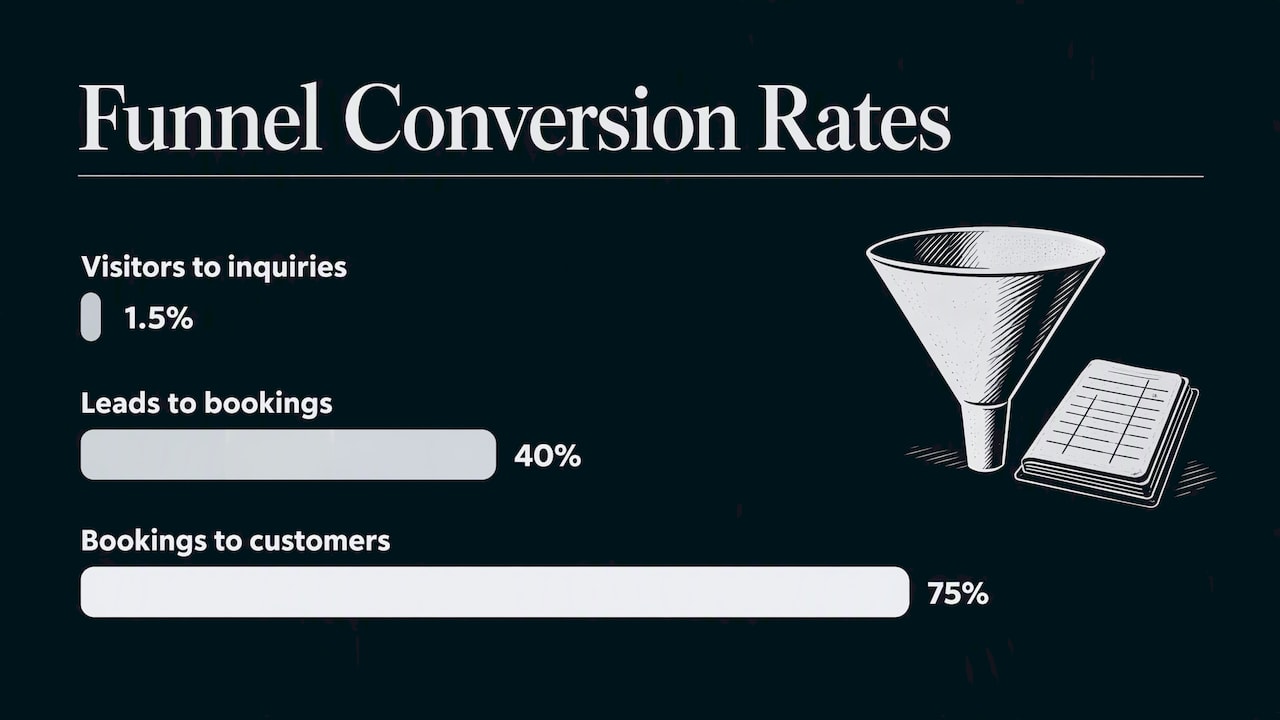
Total revenue tells you what happened. It does not tell you why. Harvard Business School Online quotes Professor Sunil Gupta on this: small business owners should track intermediate metrics that show where potential customers get stuck in the funnel.
Here is what that looks like with numbers. This is an illustration, not client data.
| Funnel stage | Last month | Reading |
|---|---|---|
| Website visitors | 2,000 | Healthy for a local service area |
| Calls and form fills | 30 (1.5%) | Within a normal range |
| Booked appointments | 12 (40% of leads) | Leak: 18 leads lost |
| Customers | 9 (75% of bookings) | Fine |
The leak is between inquiry and booking, not in traffic. More ad spend would have been wasted. The fix is faster callbacks, a text-back for missed calls and a clearer quote process. Our guide to digital ad funnels for small businesses shows how to map these stages.
Measuring marketing that is not digital
Direct mail, print, radio, referrals and word of mouth still bring customers, and they are harder to attribute. The SBA notes that experienced owners use low-tech methods: unique codes, custom landing pages, and asking new customers how they heard about you.
Practical versions:
- Give every channel its own tracking phone number or vanity URL.
- Print a different offer code on each flyer, mailer or ad.
- Add “How did you hear about us?” to the booking form and the front-desk script.
- Log the answers in the same sheet as your digital leads.
Self-reported sources are imperfect, but they catch things software misses, like a patient who saw your truck, then searched your name.
Building your KPI routine
Step 1: Set one business goal
Write it with a number and a date: “Add 20 booked jobs a month by March” or “Fill 12 more weekend event dates this year.” Work backward through close rate and conversion rate to the leads you need.
Step 2: Choose five to seven KPIs
Start with the core table above. Add one or two specific to your model: for example, cost per booked consultation for a med spa, or cost per site tour for a venue.
Step 3: Set up tracking before you spend
Install Google Analytics and Search Console, claim your Business Profile, track calls and form submissions as conversions, and use unique numbers per channel. If you cannot measure a channel, say so, and test it in a small, time-boxed way. If setup is not your strength, marketing tasks like reporting and lead follow-up are often handed to outside help, and deciding which to delegate is easier when your KPIs are defined first.
Step 4: Review monthly, decide quarterly
One page, same layout every month: spend, leads, CPL, conversion rate, CAC, revenue. Look at the trend over three months before reacting to one. Change one variable at a time, such as a headline, a bid strategy or a landing page, and write down the date.
Step 5: Align with the money
BCG’s guidance on marketing measurement is aimed at large companies, but the principle scales down. It recommends that functions align KPIs to forge a common definition of success, because chasing traffic while finance watches return leads to contradictory goals. For you, this means your bookkeeper’s revenue figures and your marketing report should use the same definitions of “new customer” and “sale.”
KPIs by business type
The core list stays the same. What counts as a “lead” and what drives value changes.
- HVAC, plumbing and home contractors: calls from Google Business Profile, missed-call rate, booked jobs per lead, average job size, repeat service agreements. Seasonality is large, so compare to the same month last year.
- Dentists and med spas: new patient or client inquiries, booked consults, show rate, treatment acceptance, recall or rebooking rate. LTV does most of the work here.
- Venues and banquet halls: tour requests, tours booked versus held, proposals sent, booked dates, and revenue per event. Long sales cycles mean you should track the leading indicators (tours) as well as signed contracts.
- Retail and local shops: foot traffic signals such as direction requests, promo code redemptions, email list growth and average order value.
Perspective: how we use KPIs with local businesses
We see the same pattern again and again: owners are handed a report full of impressions and rankings, yet cannot answer “How many new customers did marketing bring in last month?” That is a reporting failure, not an owner failure.
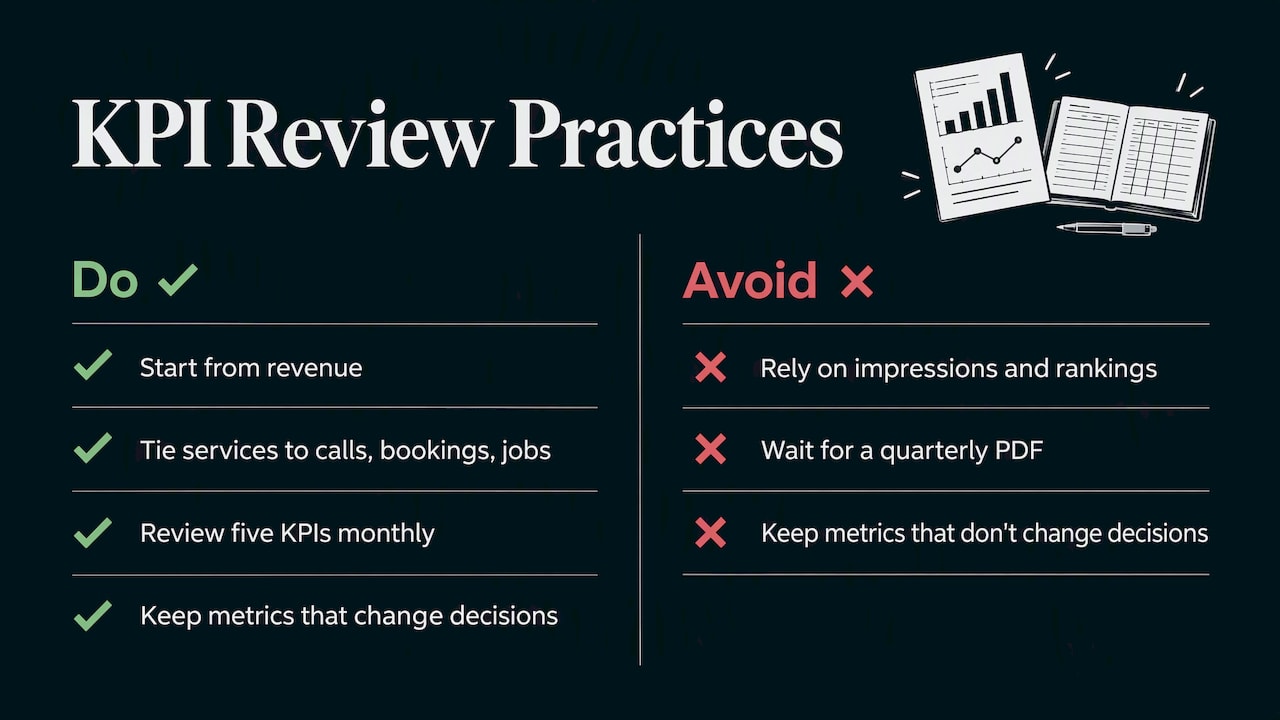
Our view is simple. Start from revenue and walk backward. Every service we offer, from SEO and local marketing to web design, advertising and social media, should be tied to a number that a business owner already cares about: calls, bookings, jobs. We build a custom plan for each client rather than a template, and we show performance in real time so you do not wait for a quarterly PDF to find out something broke.
We also push owners to track fewer things. Five KPIs reviewed monthly beat thirty reviewed never. If a metric does not change a decision, drop it.
— TONY
Where we can help
If you would rather not build the tracking yourself, we set up measurement as part of every plan: SEO, local marketing, web design, advertising and social media, with real-time stats so you see leads and sources as they come in. Tell us your goal and your service area on our main page and we will propose a plan with the KPIs it will be judged on. For more on dashboards, see our piece on real-time website analytics.
Common mistakes to avoid
- Tracking everything. Too many numbers hide the few that matter.
- Judging by clicks. A cheap click that never calls is expensive.
- Ignoring follow-up. Many leaks sit after the lead arrives, in slow replies and missed calls.
- Changing five things at once. You will not know what worked.
- Comparing to the wrong benchmark. Industry averages mix very different businesses. Use them to spot outliers, then benchmark against your own history.
- Skipping the baseline. Record three months of data before a big change so you can see the effect.
FAQ
What are good KPIs for small business marketing?
The best ones connect directly to revenue: leads by source, cost per lead, conversion rate, customer acquisition cost, lifetime value and return on ad spend. Add one or two that reflect your model, such as booked consultations or tours. Keep the list short enough to review in 20 minutes a month.
How many marketing KPIs should I track?
Five to seven is a practical range for a small business. More than that and the reporting becomes a job of its own. Each KPI should have an owner, a target and an action you take when it moves.
How often should I review my marketing KPIs?
Check leads weekly if you run paid ads, because budgets can leak fast. Do a full review monthly and make strategy decisions quarterly, using three-month trends. Seasonal businesses should compare to the same period last year.
How do I measure ROI when customers come from word of mouth?
Ask every new customer how they found you and record the answer. Add unique phone numbers and promo codes to offline efforts. The data will be imperfect, but a consistent log shows which channels deserve more budget.
Sources
- 8 Marketing Resolutions for 2020, U.S. Small Business Administration
- Small Business KPIs: What Are the Numbers That Matter?, US Chamber of Commerce
- 15 Essential Marketing KPIs and How to Measure Them, G2
- Understand your Business Profile performance and insights, Google Business Profile Help
- Using Search Console and Google Analytics Data for SEO, Google Search Central
- 7 Key Marketing KPIs to Track and How to Measure Them, Harvard Business School Online
- How to Get the Most From Your Marketing Budget, U.S. Small Business Administration
- Six Steps to More Effective Marketing Measurement, BCG
Recent Comments