
Lead generation for contractors is the process of building a repeatable system that fills your schedule with qualified project inquiries and converts them into booked jobs. The single metric that proves it’s working isn’t how many leads you got this week. It’s your cost-per-booked-job (CPBJ): what you actually spent to land a signed contract.
A healthy contractor lead system passes three tests:
- Response speed: You or someone on your team contacts every new inquiry promptly during business hours.
- Repeatable close rate: You track estimate-to-close percentage by channel, not just total jobs won.
- Predictable pipeline: You know, within a reasonable range, how many booked jobs a given spend or effort will produce next month.
If any of those three are missing, you don’t have a lead generation system. You have a marketing expense.
Table of Contents
- Why lead generation matters for your contracting business
- What are the best lead channels for contractors?
- How do you make word-of-mouth predictable?
- Does your website and Google profile actually capture leads?
- Which paid channels work best for contractors?
- How do you turn leads into booked jobs?
- How do you measure whether lead generation is working?
- What should you budget, and when will you see results?
- What mistakes are contractors making with lead generation?
- Your 30/90-day starter plan to get leads fast
- Key Takeaways
- What most agencies won’t tell you about contractor lead generation
- How Ibrand helps contractors build a lead pipeline that actually books jobs
- Useful sources for contractors
- FAQ
Why lead generation matters for your contracting business
Most contractors get their first jobs through word-of-mouth, and that’s fine. The problem is that referrals are unpredictable. A slow month hits, crews sit idle, and suddenly you’re dropping your price just to keep people busy. That’s margin erosion in real time.

A repeatable pipeline changes the math entirely. When you know roughly how many qualified inquiries a given channel produces, you can staff accordingly, hold your pricing, and stop bidding desperately. Crew utilization goes up. Rushed, underpriced bids go down.
The demand is there. Homeowners and property managers search for local contractors constantly, and high-intent local searches convert at rates that most other industries envy. The gap isn’t demand. It’s whether your business shows up, responds fast enough, and has a system to close.
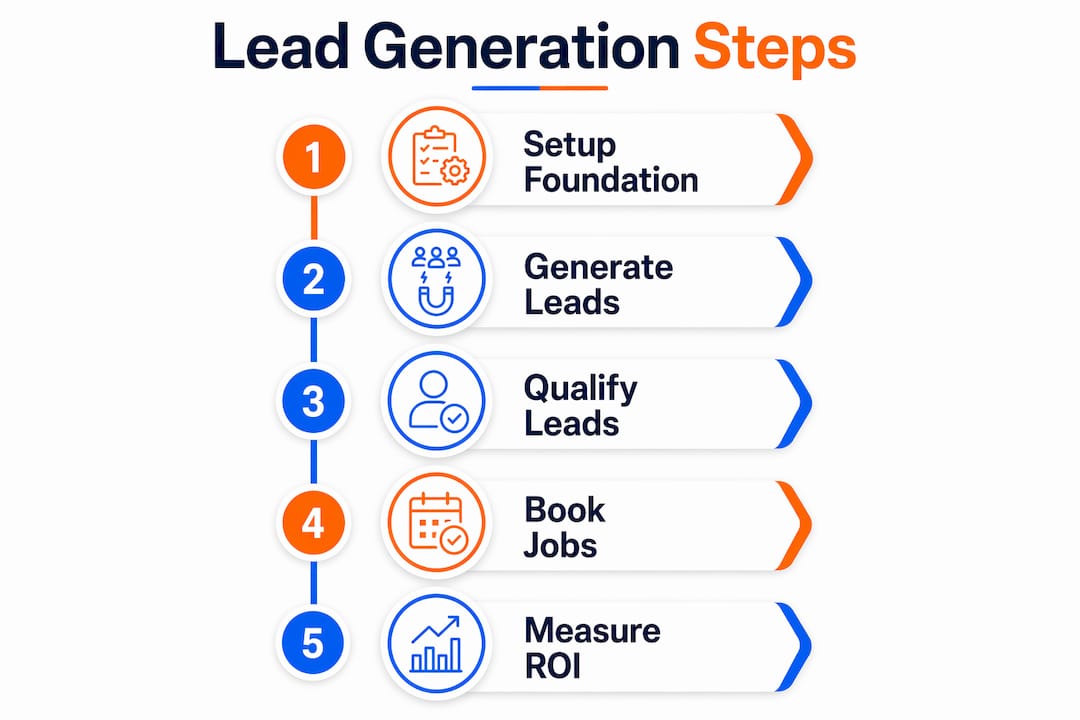
What are the best lead channels for contractors?
Most small contractors get the bulk of their booked jobs from the first four or five channels below. Add more as you grow, but don’t scatter your budget across all of them at once.
Ranked by speed-to-payback and lead quality:
- Referrals and word-of-mouth: Highest close rate, lowest cost, slowest to scale. A referred lead already trusts you before the first call.
- Google Business Profile (GBP) + local SEO: Free to maintain, produces high-intent local searches, and compounds over time. The single most important owned asset for residential contractors.
- Owned website with lead capture: Your website converts organic and paid traffic. Without a fast mobile site and a clear quote form, every other channel leaks.
- Google Local Services Ads (LSA): Pay-per-lead, Google Guaranteed badge, high intent. Best for urgent service trades (plumbing, HVAC, electrical) and contractors ready to respond within minutes.
- Google Search Ads: Pay-per-click, faster than SEO, more control over targeting. Works well when your landing page converts and you track CPBJ tightly.
- Facebook/Meta ads: Lower intent than search, but effective for replacement projects, seasonal campaigns, and before/after creative. Longer nurture cycle.
- Directories and marketplaces: Quick to set up, but lead quality varies widely and you’re competing on price. Use selectively while building owned channels.
- Partnerships with complementary businesses: Referrals from real estate agents, property managers, architects, and insurance adjusters. Slower to build, but the leads are pre-qualified and often high-value.
For urgent repair work, LSA and GBP are your fastest paths. For planned replacement projects, Google Search Ads and social ads work well with a longer follow-up cadence. For commercial bidding, relationships and project databases matter more than inbound search.
How do you make word-of-mouth predictable?
Referrals don’t just happen. They happen when you ask, and when you make it easy.
The most reliable moment to ask is right after a job wraps and the customer is happy. Don’t wait a week. Ask on the day of completion, in person or with a text message that takes them directly to your Google review link. A QR card left at the job site works well for homeowners who might share it with a neighbor.
Pro Tip: Create a short, shareable message your best customers can copy and paste: “Just had [Your Company] redo our roof. Solid work, showed up on time, cleaned up after. Here’s their number if you need them.” Give it to them. Most people want to help but don’t know what to say.
Track where every booked job came from. A simple spreadsheet with columns for lead source, job value, and whether the customer was referred works fine to start. Once you know which customers refer the most, you can prioritize those relationships, send a thank-you gift, or offer a small referral incentive without undermining your margin.
Hyper-local tactics work too. A yard sign on a finished job, a door hanger on the three houses nearest the project, or a mention in a neighborhood newsletter can generate inquiries at near-zero cost. These aren’t glamorous, but they’re affordable local marketing that compounds over time.
Does your website and Google profile actually capture leads?
This is the Foundational Marketing System (FMS): the combination of your website, Google Business Profile, and local SEO. Fix these before spending a dollar on paid ads. If your foundation leaks, paid traffic just leaks faster.
What your contractor website must do on mobile
More than half of local contractor searches happen on a phone. Your site needs to pass a simple test: can a homeowner find your phone number, tap to call, and submit a quote request in under 30 seconds?
- Tap-to-call button visible above the fold on every page
- Fast-loading quote form collecting essential information like name, phone, service type, and zip code.
- Separate service pages for each trade you offer (roofing, siding, gutters — not one generic “services” page)
- City and service-area pages for every market you work in
- A photo gallery of real completed projects, not stock images
Pro Tip: Run your site through Google’s PageSpeed Insights. A low mobile score can cost you leads. A slow site ranks lower and converts worse — two problems for the price of one.
The role of web design in contractor marketing goes beyond aesthetics. A site that loads in under two seconds and makes the next step obvious converts dramatically better than a beautiful site that makes visitors hunt for a phone number.
Google Business Profile checklist
Your GBP is often the first thing a homeowner sees. Treat it as a living asset, not a one-time setup.
- Select the most specific primary category (e.g., “Roofing Contractor,” not just “Contractor”)
- Add every relevant secondary category
- Set accurate service areas by city and zip code
- Upload at least 10 recent, high-quality job photos — and add new ones monthly
- Respond to every review, positive or negative, within 48 hours
- Keep hours, phone number, and website URL accurate and consistent with your website
Local SEO priorities
Local SEO for contractors comes down to three things: consistent NAP (name, address, phone) across every directory listing, service-area pages on your website that match what you put in GBP, and a steady stream of new reviews. Internal linking between your service pages and city pages helps Google understand your coverage area.
Fix FMS first. A contractor who completes their GBP, gets multiple reviews, and builds service-area pages will outperform competitors spending heavily on ads with a broken mobile site.
Which paid channels work best for contractors?
Paid channels produce leads faster than organic, but they require tight tracking to avoid burning budget. The right sequence is: fix FMS, establish baseline conversion metrics, then test one paid channel at a time.
Google Local Services Ads
LSA is pay-per-lead, not pay-per-click. You pay only when a homeowner calls or messages you through the ad. The Google Guaranteed badge (earned through a background check and license verification) significantly increases trust and click-through rate.
- Best for: plumbers, electricians, HVAC, roofers, and other urgent-service trades
- Lead quality is generally high because intent is immediate
- You can dispute invalid leads (wrong service area, spam calls) for a credit
- Budget control is straightforward: set a weekly maximum and Google manages delivery
Google Search Ads
Search Ads give you more control over keywords, ad copy, and landing pages than LSA. The tradeoff is higher management complexity.
- Focus on high-intent keywords: “roof replacement [city],” “emergency plumber near me,” “[trade] contractor [zip code]”
- Build a negative keyword list from day one: exclude “DIY,” “how to,” “jobs,” “salary,” and any service you don’t offer
- Send traffic to a dedicated landing page, not your homepage
- Track calls and form submissions as conversions in Google Ads
Pro Tip: Set a call extension and a location extension on every Search Ad. Many homeowners searching on mobile may skip the landing page and call directly from the ad.
Facebook and Meta ads
Facebook works best for replacement projects and seasonal campaigns where the homeowner isn’t in emergency mode. Before/after photos and short video walkthroughs of completed jobs perform well.
- Use Lead Ads (native Facebook forms) for lower friction than sending traffic to your website
- Target by zip code, homeowner status, and household income for residential work
- Retarget website visitors who didn’t submit a form — these are warm leads at a fraction of the cold-audience cost
- Expect a longer follow-up cycle: Facebook leads often need two or three touchpoints before booking
What to watch before scaling any paid channel
Early metrics to track before increasing budget:
- Contact rate: What percentage of leads actually pick up or reply?
- CPBJ: Total spend divided by booked jobs, not leads.
- Close rate: Estimates submitted versus jobs won.
- Outside-service-area percentage: If more than 20% of leads are outside your territory, your targeting needs tightening.
Tracking campaign performance at the channel level is what separates contractors who scale profitably from those who spend more and wonder why margins don’t improve.
How do you turn leads into booked jobs?
Getting a lead is the easy part. Converting it is where most contractors lose money, and the fix is almost always operational, not marketing-related.
Assign an owner to every inbound channel
Every phone number, contact form, and LSA message needs a designated person responsible for responding. If it’s you, set a phone alert. If it’s an office manager, define the handoff. Ambiguity kills response speed.

The industry standard is clear: homeowners contact multiple contractors simultaneously and frequently book the first professional who responds with a clear next step. A two-day callback usually loses the job to whoever called back in 20 minutes.
Target: respond within five minutes during business hours. After hours, an auto-reply text with your next available callback time is far better than silence.
A simple qualifying script
When you call back, cover four things quickly:
- What service do they need?
- What’s their timeline?
- Are they in your service area?
- Do they have a rough budget in mind?
If they pass, book the estimate on the spot. Don’t say “I’ll call you to schedule.” Open your calendar and give them a time.
CRM and follow-up cadence
You don’t need expensive software to start. A basic CRM like HubSpot’s free tier or even a well-structured Google Sheet tracks lead source, contact date, estimate date, follow-up dates, and outcome. The goal is to never let a lead go cold because you forgot to follow up.
A practical follow-up cadence after sending an estimate:
| Day | Action |
|---|---|
| — | Send estimate with a clear expiration date (7–10 days) |
| Day 2 | Text or call to confirm they received it and answer questions |
| Day 5 | Second follow-up: ask if they’re comparing quotes |
| Day 8 | Final follow-up: offer to adjust scope or timeline if needed |
| Day 14 | Close the loop: mark won, lost, or future opportunity |
Pro Tip: Use email follow-up templates for each stage. A 90-second email beats a missed call every time, and it creates a paper trail that helps you improve your close rate over time.
Photo-to-estimate workflows speed up the quoting process for smaller jobs. Ask the homeowner to send photos of the project area before the site visit. You can pre-qualify scope, bring the right materials, and sometimes quote on the spot rather than scheduling a second trip.
How do you measure whether lead generation is working?
Tracking raw lead volume is the most common measurement mistake contractors make. A channel that produces 40 leads a month but closes 2 jobs is worse than one that produces 12 leads and closes 6.
Core KPIs every contractor should track
| KPI | What it measures | How to calculate |
|---|---|---|
| Leads | Total inbound inquiries by channel | Count per channel per month |
| Contact rate | % of leads you actually reach | Contacts made ÷ leads received |
| Estimate-booking rate | % of contacts who schedule an estimate | Estimates booked ÷ contacts made |
| Close rate | % of estimates that become jobs | Jobs won ÷ estimates submitted |
| Average job value | Revenue per booked job | Total revenue ÷ jobs won |
| CPBJ | Cost to land one booked job | Channel spend ÷ jobs booked from that channel |
Sample ROI calculation
Say you spend $800 on Google Local Services Ads in a month. That produces 20 leads. You contact 16 (80% contact rate), book 10 estimates, and close 4 jobs. Your CPBJ is $200. If your average job value is $3,500, that’s a 17.5x return on ad spend before overhead.
Now run the same math on a lead marketplace where you paid $600 for 30 leads, contacted 18, booked 6 estimates, and closed 1 job. CPBJ is $600. Same spend, very different outcome.
Understanding why tracking marketing performance matters is what makes this math possible. Without it, you’re guessing which channel to scale.
Checklist for reliable tracking
- Assign a unique phone number or call-tracking number to each channel
- Use UTM parameters on all paid ad links
- Record lead source in your CRM at the moment of first contact
- Review CPBJ by channel monthly, not quarterly
What should you budget, and when will you see results?
There’s no universal answer, but there are realistic ranges based on channel and trade.
Google Business Profile improvements: Essentially free in dollar cost, but requires consistent time investment. Expect to see meaningful movement in local pack rankings within a few months of active management, assuming you’re generating reviews regularly.
Google Local Services Ads: Budget varies by trade and market. Competitive urban markets for plumbing or HVAC can run higher per lead than rural roofing markets. Leads typically start soon after approval. The verification process (background check, license, insurance) requires some time.
Google Search Ads: Plan for a learning period of several weeks before the algorithm optimizes delivery. Set a monthly budget you can sustain for at least three months before drawing conclusions.
Facebook/Meta ads: Expect a ramp-up over a few weeks for the algorithm to find your audience. Lead quality often improves as you refine targeting based on early results.
Timeline expectations by phase
- Days 1–30: GBP completion, review requests, website mobile fixes, LSA application submitted. You may see your first GBP-driven calls within weeks.
- Days 31–60: First paid channel live with tracking in place. Baseline CPBJ established. CRM set up and follow-up cadence running.
- Days 61–90: Refine paid channel targeting based on CPBJ data. Add a second review-generation push. Evaluate whether to expand to a second paid channel or focus commercial outreach.
When to stop a test: If a paid channel has run for a couple of months with a reasonable number of leads and your CPBJ is higher than a sustainable portion of average job value, pause it, diagnose the conversion funnel (contact rate, close rate, targeting), and fix before restarting.
What mistakes are contractors making with lead generation?
The most expensive mistake is buying lead volume before fixing the internal process. More leads into a broken system just means more wasted spend.
Common mistakes and quick fixes
Tracking raw leads instead of booked jobs. Fix: add a “job won/lost” column to your CRM and calculate CPBJ monthly.
Weak GBP management. A profile with no recent photos, unanswered reviews, and outdated hours ranks poorly and converts worse. Fix: spend 30 minutes a week on GBP updates.
Overpaying for marketplace leads. Some lead marketplaces sell the same lead to five contractors. Fix: calculate CPBJ for each marketplace separately and cut the ones that don’t pencil out.
No follow-up after the estimate. Studies on contractor lead conversion consistently show that most contractors send one estimate and never follow up. Fix: implement the five-touch cadence above.
Red-flag signals a channel is failing:
- Contact rate low, indicating leads aren’t reliably picking up or responding.
- A significant portion of leads coming from outside your service area
- Close rate on estimates is low, possibly due to pricing, trust, or response speed issues.
- Cost per booked job exceeding a critical portion of the average job value
When you see these signals, don’t increase the budget. Diagnose the step that’s breaking down first.
Your 30/90-day starter plan to get leads fast
This is the sequence that produces the fastest return for most small contractors. Do it in order.
Days 1–30 (Foundation):
- Complete your Google Business Profile fully: categories, service areas, hours, photos, website link.
- Request reviews from your last 10 completed jobs. Text each customer a direct link.
- Fix your website’s mobile experience: tap-to-call button, fast quote form, accurate service pages.
- Assign a lead owner for every inbound channel. Set a five-minute response target.
- Record your baseline: how many leads came in last month, from where, and how many became booked jobs.
Days 31–60 (Test and track):
- Apply for Google Local Services Ads and complete verification.
- Set up a basic CRM (HubSpot free, Google Sheets, or similar) and log every new lead with source and outcome.
- Implement the photo-to-estimate workflow for smaller jobs.
- Run your first paid channel with a fixed monthly budget and tight geographic targeting.
- Track CPBJ weekly. Don’t scale until you have 15–20 leads through the channel.
Days 61–90 (Refine and expand):
- Adjust paid channel targeting based on CPBJ data from days 31–60.
- Launch a second review-generation push: ask every completed job customer.
- If CPBJ is profitable, increase paid budget by 20–30%. If not, diagnose the funnel before spending more.
- Evaluate whether to add a second paid channel or shift focus to commercial outreach (project databases, GC relationships) based on your trade and market.
- Review your digital marketing strategy for contractors quarterly and adjust channel mix based on what’s producing booked jobs.
Key Takeaways
Lead generation for contractors works when you fix your foundation first, respond fast, and measure cost-per-booked-job rather than raw lead volume.
| Point | Details |
|---|---|
| Fix FMS before buying leads | Complete your GBP, mobile website, and local SEO before spending on paid channels. |
| Response speed wins jobs | Contact every new inquiry within five minutes during business hours or lose it to a faster competitor. |
| Track CPBJ, not lead count | Divide channel spend by booked jobs to know which channels actually make money. |
| Referrals are your highest-ROI channel | Ask every completed-job customer for a review and referral before investing in paid volume. |
| Ibrand handles the system for you | Ibrand builds and manages GBP, local SEO, web design, and paid ads so contractors focus on the work. |
What most agencies won’t tell you about contractor lead generation
Here’s the honest version: most contractors who come to an agency frustrated with their lead generation don’t have a marketing problem. They have a process problem. The leads are there. The response speed isn’t. The follow-up isn’t. The GBP hasn’t been touched in eight months.
The contractors who see the fastest results from any paid channel are the ones who already have a functioning internal process: someone answers the phone, estimates go out within 24 hours, and there’s a follow-up system that doesn’t depend on memory. When those pieces are in place, paid channels multiply what’s already working. When they’re not, paid channels just surface the dysfunction faster.
The other thing worth saying plainly: trade matters. A roofing contractor in a competitive metro needs a different channel mix than an HVAC company in a mid-sized market or a commercial GC building relationships with property developers. The framework in this guide applies across trades, but the specific channel weighting, budget, and timeline will shift. Don’t copy a competitor’s strategy without knowing their trade, market, and average job value.
The 30/90-day plan above isn’t theory. It’s the sequence that produces the clearest early signal on what’s working, because it forces you to fix the foundation before scaling spend. That order matters more than any individual tactic.
How Ibrand helps contractors build a lead pipeline that actually books jobs
Running a contracting business leaves little time to manage Google profiles, rebuild websites, and track ad performance simultaneously. Ibrand works with small construction businesses to set up and run the exact system described in this guide: GBP management, local SEO for small businesses, mobile-ready web design, paid ad campaigns, and performance tracking tied to booked jobs rather than vanity metrics.
The starting point is a free site and GBP diagnostic. Ibrand reviews your current profile, website mobile performance, and local search visibility, then shows you exactly where leads are leaking before recommending any spend. No long-term contract required to get the audit.
Contractors who work with Ibrand get a personalized plan built around their trade, market, and crew size, not a generic package. If you’re ready to stop guessing which channel is producing and start tracking what actually fills your schedule, reach out for a free local marketing check and see where your pipeline stands today.
Useful sources for contractors
- Google Business Profile Help Center: Official documentation for setting up, verifying, and managing your GBP listing, including how to add service areas and respond to reviews.
- Google Local Services Ads Help: Step-by-step verification process, budget controls, lead dispute instructions, and the Google Guaranteed badge requirements.
- Google Ads Help Center: Keyword setup, negative keyword lists, call extensions, and conversion tracking for Search Ads campaigns.
- Salesforce Lead Generation Guide: Solid foundational explanation of inbound vs. outbound lead generation and how to structure a nurture process.
- ProTradeHQ Contractor Lead Generation Guide: Practical contractor-specific system covering CPBJ tracking, GBP management, and channel sequencing.
- SimplyWise: 12 Ways Contractors Get More Leads: Channel-by-channel breakdown with notes on payback speed and lead quality, useful for prioritizing your channel mix.
- Meta Business Help Center: Setup guides for Facebook Lead Ads, audience targeting by location and homeowner status, and retargeting pixel installation.
FAQ
What is lead generation for contractors?
Lead generation for contractors is a repeatable system that attracts qualified project inquiries and converts them into booked jobs. Success is measured by cost-per-booked-job, not raw lead volume.
What is the best lead generation strategy for contractors?
Referrals and an actively managed Google Business Profile produce the highest-quality leads at the lowest cost. Add paid channels like Google Local Services Ads only after your response speed and tracking are in place.
What does a lead contractor do differently to win more work?
A contractor who wins more work responds to every inquiry within five minutes, sends estimates within 24 hours, and follows up at least three times before closing a lead as lost. Speed and follow-up consistency beat lower pricing in most markets.
How long does it take to see results from contractor lead generation?
Google Business Profile improvements typically show results within 60–90 days. Google Local Services Ads can produce leads within days of approval. Paid search campaigns usually need a 30–60 day learning period before performance stabilizes.
What is the purpose of lead generation for a contracting business?
The purpose is to replace unpredictable referral-only pipelines with a system that produces a consistent, measurable flow of qualified project inquiries, giving you control over crew utilization, pricing, and revenue.
Recent Comments