
A Google Ads landing page is the page a person sees after clicking your ad. For most local and small businesses, the best one is a dedicated page that repeats the promise of the ad, shows one clear action (call, book, request a quote) and loads fast on a phone. Sending paid clicks to your homepage is the most common way small advertisers waste budget.
This guide explains what the page does, whether you need a separate one, what to put on it, how Google judges it, and how to check it is working.
TL;DR
- Your landing page is the ad’s final URL. Google judges it as part of Quality Score, so it affects both your costs and your results.
- Yes, you almost always need a dedicated page. One ad group, one offer, one action.
- Match the headline to the ad and the search, put the phone number and form above the fold, and keep navigation to a minimum.
- Follow Google’s destination rules: fast loading, no intrusive pop-ups, no broken back button.
- Track calls and form fills, then change one thing at a time.
Table of Contents
- What a Google Ads landing page does
- Do you need a separate landing page?
- How Google judges your landing page
- What to put on the page, section by section
- What a good conversion rate looks like
- Build it faster from what you already have
- Our perspective
- Set up tracking before you spend
- Common mistakes to avoid
- Where we can help
- FAQ
- Sources
What a Google Ads landing page does
The landing page is where your ad’s promise either pays off or falls apart. The click has already cost you money. What the visitor sees in the next few seconds decides whether that money turns into a lead.
In practice the page has three jobs:
- Confirm they are in the right place. The headline echoes the ad and the search term.
- Give enough proof to act. Reviews, license details, photos of real work, clear pricing logic or a guarantee, whatever the client in your trade needs to feel safe.
- Make the next step obvious. One main action, repeated where the visitor is ready to take it.
The page is usually the same as your ad’s final URL, which means every ad you write needs a destination chosen on purpose.
Do you need a separate landing page?
If your ad is about one service, send it to a page about that service. A homepage has to serve everyone: existing customers, job seekers, people comparing you with others. A landing page serves one person with one problem.
Here is how that looks for a few of the businesses we work with:
| Business | Ad promise | Weak destination | Strong destination |
|---|---|---|---|
| HVAC company | Same-day AC repair | Homepage with ten services | Page about AC repair with call button and service area |
| Dentist | New patient exam offer | “About us” page | Offer page with booking form and insurance note |
| Med spa | Consultation for a specific treatment | Treatments menu | Page for that treatment with before and after photos and booking |
| Banquet hall | Wedding venue tours | Gallery page | Tour request page with capacity, packages and a date picker |
| Plumber | Emergency leak repair | Contact page | 24/7 call page with service area and response expectations |
A separate page is not mandatory for every campaign. A well-organized service page on your site can work as a landing page if it matches the ad and strips away distractions. What fails is the generic destination that makes the visitor hunt.
If your business serves several towns, consider one page per location. Our local landing pages playbook and launch checklist walks through how to do that without creating thin, copied pages. Venue owners can also see how we approach event landing pages.
How Google judges your landing page
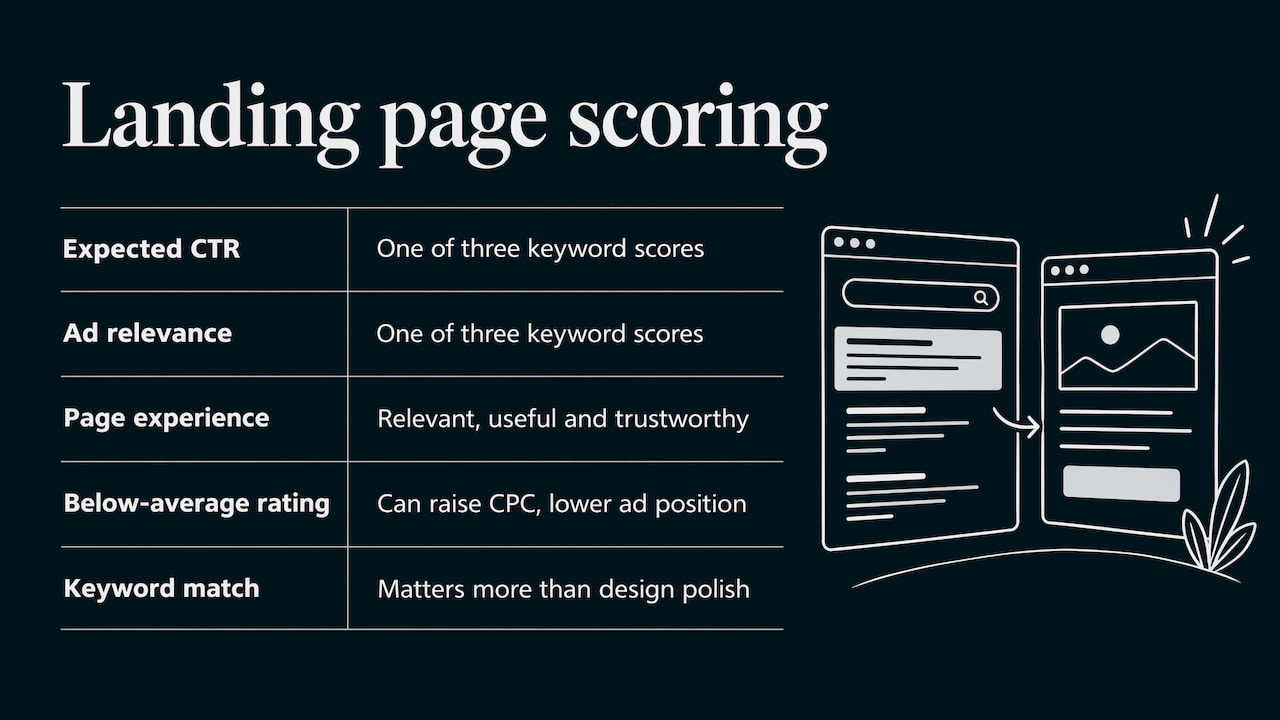
Google Ads scores three things for each keyword: expected click-through rate, ad relevance and landing page experience. Landing page experience reflects how relevant, useful and trustworthy the page is to the person who clicked. A below-average rating can push your cost per click up and your ad position down, so a weak page costs you twice: once in the auction and once in conversions.
The practical lesson: relevance to the keyword matters more than design polish. If someone searches “emergency water heater replacement” and lands on a page that leads with that phrase, you have done most of the work. If you are seeing low ratings, our 30 day playbook for fixing low Quality Score ads gives a week-by-week order of work.
Google’s destination rules
Beyond scoring, Google enforces policy on where ads send people. Its destination experience policy says ad destinations must be easy to navigate and safe. It lists examples of what is not allowed, including pop-ups or interstitials that interfere with seeing the content, sites that disable the back button, and sites that do not load quickly on popular browsers and devices.
Treat these as design constraints:
- No full-screen pop-ups the moment the page opens.
- Never redirect the visitor automatically without an action on their part.
- Do not trap the back button.
- Test on a mid-range phone over mobile data, not just on your office computer.
What to put on the page, section by section
You do not need a long page. You need the right pieces in the right order.
1. A headline that mirrors the search
Use the words your customer typed. “Same-Day AC Repair in Tampa” beats “Quality Comfort Solutions You Can Trust.” If you use dynamic text or several ad groups, create variations so each headline stays tied to its keyword group. Our guides on writing ad copy that converts and ad copy for small businesses help you keep ad and page saying the same thing.
2. One primary action, visible without scrolling
On mobile, that usually means a tap-to-call button, a short form, or both. Ask only for what you need to follow up: name, phone, and one question about the job. Every extra field costs you some leads.
3. Proof close to the action
Place star ratings, review excerpts, years in business, license and insurance details (where they apply to your trade) and real project photos near the button. Stock photos of smiling strangers add nothing. A photo of your own crew, van or finished work does.
4. A short explanation of the offer
Say what happens next in plain steps: you call, we confirm a window, a technician arrives, you get a written quote. Visitors act when the process feels predictable.
5. Answers to the two or three objections that stop people
For a med spa it may be “is the consultation free?” For a banquet hall, “what is the minimum guest count?” For a plumber, “do you come out at night?” Put the answers on the page rather than behind a click.
6. Minimal navigation
Remove the full site menu on campaign pages, or cut it to a logo and a phone number. Each link out is a way to leave without converting.
7. Speed and mobile layout
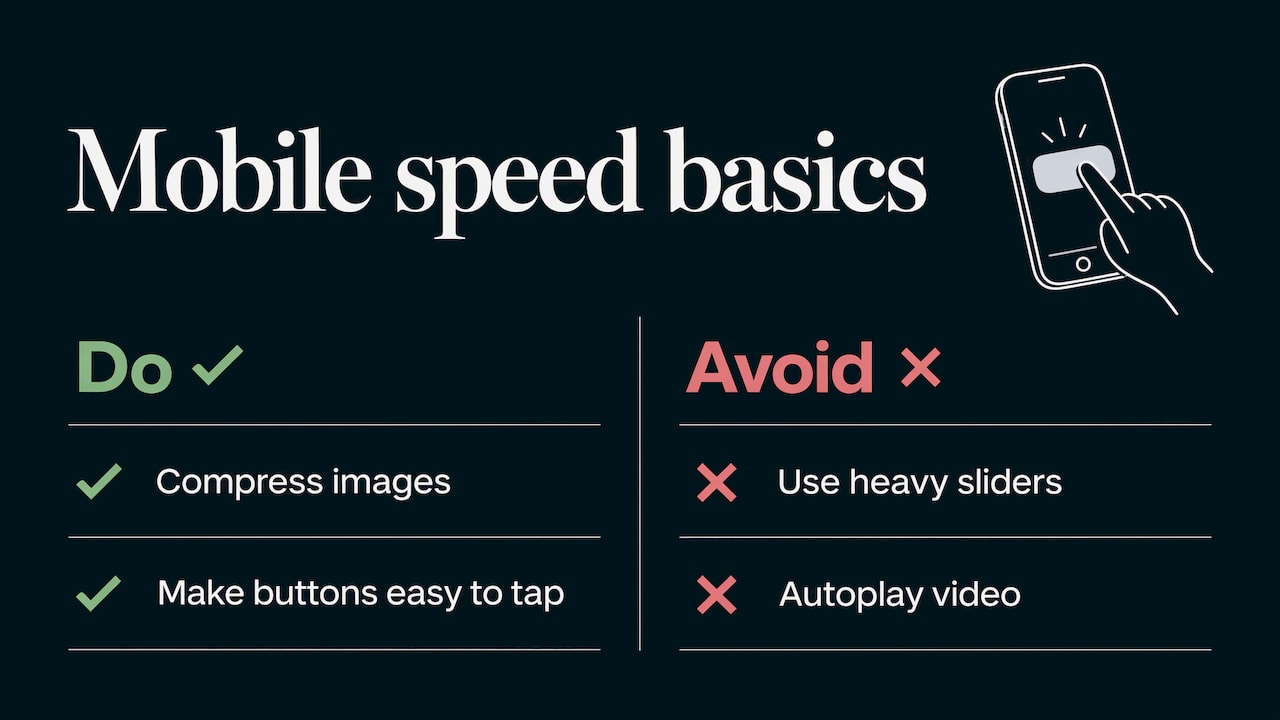
Most local searches happen on phones. Compress images, avoid heavy sliders and autoplay video, and check that buttons are large enough to tap. We cover the numbers behind this in how mobile design lifts conversions.
What a good conversion rate looks like
Benchmarks give you a sanity check, not a target to chase. WordStream’s Google Ads conversion rate benchmarks put the average across Google Ads at 8.18% in its 2026 data, with wide differences by industry. In the same report, dentists and dental services average 10.67%, automotive repair and service 15.51%, and home and home improvement 8.05%.
Use those figures as a rough range. Your own numbers depend on your offer, your market and how you count a conversion (a call, a form, a booking). Measure against your own baseline first, then improve it.
Build it faster from what you already have
If you do not have a developer on call, you can still launch a focused page quickly. Some local businesses start from a simple site generated from their Google Business Profile, such as campaign-specific landing pages from Peak Pages, then refine headline, offer and proof for each ad group. Whatever route you choose, the rules above apply: one offer, one action, fast load.
The page is only half of the lead-handling system. A visitor who submits a form at 9 p.m. expects an answer. Responding quickly and qualifying the lead matters, and an overview of AI lead qualification from chat shows one way to sort serious inquiries from casual ones without adding staff hours.
Our perspective
Most small business owners we meet do not have an ad problem. They have a destination problem. They pay for a click, then drop the visitor on a page that was built for everyone.
We build campaign pages the same way we plan campaigns: around one customer, one need and one action. That is why our approach starts with a custom plan for each client rather than a template. A dental practice, a banquet hall and an HVAC company do not need the same page, and their ads should not share one either.
We also think you should see what is happening. Real-time performance tracking means you can watch calls and form fills come in from each page and judge the work by results, not promises. Keep what converts, change what does not, and put the next dollar where it does the most.
The goal is affordable, practical marketing that a local owner can understand and use.
TONY
Set up tracking before you spend
A landing page you cannot measure is a guess. Before launch:
- Define the conversion. Phone call from the ad, tap on the call button, form submission, booking confirmation.
- Track each separately. A call and a form fill have different values and different follow-up.
- Tag each ad group’s page. So you know which page produced which lead.
- Review search terms weekly. Add irrelevant terms as negatives so the page is not judged on traffic it was never meant to serve.
- Record a baseline. Cost per lead and conversion rate for the first two weeks give you something to beat.
Once data accumulates, test one change at a time: the headline, the form length, the main image, the offer wording. Changing five things at once teaches you nothing. Our conversion rate optimization tips for small businesses and guide to increasing website conversions give you a testing order that fits small budgets, and the website conversion rate tips cover the on-page details.
Common mistakes to avoid
- Sending every ad to the homepage. The visitor has to work out where to go, and many will not.
- Promising one thing in the ad and another on the page. A “$0 consultation” ad needs that offer in the headline, not three clicks deep.
- Burying the phone number. For urgent services like plumbing or HVAC, the call button is the page.
- Too many choices. Three buttons to three different actions split attention.
- Slow, heavy pages. Large uncompressed images and auto-playing video lose mobile visitors and can run into Google’s rules on loading speed.
- Forgetting the thank-you page. Use it to confirm what happens next and to record the conversion.
- Never revisiting the page. Seasonal offers, new reviews and new service areas should all show up on the page.
Where we can help
If you would rather spend your time running the business, we build and manage this for small and local companies. Our team handles web design, advertising, SEO and local marketing, and builds a custom plan around your trade, your service area and your budget. You see results through real-time stats, so you know which ad and which page is producing leads.
To discuss a landing page for your next campaign, start at ibrand.media and tell us what you sell and where. If you want more background first, read our explainer on PPC advertising and online visibility.
FAQ
What is the purpose of a landing page in Google Ads?
It turns a paid click into an action: a call, a booking or a form submission. It also affects how Google rates your ad, because landing page experience is one of the three components of Quality Score. A relevant, fast, trustworthy page helps both your results and your costs.
Do I need a landing page for Google Ads?
You need a destination, and the closer it matches the ad, the better. A dedicated page for each service or offer usually converts better than a homepage. A focused service page on your existing site can do the job if it is fast, matches the ad and keeps one clear action.
How do I add a landing page in Google Ads?
You enter the page’s web address as the final URL when you create or edit an ad. Each ad can point to a different page, so match the URL to the ad group’s keywords and offer. After saving, check the live page on a phone and confirm your conversion tracking fires.
What makes a good landing page for Google Ads?
A headline that mirrors the search, one clear action above the fold, proof such as reviews and real photos, and fast mobile loading. Add short answers to the questions that stop buyers and remove extra navigation. Then track results and test one change at a time.
Recent Comments