
TL;DR:
- Building trust is the key to long-term customer loyalty, as consistent delivery and emotional connections compel repeat business. Small businesses should focus on fixing experience gaps first, then implement simple, well-designed loyalty programs that combine rewards with quick problem resolution. Monitoring multiple metrics and responding swiftly to customer feedback strengthen loyalty and reduce customer churn over time.
Customer loyalty is defined as the emotional connection and repeated patronage a customer gives to a business over time. For small and medium-sized business owners, building that connection is the most cost-effective growth strategy available. Customers who form emotional bonds with a brand spend 31% more and purchase 64% more frequently than average buyers. That gap in lifetime value is the difference between a business that grinds for new leads every month and one that grows on a foundation of returning customers. Knowing how to boost customer loyalty means understanding what drives that connection and acting on it deliberately.
What are the core factors that drive customer loyalty?
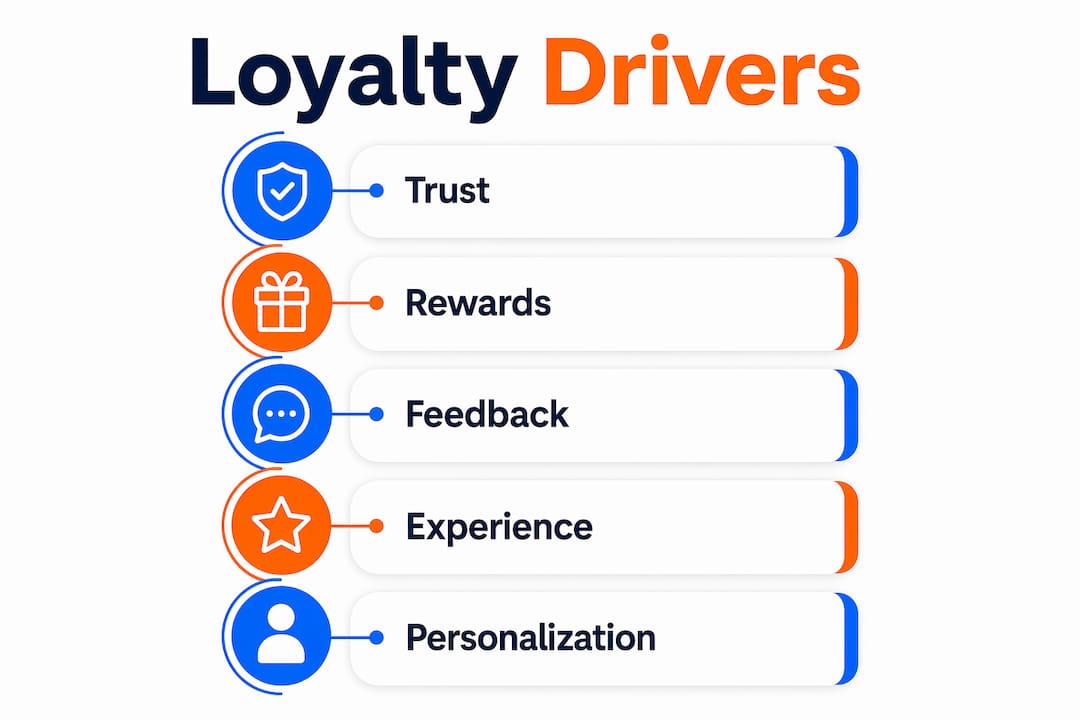
Trust is the foundation of every loyal customer relationship. 93% of consumers say trust is a prerequisite for loyalty, not a bonus. That means consistent delivery at every touchpoint matters more than any single impressive moment.
The core drivers of customer loyalty break down into four areas:
- Consistent experience. Customers return when they know what to expect. A coffee shop that gets your order right every time beats the one with the best espresso but unpredictable service.
- Emotional connection. Customers who feel recognized and valued buy more and refer more. Personalization, even at a basic level, signals that you see them as individuals.
- Value realization. Loyalty grows when customers achieve the outcome they paid for. A gym that helps members hit fitness goals retains them far longer than one that just offers equipment.
- Aligned values. Customers increasingly stay with brands whose ethics and mission match their own. Transparency about sourcing, pricing, or community involvement builds this alignment.
The industry term for managing these drivers systematically is “customer experience management,” or CXM. It covers every interaction a customer has with your business, from the first ad they see to post-purchase support.
Pro Tip: Map your customer journey before you spend a dollar on loyalty programs. Identify the two or three moments where customers are most likely to feel let down, and fix those first.

Building customer trust online is not a separate project from loyalty. They are the same project.
How can small businesses design effective loyalty programs?
84% of loyalty program members are more likely to make repeat purchases. That number is compelling, but it comes with a critical caveat: programs that reward transactions without fixing the underlying experience create loyalty to the discount, not the brand.
The four main loyalty program types
- Points programs. Customers earn points per purchase and redeem them for rewards. Simple to understand and easy to run on a small budget.
- Tiered programs. Customers unlock better benefits as they spend more. This works well for businesses with a wide range of purchase frequencies, like salons or restaurants.
- Referral programs. Customers earn rewards for bringing in new buyers. This doubles as a customer acquisition tool and a retention tool.
- Paid membership programs. Customers pay a flat fee for exclusive perks. This model works when the perceived value of the perks clearly exceeds the membership cost.
Balancing rewards and rescues
Effective loyalty strategies balance rewards, which are positive reinforcements for good behavior, and rescues, which reduce friction when something goes wrong. A points program alone is not enough. When a customer has a bad experience, a fast, empowered response from your team is the rescue that keeps them from leaving. Programs that combine both outperform those built on rewards alone.
| Program type | Best for | Main risk |
|---|---|---|
| Points | High-frequency purchases | Customers chase points, not the brand |
| Tiered | Businesses with loyal top spenders | Lower tiers feel undervalued |
| Referral | Growth-stage businesses | Reward abuse if not monitored |
| Paid membership | Strong value proposition brands | Low sign-up if perks feel weak |
Pro Tip: Keep redemption simple. If a customer needs three steps to use a reward, most will not bother. One-tap redemption at checkout is the standard to aim for.
For more ideas on affordable loyalty strategies that fit an SMB budget, Ibrand has a dedicated guide worth reading alongside this one.
How to leverage customer feedback to enhance loyalty
Voice of the Customer (VoC) programs are the structured practice of collecting, analyzing, and acting on customer feedback continuously. Most small businesses collect feedback occasionally. The ones that build loyalty do it constantly and act on it fast.
Here is a practical four-step process:
- Collect feedback at every key touchpoint. Use post-purchase surveys, support ticket follow-ups, and behavioral signals like cart abandonment or repeat returns. Each signal tells you something different about where loyalty is at risk.
- Segment feedback by customer type. A complaint from a first-time buyer means something different than the same complaint from a customer who has bought ten times. Treat them differently.
- Close the loop within 48 hours. Only 48% of organizations follow up on negative feedback within 48 hours. That gap is a direct loyalty recovery opportunity your competitors are likely missing.
- Empower frontline staff to act. Quick follow-up by frontline employees on negative feedback within 24–48 hours is one of the highest-return loyalty tactics available. Give your team the authority to offer a refund, a discount, or a direct call without needing manager approval every time.
AI-powered CX platforms can now predict customer churn 30–90 days in advance by analyzing behavioral patterns. For SMBs not yet ready for enterprise tools, even a basic CRM with automated follow-up sequences achieves a meaningful version of this.
Pro Tip: After resolving a complaint, send a short follow-up message two weeks later asking if the issue stayed resolved. That second touchpoint converts frustrated customers into vocal advocates more reliably than the initial fix alone.
What metrics should SMBs use to track customer loyalty?
Measuring loyalty accurately requires tracking behavioral, attitudinal, and advocacy dimensions together. Relying on a single metric like Net Promoter Score (NPS) gives you an incomplete picture.
The four metrics every SMB should track are:
- Net Promoter Score (NPS). Measures how likely customers are to recommend you. Useful as a directional signal, but not sufficient on its own.
- Customer Satisfaction Score (CSAT). Captures satisfaction at a specific interaction. Best used after support tickets, purchases, or onboarding moments.
- Retention rate. The percentage of customers who return within a defined period. This is the clearest measure of loyalty health for most SMBs.
- Repeat purchase rate. The share of customers who buy more than once. For new businesses, tracking second-purchase rate and cohort behavior is more practical than complex lifetime value modeling.
Setting realistic benchmarks
Benchmarks vary by industry, but a retention rate above 60% is a strong baseline for most service-based SMBs. E-commerce businesses typically aim higher, closer to 30% repeat purchase rates in the first 90 days. The most useful benchmark is your own trend line. If retention is improving month over month, your strategies are working.
Avoid adding too many metrics at once. Pick two or three, track them consistently for 90 days, and then layer in additional data as your systems mature.
What practical steps can SMBs take to build loyalty right now?
Launching a loyalty program before fixing your customer experience is the most common mistake SMBs make. Customers who have a bad experience will use your rewards program once and leave anyway.
Follow this sequence:
- Audit your experience gaps first. Survey your last 20 customers and ask one question: “What almost made you not come back?” The answers will tell you exactly where to focus.
- Segment your customers. Divide them into at least three groups: new arrivals, active regulars, and lapsed customers. Each group needs a different message and a different incentive.
- Onboard new customers fast. Customer acquisition costs 5 to 25 times more than retention, and the first 30 days are the critical window for driving a second purchase. Send a welcome sequence that explains your loyalty program benefits clearly within the first week.
- Build community around your brand. Customer communities increase retention by up to 37%. A private Facebook group, a local event, or even a monthly email digest for your best customers creates peer bonds that make switching feel like a social loss.
- Train staff for proactive outreach. Do not wait for customers to complain. Have your team reach out to customers who have not purchased in 60 days with a personal message, not a mass email.
Pro Tip: Personalize your re-engagement messages with the customer’s last purchase. “We noticed you loved our [product]. Here’s what pairs well with it” outperforms generic discount blasts every time.
For more ideas on attracting repeat customers without a large marketing budget, Ibrand has a practical guide built specifically for SMBs.
Key Takeaways
Building customer loyalty requires fixing experience gaps first, then layering in programs, feedback loops, and measurement to sustain retention over time.
| Point | Details |
|---|---|
| Trust drives loyalty | 93% of consumers require trust before becoming loyal; consistent delivery builds it. |
| Programs need rescues too | Combine rewards with fast problem resolution to prevent loyalty to discounts over brand. |
| Close feedback loops fast | Follow up on negative feedback within 48 hours to recover trust before customers leave. |
| Track the right metrics | Measure NPS, CSAT, retention rate, and repeat purchase rate together for a full picture. |
| Fix experience before programs | Launching rewards before resolving experience gaps creates short-term transactions, not loyalty. |
What I’ve learned about loyalty that most guides get wrong
Most loyalty advice focuses on programs. Points, tiers, referrals. The mechanics are real, but they are not the engine. The engine is trust, and trust is built in the moments nobody plans for.
I have seen small businesses with no formal loyalty program at all outperform competitors running sophisticated rewards platforms. The difference was always the same: their teams responded to problems fast, personally, and without making customers fight for a resolution. That behavior, repeated consistently, is what creates the emotional connection that drives repeat buying and lifetime value.
The trend toward AI-driven personalization is real and worth paying attention to. Predictive churn models and automated follow-up sequences give SMBs capabilities that used to require enterprise budgets. But the businesses that will win on loyalty in the next five years are not the ones with the best technology. They are the ones that use technology to be more human, not less.
My honest advice: pick one loyalty metric, track it for 90 days, and make one structural change based on what you find. Loyalty is a discipline, not a campaign. Treat it like one.
— TONY
How Ibrand can help you retain more customers
Retaining customers starts with being visible and credible online. Ibrand works with small and medium-sized businesses to build the digital presence that keeps customers coming back, from local SEO for small businesses that puts you in front of nearby buyers, to real-time analytics that show you exactly where customers drop off.
Ibrand’s services include social media management, web design, and performance tracking, all built for SMB budgets and timelines. If you want to connect your loyalty strategy to a stronger online presence, Ibrand offers a personalized plan to match your goals. Reach out to see what a tailored digital marketing approach can do for your retention numbers.
FAQ
What is the fastest way to improve customer loyalty?
Close the feedback loop with dissatisfied customers within 48 hours. Research shows this single action recovers trust more effectively than any reward program.
How do loyalty programs increase customer retention?
84% of loyalty program members are more likely to make repeat purchases. Programs work best when they combine rewards for good behavior with fast resolution of problems.
What metrics measure customer loyalty for small businesses?
Track NPS, CSAT, retention rate, and repeat purchase rate together. For new businesses, the second-purchase rate is the most practical starting metric.
How much does it cost to retain a customer vs. acquire a new one?
Acquiring a new customer costs 5 to 25 times more than retaining an existing one. That gap makes retention investment the highest-return use of a small marketing budget.
How does community building help with customer retention?
Customer communities increase retention by up to 37% by creating peer bonds that make switching brands feel like a social loss, not just a transactional decision.
Recent Comments