
TL;DR:
- Geo-fencing marketing uses virtual boundaries and location data to target users with timely, relevant ads. It improves foot traffic and local engagement by reaching nearby potential customers at precise moments. Proper campaign design, including accurate geofences and tracking, ensures measurable success and maintains user trust.
Geo-fencing marketing is defined as a location-based advertising strategy that creates virtual boundaries around real-world locations and triggers targeted messages when a user’s mobile device crosses those boundaries. Using GPS, Wi-Fi, and cellular data, businesses can deliver push notifications, SMS offers, or display ads at the exact moment a potential customer is nearby. For marketing professionals and small business owners, this precision separates geo-fencing from every other form of local digital advertising. The result is context-aware messaging that feels timely rather than intrusive, and that directly shortens the path from awareness to purchase.
What is geo-fencing marketing and how does it work?
Geo-fencing marketing is a location-based digital marketing strategy that uses GPS, Wi-Fi, or cellular data to create virtual perimeters around physical locations and trigger marketing actions when user devices cross those boundaries. The industry term for those virtual perimeters is “geofences,” and they are the core mechanism behind every campaign.

Setting up a geofence starts with defining a geographic area on a digital map. That area can be a simple circle around your storefront, a custom polygon that follows the exact footprint of a shopping mall, or a boundary drawn around a competitor’s parking lot. Once a mobile device enters or exits that zone, the system fires a pre-set action.
Common marketing actions triggered by geofences include:
- Push notifications sent directly to a brand’s app users
- Targeted display ads served through mobile ad networks
- SMS messages with time-sensitive offers or directions
- Retargeting triggers that follow users with ads after they leave the zone
The technologies behind detection work in layers. GPS provides the most accurate location data outdoors. Wi-Fi positioning fills gaps in dense urban environments. Cellular network data covers large areas where GPS signals are weak. Most campaigns use all three in combination to maximize reliability.
Geofence shapes and sizes matter more than most business owners realize. A circle with a 300-meter radius works well for a single storefront. A custom polygon suits a large venue like a stadium or convention center. Size directly affects relevance. Dwell time filters prevent triggering ads when users just pass by quickly, filtering out entries shorter than a set duration such as 120 seconds. This keeps your ad spend focused on people who are actually present, not just driving past.
Pro Tip: Start with a geofence larger than you think you need. GPS inaccuracies and device behavior can cause missed triggers on very small zones. Test at a wider radius first, then tighten the boundary once you have real data.
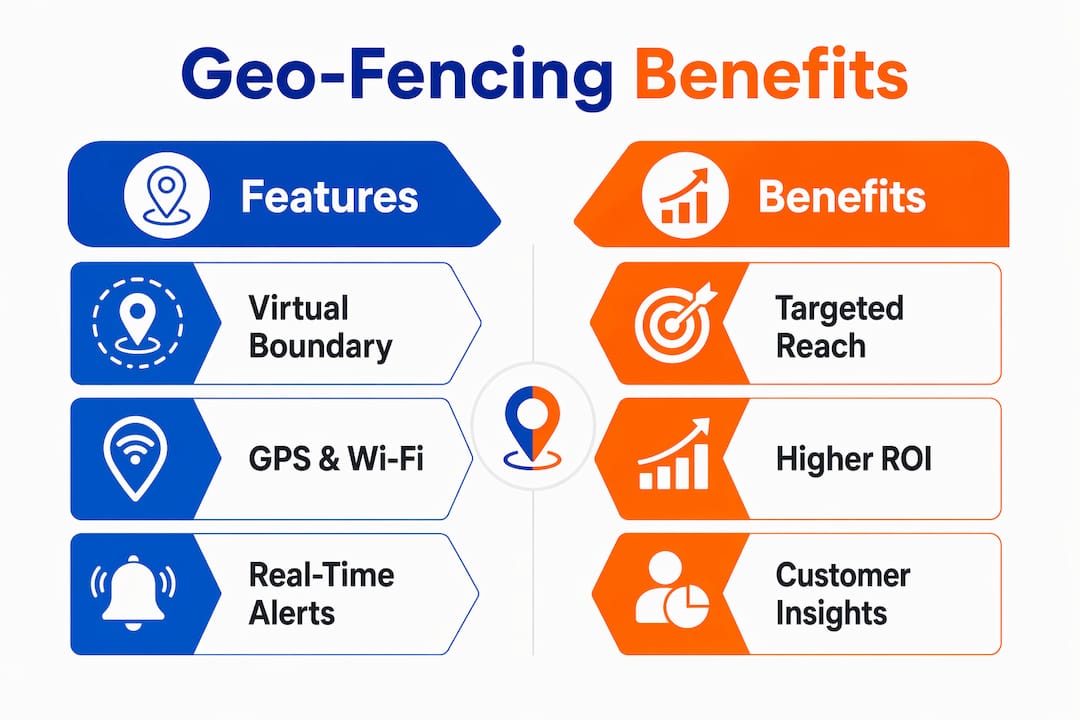
What are the key benefits of geo-fencing advertising?
Geo-fencing advertising delivers a level of targeting precision that city-level or regional campaigns simply cannot match. Traditional digital advertising targets users based on demographics or browsing history. Location-based marketing adds physical proximity to that mix, which changes the entire dynamic of the message.
The core benefits break down clearly:
- Hyper-local reach. You target people within a specific block, building, or venue rather than an entire zip code or city.
- Context-aware relevance. Geo-fencing enables context-aware advertising that feels personal and timely, shortening consumer paths to purchase for local businesses.
- Focused ad spend. Budget goes toward people who are physically capable of walking into your store right now, not users across town.
- Foot traffic measurement. Geo-fencing campaigns can measurably increase foot traffic by connecting digital ad impressions directly to physical store visits, giving you proof that online ads drive offline results.
- Omnichannel reinforcement. Geo-fencing works best when integrated with offline media like billboards or local print, reinforcing messaging and increasing consumer awareness when people are physically nearby.
The omnichannel angle is underused by most small businesses. A customer who sees your billboard on the highway and then receives a mobile offer when they enter your parking lot is far more likely to convert than one who only saw the digital ad. The two channels amplify each other.
Geo-targeting for businesses at the city or regional level still has its place for brand awareness campaigns. But when the goal is driving foot traffic or capturing a customer in a buying moment, geolocation marketing strategies that use precise virtual boundaries outperform broader approaches every time.
How to design effective geo-fencing campaigns and measure success
A well-designed geo-fencing campaign follows a clear sequence. Skipping steps in this process is the most common reason campaigns underperform.
- Define your goal first. Foot traffic, coupon redemption, app downloads, and event attendance each require different geofence placements and trigger actions.
- Set the right geofence radius. The optimal geofence size for retail or local foot traffic is a 4–5 minute travel radius. This keeps offers actionable and prevents wasted impressions on users too far away to respond.
- Apply dwell time filters. Require devices to remain inside the zone for at least 2 minutes before triggering an ad. This eliminates passersby and focuses spend on genuinely present prospects.
- Set frequency caps. Campaigns should limit ads to 1–2 per user per day to avoid alert fatigue and protect your brand’s reputation.
- Ensure privacy compliance. Anonymize location data and align your campaign with applicable privacy regulations. Users who feel tracked without consent do not convert. They complain.
- Choose your trigger action. Match the action to the context. A push notification works for app users. A display ad works for everyone else. SMS requires explicit opt-in.
KPIs that actually measure geo-fencing success
Tracking the right metrics separates campaigns that improve from campaigns that just run. Effective geo-fencing campaigns should track KPIs including impressions, reach, visit attribution, and conversion rates. Click-through rate alone tells you very little about whether your geo-fencing effort drove real-world behavior.
| KPI | What it measures |
|---|---|
| Impressions | Total number of times the ad was served inside the geofence |
| Reach | Unique devices that received the triggered message |
| Visit attribution | Store visits confirmed among users who saw the ad |
| Conversion rate | Purchases or redemptions tied to the campaign |
Visit attribution is the most powerful metric for local businesses. It directly links a digital impression to a physical store visit, which is the clearest proof of ROI you can get from campaign performance tracking.
Pro Tip: Run an A/B test with two geofence sizes around the same location. The version with higher visit attribution at lower cost per visit is your baseline for future campaigns.
Geo-fencing vs. geo-targeting: what’s the difference?
Geo-targeting and geo-fencing are related but not the same. Confusing them leads to mismatched strategies and wasted budget.
Geo-targeting covers broader areas like cities or regions and often layers in demographic or behavioral data. You use it to reach people who live in or frequently visit a certain area. Geo-fencing triggers actions precisely when a device crosses a specific virtual boundary. The distinction is immediacy and precision.
Think of it this way. Geo-targeting says, “Show this ad to people in Chicago who like coffee.” Geo-fencing says, “Show this ad to anyone who just walked within 200 meters of my coffee shop.” The first is a profile. The second is a moment.
| Factor | Geo-targeting | Geo-fencing |
|---|---|---|
| Geographic scope | City, region, or radius | Specific boundary or zone |
| Trigger mechanism | Profile or location history | Real-time device entry or exit |
| Best use case | Brand awareness, broad reach | Foot traffic, real-time offers |
| Data used | Demographics, behavior, location history | Live GPS, Wi-Fi, cellular signal |
| Response window | Hours to days | Seconds to minutes |
For attracting local customers, the two methods work best together. Use geo-targeting to build awareness among people in your area. Use geo-fencing to capture them at the moment they are close enough to act. Neither method replaces the other.
Key Takeaways
Geo-fencing marketing delivers its strongest results when precise boundaries, dwell time filters, frequency caps, and visit attribution tracking work together as a system.
| Point | Details |
|---|---|
| Define geofences precisely | Use a 4–5 minute travel radius for retail to keep offers relevant and actionable. |
| Filter with dwell time | Require at least 2 minutes inside the zone before triggering ads to eliminate passersby. |
| Cap ad frequency | Limit to 1–2 ads per user per day to prevent alert fatigue and protect brand trust. |
| Track visit attribution | Measure store visits linked to ad exposure, not just clicks, to prove real-world ROI. |
| Combine with geo-targeting | Use geo-targeting for awareness and geo-fencing for real-time conversion at the moment of proximity. |
What I’ve learned from watching geo-fencing campaigns succeed and fail
The most common mistake I see from small business owners running their first geo-fencing campaign is setting the geofence too small. They assume tighter means better. It does not. GPS signals drift. Devices delay location updates. A geofence smaller than 100–200 meters will miss a meaningful share of the people who are actually standing in front of your door. Start wider, collect data, then tighten.
The second mistake is treating geo-fencing as a standalone channel. The businesses that get the best results layer it on top of something the customer has already seen. A radio ad, a yard sign, a social post. When the mobile notification arrives and it echoes something the customer already encountered, the conversion rate climbs noticeably. Geo-fencing alone is a nudge. Geo-fencing combined with another touchpoint is a close.
Privacy is not optional, and it is not just a legal issue. Users who feel their location is being used without clear consent will not just ignore your ad. They will form a negative opinion of your brand. Frequency caps and transparent opt-in practices are not bureaucratic overhead. They are the difference between a campaign that builds trust and one that erodes it.
My honest recommendation: run your first geo-fencing campaign around an event or a competitor’s location rather than your own store. You will learn more about how your audience moves and responds than any survey could tell you. Then bring those insights back to your own location strategy.
— TONY
How Ibrand helps local businesses run location-based campaigns
Local advertising works best when every channel reinforces the others, and geo-fencing is one piece of a larger system.

Ibrand works with small and medium-sized businesses to build local marketing strategies that connect digital campaigns to real-world results. From setting up location-based ad triggers to tracking visit attribution and conversion data, Ibrand’s team handles the technical and strategic sides of the work. If you are ready to move beyond broad digital ads and start reaching customers at the moment they are closest to your door, Ibrand’s local customer targeting guides are a practical place to start.
FAQ
What is geo-fencing marketing in simple terms?
Geo-fencing marketing is the practice of drawing a virtual boundary around a real location and sending targeted ads or notifications to mobile devices that enter that zone. It uses GPS, Wi-Fi, and cellular data to detect when a device crosses the boundary.
How does geo-fencing differ from geo-targeting?
Geo-targeting reaches users based on their general location, such as a city or region, while geo-fencing triggers a specific action the moment a device crosses a defined virtual boundary. Geo-fencing is more immediate and precise.
What is the best geofence size for a small retail business?
A 4–5 minute travel radius is the recommended starting point for retail geo-fencing. This keeps offers relevant to users who can realistically act on them without wasting impressions on people too far away.
How do I measure whether my geo-fencing campaign worked?
Track visit attribution, which links confirmed store visits to users who saw your ad, alongside impressions, reach, and conversion rates. Click-through rate alone does not capture the real-world impact of a location-based campaign.
Is geo-fencing marketing legal and privacy-compliant?
Geo-fencing is legal when campaigns anonymize location data and comply with applicable privacy regulations. Limiting ad frequency to 1–2 per user per day and using clear opt-in practices protects both users and your brand.
Recent Comments