
TL;DR:
- Paid traffic offers small businesses immediate, targeted visitors through platforms like Google Ads and social media. It provides fast results, real-time data, and precise audience control, complementing organic search growth. Proper testing, landing page optimization, and continuous analysis maximize ROI and sustain long-term growth.
Paid traffic is the purchase of targeted online visitors through advertising platforms, and it is the fastest way for a small business to generate measurable growth. Understanding why invest in paid traffic matters starts with one fact: organic search drives 53% of all website traffic, yet it takes months to build. Paid advertising fills that gap immediately, giving you precise control over who sees your offer, when they see it, and how much you spend. Platforms like Google Ads and paid social channels let you reach buyers at the exact moment they are ready to act.
Why invest in paid traffic instead of waiting for organic growth?
Paid traffic, known in industry terms as paid search or pay-per-click (PPC) advertising, puts your business in front of buyers without waiting for search engines to rank your pages. Paid traffic can start sending visitors within 30 minutes, giving you a speed-to-market advantage that organic SEO simply cannot match. That speed matters most when you are launching a product, running a promotion, or entering a new market.
Organic traffic builds authority over time through content, backlinks, and SEO. Paid traffic, by contrast, gives you real-time control. You can scale a campaign up on a Monday and pause it by Wednesday if the numbers are off. That level of control is a core reason small business owners choose paid advertising as their first growth channel.
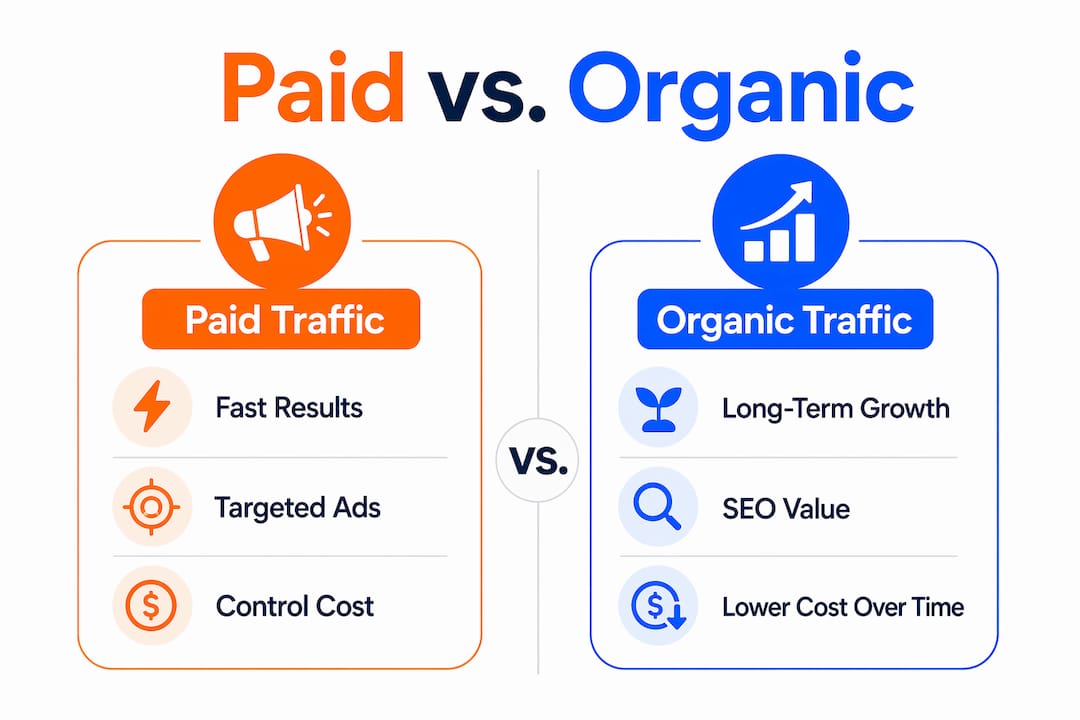
The two approaches are not rivals. Paid and organic traffic work best as partners, with paid accelerating growth and validating concepts while organic builds long-term authority and reduces acquisition costs over time. The businesses that grow fastest use both.
Paid vs. organic traffic at a glance
| Factor | Paid traffic | Organic traffic |
|---|---|---|
| Speed to results | Hours to days | Weeks to months |
| Cost structure | Pay per click or impression | Time and content investment |
| Targeting precision | Highly specific by audience, location, and intent | Broad, keyword-driven |
| Longevity | Stops when budget stops | Compounds over time |
| Data feedback | Immediate conversion and audience data | Slower, less granular |
What are the main benefits of paid traffic for small businesses?
The benefits of paid traffic go well beyond getting more website visitors. Paid advertising gives small business owners a direct line to their best potential customers, with data to prove what works.
- Rapid brand discovery. 32% of Gen Z and 31% of millennials discover brands through paid social ads. If your audience skews younger, paid social is not optional. It is where they find new businesses.
- Precise audience targeting. You can target by age, location, income, interests, search intent, and past website behavior. No other channel gives you that level of control over who sees your message.
- Instant measurability. Every click, conversion, and dollar spent is tracked in real time. You know exactly what your ad spend produces, which makes budget decisions straightforward.
- Retargeting. Paid platforms let you show ads specifically to people who already visited your site. These warm audiences convert at far higher rates than cold traffic.
- Market research at low cost. Running a small paid campaign tells you which headlines, offers, and audiences respond best. That data is worth more than any survey.
- Campaign flexibility. You can drive website traffic affordably for a product launch, a seasonal sale, or a new service without committing to a long-term contract.
Pro Tip: Test your ad creative on organic social channels first. Post variations on Instagram or TikTok and watch which ones get the most engagement. Then put paid budget behind the winner. This approach, recommended by Shopify, reduces wasted ad spend before you scale.
The importance of paid traffic also shows up in cash flow. Unlike SEO, which requires months of content production before results appear, a paid campaign can generate revenue in the same week it launches. For a small business with limited runway, that speed is a real financial advantage.

How to measure and maximize ROI when investing in paid traffic
ROI for paid campaigns is calculated as net profit divided by total ad cost, multiplied by 100. A clear example: a $500 investment yielding $1,800 in conversions produces a 260% ROI. Even campaigns that break even still deliver brand awareness and customer data that inform future decisions.
Tracking real ROI means focusing on conversions, not impressions. Impressions tell you how many people saw your ad. Conversions tell you how many people bought something, signed up, or called. The second number is the only one that matters for tracking marketing ROI as a business owner.
Here are the key steps to maximize your paid traffic return:
- Set a conversion goal before you spend. Define what a successful visit looks like: a purchase, a form fill, a phone call. Without a goal, you cannot measure success.
- Optimize your landing page first. Poor conversion almost always reflects a landing page or offer problem, not a traffic problem. Fix the page before scaling the budget.
- Use negative keywords. In Google Ads, negative keywords block irrelevant searches from triggering your ads. This cuts wasted spend immediately.
- Test one variable at a time. Change the headline, the image, or the call to action, but not all three at once. Clean tests produce clear answers.
- Review data weekly. Paid campaigns drift. Audiences change, competitors adjust bids, and ad fatigue sets in. Weekly reviews catch problems before they become expensive.
- Align paid goals with your full marketing strategy. A paid campaign that drives traffic to a weak offer or a slow website will underperform regardless of targeting quality.
Pro Tip: Use paid traffic as a diagnostic tool. Run a small campaign for 72 hours and analyze which audience segments, messages, and landing page versions perform best. Paid campaigns deliver conversion data in days that organic search takes months to produce. Feed those findings back into your SEO and content strategy.
For small business owners new to paid advertising, reviewing effective online advertising tips before launching a first campaign saves both time and money.
What strategies integrate paid traffic with organic marketing for sustained growth?
The strongest paid traffic strategies do not operate in isolation. They feed directly into your organic marketing efforts, creating a cycle where each channel makes the other more effective.
Paid campaigns validate your messaging fast. When you run ads with three different headlines and one outperforms the others by a wide margin, you now know which message resonates with your audience. That winning message belongs in your SEO title tags, your email subject lines, and your homepage copy. Paid traffic acts as a learning engine, delivering audience and intent data that would take months to gather through organic channels alone.
Organic SEO, on the other hand, builds compounding value. A blog post that ranks on page one of Google keeps sending free traffic for years. Paid traffic does not compound. It stops the moment your budget does. The practical answer is to use paid traffic to generate revenue and data now, while simultaneously building organic assets that reduce your cost per acquisition over time.
Balancing budget between the two channels depends on your stage of growth. A new business with no organic presence should weight heavily toward paid traffic early on. An established business with strong organic rankings can reduce paid spend on branded terms and redirect that budget toward new audience acquisition. The organic vs. paid traffic comparison shifts as your business matures, and your budget allocation should shift with it.
What common mistakes to avoid when investing in paid traffic?
Most paid traffic failures come from predictable, avoidable errors. Knowing them before you spend saves real money.
- Treating ads as set-and-forget. Paid campaigns require ongoing testing and adjustment. An ad that performs well in week one often decays by week four as audiences see it repeatedly.
- Scaling before validating. Increasing budget on a campaign that has not yet proven it converts is the fastest way to burn money. Validate the conversion loop first, then scale.
- Buying low-quality traffic. Some platforms and networks sell cheap traffic that is largely bots or unengaged users. These visits produce zero conversions and skew your analytics. Stick to established platforms with transparent audience data.
- Ignoring audience fit. Showing a B2B software ad to a general consumer audience wastes every impression. Precise targeting is the core advantage of paid advertising. Use it.
- Skipping landing page optimization. Sending paid traffic to your homepage instead of a dedicated, conversion-focused landing page is one of the most common and costly mistakes small business owners make.
- Measuring the wrong metrics. Click-through rate and impressions are not business results. Track cost per acquisition and revenue generated per campaign.
Key Takeaways
Paid traffic is a measurable, controllable growth channel that delivers results in hours, not months, and its full value comes from combining speed with ongoing optimization.
| Point | Details |
|---|---|
| Speed advantage | Paid traffic can send targeted visitors within 30 minutes, far faster than organic SEO. |
| ROI is trackable | A $500 campaign yielding $1,800 in sales produces a 260% ROI you can measure in real time. |
| Landing pages matter | Poor conversion almost always reflects a landing page or offer problem, not a traffic problem. |
| Paid feeds organic | Paid campaign data reveals winning messages and audiences that strengthen your SEO and content strategy. |
| Test before scaling | Validate creative on organic channels first, then put paid budget behind proven performers. |
Paid traffic is not a gamble. Here is what I have learned.
The business owners I see struggle with paid advertising share one mindset: they treat it like a slot machine. They put money in, hope for a return, and quit when the first campaign underperforms. That is the wrong frame entirely.
Paid traffic is a predictable business system when you approach it with discipline. The goal is to turn $1 into $2. That requires knowing your numbers: your average order value, your conversion rate, and your acceptable cost per acquisition. Without those numbers, you are guessing. With them, you are running a system.
The most valuable thing paid traffic gave me was not sales. It was data. Within 72 hours of a campaign, I knew which audience responded, which headline worked, and which landing page converted. That information reshaped how I wrote content, structured offers, and positioned products for months afterward.
My honest advice: start small, measure everything, and treat every campaign as a test. The businesses that win with paid advertising are not the ones with the biggest budgets. They are the ones who learn the fastest.
— TONY
How Ibrand helps small businesses get more from paid and organic traffic
Small business owners who want results from paid advertising need more than a live campaign. They need a website that converts the traffic they pay for.
Ibrand works with small and medium businesses to build the full picture: paid advertising strategy, SEO, and website optimization for search that turns visitors into customers. A well-run paid campaign sent to a poorly built website wastes every dollar. Ibrand addresses both sides of that equation. If you are ready to make paid traffic work as a real growth channel, Ibrand’s team can build a plan that fits your budget and your goals. Reach out at ibrand.media to get started.
FAQ
What is paid traffic in digital marketing?
Paid traffic refers to website visitors acquired through paid advertising, such as PPC ads on Google Ads or paid social campaigns on platforms like Meta. Unlike organic traffic, paid traffic delivers visitors immediately and allows precise audience targeting.
Is paid traffic worth it for small businesses?
Paid traffic is worth it when campaigns are properly targeted and sent to optimized landing pages. A well-structured campaign can produce measurable ROI within days, making it one of the fastest growth tools available to small business owners.
How does paid traffic compare to organic traffic?
Organic traffic compounds over time and costs less per visit once established, but takes months to build. Paid traffic delivers immediate, targeted visitors and real-time data, making the two channels most effective when used together.
What is a good ROI for a paid traffic campaign?
A $500 investment that generates $1,800 in conversions equals a 260% ROI, which is a strong benchmark. Even campaigns that break even provide brand awareness and audience data that improve future campaign performance.
What is the biggest mistake businesses make with paid traffic?
The most common mistake is scaling ad spend before validating that the landing page and offer actually convert. Fix the conversion loop first, then increase budget on what is already working.
Recommended
- Why invest in online advertising in 2026: A small business guide | Ibrandmedia
- What is pay-per-click? A clear guide for small businesses – Ibrandmedia
- Understanding Online Advertising: A 2025 Guide for Small Business | Ibrandmedia
- Effective Online Advertising Tips for Small Businesses 2025 | Ibrandmedia
Recent Comments