
TL;DR:
- Understanding contractor SEO terminology is essential for improving online visibility and generating leads. Local SEO targeting geographical searches is the fastest way to attract nearby clients, with the Google local 3-pack being the most prominent result. Mastering terms like NAP, citations, backlinks, and service-area settings helps contractors optimize their marketing efforts effectively.
Contractor SEO terminology is the specialized language that describes how search engines find, rank, and display contracting businesses online. Understanding these SEO terms for contractors is not optional if you want to generate leads from Google. A roofer in Dallas who knows what a Google Business Profile citation is will outrank one who does not, because that knowledge drives real decisions. This guide covers contractor SEO explained in plain English, from local SEO and organic SEO to keywords, backlinks, and service-area business concepts, so you can act on every term you learn.
What is local SEO and why is it critical for contractors?
Local SEO is the practice of making your business appear in location-based search results, specifically when someone searches “roof repair near me” or “HVAC contractor in Phoenix.” For contractors, it is the single highest-return SEO strategy because it targets buyers who are ready to hire, not just browse.

The most visible local SEO result is the Google local 3-pack, the map block showing three businesses at the top of mobile search results. Most “near me” searches on mobile display this local 3-pack prominently, above all organic blue links. If your business is not in that map block, you are invisible to the majority of mobile searchers.
Three factors determine your local 3-pack ranking:
- Google Business Profile (GBP): Your free listing on Google. Completeness, correct categories, real photos, and active review responses all affect rank.
- Proximity: How close your business location or service area is to the person searching.
- Reviews: The quantity, recency, and rating of your Google reviews send strong trust signals to Google.
Citations are also a local SEO factor. A citation is any online mention of your business name, address, and phone number, known as NAP. Consistent NAP data across directories like Yelp, Angi, and the Better Business Bureau reinforces your legitimacy to Google.
Local SEO differs from organic SEO in one key way. Local SEO targets map results tied to geography. Organic SEO targets the blue-link results below the map. Both matter, but local SEO delivers faster results for most contractors.
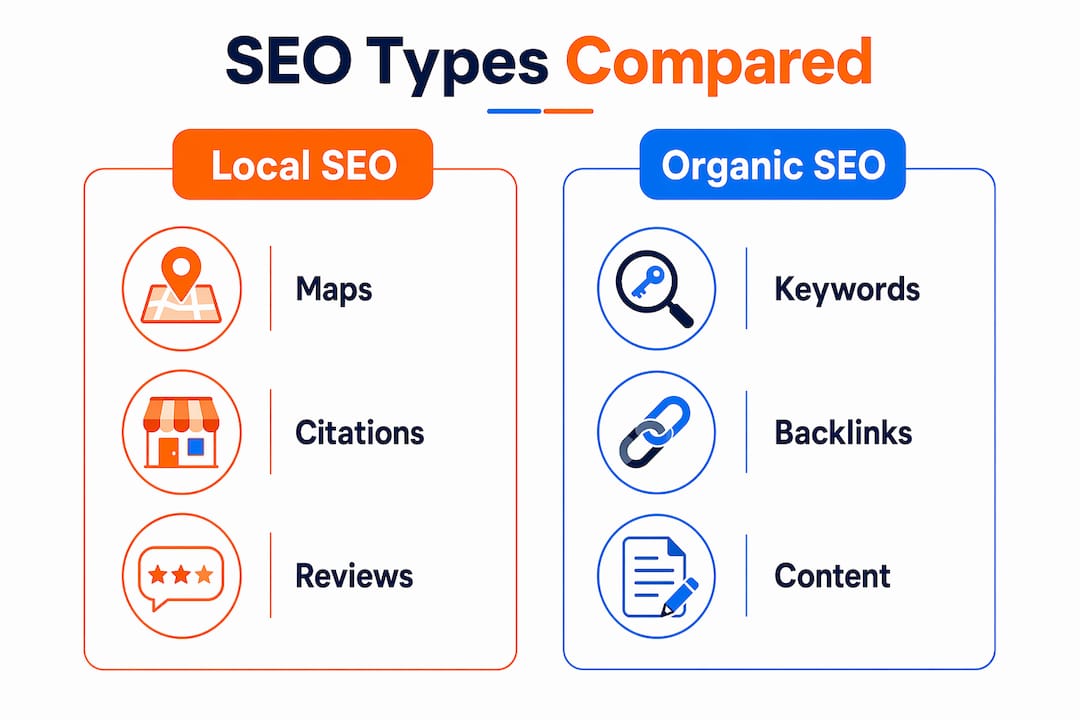
Pro Tip: Complete every field in your Google Business Profile, including services, business hours, and a keyword-rich description. Incomplete profiles rank lower, even when proximity is strong.
How does organic SEO support contractor websites?
Organic SEO is the process of ranking in blue-link results through website content, backlinks, and technical improvements. These results appear below the local 3-pack and answer informational searches like “how much does a new roof cost” or “what is a load-bearing wall.”
Organic SEO works through several interconnected elements:
- Service pages: Dedicated pages for each service you offer, such as “kitchen remodeling in Austin” or “commercial electrical installation.” Each page targets a specific keyword and service area.
- Content optimization: Writing page text that includes the words your customers actually search, placed in headings, body copy, and image descriptions.
- Meta tags: The meta title and meta description are HTML elements that tell Google and searchers what a page is about. A strong meta title for a plumber might read: “Emergency Plumber in Denver | Same-Day Service.”
- Backlinks: Links from other websites pointing to yours. A backlink from a local chamber of commerce or a home improvement publication signals authority to Google.
- Technical SEO: The behind-the-scenes factors that affect how Google reads your site, including page speed, mobile responsiveness, and a clean sitemap.
Organic SEO is a longer-term effort than local SEO. Results typically build over months, not weeks. The payoff is durable visibility for informational and long-tail queries that local SEO does not capture. A contractor who ranks organically for “how to choose a roofing contractor” earns trust before a prospect even picks up the phone.
Organic and local SEO work best together. Local SEO fills your pipeline with ready-to-hire leads. Organic SEO builds authority and captures prospects earlier in their decision process.
Common SEO terminology every contractor should know
Contractor SEO terminology covers a specific set of terms that appear in every marketing conversation. Knowing these definitions lets you evaluate proposals, ask better questions, and make smarter decisions.
| SEO Term | Plain-English Definition | Contractor Example |
|---|---|---|
| Keyword | A word or phrase people type into Google | “bathroom remodel cost Denver” |
| SERP | Search Engine Results Page, the full page Google shows | The page after you search “electrician near me” |
| Meta title | The clickable blue headline in search results | "Licensed Plumber in Chicago |
| Meta description | The short summary under the meta title | “We fix leaks, clogs, and broken pipes. Call today.” |
| Backlink | A link from another site to yours | A local news article linking to your roofing company |
| Citation | Any online mention of your NAP data | Your business listed on Yelp or HomeAdvisor |
| NAP | Name, Address, Phone number | Must match exactly across all directories |
| Sitemap | A file listing all pages on your site for Google to read | Submitted through Google Search Console |
| Indexing | Google adding your page to its searchable database | A new service page becomes findable after indexing |
| SAB | Service-Area Business, a contractor who travels to clients | A plumber who serves a metro area but has no storefront |
Keywords deserve extra attention. Keyword research means finding the exact phrases your ideal customers type into Google. A roofing contractor in Atlanta should target “roof replacement Atlanta” rather than just “roofing,” because the specific phrase signals buyer intent. Searchers use mixed keywords like “contractor,” “pro,” and “installer” interchangeably, so your pages should reflect that natural variation.
Service-area businesses (SABs) are treated differently by Google than storefront businesses. An SAB sets a service area in Google Business Profile instead of displaying a physical address. Focusing on a manageable metro area produces stronger ranking signals than spreading coverage across dozens of counties. A plumber who claims all of Texas will rank worse in Houston than one who targets Houston specifically.
Pro Tip: Use Google Search Console to check which pages Google has indexed. If a key service page is not indexed, Google cannot rank it, no matter how well it is written.
How does contractor SEO terminology guide real marketing actions?
Understanding SEO terms only matters if it changes what you do. Here is how the terminology translates directly into tasks that generate leads.
-
Optimize your Google Business Profile. Set the correct primary category (for example, “Roofing Contractor” not just “Contractor”). Add real photos of completed jobs. List every service you offer. GBP optimization moves your local ranking faster than almost any other single action.
-
Build service pages with specific keywords. Each major service and city combination deserves its own page. A general contractor in Nashville should have separate pages for “kitchen remodeling Nashville,” “bathroom remodeling Nashville,” and “home additions Nashville.” Service pages need specific details: job types, service areas, licensing information, and contact options.
-
Generate and manage reviews. Ask every satisfied client to leave a Google review. Respond to every review, positive or negative. Review volume and recency are direct local ranking factors, not just social proof.
-
Manage your citations. Audit your NAP data across directories. Inconsistent phone numbers or old addresses confuse Google and suppress your local ranking. Tools like Google Search Console reveal indexing issues, while manual audits catch NAP errors.
-
Track results by source. Call and form tracking tied to SEO source data shows you which pages and keywords generate actual booked jobs, not just website visits. This data tells you where to invest more effort. Ibrand builds performance tracking into every campaign so contractors see exactly which SEO actions produce revenue.
-
Balance local and organic efforts. Start with GBP and local citations. Once your local presence is solid, invest in service pages and blog content to capture organic traffic. The two strategies reinforce each other over time.
Local SEO strategies for small businesses follow the same core logic for contractors: claim your geography, prove your authority, and make it easy for Google to connect you with nearby buyers.
Key takeaways
Contractors who understand SEO terminology make better marketing decisions, spend less on guesswork, and rank higher in the searches that produce real jobs.
| Point | Details |
|---|---|
| Local SEO drives the fastest ROI | Google Business Profile, reviews, and citations produce leads faster than organic content for most contractors. |
| Organic SEO builds long-term authority | Service pages and backlinks capture informational searches and compound in value over months. |
| NAP consistency is non-negotiable | Mismatched name, address, or phone data across directories suppresses local rankings directly. |
| SAB settings affect local rank | Contractors should define a focused service area in GBP rather than claiming an entire state. |
| Tracking ties terms to revenue | Call and form tracking by source shows which SEO actions produce booked jobs, not just traffic. |
Why most contractors get SEO backwards
I have worked with contractors who spent thousands on blog content before their Google Business Profile was even fully set up. That is the most common and most expensive mistake I see. The terminology confusion is real: contractors hear “SEO” and picture website articles, when the fastest path to leads is almost always the local 3-pack.
The distinction between local SEO and organic SEO is not just academic. It determines where your budget goes first. A plumber with a half-finished GBP and no reviews will not outrank a competitor who has 80 five-star reviews and correct service-area settings, regardless of how good their website content is. I always tell contractors: fix your Google Business Profile before you write a single blog post.
The other pitfall I see constantly is ignoring the SAB concept. Contractors who set their service area to an entire state dilute their ranking signal across too large a geography. Narrowing to a metro area or a cluster of specific cities produces measurably better results. This is one of those cases where doing less, but doing it precisely, wins.
Mastering contractor SEO terms is not about becoming a technical expert. It is about knowing enough to hold your marketing partners accountable and to recognize when a tactic actually fits your business goals. The contractors I see succeed with SEO are not the ones who know the most jargon. They are the ones who understand what each term means for their pipeline and act accordingly.
— TONY
Ibrand’s SEO services built for contractors
Contractors who want to rank locally and book more jobs need more than a glossary. They need a plan that connects every SEO term to a real marketing action.

Ibrand works with contractors and construction professionals to build SEO strategies that produce leads, not just rankings. From Google Business Profile setup to service-page creation and citation management, every tactic is tied to measurable outcomes. The SEO for small businesses guide on Ibrand’s site walks through the same principles covered here, with step-by-step guidance for local markets. If you are ready to put contractor SEO terminology to work, Ibrand’s team is ready to build the plan with you.
FAQ
What is contractor SEO terminology?
Contractor SEO terminology is the set of specialized terms, such as local SEO, Google Business Profile, backlinks, NAP, and SERP, that describe how search engines rank contracting businesses online.
What is the Google local 3-pack?
The local 3-pack is the map block showing three local businesses at the top of Google search results. It is driven by GBP completeness, proximity, and reviews.
What does NAP mean in contractor SEO?
NAP stands for Name, Address, and Phone number. Consistent NAP data across all online directories is a direct local ranking factor for contractors.
What is a service-area business in SEO?
A service-area business (SAB) is a contractor who travels to clients rather than serving them at a fixed location. SABs set a service area in Google Business Profile instead of displaying a physical address, which affects how Google calculates local ranking.
How do backlinks help contractor websites?
Backlinks are links from other websites to yours. They signal authority to Google and improve organic rankings, especially when they come from local directories, industry publications, or community organizations.
Recent Comments