
TL;DR:
- Online reviews are the most influential factor in attracting homeowners and ranking high on Google.
- Building a strong review profile increases local search visibility, resulting in more leads and better close rates.
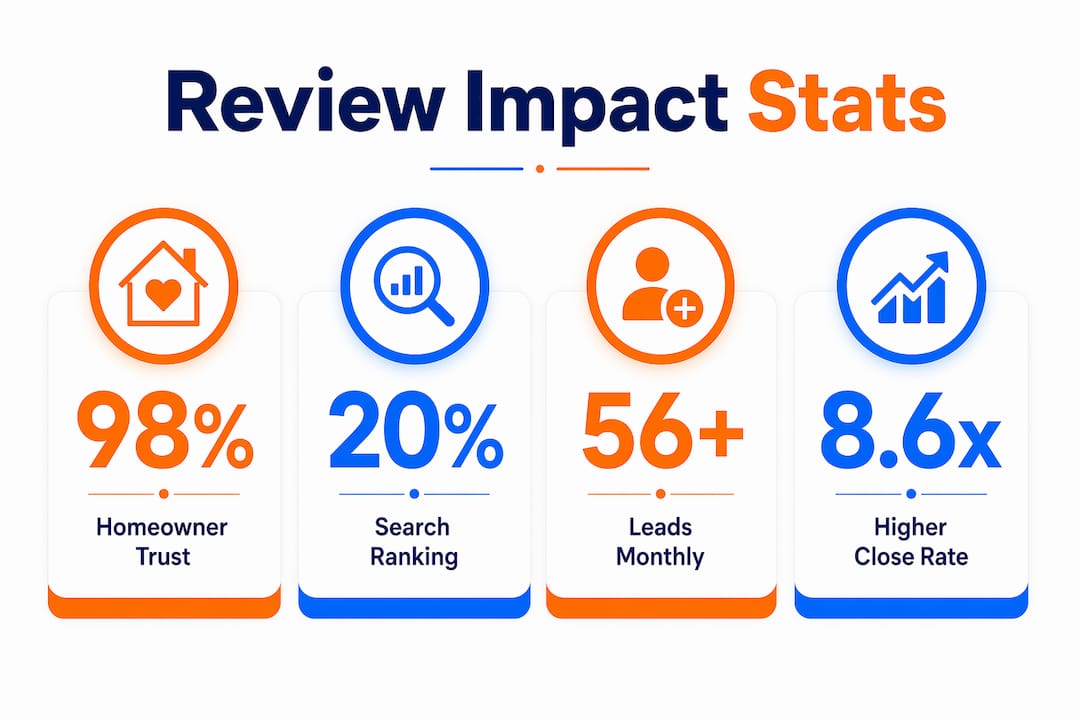
Digital reviews are the single most influential factor in whether a homeowner hires you or your competitor. 98% of homeowners read online reviews before hiring a contractor, making your Google profile more persuasive than any flyer, yard sign, or paid ad. Understanding how digital reviews impact contractor business is no longer optional. It is the difference between a full schedule and an empty pipeline. Platforms like Google Business Profile, Yelp, and Houzz now function as your first sales conversation, and most of that conversation happens before you ever pick up the phone.
How do online reviews improve local search visibility for contractors?
Review signals account for approximately 20% of local pack ranking weight, making them one of the most controllable factors in your Google search position. That is a significant share of the algorithm, and unlike backlinks or domain authority, you can influence it directly through consistent review collection. Contractors who build strong review velocity rank higher in Google’s Local Pack, the three-result map block that captures the majority of local search clicks.

The volume gap matters more than most contractors realize. Businesses with strong review profiles capture three times more search citations than those with fewer than 50 reviews. More citations mean more calls, more quote requests, and more jobs booked without spending a dollar on ads.
Recency is just as important as volume. 74% of consumers only consider reviews from the last 90 days. A contractor with 200 reviews from two years ago looks less trustworthy than one with 40 reviews from the past three months. Google’s algorithm reflects this same preference. Fresh reviews signal an active, reliable business.
| Review count | Estimated monthly leads | Ranking visibility |
|---|---|---|
| Fewer than 50 reviews | Low | Rarely appears in Local Pack |
| 50–299 reviews | Moderate | Occasional Local Pack placement |
| 300+ reviews | High (56+ leads/month) | Consistent top-3 placement |
Pro Tip: Set a weekly reminder to check your Google Business Profile for new reviews. Responding within 24 hours signals activity to both Google and potential customers.
How do positive reviews and responses build customer trust?
Trust is the core currency in contracting. Homeowners are handing you access to their property and often spending thousands of dollars. Reviews reduce that perceived risk faster than any sales pitch. The importance of digital feedback for contractors goes beyond star ratings. It is about the full conversation your profile presents to a stranger.
The response gap is where most contractors lose business they never knew they had. 88% of consumers would hire a contractor who responds to all reviews, compared to just 47% for those who do not. That nearly doubles your hiring likelihood with a behavior that costs nothing but a few minutes per week.
Negative reviews are not fatal. They are actually an opportunity. 56% of consumers say a thoughtful response to a negative review improves their perception of the business. Ignoring a negative review, on the other hand, can cost you up to 30 potential customers per incident. That is not a hypothetical. That is lost revenue from a single unanswered complaint.
“Displaying reviews on websites for high-priced services can increase purchase likelihood by 380%, meaning reviews are not just a trust signal. They are a direct conversion tool.”
Key behaviors that build trust through reviews:
- Respond to every review, positive or negative, within 48 hours
- Acknowledge specifics in your response, not just “thanks for the feedback”
- Address complaints professionally without being defensive or dismissive
- Feature reviews on your website, especially for high-ticket services like roofing, HVAC, or remodeling
- Ask satisfied customers to mention the specific job type so future prospects see relevant social proof
What is the measurable ROI of a structured review strategy?
The business case for reviews is not abstract. Contractors with 300 or more reviews generate over 56 leads per month, representing a 1,046% increase in leads compared to contractors with fewer than 100 reviews. That is not a marginal improvement. It is a fundamentally different business.
The cost advantage is equally compelling. SEO leads driven by reviews cost between $25 and $45 each. Paid leads from platforms like Angi or HomeAdvisor often run $150 to $300 per lead, and those leads are shared with multiple contractors. The math strongly favors organic reputation building.
Close rates tell the same story. Contractors who respond to reviews achieve an 8.6x higher close rate on SEO leads compared to shared platform leads, specifically 14.6% versus 1.7%. Organic leads arrive with intent and trust already established. Shared platform leads arrive skeptical and price-shopping.
| Lead source | Cost per lead | Close rate | Quality |
|---|---|---|---|
| Review-driven SEO | $25–$45 | 14.6% | High intent, exclusive |
| Shared lead platforms | $150–$300 | 1.7% | Low intent, shared |
| Paid search ads | $80–$150 | 3–5% | Medium intent, competitive |
Contractors with strong review profiles consistently outperform those with large ad budgets. Reviews compound over time. Ad spend stops the moment you pause the campaign.
Pro Tip: Track your lead source in a simple spreadsheet. After 90 days, you will likely find that review-driven organic leads close faster and require less follow-up than any paid channel.
How can contractors collect and manage reviews at scale?
A systematic approach to review collection separates contractors who grow from those who plateau. Most contractors rely on hoping satisfied customers leave a review. The top performers build a process that makes it automatic.
The most effective method is automated SMS sent within one hour of job completion. This approach converts at 35–40% because the customer’s experience is fresh and the request feels natural. Waiting 24 hours or more drops that rate significantly. The highest-performing systems combine that immediate SMS with a follow-up email for non-responders, achieving overall collection rates near 50%.
Here is a practical four-step system any contractor can implement:
- Send an automated SMS within 60 minutes of job completion. Use a tool like Podium, NiceJob, or Birdeye to trigger the message automatically. Include a direct link to your Google review page. Remove every possible barrier between the customer and the review form.
- Route negative sentiment internally before it goes public. Reputation management platforms use sentiment routing to direct unhappy customers to a private feedback form instead of Google. This gives you a chance to resolve the issue and collect operational data. It also prevents a one-star review from appearing before you know there is a problem.
- Respond to every public review within 48 hours. Use a template for positive reviews but personalize the first sentence. For negative reviews, acknowledge the issue, apologize without admitting fault, and offer to resolve it offline. This response is not just for the reviewer. It is for every future customer reading that thread.
- Turn feedback into a formal improvement loop. Formalized feedback programs allow contractors to convert client feedback into verified testimonials that strengthen RFP submissions and complex sales proposals. The data you collect internally also reveals patterns in complaints, helping you fix recurring issues before they become public problems.
For a deeper look at managing your online reputation as a contractor, the process extends well beyond review collection into how you present your brand across every digital touchpoint.
Pro Tip: Never ask for a review in a group text or email blast. Personalized, one-on-one requests convert at dramatically higher rates and feel authentic rather than transactional.
Key takeaways
Digital reviews are the highest-ROI marketing activity available to contractors, directly controlling search rankings, lead volume, close rates, and customer trust at a fraction of the cost of paid advertising.
| Point | Details |
|---|---|
| Reviews drive rankings | Review signals control about 20% of Google Local Pack placement, making collection a direct SEO tactic. |
| Response rate doubles trust | Responding to all reviews nearly doubles hiring likelihood, from 47% to 88% of consumers. |
| Volume unlocks lead growth | Contractors with 300+ reviews generate over 56 leads per month, a 1,046% increase over low-review competitors. |
| Organic leads close better | Review-driven SEO leads close at 14.6% versus 1.7% for shared platform leads, an 8.6x advantage. |
| Automate collection early | SMS requests sent within one hour of job completion convert at 35–40%, the highest rate of any method. |
Why most contractors are leaving serious money on the table
I have worked with dozens of contractors over the years, and the pattern is almost always the same. They do excellent work, their customers are genuinely happy, and they have almost no reviews to show for it. They are not losing because of bad service. They are losing because they never built the system to capture proof of good service.
Here is what I find most contractors miss: reviews are not just a marketing asset. They are a cash flow mechanism. A contractor sitting at 30 reviews and a 4.2-star rating is not just ranking lower. They are losing jobs to a competitor with 150 reviews and a 4.7-star rating who may not even do better work. The review profile is the tiebreaker, and most homeowners never get past it.
The other mistake I see constantly is treating review management as a one-time project. You cannot collect 50 reviews in January and coast. 74% of consumers only look at reviews from the last 90 days. Your reputation has an expiration date. The contractors who understand this build review collection into their close-out process the same way they build invoicing into it. It is not optional. It is operational.
The technology side has gotten much easier. Tools like Podium, Birdeye, and NiceJob handle the automation. The step-by-step reputation management process is well-documented and accessible to any contractor regardless of technical skill. The barrier is not complexity. It is prioritization. Contractors who treat their review profile as a revenue driver rather than a vanity metric consistently outperform their market.
— TONY
How Ibrand helps contractors turn reviews into real revenue

Ibrand works with contractors to build the digital foundation that turns reviews into a predictable lead source. That means combining local SEO for small businesses with reputation management, so your review profile does not just look good but actively ranks and converts. The team at Ibrand sets up automated review collection, builds response workflows, and integrates your review signals into a broader SEO strategy that compounds over time. If you are spending money on paid leads and getting a 1.7% close rate, there is a better path. Ibrand builds it for you, with transparent pricing and a personalized plan from day one.
FAQ
How much do reviews affect a contractor’s Google ranking?
Review signals account for approximately 20% of Google Local Pack ranking weight. Contractors with strong review velocity and volume rank higher and capture significantly more search traffic than competitors with fewer reviews.
How many reviews does a contractor need to see real results?
Contractors with 300 or more reviews generate over 56 leads per month, a 1,046% increase compared to those with fewer than 100. Even reaching 50 reviews meaningfully improves Local Pack visibility.
Does responding to negative reviews actually help?
Yes. Responding professionally to a negative review improves business perception for 56% of consumers who read it. Ignoring a negative review can cost up to 30 potential customers per incident.
What is the fastest way to collect more reviews?
Automated SMS requests sent within one hour of job completion convert at 35–40%. Pairing that with a follow-up email for non-responders pushes overall collection rates close to 50%.
Are review-driven leads better than paid leads?
Review-driven SEO leads close at 14.6% compared to 1.7% for shared platform leads. They also cost $25–$45 each versus $150–$300 for paid platform leads, making them both higher quality and more cost-effective.
Recent Comments