
Did you know that 70% of small businesses waste their online advertising budgets because they fail to track performance accurately? If you’re pouring money into ads without seeing real results, you’re not alone. Many small business owners struggle to translate clicks into sales, leaving them frustrated and skeptical about online advertising. This guide reveals how proper tracking, platform selection, and optimization can transform your online ads into a powerful sales engine in 2026.
Table of Contents
- Understanding The Role Of Online Advertising For Small Businesses
- Affordable Online Advertising Platforms And Channels
- Common Misconceptions And Pitfalls In Small Business Online Advertising
- A Framework For Selecting And Optimizing Online Advertising Strategies
- Case Studies And Real-World Success Stories
- Practical Next Steps For Small Businesses
- Boost Your Small Business With Expert Online Advertising Help
Key Takeaways
| Point | Details |
|---|---|
| Online ads boost customer acquisition | Targeted campaigns directly increase sales when properly tracked and optimized. |
| Google and Facebook offer affordable options | Each platform has unique strengths for reaching different customer segments cost-effectively. |
| Most small businesses fail without tracking | 70% waste budgets by neglecting performance measurement and optimization. |
| Structured frameworks maximize ROI | Clear budget allocation and platform selection strategies prevent wasted spending. |
| Mobile-local ads deliver fastest results | 60% of mobile searches lead to same-day visits when ads are locally optimized. |
Understanding the Role of Online Advertising for Small Businesses
Online advertising encompasses digital promotional tactics like search engine ads, social media campaigns, and display banners designed to reach customers where they spend time online. For small businesses, this approach offers precision targeting impossible with traditional billboards or newspaper ads. You can reach people actively searching for your services right when they need them.
Traditional advertising casts a wide net hoping to catch interested buyers. Online advertising flips this model by putting your message directly in front of people already looking for what you sell. The benefits of online advertising for small businesses include measurable results, flexible budgets, and the ability to adjust campaigns in real time based on performance data.
More than 60% of local business searches on mobile devices lead to calls or visits within one day, emphasizing the critical importance of mobile-friendly ads. If your ads aren’t optimized for mobile users, you’re missing the majority of potential customers at the exact moment they’re ready to buy.
Here’s why online advertising matters for local businesses:
- Increased visibility in local search results when customers need services
- Direct customer acquisition through targeted campaigns reaching ideal buyers
- Measurable ROI with detailed analytics showing exactly what works
- Budget flexibility allowing you to start small and scale what succeeds
- Real-time optimization to improve performance without waiting weeks for results
Understanding online advertising basics for SMBs gives you the foundation to make smart decisions about where to invest your marketing budget. The key is matching your business goals with the right platforms and tracking everything to prove what drives actual sales.
Affordable Online Advertising Platforms and Channels
Google Ads and Facebook Ads dominate the affordable advertising landscape for small businesses because they offer precise targeting at flexible price points. Google Ads captures customers actively searching for solutions, while Facebook Ads builds awareness and reaches people based on interests and behaviors. Each platform serves different stages of the customer journey.
Search ads appear when potential customers type relevant queries into Google, making them perfect for high-intent buyers ready to make decisions. Display ads show up on websites and apps people browse, building awareness even when they’re not actively shopping. Search engine ads deliver a 15% higher conversion rate on average compared to display ads for small local businesses, making them the smarter starting point for limited budgets.
Customer reviews and social proof dramatically boost ad engagement by building trust before prospects even click. When potential customers see positive testimonials in your ads or on your landing pages, they’re more likely to convert because others have validated your credibility.
| Platform | Best For | Typical Budget | Targeting Strength |
|---|---|---|---|
| Google Ads | High-intent searches | $500-$2000/month | Search keywords, location |
| Facebook Ads | Awareness, engagement | $300-$1500/month | Demographics, interests |
| Instagram Ads | Visual businesses | $300-$1500/month | Age, lifestyle, behavior |
| LinkedIn Ads | B2B services | $1000-$3000/month | Job titles, industries |
Exploring affordable online advertising platforms helps you identify where your target customers spend time online. The best online advertising channels for your business depend on whether you’re reaching consumers or other businesses, selling products or services, and targeting local or national audiences.
Pro Tip: Start with search ads to capture high-intent customers ready to buy, then expand to display and social ads once you’ve established baseline conversion rates and proven ROI on your core campaigns.
Common Misconceptions and Pitfalls in Small Business Online Advertising
Many small business owners believe that throwing more money at ads automatically generates more sales. Budget size alone doesn’t determine success. Without proper targeting, compelling ad copy, and optimized landing pages, even large budgets produce disappointing results. Smart strategy beats big spending every time.
Another dangerous myth suggests all advertising platforms perform equally well for every business type. Facebook Ads might crush it for a retail boutique while Google Ads dominates for an emergency plumber. Your platform choice must align with how your customers search for and discover businesses like yours.
The expectation of instant sales from advertising sets up many business owners for disappointment. While some campaigns generate immediate results, most require testing and optimization over weeks or months to dial in the right messaging, targeting, and offers. Patience and data-driven adjustments separate successful advertisers from those who quit too soon.
Up to 70% of small businesses fail to track their online advertising performance accurately, resulting in inefficient spending and lower sales impact. Without conversion tracking, you’re flying blind, unable to identify which ads drive revenue and which waste money.
Here are the top misconceptions that sink small business advertising campaigns:
- Believing more budget always means better results without optimization
- Assuming one platform works equally well for all business types
- Expecting immediate sales without allowing time for testing and refinement
- Neglecting mobile optimization when most local searches happen on phones
- Skipping A/B testing and running the same ads indefinitely
- Targeting too broadly instead of focusing on ideal customer profiles
Reviewing advertising tips for small businesses reveals proven strategies that avoid these common mistakes. Understanding tracking digital marketing ROI ensures you can measure what matters and make informed decisions about where to invest your advertising dollars.
Pro Tip: Set up conversion tracking before launching any campaigns so you can measure results from day one and make data-driven decisions about which ads to scale and which to cut.
A Framework for Selecting and Optimizing Online Advertising Strategies
A structured approach to online advertising prevents wasted spending and maximizes return on investment. The framework I recommend allocates resources across four critical components: 30% for strategic planning and goal setting, 40% for platform selection and ad creation, 20% for local targeting and optimization, and 10% for performance measurement and testing.
Follow these steps to build your advertising strategy:
- Define clear, measurable goals tied to revenue or customer acquisition
- Choose platforms based on where your target customers actively search and browse
- Create mobile-optimized ads with local relevance and compelling offers
- Implement conversion tracking to measure actual sales or lead generation
- Run A/B tests on ad copy, images, and targeting to improve performance
- Review data weekly and adjust budget toward best-performing campaigns
| Budget Component | Allocation | Purpose |
|---|---|---|
| Strategy & Goals | 30% | Define objectives, research competitors, plan campaigns |
| Platform & Creative | 40% | Select channels, design ads, write compelling copy |
| Local Targeting | 20% | Optimize for local search, mobile users, geographic relevance |
| Testing & Measurement | 10% | Track conversions, run experiments, analyze performance |
This framework ensures you’re not just spending on ads but investing strategically in campaigns designed to deliver measurable results. Learning to boost local online sales requires aligning your advertising with local customer behavior and search patterns.
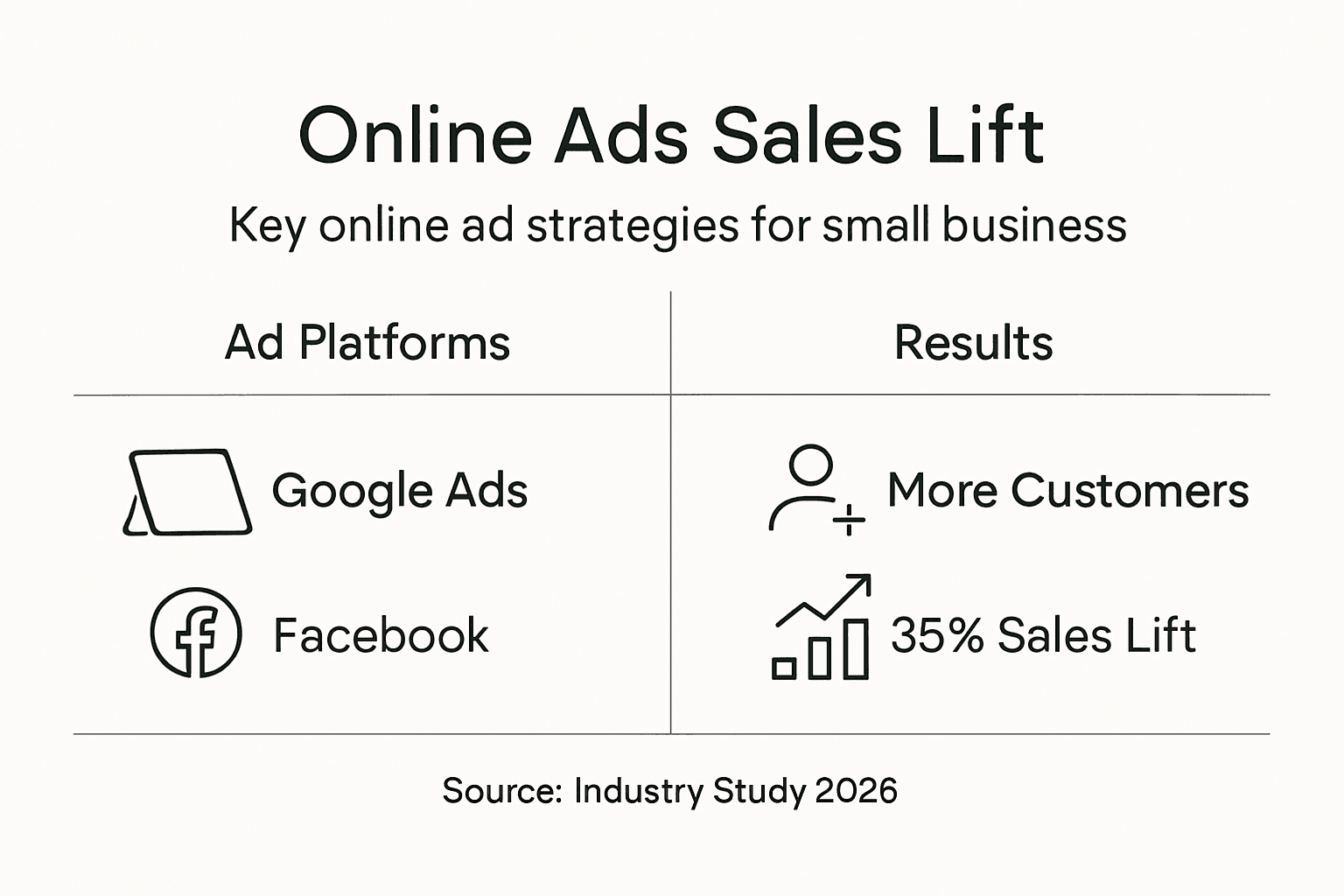
Understanding how to track marketing ROI for small businesses transforms advertising from a cost center into a profit driver. You’ll know exactly which campaigns generate positive returns and deserve more investment.
Pro Tip: Regularly review your ad performance data to identify trends and adjust your budget allocation, shifting money from underperforming campaigns to those delivering the best results for continuous improvement.
Case Studies and Real-World Success Stories
A local HVAC company in Texas combined targeted Facebook ads with Google Local Services Ads and achieved a 35% increase in service calls within three months. They focused on mobile-optimized ads highlighting same-day service availability and customer testimonials. By tracking phone calls and form submissions, they identified which ad combinations drove the most valuable leads.

Another success story involves a family-owned restaurant that integrated SEO and paid ads integration to dominate local search results. They used Google Ads to capture immediate dinner reservations while building organic rankings for long-term visibility. The combination delivered a 28% increase in weekend bookings during their first quarter.
A boutique fitness studio leveraged Instagram and Facebook ads with before-and-after client transformations as social proof. Their mobile-friendly ads included a limited-time membership offer, generating 42 new sign-ups in 30 days. They continuously tested ad images and copy, doubling down on variations that resonated with their target demographic.
Key success factors across these examples include:
- Localization of ad content to match community language and preferences
- Mobile optimization ensuring fast load times and easy contact options
- Social proof through customer reviews and testimonials building trust
- Continuous A/B testing to identify and scale winning ad variations
- Integration with SEO and other marketing channels for maximum reach
These businesses didn’t succeed by accident. They applied systematic strategies, measured results, and adjusted based on data. Effective social media management for small businesses combined with paid advertising creates a powerful multiplier effect that organic-only strategies can’t match.
Practical Next Steps for Small Businesses
Ready to launch or improve your online advertising? Start with these concrete steps:
- Set specific goals like generating 20 qualified leads per month or increasing website sales by 25%
- Pick one or two platforms based on where your customers search for businesses like yours
- Create three to five ad variations with different headlines, images, and calls to action
- Set up conversion tracking using Google Analytics, Facebook Pixel, or call tracking software
- Run campaigns for at least two weeks before making major changes to gather meaningful data
- Analyze results weekly, pausing underperforming ads and increasing budget for winners
Affordable tools that help track advertising performance include:
- Google Analytics for website traffic and conversion tracking
- Facebook Ads Manager for social media campaign performance
- Google Tag Manager for implementing tracking codes without developer help
- CallRail or similar services for tracking phone calls from ads
- Google Data Studio for creating visual performance dashboards
Ongoing optimization separates successful advertisers from those who waste money. Monitor your campaigns weekly, testing new ad variations every two weeks. Adjust targeting parameters based on which demographics, locations, and interests convert best. Don’t be afraid to pause campaigns that don’t deliver results after giving them a fair trial.
Start with a modest budget of $500 to $1000 per month, focusing on one or two platforms. Once you establish positive ROI and understand what works, gradually increase spending on your best-performing campaigns. The online advertising tips you implement today set the foundation for scalable growth tomorrow.
Use track digital marketing ROI tools to prove which advertising investments generate profit. This data-driven approach builds confidence in your marketing decisions and justifies budget increases as your campaigns succeed.
Boost Your Small Business with Expert Online Advertising Help
Transforming online advertising from a confusing expense into a reliable sales channel takes expertise and ongoing optimization. If you’re ready to stop wasting money on ineffective campaigns and start generating measurable results, professional guidance makes all the difference.
Our team specializes in helping small businesses like yours navigate the complex world of online advertising with affordable online advertising tips tailored to your budget and goals. We combine proven SEO for small businesses 2026 strategies with targeted paid campaigns that work together to maximize your visibility and customer acquisition.
Whether you’re just starting with online ads or looking to improve existing campaigns, we’ll create a customized plan that fits your budget and delivers real results. Our local marketing expertise helps you dominate your geographic area with campaigns optimized for marketing to local customers guide strategies that convert browsers into buyers. Contact us today to start building advertising campaigns that actually drive sales growth for your business.
Frequently Asked Questions
What budget should I start with for online advertising?
Start with $500 to $1000 per month if you’re new to online advertising, focusing on one platform like Google Ads or Facebook Ads. This budget allows meaningful testing while limiting risk as you learn what works for your business. You can scale up once you’ve proven positive ROI.
How do I know which platform is right for my business?
Choose Google Ads if customers actively search for your services using specific keywords. Select Facebook or Instagram Ads if you need to build awareness or reach people based on interests and demographics rather than search intent. Many businesses eventually use both for different purposes.
How often should I review and adjust my advertising campaigns?
Review campaign performance weekly to catch problems early and identify winning variations. Make minor adjustments like pausing underperforming ads or adjusting bids weekly, but allow at least two weeks of data before making major strategic changes to targeting or budget allocation.
Can online ads generate sales quickly for my local business?
Yes, especially with Google Local Services Ads or search ads targeting high-intent keywords. Many local businesses see phone calls and appointments within the first week. However, optimizing for maximum profitability typically takes four to eight weeks of testing and refinement.
What tools help me track advertising performance effectively?
Google Analytics tracks website conversions, Facebook Pixel measures social ad performance, and call tracking services like CallRail monitor phone leads. Google Tag Manager simplifies implementing these tracking tools, while Google Data Studio creates visual dashboards showing your most important metrics in one place.
Recent Comments