
Consistent branding across your digital channels can increase revenue by 23%. Yet many small business owners confuse branding with advertising or dismiss it as expensive logo design. This article cuts through the noise to show you exactly how branding fuels digital marketing success and how to apply affordable strategies that drive measurable growth for your business.
Table of Contents
- Understanding Branding In Digital Marketing
- How Branding Drives Digital Marketing Success
- Common Misconceptions About Branding In Digital Marketing
- Comparison: Branding Vs. Advertising In Digital Marketing
- Practical Branding Strategies For Small Businesses Online
- Measuring And Optimizing Branding Impact In Digital Campaigns
- Boost Your Small Business Branding With Ibrandmedia
- Frequently Asked Questions
Key Takeaways
| Point | Details |
|---|---|
| Branding builds trust and loyalty | Strong digital branding boosts customer recognition by up to 80%. |
| Reduces marketing costs | Effective branding can cut customer acquisition costs by 60%. |
| Distinct from advertising | Branding creates long-term recognition while advertising drives immediate sales. |
| Storytelling drives engagement | Authentic narratives increase user engagement by over 50%. |
| Measurable ROI improvement | Integrated branding strategies deliver 20-25% average ROI increases. |
Understanding Branding in Digital Marketing
Branding extends far beyond logos, color schemes, or visual design elements. In digital marketing, it encompasses every touchpoint where customers interact with your business online. This includes your brand promise, the experience you deliver, and the emotional connections you forge through content, social media, and customer service.
For small and medium businesses, understanding why branding matters for small businesses becomes crucial when competing against larger players with bigger budgets. Your brand becomes the personality and values customers associate with your business. When someone searches for your services online, your brand determines whether they choose you or scroll past.
Strong digital branding boosts customer recognition by up to 80%. This recognition translates directly into trust. Customers buy from brands they recognize and trust, which explains why consistent digital branding forms the foundation of every successful marketing campaign.
Key elements of effective digital branding include:
- Consistent visual identity across all platforms and channels
- Clear brand voice that reflects your values and resonates with your audience
- Authentic storytelling that connects emotionally with customers
- Reliable customer experience at every digital touchpoint
- Transparent communication that builds credibility over time
Many online branding services for SMBs focus on these core elements because they create the framework for all other marketing efforts. Without this foundation, even the best advertising campaigns struggle to convert browsers into buyers.
How Branding Drives Digital Marketing Success
The numbers tell a compelling story about branding’s impact on your bottom line. Consistent brand presentation increases revenue by 23% across all platforms. This happens because customers trust what they recognize, and trust accelerates purchasing decisions.
Emotional branding raises customer lifetime value by over 30%. When customers feel connected to your brand story, they become repeat buyers and advocates. They recommend your business to friends, leave positive reviews, and engage with your content on social media. This organic promotion costs you nothing but delivers significant returns.
Perhaps most importantly for budget-conscious SMBs, strong branding can reduce customer acquisition costs by up to 60%. Here’s why: established brand recognition means less convincing required at each stage of the sales funnel. Customers already know who you are and what you stand for when they first interact with your ads or content.
The mechanics work like this:
- Recognition shortens the decision-making process for new customers
- Trust reduces friction at conversion points
- Emotional connection increases order values and repeat purchases
- Brand advocates provide free word-of-mouth marketing
- Consistent messaging improves ad performance and click-through rates
Pro Tip: Track your customer acquisition cost monthly before and after implementing consistent branding. Most SMBs see measurable decreases within 90 days as branding impact on business success compounds across channels.
Over time, a strong brand becomes an asset that reduces overall marketing expenses. You spend less convincing people to try your services because your reputation precedes you. This creates a virtuous cycle where marketing becomes more efficient as your brand grows stronger.

Common Misconceptions About Branding in Digital Marketing
Many small business owners believe branding means hiring expensive designers to create fancy logos. This misconception keeps them from leveraging branding’s true power. Branding encompasses your entire customer experience, from the tone of your social media posts to how you handle complaints.
Another widespread myth conflates branding with advertising. Branding and advertising serve different digital marketing roles; branding builds recognition and loyalty, advertising drives short-term sales. Understanding this distinction helps you allocate budget appropriately and set realistic expectations for each investment.
Some SMB owners dismiss storytelling as fluff that doesn’t drive sales. The data proves otherwise. Authentic narratives that connect your business to customer needs create emotional bonds that rational appeals cannot match. These bonds translate into loyalty and higher lifetime value.
Here are the facts that counter common myths:
- Branding requires consistency, not huge budgets or celebrity endorsements
- Visual identity matters but represents only one component of comprehensive branding
- Small businesses benefit from branding as much as large corporations do
- Branding vs advertising roles complement each other rather than compete
- Storytelling directly impacts engagement and conversion metrics
Pro Tip: Start by defining your brand voice and values before worrying about visual design. A consistent voice across email, social media, and website content costs nothing but builds recognition faster than any logo refresh.
Clearing up these misconceptions allows you to focus resources where they matter most. Branding isn’t a luxury reserved for big companies with marketing departments. It’s a strategic necessity for any business competing online.
Comparison: Branding vs. Advertising in Digital Marketing
Understanding how branding versus advertising explained clarifies where to invest your limited marketing budget. Both play essential roles but serve fundamentally different purposes in your digital strategy.
Branding builds long-term recognition and loyalty, while advertising drives short-term sales spikes. This distinction matters because it shapes how you measure success and allocate resources across different marketing activities.
| Aspect | Branding | Advertising |
|---|---|---|
| Primary Goal | Build recognition, trust, and loyalty | Drive immediate sales and conversions |
| Time Horizon | Long-term investment in reputation | Short-term campaigns with defined end dates |
| Measurement | Brand awareness, sentiment, recall | Click-through rates, conversions, ROI |
| Cost Structure | Ongoing consistency across channels | Campaign-based with clear budgets |
| Customer Impact | Emotional connection and relationship | Awareness of specific offers or products |
| Channel Focus | All touchpoints create unified experience | Targeted placements for maximum reach |
Successful digital marketing integrates both approaches. Your branding provides the foundation that makes advertising more effective. When customers already recognize and trust your brand, your ads require less convincing and convert at higher rates.
Budget allocation should reflect distinct goals. Branding investments include website design, content creation, social media presence, and customer experience improvements. Advertising budget covers paid search, social ads, display campaigns, and promotional offers.
For most SMBs, a 70/30 split favoring branding activities delivers better long-term results than heavy advertising spend without brand foundation. Once your brand gains traction, advertising becomes more efficient because you’re amplifying an existing reputation rather than building awareness from scratch.
Practical Branding Strategies for Small Businesses Online
You don’t need a Fortune 500 budget to build a strong digital brand. Start with these affordable branding tactics for SMBs that deliver measurable results without breaking the bank.
-
Optimize for local SEO with branded content. Small businesses targeting local customers see search rankings improve by 40% when they integrate local keywords with consistent brand messaging. Create location-specific content that highlights your brand values and community involvement.
-
Establish a consistent brand voice across all channels. Define how your brand speaks. Is it professional and authoritative? Friendly and approachable? Maintain this voice in every email, social post, and website page. Businesses with consistent voice increase leads by 35%.
-
Tell authentic stories that connect emotionally. Share customer success stories, behind-the-scenes glimpses, and the challenges you’ve overcome. Effective storytelling increases user engagement by over 50%. These narratives cost nothing but create powerful connections.
-
Create brand guidelines even with limited resources. Document your logo usage, color palette, fonts, and voice characteristics. Free tools like Canva offer brand kit features that keep your visual identity consistent across all materials.
-
Engage authentically on social media platforms. Respond to comments, participate in relevant conversations, and share valuable content beyond promotional posts. This builds community and reinforces your brand personality.
-
Deliver exceptional customer experiences consistently. Every interaction shapes brand perception. Quick responses, helpful service, and going beyond expectations turn customers into brand advocates who spread your message organically.
Pro Tip: Survey your best customers to identify the words and feelings they associate with your brand. Use this feedback to refine your messaging and ensure it resonates with your target audience’s actual perceptions.
Implementation doesn’t require perfection. Start with one or two strategies, execute them consistently for 90 days, and measure results. Add additional tactics as you build momentum and see what resonates with your specific audience.
Measuring and Optimizing Branding Impact in Digital Campaigns
Tracking branding effectiveness requires different metrics than advertising performance. While ads focus on immediate conversions, branding measurement captures long-term value creation and customer relationship strength.
Businesses integrating branding see 20-25% average increase in ROI. To achieve these results, you need systems that connect branding activities to business outcomes. Start by establishing baseline metrics before launching new branding initiatives.
Key performance indicators for digital branding include brand mentions across social media and review sites, direct traffic to your website, branded search volume, customer retention rates, and net promoter scores. These metrics reveal how many people know your brand, trust it, and recommend it to others.
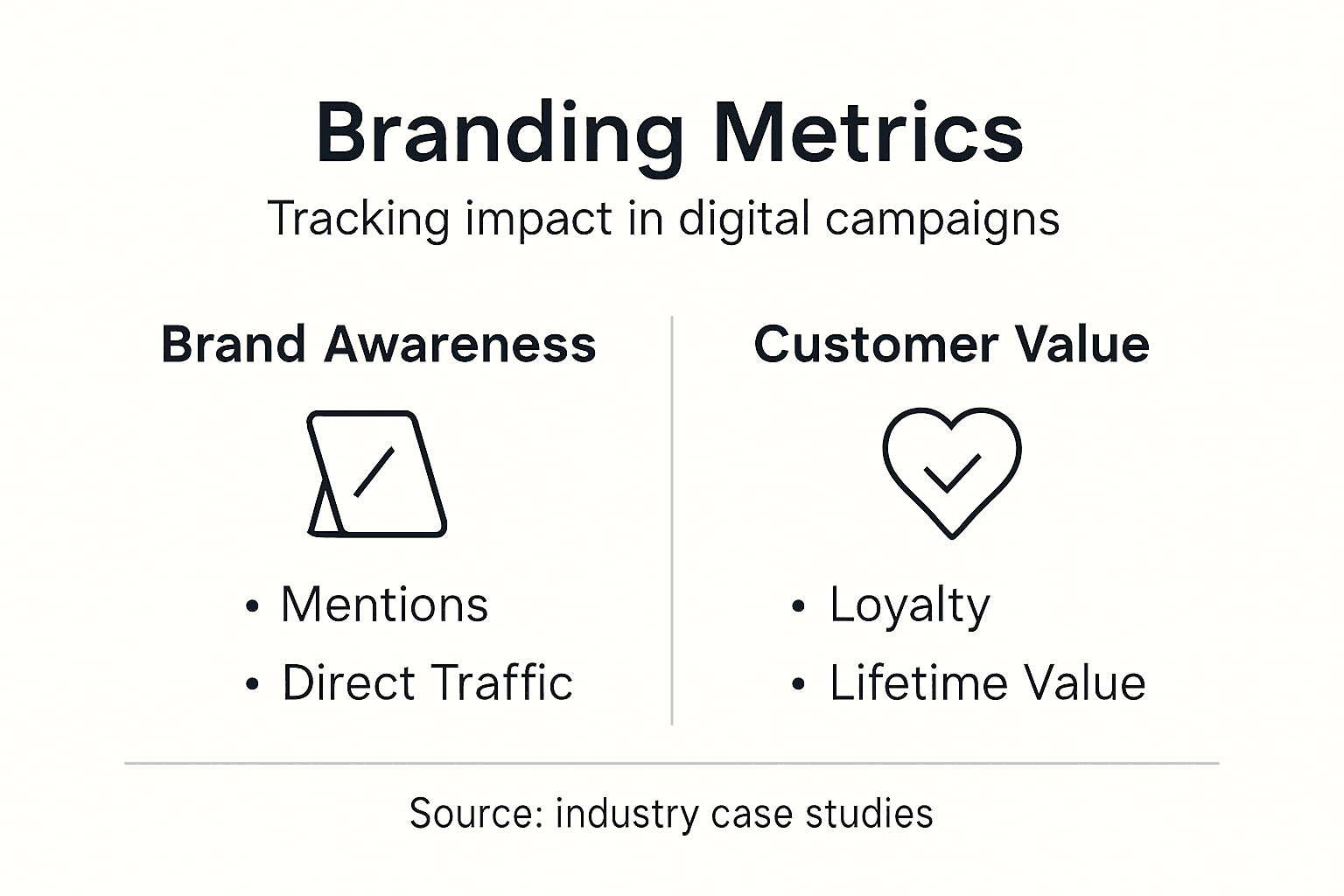
| Metric | What It Measures | Target Improvement |
|---|---|---|
| Branded Search Volume | How many people search for your business name | 15-20% quarterly growth |
| Direct Website Traffic | Visitors who type your URL directly | 10-15% increase over 6 months |
| Social Media Engagement | Likes, shares, comments on brand content | 25-30% improvement in 90 days |
| Customer Retention Rate | Percentage of repeat customers | 5-10% annual increase |
| Net Promoter Score | Likelihood customers recommend you | Move from neutral to positive zone |
Google Analytics provides free tools to tracking digital marketing ROI by segmenting direct and branded search traffic. Social media platforms offer built-in analytics showing engagement trends over time. Customer surveys reveal sentiment and perception changes as your branding matures.
Analyze this data monthly to identify what’s working. If branded search volume increases after you start posting consistent content, double down on that channel. If engagement drops when you change your brand voice, revert to what resonated.
Optimization happens through continuous testing and refinement. Try different story angles in your content. Experiment with various brand voice tones. Test visual elements to see what drives recognition. Let data guide your decisions rather than assumptions about what should work.
Boost Your Small Business Branding with Ibrandmedia
Applying these branding principles requires strategy, consistency, and expertise. Ibrandmedia specializes in helping small and medium businesses build powerful digital brands without enterprise budgets. Our team creates tailored branding strategies that integrate seamlessly with SEO for Small Businesses to maximize visibility and customer engagement.
We understand the unique challenges SMBs face when competing online. That’s why our affordable digital marketing tactics focus on high-impact activities that deliver measurable results quickly. From local marketing optimization to consistent brand messaging across channels, we handle the technical execution while you focus on running your business. Our branding solutions for small businesses transform how customers perceive and interact with your company online.
Frequently Asked Questions
What is the role of branding in digital marketing?
Branding shapes how customers perceive, trust, and remember your business across all digital channels. It creates the emotional foundation that makes your marketing messages resonate and converts browsers into loyal customers. Effective branding differentiates you from competitors and builds recognition that accelerates purchasing decisions.
How can small businesses implement branding affordably online?
Start with consistent messaging across your website, social media, and email communications. Leverage local SEO to connect your brand with community relevance. Use free tools like Canva for visual consistency and focus on authentic storytelling that requires creativity rather than budget. Social media platforms offer powerful branding opportunities at zero cost when you engage genuinely with your audience.
What is the difference between branding and advertising in digital marketing?
Branding builds long-term recognition, trust, and customer relationships through consistent experience and messaging. Advertising drives immediate awareness and sales through paid campaigns with specific goals and timelines. Both are essential, but branding provides the foundation that makes advertising more effective and efficient over time.
How can I measure the success of my digital branding efforts?
Track branded search volume, direct website traffic, social media engagement rates, and customer retention metrics. Monitor how many people mention your brand online and measure changes in customer acquisition costs. Use tools like Google Analytics and social media insights to quantify improvements in brand awareness and customer loyalty over time.
Recommended
- Digital Marketing for Service Businesses: Actionable Strategies for 2025 | Ibrandmedia
- Why Invest in Digital Marketing: Boost Sales Fast | Ibrandmedia
- Digital Marketing for Retailers: Proven Strategies for 2025 | Ibrandmedia
- Building Online Brand Presence: Complete Guide | Ibrandmedia
- Digitales Branding: Sichtbarkeit und Markenaufbau online
- Was ist digitales Branding? Wirkung, Chancen, Stolperfallen
Recent Comments