
Yelp forbids businesses from soliciting or paying for reviews, and violating that rule can get honest feedback suppressed or trigger a public Consumer Alert on your page. If you spot a review that breaks the rules, report it with specific evidence, but respond professionally in the meantime since removal is never guaranteed.
TL;DR:
- Soliciting reviews through staff reminders, incentives, or directing customers to Yelp violates platform rules and risks public alerts or review suppression.
- Yelp’s filtering system and manual moderation detect suspicious review activity, especially clusters or accounts with no activity, leading to hidden or flagged reviews.
- Reporting a review requires specific evidence, but even strong reports do not guarantee removal, as the Recommendation Software can act independently to suppress content.
- Businesses should respond professionally to all reviews, avoid asking for reviews or offering incentives, and monitor review patterns to maintain compliance.
- Federal law now enforces strict penalties for fake reviews, making illegal paid or coerced reviews a serious legal risk beyond Yelp’s own policies.
Table of Contents
- What Yelp’s review policies actually prohibit
- How Yelp catches violations: software, moderators, and alerts
- How to report a review and what actually happens next
- Do’s and don’ts for growing your reputation the right way
- The FTC’s fake review rule and your legal exposure
- What actually protects your rating
- Why the “just get more reviews” advice misses the point
- How ibrand.media helps you build a compliant reputation
- Where to go for the official rules
- Sources
- FAQ
What Yelp’s review policies actually prohibit
Yelp’s core rule is simple: you cannot ask anyone, customers, staff, friends or your email list, to write you a review. The Content Guidelines treat this as a conflict-of-interest problem, not a marketing tactic, and Yelp’s own guidance on getting reviews without asking says the safest path is simply delivering a good experience and letting people find you.
Solicitation covers more than a direct request. A “how did we do” email that nudges someone toward Yelp, a sign-up sheet at the register, or a manager telling staff to “remind customers to leave a review” all count. Compensation is treated the same way: discounts, free items, and paid review services are banned outright, and so is hiring a firm that promises to “fix” your rating.
Conflicts of interest are another flagged category. Reviews from employees, owners, competitors, or family members are considered non-firsthand or biased, even when the experience described is real.
- Solicitation includes staff reminders, mailing list nudges, and feedback surveys that funnel people to Yelp.
- Incentives include discounts, freebies, and any paid or brokered review service.
- Conflicts of interest include reviews from employees, owners, competitors, or relatives.
- Prohibited content includes privacy violations, hate speech, plagiarized text, and AI-generated reviews with no firsthand basis.
How Yelp catches violations: software, moderators, and alerts
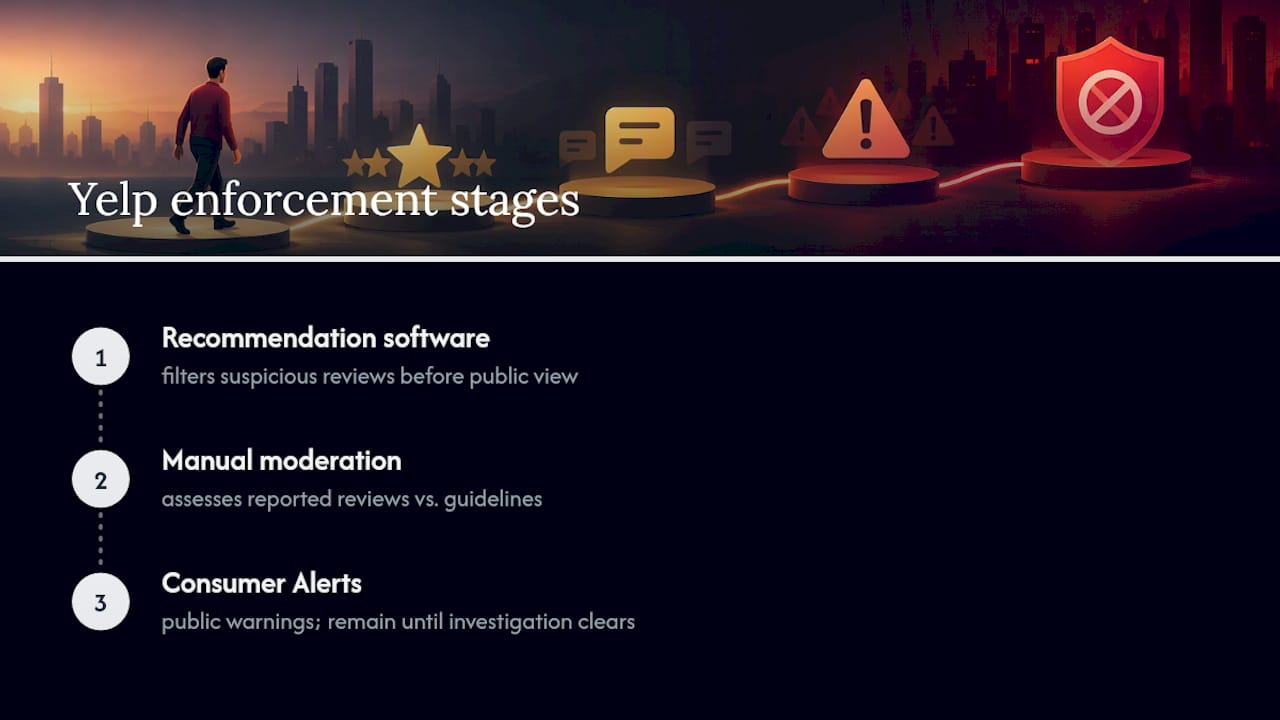
Yelp’s Recommendation Software filters reviews before most people ever see them, weighing reliability signals like account activity, writing patterns, and connections between the reviewer and the business. A review that looks solicited, clustered with others posted the same week, or written by an account with no other activity, tends to land in the “not recommended” section rather than the main page, as Yelp explains in its own guidance on earning reviews.
Manual moderation sits on top of that automated layer. According to Yelp’s explanation of how it moderates content, moderators evaluate reported reviews against the Content Guidelines but do not referee factual disputes between a business and a reviewer. They look for evidence: patterns, timestamps, and documentation, not just a business’s word that a review feels unfair.
Consumer Alerts are the most visible consequence of failed compliance. Yelp publishes these public warnings on a business page when it detects organized manipulation, such as review rings or attempts to buy reviews, and the alert stays up until an investigation confirms the activity has stopped. They apply whether or not a business advertises with Yelp, and they are hard to shake once posted.
How to report a review and what actually happens next
Reporting a review is straightforward, but it only works when you bring evidence. Here is the process:
- Open the review in question and click the flag or “report” option, or start a report through Yelp Business Support.
- Select the reason that matches the violation, such as conflict of interest, fake content, or harassment.
- Attach evidence: screenshots of solicitation, employment records showing the reviewer is staff, timestamps showing a pattern, or links proving plagiarized text.
- Submit and wait. Yelp’s support hours vary, and review times depend on the complexity of the case.
Yelp is direct about outcomes: when to report a review guidance states that reporting alone usually is not enough without clear proof, and even a strong report does not guarantee removal. The Recommendation Software can independently decide to suppress a review regardless of whether you reported it, which means the report and the algorithm are two separate systems working in parallel, not one guaranteed pipeline.
Do’s and don’ts for growing your reputation the right way
The businesses that build strong Yelp pages over time tend to follow the same pattern: they respond well and never ask.
- Do respond to every review, positive or negative, within a day or two using a consistent, professional tone.
- Do collect general feedback through surveys or comment cards without directing anyone toward Yelp specifically.
- Don’t offer discounts, freebies, or perks in exchange for a review, on Yelp or anywhere else.
- Don’t ask staff, family, or friends to post or rate your business, even “just this once.”
- Do track review volume and sentiment monthly using tools like Yonderly for Marketing Teams | Deploy and Measure Content so a sudden spike or a cluster of similar-sounding reviews gets noticed early.
Yelp’s own guidance on soliciting reviews notes that even subtle nudges, like a feedback email that funnels customers to Yelp, get flagged by its algorithms the same way a direct request would. A thoughtful, specific response to a critical review can also increase the odds a reviewer revises their rating upward, according to Yelp’s guidance for business owners, which makes response quality worth more attention than review volume. For templates and timing guidance, see responding to negative reviews.
Pro Tip: Keep a dated internal log of anything that looks like a review-related threat or suspicious pattern. If you ever need to escalate to Yelp or a lawyer, that log becomes your evidence trail.
If a cluster of reviews looks coordinated, that is the signal to start documenting before Yelp does. Our guide on protecting your online reputation covers monitoring cadence in more depth.
The FTC’s fake review rule and your legal exposure
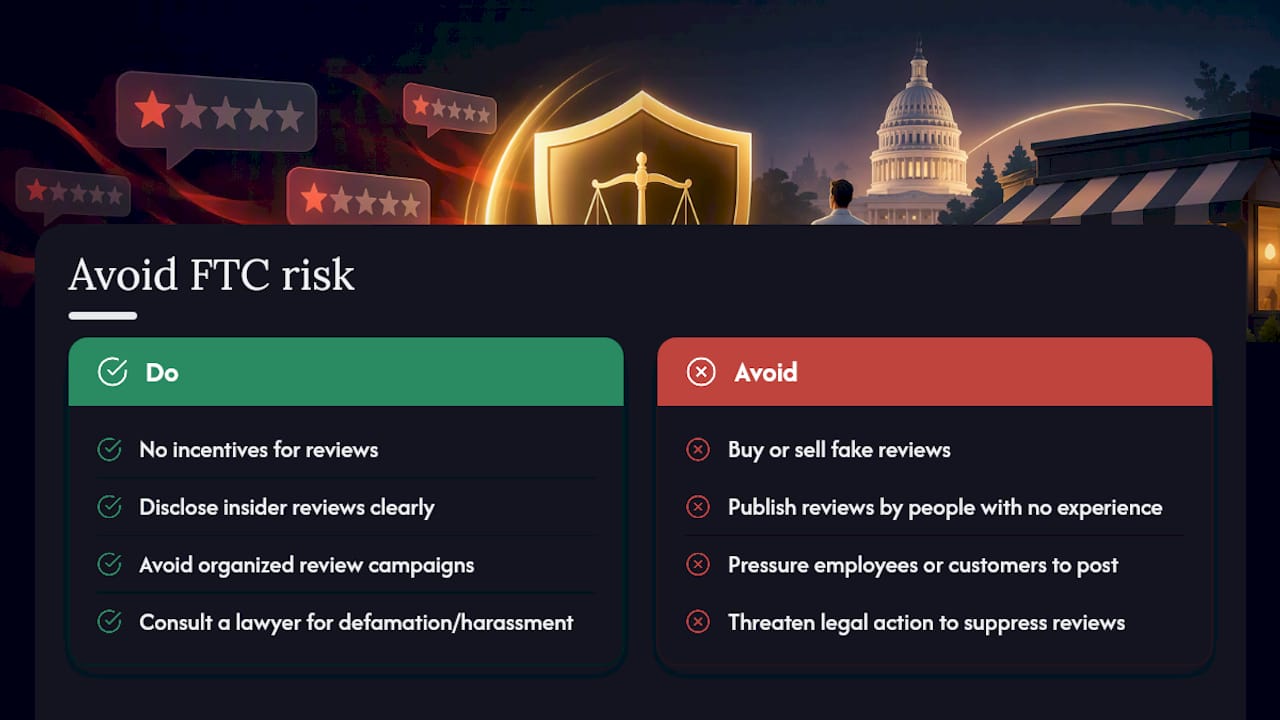
Yelp’s policy is a platform rule, but federal law now backs up the same principle. The FTC’s final rule banning fake reviews and testimonials, issued August 14, 2024, prohibits buying or selling fake reviews, publishing reviews from people with no real experience of the product or service, and certain undisclosed insider reviews. Knowing violations can carry civil penalties.
That means a business that pays for reviews, pressures an employee to post one, or threatens a customer into deleting a negative review is not just risking a Consumer Alert. It is risking federal enforcement. The rule also touches suppression tactics, so threatening legal action to force a reviewer to take down honest feedback carries its own exposure.
The safest compliance posture is the same one Yelp recommends: no incentives, no insider reviews without clear disclosure, and no organized campaigns. When a review crosses into defamation or harassment territory, that is the point to bring in a lawyer rather than trying to resolve it through Yelp’s reporting tool alone.
What actually protects your rating
Most businesses spend more energy chasing five-star reviews than they spend fixing the service gaps that produce one-star ones. That is backward. The fastest way to lose review credibility, on Yelp or with the FTC watching, is to treat review counts as a marketing lever instead of a byproduct of good service.
A short checklist:
- Stop any solicitation, even the “just mention us on Yelp” kind.
- Remove incentivized language from emails, receipts, and staff scripts.
- Set a monthly cadence to check review patterns.
- Use response templates so every reply stays professional and consistent, like the ones in our reply guide.
- Document anything that looks like solicitation, retaliation, or a coordinated review cluster.
- Consult a lawyer if a review veers into defamation or a customer threatens you over a legitimate report.
Why the “just get more reviews” advice misses the point
Most advice about Yelp treats the review count as the goal, and that framing is what gets business owners in trouble. Yelp built its Recommendation Software specifically to catch solicited and incentivized reviews, so a strategy built around asking is a strategy built to be filtered out. The businesses that actually build durable ratings are the ones that treat reviews as a byproduct of service quality, not a metric to manage directly.
The other blind spot is legal risk. Business owners tend to think of a bad review as a reputation problem to fix quietly. It is also, increasingly, a federal compliance question, since the FTC rule now makes fake or purchased reviews an enforcement target with real penalties attached. The businesses that come out ahead are not the ones with the cleverest review-generation tactic. They are the ones with nothing to hide when someone looks closely: no incentives, no insider posts, no solicitation trail. Fix the service first. The reviews follow.
— TONY
How ibrand.media helps you build a compliant reputation

Reputation problems rarely start with the reviews themselves, they start with inconsistent responses, no monitoring, and no plan. Some agencies offer reputation management, local marketing, and response-template support designed for small businesses aiming to grow their Yelp presence while avoiding Consumer Alerts. Visit Ibrand to request a compliant review audit and see where your current process stands.
Where to go for the official rules
- Yelp Content Guidelines: the full list of prohibited content and conflicts of interest.
- Don’t Ask for Reviews: Yelp’s own solicitation policy.
- Yelp Terms of Service: moderation rights and Recommendation Software disclosures.
- FTC final rule on fake reviews: federal penalties for fake or bought reviews.
This article is general information, not a substitute for advice from a qualified lawyer. Consult a qualified legal professional about your own circumstances before acting on anything here.
Sources
- How to get Yelp reviews without asking
- How we moderate content at Yelp
- Content Guidelines — Yelp
- Federal Trade Commission announces final rule banning fake reviews and testimonials
FAQ
What are Yelp’s review policies?
Yelp requires reviews to be firsthand, unsolicited, and free of compensation or conflicts of interest, as laid out in its Content Guidelines. Businesses cannot ask anyone to post a review or offer anything in exchange for one, and violations can lead to suppressed content or a public Consumer Alert.
Can you sue for a bad Yelp review?
You can pursue legal action only if a review is factually false and defamatory, not simply because it is negative or unfair. Genuine opinions and firsthand experiences are protected, so legal action generally makes sense only when a reviewer fabricates facts, and a lawyer should evaluate the specifics before you proceed.
Will Yelp remove a bad review?
Not automatically. Reporting a review requires specific evidence, such as proof the reviewer was never a customer, and even then Yelp’s reporting guidance makes clear that a report alone does not guarantee removal.
Is it illegal to remove negative reviews?
Suppressing or removing honest negative reviews through threats, payment, or coercion can violate the FTC’s rule on fake reviews, which allows civil penalties for knowing violations. Simply responding to or contesting a review through legitimate platform channels is not illegal, but pressuring a customer to delete one can be.
Recent Comments